%20png%20copy.avif)
Most advice on a startup consult is backwards.
Founders are told to find a specialist, compare portfolios, and ask for a proposal. That is procurement logic. It works when you are buying output. It fails when you are trying to change the trajectory of a B2B SaaS company.
A strong consult is not extra hands. It is a temporary decision advantage. You bring someone in because your current team cannot see clearly enough, move fast enough, or validate the right things in the right order. If you miss that distinction, you will hire a capable person into a broken mandate and then call the engagement disappointing.
That happens a lot in a market this large. The global IT consulting market reached over $600 billion in revenue by 2022, with management consulting adding another $250 billion, according to Runn’s consulting market overview. External expertise is not niche. The core problem is that most startups buy it badly.
Most startup consult failures start before the first call.
The founder says they need help with content, paid ads, outbound, a website, or a deck. That sounds concrete. It is usually wrong. Those are artifacts. The underlying problem is usually one layer deeper: weak positioning, false ICP confidence, no message-market fit, founder-only sales knowledge, or channel selection without validation.

Founders often hire a consultant when internal pressure gets annoying. Sales calls feel messy. The website sounds vague. Pipeline is inconsistent. Investors want a sharper story.
So they write a brief around what feels visible.
None of those asks are bad in themselves. They are bad when they are disconnected from the business decision they are supposed to improve.
If your sales team cannot explain why a buyer should switch from a known incumbent, content volume will not save you. If your product serves three semi-related audiences with different buying triggers, ad spend will just make the confusion more expensive.
A consultant should improve one of three things quickly: clarity, speed, or confidence in a high-stakes decision.
If not, you hired a vendor and called them a strategist.
Use this test before you sign anything:
| Weak ask | Strong ask |
|---|---|
| Write five blog posts | Build a messaging spine the sales and marketing team can reuse across website, outbound, and demos |
| Redesign the site | Clarify ICP, sharpen category framing, and turn the site into a qualification asset |
| Run paid campaigns | Validate which buyer pain points produce sales conversations worth repeating |
| Build a deck | Create a narrative that aligns market problem, product wedge, and growth story |
If you cannot name the decision a consultant is supposed to improve, your scope is not ready.
The usual failure pattern is simple.
The founder withholds context because they want a fast start. The consultant gets partial access, produces plausible work, and the team later says it lacks depth. Of course it does. Strategy built on fragments always looks polished and thin.
A serious startup consult is an architecture problem. You are designing a short-term operating system upgrade. That means the brief has to define what changes, where the bottleneck sits, who owns implementation, and what “better” looks like in practice.
Do that well and outside help compounds.
Do it poorly and you just bought expensive motion.
You do not need a startup consult because you are busy. You need one when your current way of thinking has stopped producing useful answers.
That usually shows up in patterns, not one-off pain.
Research on startup failure found recurring competency gaps in founding teams, including information-seeking in 70% of cases and customer service orientation in 66% of cases, based on an analysis of failure accounts published in the NIH-hosted research paper. This is important because many B2B SaaS teams are strongest internally. Product, roadmap, architecture, shipping. They are weaker at the outside-in work that keeps a go-to-market motion honest.
This is common in founder-led sales environments.
The founder can still close deals because they carry all the context. They know product nuance, buyer objections, roadmap logic, and the specific reason customers switched. Nobody else can reproduce that performance consistently.
Symptoms look familiar:
At this point, adding more execution usually makes things worse. You do not need more campaigns. You need a tighter theory of demand.
If this sounds familiar, a more detailed look at what a startup consultant should do will help you separate strategic work from task support.
This is the post-PMF obscurity trap.
The product solves something real. Users stay. Customers renew. Referrals happen. Yet the company still sounds generic in market. Messaging drifts between features and category clichés. The website reads like it was approved by committee. Sales decks differ by rep.
This happens when product truth exists, but commercial translation does not.
You likely need a strategic consult if:
A strong consultant brings external pattern recognition here. Not because outsiders are magic, but because insiders usually normalize their own ambiguity.
After a funding event, a major hire, or a market shift, startups often discover that ambition grew faster than operating discipline.
You now need repeatability. Not aspiration. A strategic consult makes sense in this scenario:
| Situation | What is really broken |
|---|---|
| You hired demand gen, but pipeline quality is uneven | Positioning and channel-message fit are underdefined |
| You expanded the sales team, but ramp is slow | Founder knowledge was never converted into usable GTM assets |
| You need faster growth, but priorities keep changing | No shared decision framework exists across leadership |
Bring in outside help when internal disagreement starts wasting cycles across product, sales, and marketing. That is no longer a staffing issue. It is a strategy issue.
The point is not to outsource thinking. The point is to inject the kind of externally anchored, commercially disciplined thinking your team lacks at that exact moment.
Do not ask, “Who is the best consultant?”
Ask, “What job needs to get done, and what form of partner is built for that job?”
That framing eliminates a lot of noise. Most hiring mistakes happen because founders match a blurry problem with the wrong delivery model. They hire an agency for diagnosis, a strategist for production, or a solo expert for a cross-functional change effort.
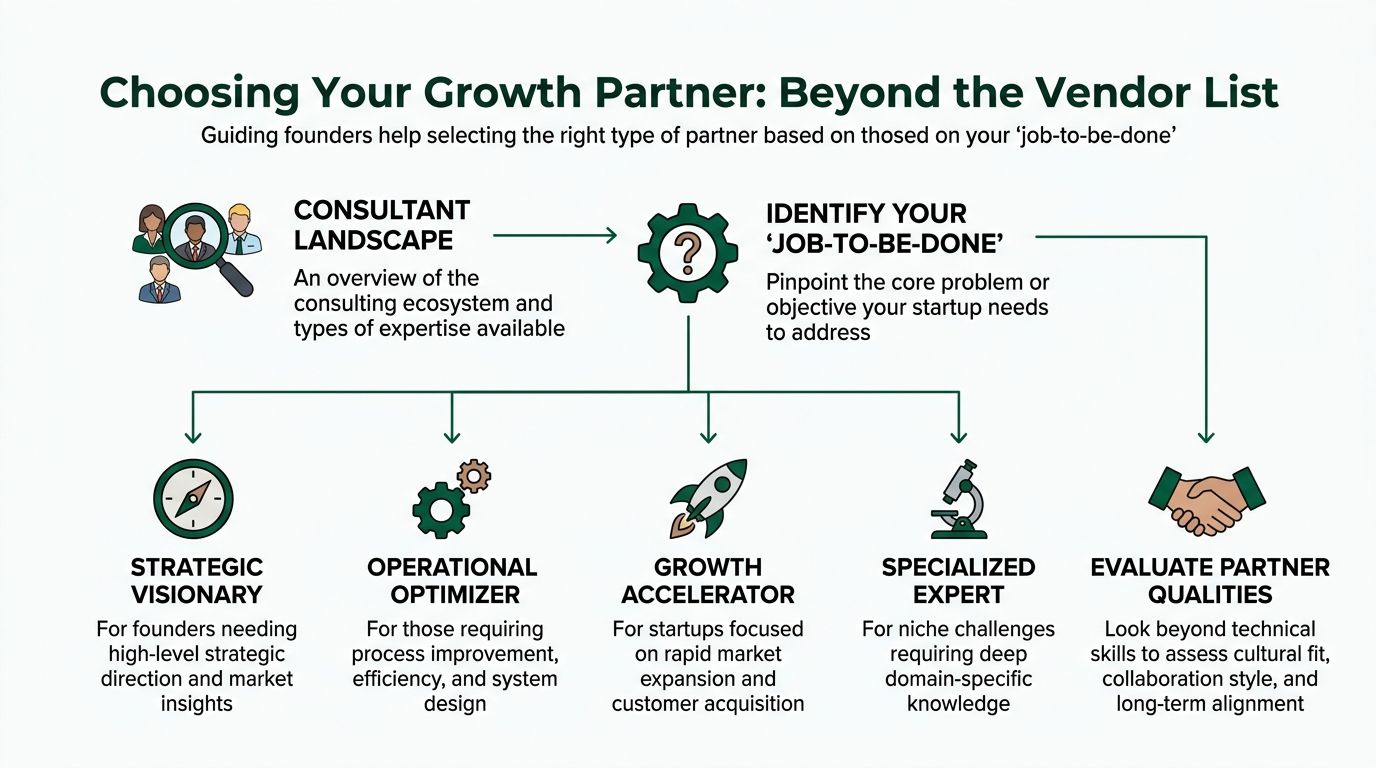
There are three broad partner types in startup growth work.
A fractional CMO or equivalent strategic operator is the right fit when the problem spans multiple functions. Positioning affects sales. Sales feedback should inform messaging. Website structure shapes conversion. Channel strategy needs sequencing.
This model works when you need someone to make integrated decisions, not just deliver isolated assets.
Good use cases include:
If that is your need, compare your options against what a fractional chief marketing officer is supposed to own.
Agencies are useful when the strategy is already reasonably clear and you need throughput. Paid media management, SEO production, design systems, outbound support, lifecycle execution. Those are valid agency jobs.
Agencies struggle when the brief requires organizational truth-telling. Most are not set up to challenge your ICP assumptions, force leadership alignment, or rewrite your commercial narrative from first principles. Some can. Many say they can. Few want that fight.
A solo consultant is often the best choice for a narrow but important problem. Pricing strategy. Sales process design. Positioning workshop facilitation. Category narrative. Product marketing for a launch.
This model works if the scope is sharp and the internal team can implement well afterward.
It fails when founders expect one person to diagnose, align, execute, manage stakeholders, and produce at speed across channels.
The core trade-off is not cost versus quality. It is depth versus bandwidth.
| Partner model | Strength | Limitation | Best fit |
|---|---|---|---|
| Fractional leader | Cross-functional judgment | Less raw production capacity | Strategic resets, leadership alignment, GTM design |
| Agency | Execution capacity | Often weaker strategic diagnosis | Known channel playbooks with clear goals |
| Solo specialist | Deep niche expertise | Narrow operating surface | High-stakes focused problems |
You cannot hire around this trade-off. You have to choose it consciously.
Most consultants know how to sound sharp in a sales call. That tells you little.
Push on these areas instead:
A useful answer should sound like judgment under constraints. Not a polished menu.
A serious advisor will refuse work that starts with the wrong premise.
They will tell you not to run paid acquisition before message validation. They will push back on a homepage rewrite if your ICP is still fuzzy. They will question whether content is useful when sales calls are inconsistent and buyer language is stale.
That resistance is a feature.
One example in the market is Big Moves Marketing, which works as a fractional CMO and GTM partner for B2B SaaS teams across positioning, messaging, websites, and demand generation. That model makes sense when the company needs connected strategic judgment rather than a standalone channel vendor.
The right partner reduces the number of growth motions you attempt. That is often more valuable than increasing activity.
If a consultant promises to do everything, they probably understand little about where your core bottleneck sits.
Most startup consult scopes are too vague to succeed and too broad to manage.
The fix is simple. Scope the engagement like a tour of duty. A defined mission. A fixed time horizon. A clear operating cadence. A specific business change the company should be able to point to at the end.
That is how you avoid endless advisory drift.
A weak scope describes deliverables. A strong scope describes the capability or decision quality the startup needs by the end of the engagement.
Compare these.
| Weak scope | Strong scope |
|---|---|
| Create a pitch deck | Build an investor narrative that aligns market problem, product wedge, and commercial proof |
| Improve our website copy | Clarify ICP and buying triggers, then turn the site into a usable qualification and sales support asset |
| Launch demand gen | Test a small set of buyer pains and offers to identify which message earns credible sales conversations |
| Help with strategy | Decide the GTM motion, sequencing, and operating rhythm for the next stage of growth |
The stronger version forces precision. It also makes pricing easier, because you are paying for a mission with bounded complexity, not open-ended availability.
Use this structure before you ask for a proposal.
What has to change
Spell out the business problem. Not “need marketing help.” Try “sales conversations are inconsistent because reps lack a clear point of view and the website attracts mixed-fit buyers.”
Why now
Tie the timing to a real trigger. New funding. Stalled founder-led growth. Product launch. Category confusion.
What decisions the consultant must influence
Messaging, ICP, channel selection, sales enablement, website narrative, pricing story, investor framing.
Who owns implementation
If nobody internal can carry the work forward, the scope is incomplete.
What done looks like
This can be qualitative. Shared messaging spine. Sharper qualification. Clear campaign thesis. Better sales call consistency. Faster strategic decisions.
There is no universally correct pricing model. There is only fit.
Best when the mission is bounded. Positioning reset. Website narrative. GTM audit. Launch strategy.
This works because both sides know what the engagement is trying to produce. It also prevents the common startup habit of turning every strategic brief into an amorphous retainer.
Useful when the problem is ongoing and cross-functional. Fractional leadership, weekly decision support, campaign guidance tied to changing market inputs.
Retainers fail when the founder cannot define priorities and expects the consultant to absorb organizational chaos.
This can make sense when the outcome is strategically central and the consultant has unusual confidence in the scope. It is less about hours and more about importance.
Founders like the idea of this model. In practice, it only works when the mission is tightly framed and both sides agree on what success means.
One of the best uses of a startup consult is to examine opportunities your team has ignored because they sit outside your default founder worldview.
Startups building for underserved markets often benefit from focused strategic work around niche demand, category framing, and lower-competition wedges, as discussed in Digital Native Tech’s piece on building for underserved markets. That can influence how you scope research, positioning, and validation work from the start.
If you need support thinking through these kinds of strategic engagements, consulting services for startups should look more like business design than outsourced marketing.
A startup consult should leave your company with reusable assets and better judgment. If the scope only produces tasks, it is too small.
A bad onboarding process wastes the first month and poisons the rest of the engagement.
Founders often want speed, then starve the consultant of context. They schedule a kickoff, share a Notion doc, and assume a smart outsider will “figure it out.” That is lazy. It also slows everything down.
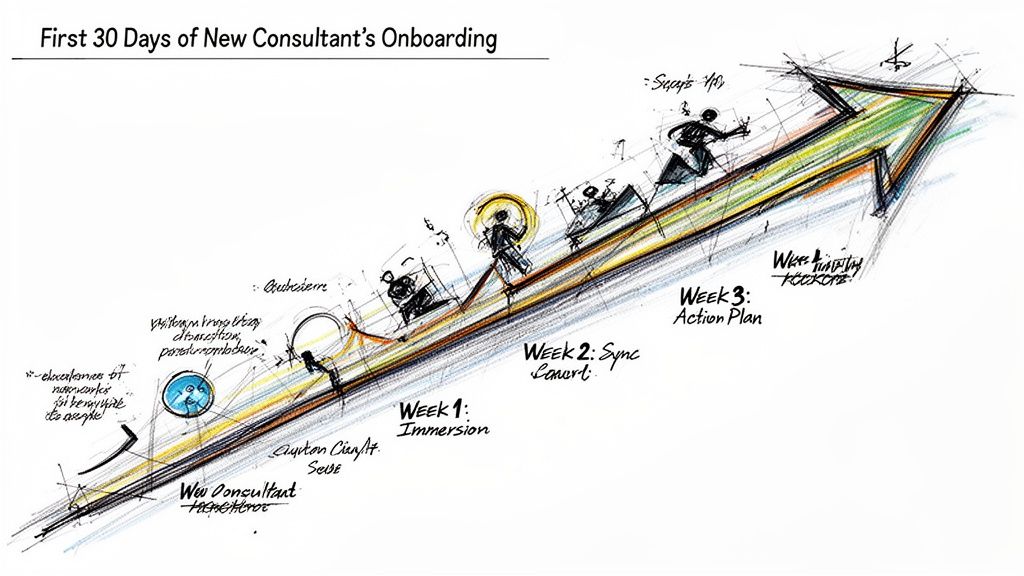
The consultant should get access to the raw material behind your GTM reality.
That includes:
Do not curate this too much. Curated inputs produce curated conclusions.
A useful reference point here is how disciplined teams think about customer onboarding best practices. The same principle applies internally. Fast time-to-value depends on structured handoff, clear expectations, and early adoption of a working rhythm.
By now, the consultant should be talking to the people who carry fragmented truth across the business.
Not everyone. The right people.
The goal is not consensus. It is pattern detection.
By the end of week two, the consultant should be able to tell you where your story breaks between leadership intent and market reception.
Early onboarding should surface contradiction. If every stakeholder interview sounds aligned, the questions were too shallow.
Many startup consults drift into abstract strategy here. Avoid that.
The first month should end with concrete artifacts that the team can react to and use.
Examples:
| Asset | Why it matters |
|---|---|
| One-page positioning framework | Gives leadership and sales a shared commercial story |
| Buyer pain map | Forces message decisions around real triggers, not internal preferences |
| Competitive battlecard template | Helps reps handle comparisons without improvising every call |
| Initial channel thesis | Prevents random experimentation across too many channels |
A practical conversation about this operating style is often easier to grasp in video than prose. This is a useful watch if you want a clearer sense of how strategic marketing leadership should think and communicate in practice.
You need a simple cadence.
This is not bureaucracy. It is what keeps strategic work from dissolving into Slack noise and half-approved docs.
A startup consult gains velocity when the founder treats onboarding as strategic infrastructure, not admin.
The shallow way to evaluate a startup consult is to ask what showed up in the dashboard.
The better question is whether the company now makes better commercial decisions with less waste.
That distinction matters because premature scaling destroys startups long before dashboards fully reveal the damage. The Startup Genome material cited by ElectroIQ notes that 70% of tech startups fail due to premature scaling, and that is the right lens for ROI in strategic consulting work, not just short-term lead counts, as summarized in this Startup Genome-based analysis.
A strong engagement should improve second-order outcomes.
These are not vanity outcomes. They change how the company operates.
If you need a more financial lens for the mechanics, How to Calculate Marketing ROI for B2B is a useful reference. But a startup consult should also be judged on whether it created durable commercial infrastructure.
That includes assets like:
For internal review, your own process for how to measure marketing ROI should include both direct outcomes and these operating-system effects.
If the engagement made your team faster, clearer, and harder to distract, the ROI is probably higher than the dashboard suggests.
Ask these questions after a few months:
| Question | What a good answer sounds like |
|---|---|
| Are we clearer on who we sell to? | The team uses the same language and disqualifies faster |
| Are we more confident in our story? | Sales, marketing, and leadership no longer describe the company differently |
| Are we making fewer random bets? | The roadmap and GTM plan reflect explicit priorities |
| Did the work survive the consultant? | The assets and thinking remain useful without constant external translation |
The true return. Not more activity. Better judgment with lower waste.
Watch for weak diagnosis.
If a consultant jumps to tactics before interrogating ICP, buyer pain, sales motion, and category context, they are selling confidence, not judgment.
Other red flags matter too:
Start with the type of problem, not a universal number.
A narrow expert engagement is different from a multi-month strategic partnership. A solo specialist solving one hard issue should not be priced or evaluated like a fractional leader helping redesign your GTM motion.
The mistake is trying to buy senior thinking with junior budget logic. If the work influences positioning, sales efficiency, launch sequencing, or market validation, underfunding it usually costs more later through drift, false starts, and bad execution.
If you need lower-cost support for narrower administrative work around a strategic engagement, resources like Hire LatAm Virtual Assistants can help separate operational support from high-value strategic judgment. Do not confuse the two roles.
Yes, if the consultant understands the problem correctly.
McKinsey has written that underrepresented founders often face unconscious bias when seeking resources and opportunities, in its article on underestimated start-up founders. That means a good startup consult should do more than produce messaging.
It should help with:
Biased ecosystems punish ambiguity more harshly. The consultant’s job is not to remove bias. It is to reduce avoidable friction and strengthen market-facing clarity.
Hire a consultant first if the company still needs strategic diagnosis.
Do not recruit a full-time marketing leader into unresolved confusion. That person will spend their first months untangling basic questions you should have answered earlier. If your ICP, narrative, or GTM motion is still unstable, a startup consult can create the clarity that makes the full-time hire far more effective.
If your company has product strength but weak go-to-market clarity, Big Moves Marketing can be a useful next conversation. The focus is strategic growth work for B2B SaaS and tech teams across positioning, messaging, websites, and demand generation, with scopes built around decisions and outcomes rather than task lists.
Explore Big Moves Marketing services and resources:



%20-%20white.svg)