The most popular advice about hiring a search marketing agency is to compare services, review case studies, and negotiate the fee. That skips the harder question: can your business distinguish profitable demand from expensive activity? If you can't, a polished dashboard will make a weak engagement look productive.
The agency fee is only the visible cost. The larger exposure is wasted media spend, misread search data, and leads that never become sales conversations. Buy search expertise to improve those decisions, not just to produce more traffic.
A search marketing agency can get paid for managing clicks while you judge it on revenue. Those incentives won't align unless someone connects the advertising account, website, and sales system.
The job is straightforward: identify relevant search demand, earn or buy access to it, and measure what happens afterward. SEO earns visibility for existing queries. PPC buys placement against that demand. Neither channel creates a compelling offer by itself.
The working relationship should make that measurement chain visible.

The operating work includes keyword research, technical site fixes, content briefs, Google Ads account structure, bidding, landing-page testing, and reporting. Think of the agency as traffic control: it influences which vehicles enter the road and how efficiently they travel. It doesn't necessarily build the destination.
That distinction matters when a founder expects an account rebuild to solve an unclear value proposition. Positioning, pricing, product-led activation, and sales follow-up need explicit owners. Otherwise, the agency can deliver relevant visitors to a business that still can't explain why someone should buy.
For B2B SaaS, don't import consumer-search assumptions. Your qualifying query pool may be narrow, competitive clicks may be expensive relative to your economics, and anonymous researchers may represent a buying committee rather than an immediate purchaser. A successful self-service signup and a successful enterprise opportunity also require different conversion paths.
Ownership test: If a result depends on work outside the agency's scope, assign that work before launching the campaign.
Use an ownership map rather than a generic services list:
An agency should challenge the offer. It shouldn't become the unaccountable owner of it. You're buying a demand-capture operator, not outsourcing commercial judgment.
Separate real work from theatre by asking what will change in the account, on the website, and in the measurement system. An audit that identifies issues without assigning actions, owners, and priorities is a document, not an operating plan.
The opening phase should produce a technical audit, a keyword map organized around buyer tasks, and a conversion-tracking plan connected to CRM stages. Group queries by problem, comparison, validation, and purchase, not just by shared words.
Use this checklist to distinguish concrete deliverables from broad promises.

Google Ads work should include coherent ad groups, negative keyword lists, and a documented reason for structural changes. Don't authorize a rebuild solely because the incoming agency prefers a different naming convention.
For provider discovery, the NZ Apps search marketing directory can be a starting point. Evaluate shortlisted providers against the same deliverables, rather than treating directory inclusion as proof of capability.
Set a measurable technical standard. Google's good-experience thresholds are LCP of 2.5 seconds or less, INP of 200 milliseconds or less, and CLS of 0.1 or less, evaluated using real-user data; a URL group's status depends on its poorest-performing metric once sufficient data exists, as explained in Google's Core Web Vitals guidance.
Consider a hypothetical SaaS company whose pricing page responds poorly when visitors interact with its plan selector. The agency should investigate and fix that friction before recommending more traffic. Whether the fix reduces acquisition costs is something to measure, not a result to promise.
Once the foundation works, require intent-specific landing pages, briefs based on sales objections, and a recurring search-term review. A useful SEO content strategy connects those pages to buyer decisions rather than filling a publishing calendar.
Reject deliverables that substitute visibility for accountability:
The deliverable isn't more assets. It's a better-supported decision about what to fix, publish, test, or stop.
| KPI | What it tells you | Source | Common misread |
|---|---|---|---|
| Impressions and clicks by query | Demand and reach | Search Console, Google Ads | Read alone as growth |
| Average position | Impression-weighted visibility across queries | Search Console | Treated as a page's universal rank |
| Click-through rate | Snippet relevance to query intent | Search Console, Google Ads | Compared across queries with different intent |
| Cost per qualified lead | Paid efficiency at lead stage | Google Ads, CRM | Used without a sales-acceptance filter |
| Sales-accepted opportunity rate | Lead quality by keyword and landing page | CRM | Measured before sales reviews leads |
| Qualified pipeline per dollar | Program return on managed spend | CRM plus ad platform | Calculated on form fills |
| Revenue per click | Commercial value of paid traffic | Google Ads with offline conversion import | Set without closed-won data |
| Branded search growth | Possible demand created by other channels | Search Console, Google Trends | Credited entirely to SEO |
Read this table as a diagnostic sequence. Visibility shows where demand exists. CTR helps assess relevance, while qualification and opportunity creation tell you whether the business should pay to capture more of it.
Search Console's average position uses the site's topmost result and averages it across impressions. It isn't a universal page ranking, as Google's performance-report documentation explains.
A hypothetical team could see average position worsen while impressions and qualified demo requests increase. Newly visible queries may have changed the mix. Cutting that keyword set without segmenting by query, page, geography, and device would turn an ambiguous signal into a potentially bad decision.
Separate micro-conversions, such as downloads and demo requests, from primary business outcomes, such as sales-accepted opportunities and closed revenue. A request signals interest. Sales acceptance establishes whether that interest deserves commercial attention.
Google supports conversion values, offline conversion imports, and attribution reports that reveal assisting interactions through its conversion-tracking capabilities. Use those capabilities to improve the optimization signal, not merely to add dashboard columns.
Before launch, agree on:
Don't pause assisting keywords solely because they lose under last-click attribution.
A cheap lead is only cheap after you know what sales can do with it.
For reporting-format comparison, SEO reporting for ecommerce teams offers an adjacent reference, but don't substitute transaction-led logic for a B2B qualification process. Your marketing ROI measurement should reconcile channel costs, agency costs, accepted opportunities, and eventual revenue.
AI summaries complicate a basic assumption: visible search demand doesn't necessarily produce a visit. A traffic decline can therefore coexist with continued buyer research.
Pew's analysis of nearly 69,000 searches from about 900 U.S. adults found conventional-result clicks on 8% of searches with an AI Overview, versus 15% without one; only about 1% clicked a source inside the overview, according to this report on Pew's search-behavior findings.
The environment isn't stable either. Semrush's analysis of more than 10 million keywords found AI Overviews on 6.5% of queries in January 2025, just under 25% in July, and below 16% by November, as reported in Search Engine Land's analysis of their expansion and pullback.
Don't interpret every traffic shortfall as an instruction to publish more.
Budget discipline: Weak, broad, or poorly attributed demand is a reason to hold investment, not to buy more clicks.
If prospects recognize the problem but don't search for your category, search may be the wrong place to fund expansion. Partnerships, targeted outreach, or educational demand creation may deserve the next test.
If relevant searches exist but never become qualified opportunities, investigate positioning and qualification before blaming channel volume. A disciplined demand forecast should make that distinction explicit. Don't let an agency use total keyword volume as your addressable pipeline estimate.
| Engagement model | Typical fee (USD) | Ad spend handling | Typical minimum term | Best fit |
|---|---|---|---|---|
| Project audit, SEO or PPC | Verify in proposal | Not included | None recommended for a standalone project | Pre-launch diagnosis or in-house handoff |
| Single-channel retainer | Verify in proposal | Not included | Defined test term, negotiated | Clear ICP and focused channel scope |
| Integrated SEO and PPC retainer | Verify in proposal | Percentage management fee or flat fee | Verify in contract | Proven positioning and coordinated search work |
| Enterprise program | Verify in proposal | Management fee or flat fee | Verify in contract | Multiple markets or product lines |
| Per-result pricing | Negotiated fee per lead or opportunity | Confirm whether included in unit price | Verify attribution and exit terms | Rarely advisable without auditable qualification |
The fee cells are deliberately open. There's no defensible universal price in the evidence available, and an unsupported benchmark won't help you evaluate an actual contract. Fill the table from proposals, including setup charges, website work, tracking implementation, and exit support.
A percentage-of-spend model gives the agency a financial reason to recommend a larger budget. That doesn't make it wrong in itself. It means budget increases need a commercial justification independent of the agency's compensation.
A flat retainer removes that particular incentive but can conceal limited capacity. Ask what work is included, who performs it, and what gets deferred when priorities change. A retainer without explicit scope is a reservation fee for an undefined amount of attention.
Per-result pricing transfers the argument to attribution. What counts as a lead? Who rejects duplicates, existing opportunities, students, competitors, or companies outside the ICP?
If the agency and sales team use different qualification rules, the arrangement creates a billing dispute instead of shared accountability.
When positioning or website conversion is unproven, start with a bounded diagnostic engagement. Require findings, prioritized decisions, and a handover that your team can use independently.
Move to an integrated retainer when the business has a recognizable ICP, a credible offer, and evidence that relevant prospects progress. Don't commit to broad channel coverage because the bundled price looks efficient.
Evaluate outsourcing digital marketing as an ownership decision, not just a staffing shortcut. Someone inside the business must still approve priorities and resolve cross-functional blockers.
Your budget rule should include fees plus media plus required implementation, not ad spend alone. Write down the relationship you expect between that total cost, qualified pipeline, and eventual gross profit. A pipeline ratio without a credible close-rate assumption can make an expensive engagement look attractive.
The right commercial model makes good decisions easier. It doesn't replace them.
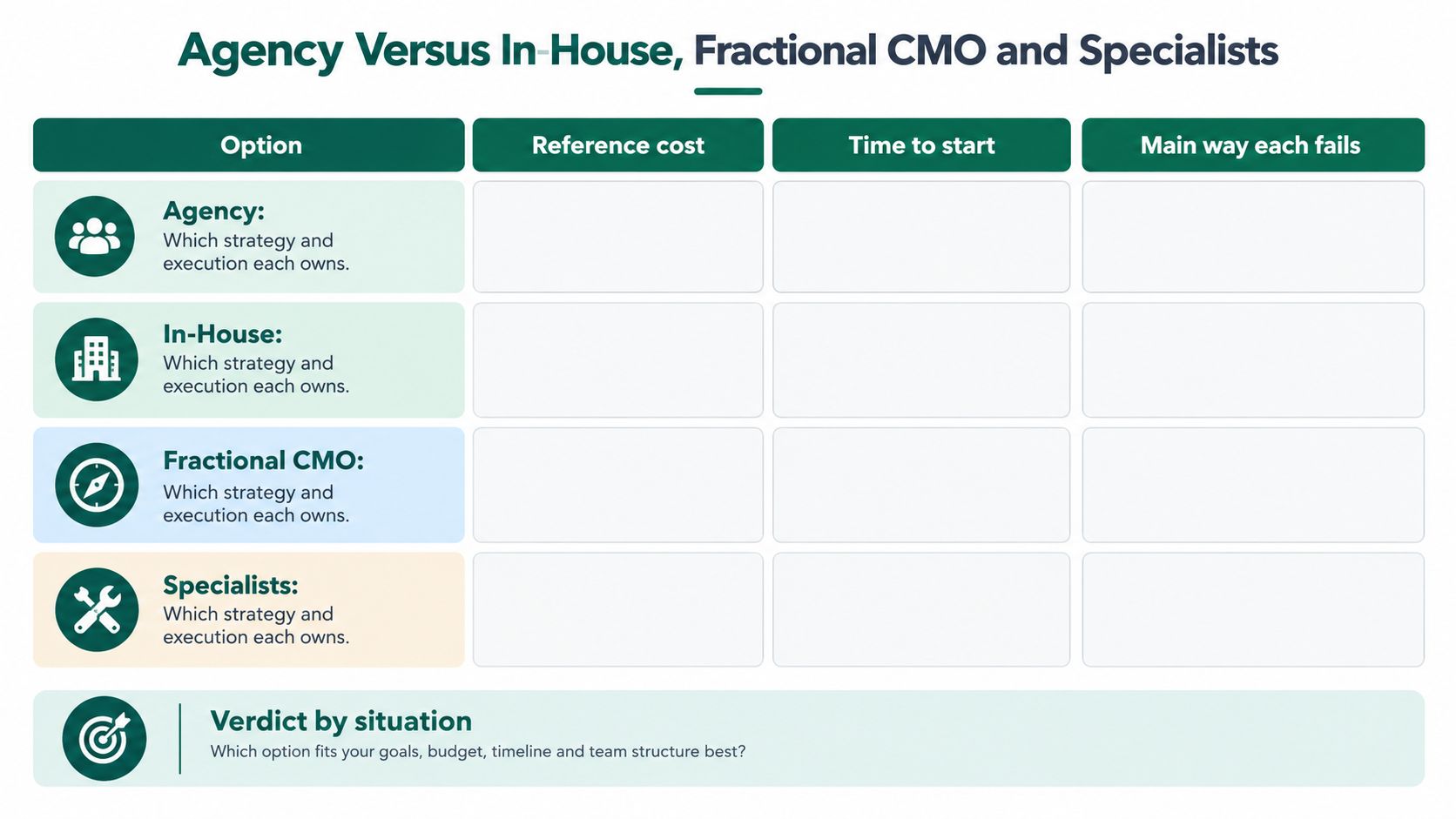
| Option | Reference cost | Time to start | Strategy ownership | Main risk |
|---|---|---|---|---|
| Search marketing agency | Compare scoped proposals | Confirm staffing and onboarding | Channel execution, limited positioning unless scoped | Junior delivery and activity-led reporting |
| In-house search hire | Salary, hiring, tools, and management | Recruitment and ramp required | Broad ownership if sufficiently senior | Single point of failure without outside challenge |
| Fractional CMO | Compare leadership scope | Depends on availability and access | Strategy, priorities, and budget | Execution gap without an operator |
| Specialist consultant | Compare defined assignments | Depends on availability | Narrow channel expertise | Key-person risk and limited capacity |
Don't choose between these options as if they solve the same problem. An agency supplies coordinated capacity. A senior employee builds internal knowledge. A fractional leader decides what deserves investment. A specialist addresses a defined technical or channel problem.
Use the comparison as an ownership worksheet, not a vendor ranking.
Before product-market fit, or when positioning is unclear, start with senior growth leadership rather than broad search execution. Buying traffic to an unresolved message produces ambiguous feedback: you won't know whether the problem was audience, promise, product, or page.
Big Moves Marketing fits the fractional-leadership option as a strategic growth partner led by a fractional CMO. Its role is to connect positioning, priorities, and measurable growth work rather than sell execution volume.
For a company with a validated ICP, repeatable offer, and a funded search test, an agency or channel specialist becomes more appropriate. Keep account ownership inside the business and make the delivery scope explicit.
Once a senior marketer owns the program internally, use external expertise for independent audits, difficult technical questions, or temporary capacity. Don't pay an external team to recreate strategic ownership you already have.
A CMO-as-a-service model makes sense when the missing function is judgment and coordination. It's not a substitute for an operator when the strategy is already sound.
Buy the function you can't yet judge, in the order you need it judged. Establish direction, then add the execution capacity that direction requires.
A proposal should expose how the agency thinks under uncertainty. Attractive forecasts matter less than its willingness to inspect the assumptions behind them.
Use the commercial review to clarify responsibilities before they become contract disputes.

Who runs the account daily? Ask for the operator's name, responsibilities, and allocated capacity. A senior salesperson isn't evidence of senior delivery.
Can you show a client reporting pack? Accept an anonymized example, but require a connection between channel activity and qualified pipeline.
What business inputs do you need? A strong answer includes CRM access, sales-call notes, qualification rules, and win-loss evidence before final keyword selection.
How will you define conversions? The agency should explain the taxonomy, values, and validation process before launch, not after disappointing results.
Who resolves messaging problems? Require either a defined positioning step or a named collaborator. A keyword spreadsheet isn't a messaging process.
What happens when we leave? Your company should own Google Ads, Search Console, and analytics access. Put data handover, documentation, and administrative access in the exit clause.
Treat weak answers as unresolved commercial risks, not minor presentation flaws. My recommendation is to keep looking if the proposal leaves substantial gaps across these criteria.
Also inspect the landing-page thinking. Gartner found 74% of B2B buyer teams demonstrated unhealthy conflict, based on a survey of 632 buyers conducted in August and September 2024, according to its research on buying-group consensus. Ask how proposed pages will address technical, economic, operational, and executive concerns within a coherent buying case.
Use the same ownership questions when reviewing the engagement with your leadership team.
Disqualify guaranteed rankings, discovery-free proposals, and case studies without baselines. They don't give you enough evidence to evaluate causality or fit.
Before signing, write a concise scope that covers:
A fractional CMO can own this scope while channel specialists operate within it. The key hiring question isn't whether someone can run search. It's whether anyone on your team can tell a good result from a bad one.
Big Moves Marketing provides fractional CMO leadership to connect positioning, website decisions, and search investment to measurable pipeline. Before you sign an agency retainer, visit Big Moves Marketing to discuss a scope that defines what to test, what to measure, and when to stop.