%20png%20copy.avif)
Most advice about outsourcing digital marketing starts with the wrong question: should you hire an agency or build an internal team? That framing is too crude for B2B SaaS. It treats marketing as one block of work when growth depends on distinct jobs, including positioning, demand creation, channel execution, analytics, and commercial ownership.
The harder truth is that outsourcing usually fails before a vendor touches an account. The ICP is still vague. The message changes every few weeks. Nobody owns pipeline quality. Sales and marketing disagree about what counts as a qualified opportunity. Then leadership hires an external team and expects activity to compensate for strategic confusion.
That rarely works. A vendor can produce content, manage paid search, build nurture sequences, or improve reporting. It can't decide which market deserves focus if the leadership team hasn't made that decision. It can't turn an undifferentiated product into a compelling category story through volume alone.
I've seen this pattern across early-stage and growth-stage B2B SaaS companies. The companies that get outsourcing right don't outsource accountability. They create a portfolio operating model. Internal leaders retain control of market choices and commercial priorities. External specialists provide focused capacity where speed, depth, or flexibility matters.
That distinction matters because outsourcing digital marketing has become routine, not exceptional. Marketing Week's 2025 Career & Salary Survey found that 63.1% of more than 3,500 respondents had outsourced work to an agency or third party in the previous 12 months, compared with 46.2% the year before. Digital marketing was the most commonly outsourced discipline, cited by 28.2% of marketers overall and 29.3% of B2B marketers in the same survey, as reported by Marketing outsourcing statistics.
The strategic question is no longer whether external support is legitimate. It's which work should sit outside the company, under whose direction, and against which pipeline outcome.
Founders often outsource because marketing feels slow, expensive, or difficult to staff. Those are real constraints, but they aren't usually the root problem. The root problem is that the company hasn't separated strategic decisions from production work.
A Series A SaaS company may hire an agency to publish thought leadership while its sales team targets several incompatible buyer groups. A PLG company may outsource paid acquisition before understanding whether activation or acquisition is the true constraint. A founder-led sales team may commission LinkedIn content before deciding which objections the content should neutralize.
In each case, the vendor receives a task list without a reliable growth thesis. The resulting work may look competent. It can still fail commercially.
Practical rule: Don't outsource a decision you haven't made internally.
The evidence supports a more selective view. A 2024 peer-reviewed study of SME digital marketing outsourcing found that only 17.2% of the sample outsourced digital marketing, and it described outsourcing as the transfer of selected activities to external vendors, not automatic replacement of the whole function. The study also placed governance and capability fit at the center of performance. You can read the study in Digital marketing outsourcing among SMEs.
That finding matters for SaaS leaders. Outsourcing isn't a shortcut around strategic work. It's a way to add specialist capability after the company has decided what it needs that capability to accomplish.
Every outsourced program needs an internal owner who can answer five questions:
If nobody can answer those questions, the vendor will default to visible outputs. More posts. More landing pages. More campaigns. More reports. Activity becomes a substitute for judgment.
The strongest use of outsourcing is different. It increases decision speed without removing internal accountability. A fractional marketing leader can prioritize the work. A specialist can solve a channel problem. An offshore team can provide production capacity. An internal revenue leader can keep the work tied to pipeline.
That is the model Big Moves Marketing uses as a strategic lens. Outsourcing should reduce wasted growth motion, not merely reduce the number of tasks on a founder's calendar.
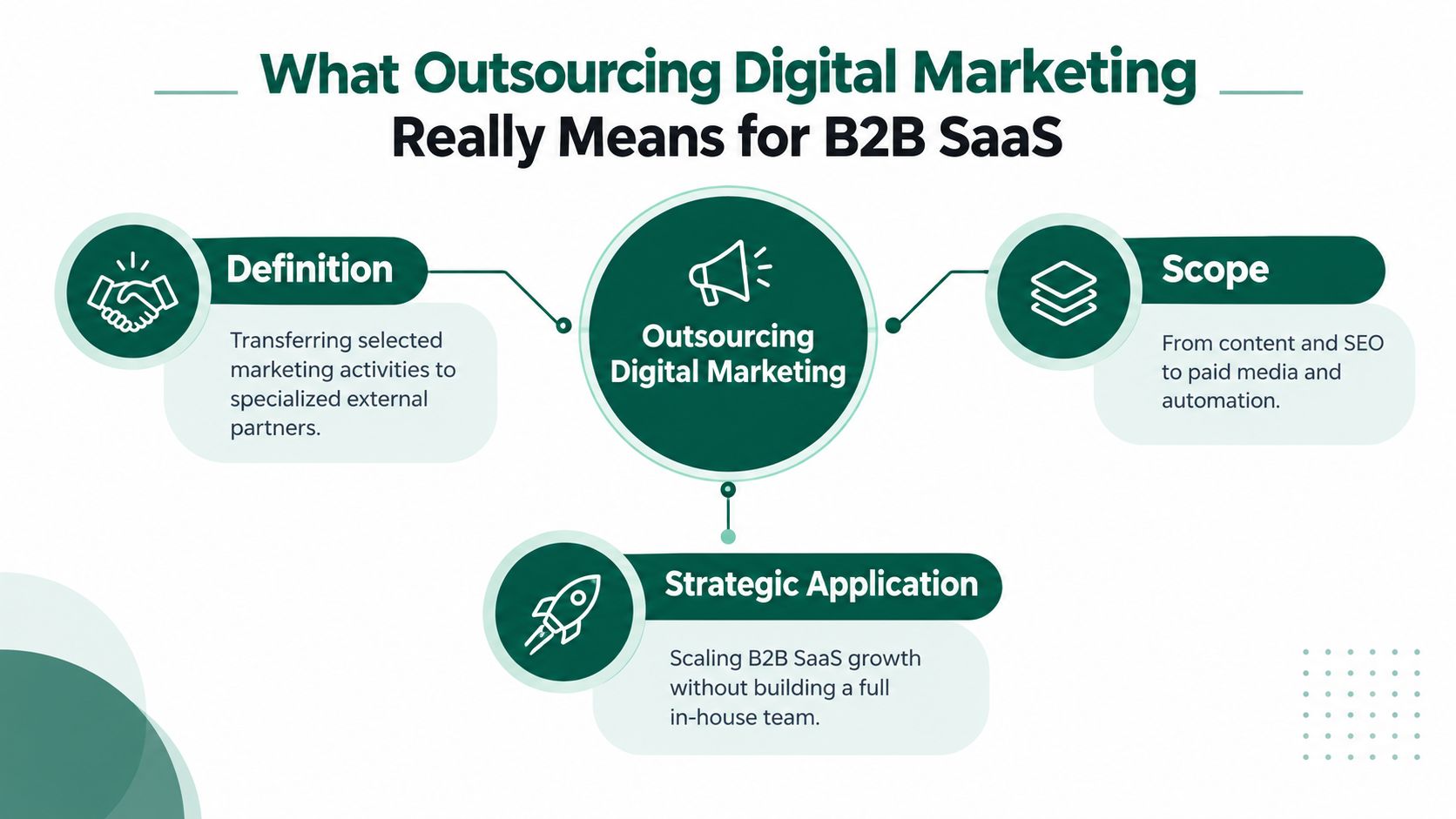
Outsourcing digital marketing means transferring selected marketing activities to specialized external partners under shared governance. It doesn't mean handing over the company's market narrative, customer understanding, or pipeline accountability.
That distinction separates a useful operating model from an expensive delegation exercise. A B2B SaaS company may outsource SEO production, Google Ads management, content design, email operations, conversion-rate work, or marketing analytics. It should rarely outsource the final decision about its ICP, strategic narrative, pricing logic, or definition of a qualified opportunity.
The market is moving toward this selective model. Market.us estimated the digital marketing outsourcing market at USD 17.1 billion in 2025 and projected an 11.7% CAGR from 2026 to 2035, reaching about USD 51.8 billion by 2035. It also estimated that North America represented more than 36.2% of global share in 2025, or roughly USD 6.2 billion, according to digital marketing outsourcing market data. These figures describe market expansion, but they don't prove that every SaaS company should outsource more. They show that external delivery has become a substantial services category.
The simplest useful analogy is this:
This structure works especially well when a company needs several capabilities but doesn't need each capability full time. One external partner may lead positioning. Another may run paid search. A specialist writer may support sales enablement. An offshore production team may adapt approved content into campaign assets.
B2B SaaS growth rarely depends on one channel in isolation. A sales-led company may need category education, account research, outbound support, paid search, nurture, and sales enablement. A PLG company may need acquisition, onboarding, activation analysis, lifecycle messaging, and product-led conversion experiments.
That breadth makes a single generalist vendor a poor answer in many cases. The company needs a coordinated system, not a large activity list. Practical guidance on the relationship between marketing systems and artificial intelligence is available in digital marketing and AI, but the operating principle remains stable: externalize execution where specialist depth matters, and keep strategic judgment close to the business.
There are five common outsourcing models. None is universally superior. The right choice depends on whether the company's constraint is strategic direction, specialist skill, production capacity, or management bandwidth.
Full-service agency. This model suits teams that want one external partner across multiple channels. It can coordinate content, paid media, SEO, creative, and reporting, but broad coverage often dilutes positioning. Agencies tend to scale production more easily than they sharpen a confused go-to-market story.
Fractional CMO-led consultancy. This is the strongest option when leadership needs prioritization and senior ownership without a permanent executive hire. A fractional CMO can connect positioning, demand generation, sales enablement, and measurement. The trade-off is that execution depth may require additional specialists.
Specialist consultants and freelancers. Specialists are valuable when the problem is narrow and well defined. Examples include technical SEO, Google Ads, lifecycle email, conversion copy, or marketing operations. They move quickly, but they won't naturally coordinate the wider system unless someone else owns integration.
Offshore execution teams. Offshore capacity works well for repeatable production, content adaptation, design support, research, list operations, and campaign administration. It fails when the work depends on nuanced market judgment or constant access to customer context.
Hybrid portfolio model. This model combines internal leadership with external specialists and flexible production capacity. It requires more governance, but it gives a SaaS company the best balance of control, expertise, and adaptability.
| Model | Best For | Trade Off | Control Level |
|---|---|---|---|
| Full-service agency | Multi-channel execution with limited internal capacity | Broad coverage can weaken strategic depth | Medium |
| Fractional CMO-led consultancy | Prioritization, positioning, and senior marketing ownership | May need separate channel specialists | High |
| Specialist consultants or freelancers | Clearly defined technical or channel problems | Coordination remains an internal responsibility | Medium to high |
| Offshore execution team | Repeatable production and operational capacity | Requires strong briefs, review, and quality control | Medium |
| Hybrid portfolio model | Growth-stage teams balancing strategy and execution | Demands deliberate governance | High |
Pre-PMF companies should resist broad retainers. They need customer understanding, positioning, founder-led learning, and focused experiments. A fractional leader plus targeted specialists is usually more appropriate than a full-service agency.
Series A and Series B teams often need a stronger operating layer. They may combine internal ownership of ICP and messaging with external support across content, paid search, lifecycle marketing, and analytics. If the company is hiring sales development capacity alongside marketing, a resource such as Hire SDRs can be evaluated as part of the wider pipeline design, not as a substitute for positioning.
Series C and post-PMF companies may need scale, governance, and channel specialization. A full-service partner can make sense when internal leadership already owns strategy and the agency receives clear commercial direction.
A bank-performance study found a statistically significant positive relationship between marketing-process outsourcing and organizational performance, with β=0.122 and p=0.000, as documented in the empirical study of marketing outsourcing and performance. The result supports a practical conclusion: outsourcing can contribute to performance when the external provider has the required infrastructure and resources. It doesn't justify outsourcing without governance.
Growth stalls when strategic work is handed to people without the context or authority to make sound decisions. Keep market judgment, ICP definition, positioning, strategic narrative, and pipeline accountability with the founder, CEO, CMO, or revenue leader. Build the execution layer around that core with fractional leadership, specialist partners, and offshore capacity tied to measurable pipeline work.
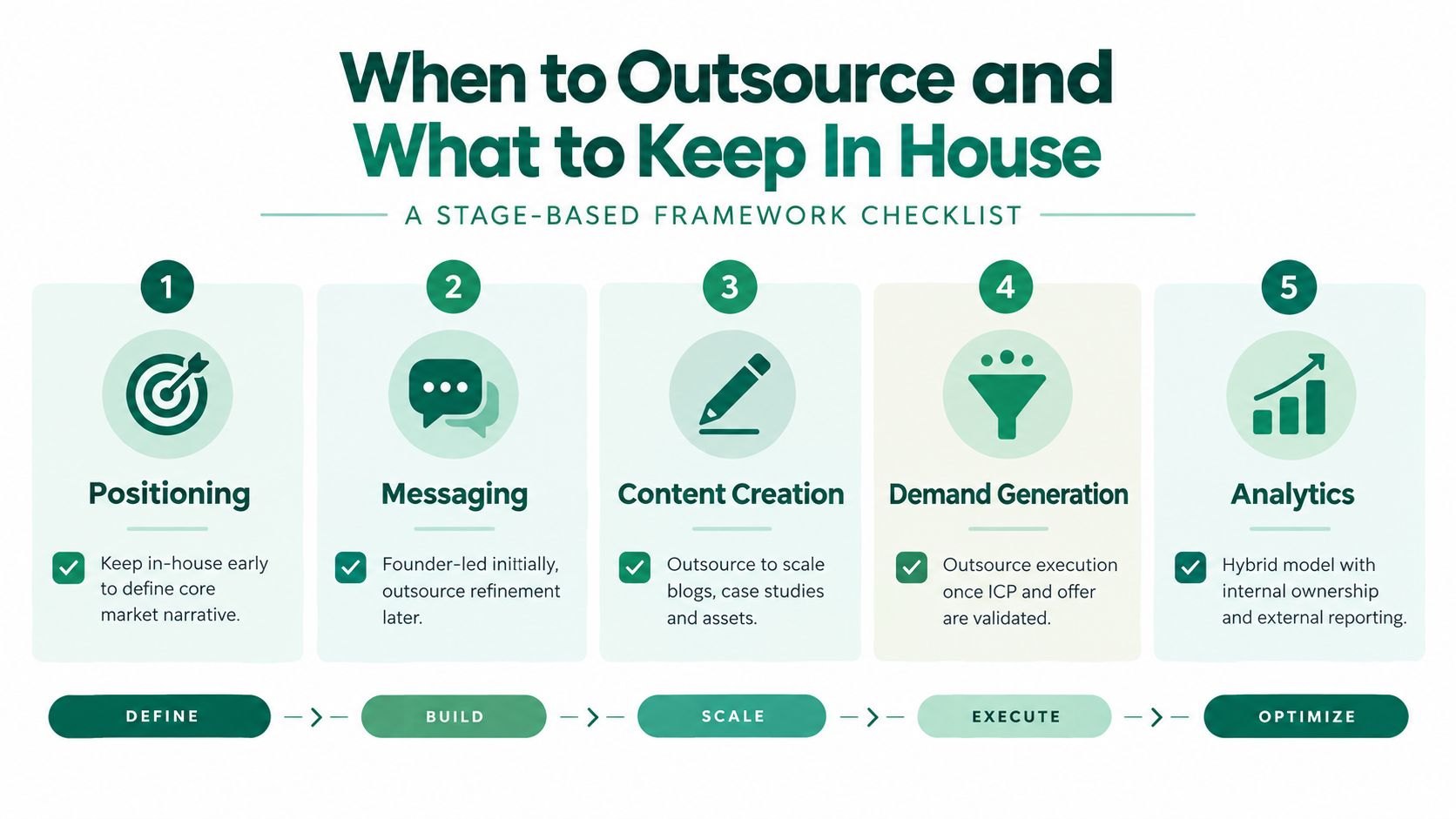
Pre-PMF: Retain positioning, customer research, messaging, and sales feedback internally. Founders should stay close to prospect conversations because those discussions test whether the problem, audience, and language are real. Assign research support, content production, design, or technical implementation to outside specialists after internal leaders establish the point of view.
Early sales traction: Internal leaders should refine the ICP and define pipeline stages. External capacity can handle SEO execution, paid search management, landing-page production, email operations, and content repurposing once the offer has enough evidence to guide those channels.
Series A to Series C: Run a hybrid portfolio. Internal leaders own quarterly priorities, budget allocation, sales alignment, and performance decisions. Specialist partners can manage workstreams such as Google Ads, LinkedIn workflows, technical SEO, conversion copy, and marketing automation.
Post-PMF: Internal teams can take broader ownership of channel strategy and operations. External partners add surge capacity, market-entry support, creative specialization, or independent measurement when those needs exceed the team's current capacity.
The motion also determines ownership. In a PLG business, product analytics, activation events, onboarding friction, and lifecycle triggers require close internal control because they depend on product context. External specialists can support experimentation, copy, research, and instrumentation.
In a sales-led motion, sales feedback, account selection, qualification, and enablement must remain connected to marketing. Outsourced demand generation can create opportunities, while sales leaders define quality standards and follow-up speed.
Founder-led sales creates a handoff risk. As opportunities move to a sales team, preserve the founder's customer language, document it, and use external support to systematize and scale that message.
Assign ICP decisions, positioning, messaging approval, pipeline definitions, sales alignment, budget ownership, and customer insight to internal leaders. These decisions shape commercial direction and require authority across the company.
Use specialists for SEO implementation, content production, paid media operations, design, email execution, research, website development, and reporting support. Offshore capacity can handle repeatable production when briefs, quality standards, and handoffs are clear.
Analytics, attribution, campaign planning, and channel prioritization need internal accountability alongside external technical support. Fractional leadership can fill senior operating gaps; the CMO as a service model works when senior judgment is scarce and execution capacity can be assembled around it.
Classify each task by its need for proprietary context, repeated production, specialist expertise, or temporary capacity. That classification sets the right owner and keeps outsourcing connected to pipeline outcomes.
Vendor selection should feel closer to hiring a senior operator than buying a package. The question isn't whether the team can produce attractive work. It's whether the team can understand your market, make sound trade-offs, and connect execution to commercial movement.
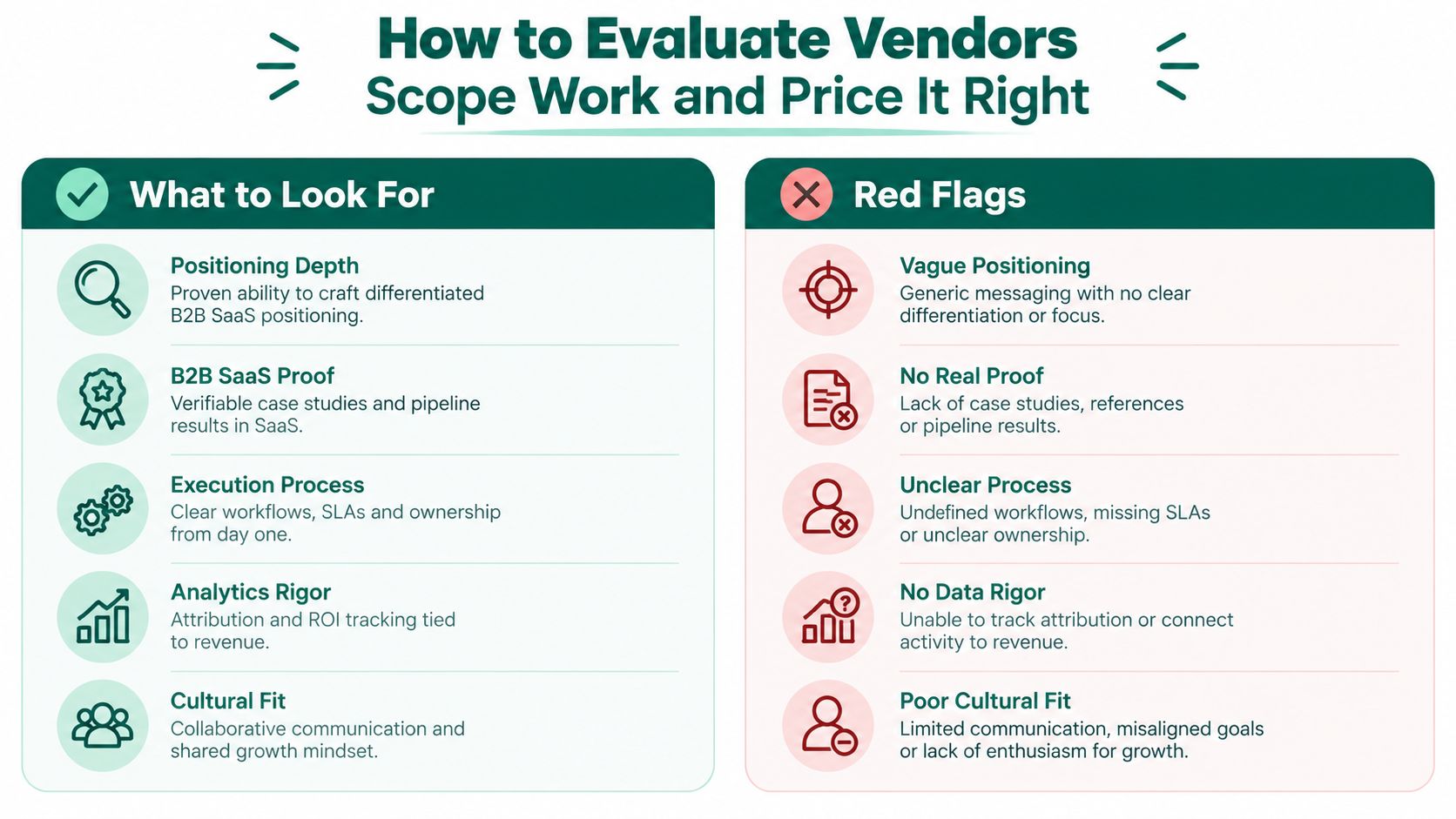
Ask the vendor to explain how it would approach your company before asking for a proposal. A credible partner should identify gaps in your ICP, positioning, funnel, and measurement plan. It should be willing to say which channels it would not prioritize.
Check for:
A useful partner will discuss what it needs from your sales team, product leaders, and customers. A weak one will promise outputs before understanding the buying process. For broader context on choosing an external B2B partner, review this B2B agency evaluation resource.
Begin with a foundation phase. That may include ICP clarification, positioning, messaging, funnel review, analytics audit, and a prioritized growth plan. Follow with a focused pilot rather than an immediate multi-channel commitment.
A practical scope should define:
Pricing varies sharply by scope. A 2026 business pricing guide places typical outsourcing costs at £50 per hour for freelancers, £1,250 to £3,500 per month for a core agency retainer, £3,500 to £16,750 for a full-service retainer, and £2,000 to £50,000 or more for one-off projects or campaigns, according to this digital marketing services pricing guide.
Treat those ranges as planning references, not benchmarks for value. A low fee for the wrong work is wasteful. A higher fee for clear strategic ownership may be rational if it prevents months of unfocused execution.
Contracts should include a defined pilot, accessible work product, IP ownership, data access, communication cadence, decision rights, and a clean exit clause. Don't pay for hours as the primary outcome. Pay for an agreed operating contribution, then judge it against evidence.
Most vendor relationships lose momentum during onboarding. Access arrives late. The CRM fields aren't agreed. Sales doesn't know what marketing is launching. The vendor begins producing assets before anyone has confirmed the message.
The first ninety days need structure, not ceremony.
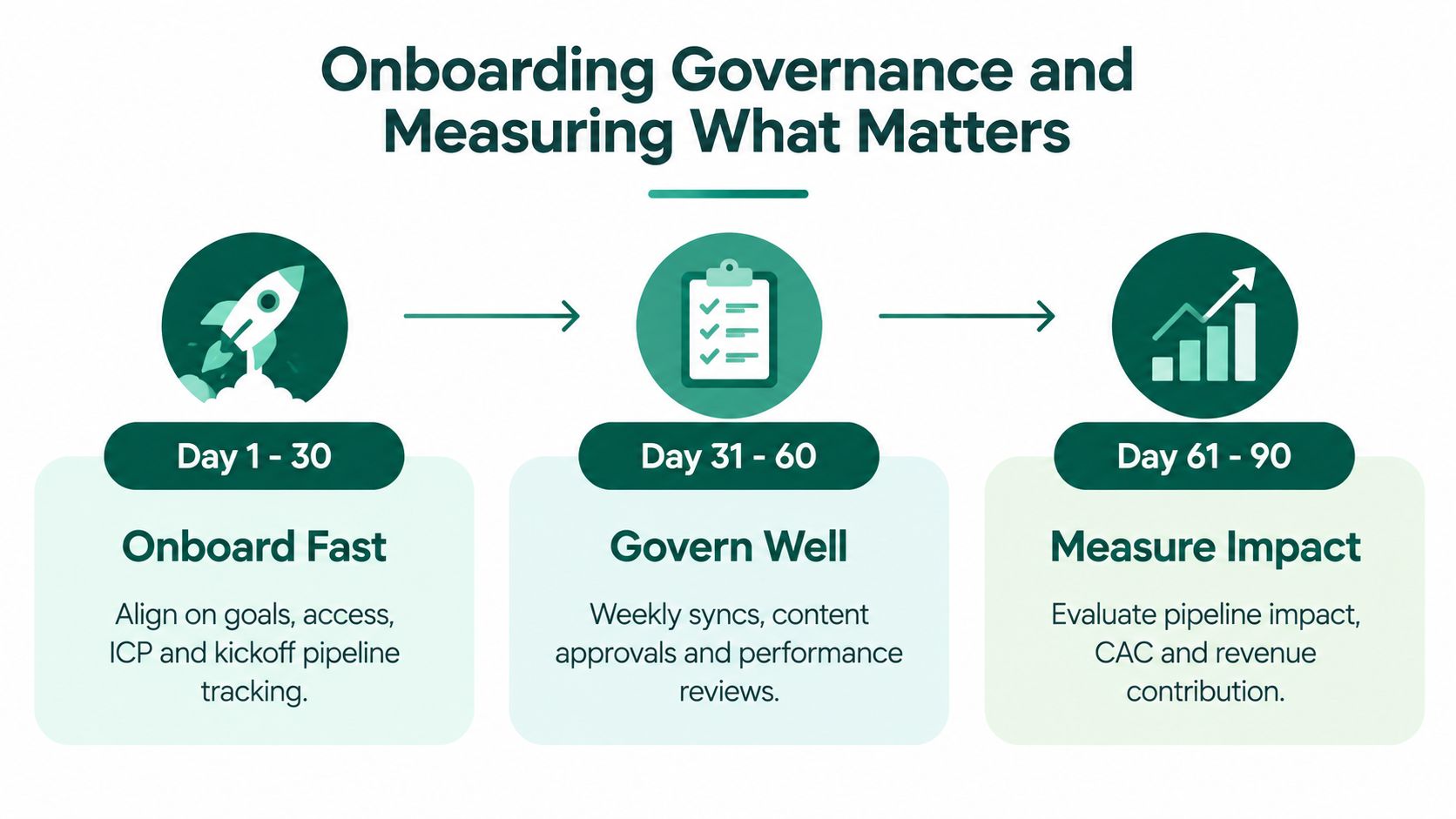
Give the partner access to the CRM, analytics, ad accounts, website, campaign history, sales materials, call recordings, and customer research. Confirm the ICP, current offer, funnel stages, opportunity definitions, and reporting owners.
Create a simple RACI:
The vendor should leave this phase with a prioritized backlog and a measurement plan, not merely a content calendar.
Run a weekly operating meeting focused on decisions, blockers, quality, and evidence. Review content against the message framework. Review campaigns against the ICP. Review lead quality with sales, not just platform metrics.
Keep approvals fast, but don't remove them. A short approval path protects brand accuracy and prevents external teams from making untested claims about the product.
Use a KPI hierarchy. Activity metrics show whether work happened. Response metrics show whether buyers engaged. Pipeline metrics show whether qualified opportunities developed. Revenue metrics show commercial contribution.
No single dashboard can solve attribution. Your reporting should still distinguish between channel-sourced activity, influenced opportunities, conversion movement, sales feedback, and revenue outcomes. The purpose is not to create perfect credit assignment. It's to improve investment decisions.
Outsourced marketing is also expanding beyond isolated SEO, content, and paid-media tasks into full-funnel operations, with analytics and insights becoming more common external functions. Industry reporting projects digital marketing outsourcing growth at roughly 11.4% CAGR through 2034 and identifies content marketing and creation as a fast-growing service segment in strategic horizons for outsourced marketing services.
That shift changes what to outsource first in an AI-search environment. Don't begin with content volume. Begin with the operating layer that connects customer language, content quality, search visibility, paid acquisition, lifecycle signals, and pipeline reporting. Generative search makes disconnected channel reporting even less useful.
For a practical measurement structure, use this marketing ROI measurement framework. The vendor can build and maintain the reporting system, but an internal leader must decide what the company will do with the evidence.
Early-stage SaaS teams often think the answer is more distribution. In practice, they first need sharper positioning. Once the market narrative is clear, external specialists can scale content, paid search, or sales enablement without inventing a new strategy for every asset.
Growth-stage teams face a different problem. They may have product-market evidence but lack senior prioritization. A fractional marketing leader can set the commercial sequence, while specialists handle channels and offshore capacity handles repeatable production. The model creates coordination without forcing the company to hire every capability permanently.
The common risks are predictable:
The relevant examples and operating patterns are collected in the Big Moves Marketing case studies. The lesson is consistent: outsourcing creates value when it increases clarity and speed. It creates noise when leaders use it to avoid making strategic choices.
Big Moves Marketing helps B2B SaaS leaders connect positioning, fractional marketing leadership, channel execution, and measurement into a pipeline-focused operating model. If your current outsourcing setup produces activity without clear ownership, visit Big Moves Marketing to assess what should stay internal, what should move outside, and what needs to change first.




%20-%20white.svg)