%20png%20copy.avif)

If you’re a B2B SaaS founder or marketing leader ready to drive pipeline through content, hire a specialized SaaS content marketing agency now. Generic agencies don’t understand product-led growth, SaaS buyer journeys, or the difference between a trial conversion and a demo request. A firm that lives in this space will get you to measurable results faster.
Bigmoves, led by Veb with extensive experience and numerous SaaS and tech engagements, is built for exactly this. The expected outcome: qualified organic traffic, more marketing-qualified leads (MQLs), and a content program that compounds over time.
Your immediate next steps:
A specialized B2B SaaS content marketing agency delivers services across six core areas. Each one maps to a different part of your growth engine.

Content strategy is the foundation. The agency audits your existing content, maps gaps to your buyer journey, and builds a topic cluster plan tied to commercial intent. This isn’t a blog calendar. It’s a prioritized roadmap of what to create, why, and in what order.
Content production covers the actual writing: blog posts, landing pages, comparison pages, case studies, technical guides, and product-led content. SaaS content creation services go well beyond blogging. Top-performing programs combine top-of-funnel category content, mid-funnel comparison assets, and bottom-of-funnel implementation guides that convert evaluation-stage buyers.
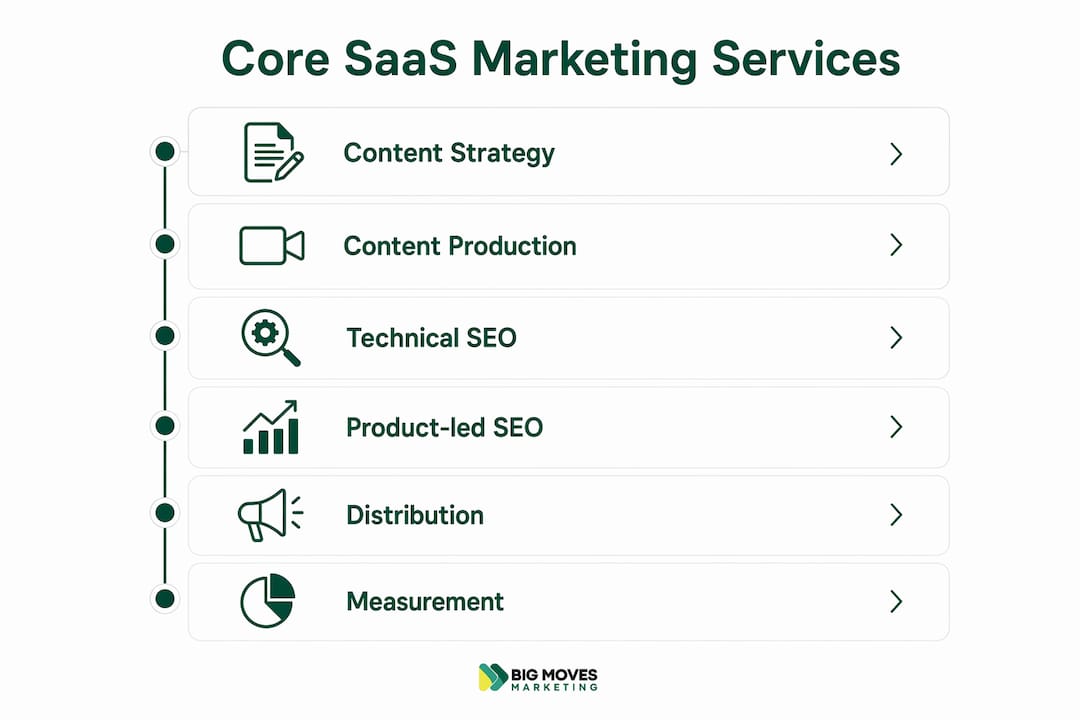
Technical SEO handles site architecture, crawlability, Core Web Vitals, internal linking, and schema. Without it, even great content stays invisible.
Product-led SEO targets feature queries, how-to searches, and use-case landing pages that map directly to your product flows. This is where PLG content earns its keep: users searching “how to automate X in [category]” are closer to a trial than anyone reading a thought leadership post.
Distribution and amplification gets content in front of the right people. Integrated programs that align earned media placements with SEO make those placements more discoverable in search and extend their shelf life.
Measurement and optimization closes the loop. A good agency tracks traffic, MQLs, pipeline contribution, and conversion rates, then feeds those signals back into the content roadmap.
On role differentiation: a fractional CMO engagement covers strategy, positioning, and GTM leadership. Blog writing services are execution only. Most scaling SaaS companies need both, but at different stages. Early product-market fit calls for tight messaging and a focused content strategy. Scale-stage enterprise GTM needs full-funnel production, distribution, and attribution infrastructure.
Every credible engagement runs through the same core phases, even if the labels differ. Here’s what to expect.

Discovery and audit (weeks 1–2): The agency reviews your existing content, SEO baseline, ICP, competitive positioning, and current funnel metrics. You’ll share access to Google Search Console, GA4, and your CRM if pipeline attribution is in scope.
Strategy (weeks 2–4): Deliverables include a keyword and topic cluster map, buyer-journey content matrix, and a prioritized production roadmap. This is where buyer-journey alignment gets built in, mapping content to the comparison and evaluation queries that convert research into demos and trials.
Production (weeks 4–12): Content goes live on a defined cadence. Expect weekly or biweekly check-ins, a shared editorial calendar, and a review-and-approval workflow.
Optimization and distribution (ongoing): Monthly performance reviews, content refreshes, and amplification through owned and earned channels.
Reporting (monthly): Traffic, MQL volume, pipeline contribution, and conversion rates against the baseline set in week one.
| Model | Best for | Typical length |
|---|---|---|
| Monthly retainer | Ongoing content + SEO programs | 6–12 months |
| Project | One-time audit, strategy, or content sprint | 4–12 weeks |
| Pilot | De-risked trial before a full retainer | 30–90 days |
| Fractional CMO | Strategy + execution leadership without a full-time hire | 3–12 months |
A 30–90 day pilot with narrowly scoped deliverables is the lowest-risk way to evaluate fit. You get real output, real data, and a clear read on whether the agency can execute before you commit to a longer contract.
| Week | Milestone |
|---|---|
| 1–2 | Kickoff, access setup, baseline audit complete |
| 3–4 | Strategy doc, keyword map, and content roadmap delivered |
| 5–6 | First content assets in review |
| 7–8 | First assets published, distribution live |
| 9–12 | First performance data, optimization round, retainer decision |
Budget ranges are wide. Content program retainers for B2B clients commonly run from $6,000 to $60,000+ per month depending on scope, team seniority, and expected outcomes. For most mid-market and enterprise SaaS companies, industry benchmarks place typical content program retainers between $6,000/month and $60,000+/month, with SMB programs starting around $6,000–$12,000/month and enterprise programs running $30,000 and up for integrated programs with attribution infrastructure.
Project fees for a standalone audit or content sprint typically run $5,000–$20,000. Fractional CMO engagements sit in the $8,000–$20,000/month range depending on hours and scope.
Budget anchor: Tie every budget conversation to commercial outcomes, not content volume. The right question isn’t “how many blog posts do we get?” It’s “what MQL or pipeline contribution do we expect at month six?”
SEO compounds slowly. Here’s a realistic milestone map:
Paid and email channels move faster. If you need pipeline in 60 days, a content-only program won’t solve that. A good agency will tell you this upfront.
Metrics your agency should report every month:
Case studies are the most common proof point agencies offer. The problem: most are written to impress, not to inform. Here’s how to read them critically.
A credible case study names the client (or gives enough context to verify), states the baseline metric, the timeframe, and the outcome with an attribution method. “We grew organic traffic 300%” means nothing without a starting number, a timeline, and a clear statement of what drove it.
Ask for original analytics exports, not screenshots. Ask for the lead-level attribution method: did MQLs come from organic search, direct, or a last-touch model that inflates content’s contribution? Ask for a client reference who will walk you through the timeline and the numbers.
Integrated programs that combine earned media and SEO tend to show stronger, more durable results than content-only plays. If an agency can show you a case where a media placement drove backlinks that moved rankings, that’s a signal of a mature program.
Attribution is always messy in B2B SaaS. Long sales cycles, multi-touch journeys, and dark social make clean attribution hard. A good agency acknowledges this and shows you a methodology, not a magic number. If they claim 100% clean attribution on a six-month enterprise deal, push back.
Use this framework. Evaluate on four dimensions: capability, process, evidence, and fit.
Capability
Process 4. Do they start with an audit before proposing a content roadmap? 5. Can they describe their keyword research and content prioritization methodology? 6. How do they handle content repurposing and distribution?
Evidence 7. Can they provide original analytics exports from a past client? 8. Will they connect you with a reference who can discuss timeline and attribution? 9. Do their case studies state baselines, timeframes, and attribution methods?
Fit 10. Do they understand your ICP and buyer journey without extensive hand-holding? 11. Is their reporting cadence compatible with your internal review cycle? 12. Do they offer a pilot before a long-term contract?
A pilot should be narrow enough to execute well and broad enough to generate real signal.
Pilot goals: Establish baseline rankings, publish four to six content assets, and generate first MQL data from organic.
Deliverables: Keyword and topic cluster map, four to six published articles or landing pages, one distribution push per asset, and a month-end performance report.
Acceptance criteria: Keyword rankings moving within 60 days, at least one MQL attributed to content by day 90, and a clear retainer proposal with projected outcomes.
Red flags to watch for:
Veb has spent 17 years working with 75+ startups and enterprises on go-to-market strategy, content, and demand generation. The work spans early-stage SaaS companies finding product-market fit to mid-market firms scaling pipeline across multiple channels.
Bigmoves delivers the full stack a scaling SaaS company needs: positioning and messaging, content strategy and production, technical SEO, product-led SEO, and growth channel execution across LinkedIn, Google Ads, email, and webinars. The B2B SaaS marketing approach is built around commercial outcomes, not content volume.
For content planning, tools like Spark Concept help validate product narratives and identify the buyer friction points worth addressing in content. Bigmoves uses this kind of product-first thinking to prioritize content that maps to real purchase decisions, not just search volume.
Pro Tip: In the first 30 days of a Bigmoves engagement, expect a full content and SEO audit, a prioritized keyword map, and a production roadmap with defined acceptance criteria. Ask for these deliverables in writing before you sign anything.
Bigmoves operates on project, retainer, and fractional CMO models. Pilots are available for new clients who want to validate fit before committing to a longer program. To start, request an audit and pilot scope document at bigmoves.marketing.
A specialized SaaS content marketing agency delivers measurable pipeline impact when you hire for SaaS GTM expertise, demand a pilot before a long-term contract, and tie every budget conversation to MQL and revenue outcomes.
| Point | Details |
|---|---|
| Hire specialized, not generic | Agencies with SaaS GTM experience move faster and produce better-converting content. |
| Budget to outcomes | Typical content program retainers for B2B SaaS companies range from $6,000 to $60,000+ per month; tie scope to MQL and pipeline targets, not post volume. |
| Pilot first | A 30–90 day pilot with defined acceptance criteria is the lowest-risk path to a full retainer. |
| Validate proof claims | Ask for original analytics exports and a client reference before signing any contract. |
| Bigmoves as your starting point | Bigmoves offers audit-first, pilot-led engagements for B2B SaaS companies ready to build a content program that compounds. |
Most SaaS marketing leaders I talk to have been burned by a content agency at least once. The pattern is familiar: a long contract, slow onboarding, content that looks good but doesn’t rank, and a reporting dashboard full of impressions with no MQL data. The problem usually isn’t the content itself. It’s the absence of a commercial framework around it.
SaaS content works when it’s built around buyer decisions, not editorial calendars. The highest-value content in any SaaS program targets the queries buyers use when they’re already evaluating solutions: comparison pages, alternative pages, use-case landing pages, and implementation guides. These convert. Thought leadership posts rarely do, at least not directly.
The pilot-first model fixes the accountability problem. When an agency knows the first 90 days will be measured against defined acceptance criteria, they prioritize differently. You get the work they’d do if they were trying to keep you, not the work they’d do if they already had you locked in.
On the SEO compounding question: the six-to-twelve month timeline for meaningful organic growth is real, but it’s not an excuse for slow starts. A well-run program shows ranking movement within 60 days and first MQL attribution within 90. If you’re at month four with no signal, that’s a process problem, not a patience problem.
The SaaS companies that get the most from content programs treat the agency as a growth partner, not a vendor. They share CRM data, ICP insights, and sales call recordings. The more context the agency has, the better the content performs.
If you’ve read this far, you know what a strong content program looks like. Bigmoves builds exactly that for B2B SaaS companies: an audit-first engagement that surfaces your biggest content and SEO gaps, followed by a scoped pilot that proves impact before you commit to a full retainer.
The pilot covers a full content and SEO audit, a prioritized keyword and topic cluster map, four to six published content assets, and a month-end performance report with MQL attribution. Contract terms are straightforward: no long lock-in on the pilot, clear deliverables in writing, and a retainer proposal at day 90 based on actual results.
Veb and the Bigmoves team work with mid-market and scaling SaaS companies that need a content program tied to pipeline, not just traffic. To get started, visit the Bigmoves services page and request an audit and pilot scope document. Come with your current traffic baseline, ICP definition, and top three growth goals.
Use these resources to prepare for vetting calls and validate agency claims before you sign.
A SaaS content marketing agency specializes in building content and SEO programs for software companies, with expertise in SaaS buyer journeys, product-led growth, and pipeline attribution. Unlike general content agencies, they understand the difference between a trial conversion and a demo request.
B2B SaaS content marketing is the practice of creating and distributing content that moves software buyers through an evaluation funnel, from category awareness to demo or trial. Effective programs target comparison, use-case, and implementation queries, not just top-of-funnel blog traffic.
Industry cost benchmarks place typical content program retainers for B2B SaaS companies between $6,000 and $60,000+ per month depending on scope and outcomes. SMB SaaS programs generally start around $6,000–$12,000/month, while enterprise programs with integrated production and attribution infrastructure run $30,000 and up.
Expect early ranking movement within 60 days and first MQL attribution within 90 days of a well-run pilot. Meaningful organic traffic growth and consistent pipeline contribution typically appear at the six-month mark and compound through month twelve.
Outsourcing to a specialized agency is faster to start and gives you immediate access to SaaS GTM expertise, SEO infrastructure, and a production team. In-house makes sense once you have enough volume and institutional knowledge to justify full-time headcount. Many scaling SaaS companies run both: an agency for strategy and production, and one in-house content lead to manage the relationship.
June 26, 2026





%20-%20white.svg)