%20png%20copy.avif)
SaaS product marketing is the practice of defining who your product serves, where to reach them, and how to convert them into paying customers who stay. Most SaaS marketing fails not from lack of effort but from lack of focus. Founders spread budget across five channels, write blogs nobody reads, and run ads before the funnel works. The playbook that actually generates recurring revenue starts with clear positioning, narrows to a specific ideal customer profile (ICP), commits to one or two channels, and measures the full customer lifecycle. Get those four things right and growth compounds.
Lack of clear positioning causes most SaaS marketing to fail, regardless of content volume or ad spend. That is the single most important fact in this guide. Every channel, every campaign, and every piece of content performs better when your positioning is sharp.
Write your positioning in one sentence under 20 words. The formula is simple: “[Product] helps [person] do [outcome] without [pain].” That sentence becomes the foundation for your homepage headline, your LinkedIn bio, your cold email opener, and your ad copy. Vague positioning like “we help businesses grow” tells nobody anything.

Your ICP needs the same precision. “Small businesses” is not an ICP. A useful ICP looks like: “B2B SaaS founders with 2–10 employees, pre-Series A, selling to mid-market operations teams.” The narrower the definition, the higher your message resonance and the lower your cost per qualified lead.
Here is how to identify your best-fit ICP:
Pro Tip: If you have fewer than 50 signups, use your own experience as a proxy. Build for the person you were before you built the product. That founder-led ICP is often the most accurate one you will ever have.
Channel-market fit requires alignment with buyer research habits, urgency, price signals, and your team’s execution capacity. Picking the wrong channel wastes months. Picking the right one and committing to it builds compounding momentum.
Match your channel to your buyer type. B2B SaaS targeting operations leaders belongs on LinkedIn. Developer tools grow fastest through GitHub, Hacker News, and developer-focused newsletters. Prosumer products with visual appeal find traction on TikTok and YouTube. Niche communities on Reddit, Slack, and Discord work well for products solving specific workflow problems.
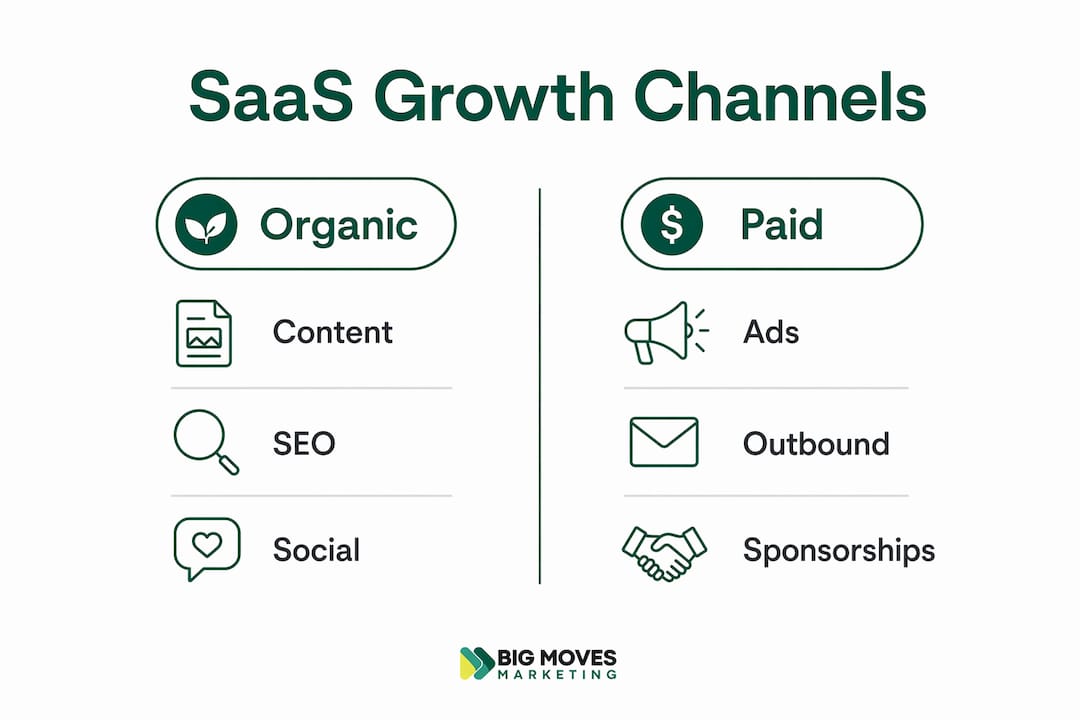
Most founders fail by spreading efforts thinly across too many channels. The fix is committing to one primary channel and one supporting channel for at least six months before considering a pivot. That timeline feels long. It is necessary.
Channel selection criteria worth applying before you commit:
Pro Tip: Batch your content production. Set aside 2–3 hours weekly to create multiple posts at once, then schedule them in advance. Consistency beats intensity every time in organic SaaS marketing.
Content that converts answers specific questions your buyers are already asking. Generic blogs about industry trends do not convert. A post that answers “how do I automate client onboarding without a developer” converts, because it matches a real search intent from a real buyer.
Pull your content topics from three sources: sales call recordings, support tickets, and direct messages from prospects. Those three sources contain every question your ICP has before buying. Answer those questions in long-form blog posts, short LinkedIn posts, and short-form video. Each format serves a different stage of awareness.
Build a repeatable content engine with these steps:
Organic SaaS marketing requires consistent, high-quality weekly effort for at least six months before generating reliable signups, with full compounding arriving at 9–12 months. That timeline is not a warning. It is a planning input. Build your content calendar knowing that the payoff is real but delayed.
Pro Tip: A SaaS SEO strategy built around buyer questions compounds faster than one built around keyword volume alone. Rank for the questions your ICP types at 2 AM when they are frustrated with their current tool.
Paid acquisition amplifies a working funnel. It does not fix a broken one. Paid ads can generate signups in week one, but those signups churn fast when positioning and onboarding are not ready. Run paid only after your organic messaging has proven it converts.
The cost difference between paid channels is significant. Newsletter sponsorships cost $1–$4 CPC for B2B tech audiences. LinkedIn Ads cost 3–10x more for the same click. For early-stage SaaS with limited budget, newsletter sponsorships in niche publications deliver better qualified traffic at a fraction of the cost.
Outbound is another paid-adjacent channel worth understanding. Cold outbound to unengaged prospects produces sub-1% reply rates. Signal-seeded outbound, which targets accounts that have already engaged with your content or visited your pricing page, achieves reply rates 10–20x higher. That difference makes signal-seeded outbound one of the highest-ROI tactics in B2B SaaS marketing.
| Paid channel | Typical CPC | Best use case |
|---|---|---|
| Newsletter sponsorships | $1–$4 | Awareness and top-of-funnel signups |
| LinkedIn Ads | $8–$40+ | Retargeting and ABM for enterprise deals |
| Google Search Ads | Varies widely | High-intent, bottom-of-funnel capture |
| Signal-seeded outbound | Low direct cost | Engaged account conversion |
Key rules for paid SaaS acquisition:
SaaS marketing success is measured by Net Revenue Retention (NRR) and lifetime value (LTV), not by impressions or follower counts. NRR above 110% means existing customers fund your growth. That is the most sustainable position a SaaS company can reach.
Vanity metrics mislead. A LinkedIn post with 50,000 impressions that generates zero qualified signups is a failure. A post with 800 impressions that generates five demo requests is a win. Measure what moves revenue.
Track these metrics across the full funnel:
SaaS marketing must operate as a full-lifecycle system, covering acquisition, onboarding, retention, and expansion. Acquisition without retention is a leaky bucket. The SaaS retention strategies that compound growth sit inside the product experience, the onboarding sequence, and the expansion email program, not just the top-of-funnel campaign. Track your SaaS marketing metrics at every stage and you will always know where to focus next.
Effective SaaS marketing requires sharp positioning, narrow ICP definition, committed channel focus, and lifecycle metric tracking to build compounding, sustainable growth.
| Point | Details |
|---|---|
| Positioning comes first | Write a sub-20-word sentence defining who you help, what outcome you deliver, and what pain you remove. |
| Narrow your ICP | Vague segments waste budget; a precise ICP improves message resonance and lowers cost per qualified lead. |
| Commit to one or two channels | Focus on one primary and one supporting channel for at least six months before pivoting. |
| Paid amplifies, not fixes | Run paid acquisition only after organic messaging has proven it converts; newsletter sponsorships offer the best CPC for B2B SaaS. |
| Track lifecycle metrics | Measure qualified signups, 7-day activation rate, and NRR rather than impressions or follower counts. |
Most founders treat positioning as a one-time task. They write a headline, ship the website, and move straight to channel tactics. That is the wrong order. Positioning is a living document. Every sales call, every churned customer, and every support ticket contains a signal that should sharpen your message. The founders who revisit their positioning every quarter outperform those who set it and forget it.
The channel commitment piece is where I see the most damage done. A founder runs LinkedIn for six weeks, sees modest results, and pivots to cold email. Then they try SEO for two months, then paid ads. None of them compound because none of them get enough time. Switching channels before momentum builds is the single most common and most expensive mistake in SaaS marketing.
The other thing I have learned is that founders’ authentic voices outperform polished brand content in almost every channel. Your opinion on a problem your ICP faces, written in plain language, will outperform a ghostwritten thought leadership piece every time. The market is saturated with generic content. Your specific experience is not.
Patience is not passive. It means producing consistently, measuring honestly, and adjusting based on data rather than anxiety. The SaaS founders who build durable growth engines are the ones who stay the course long enough for compounding to kick in. That window is 9–12 months for organic. Plan for it.
— Veb
Bigmoves works with B2B SaaS founders and marketing teams who need a clear go-to-market foundation, not just a website. Veb and the team build Webflow sites designed for conversion, develop positioning and messaging from scratch, and run pilot-led growth channel programs across LinkedIn, Google Ads, and email.
If your SaaS product needs a website that actually converts visitors into signups, or a go-to-market plan built on the principles in this guide, the SaaS website and GTM service at Bigmoves is the place to start. The work is tailored to your stage, your ICP, and your growth goals. No generic templates. No wasted spend.
Define your positioning in one sentence under 20 words before touching any channel or campaign. Clear positioning is the foundation every other marketing decision builds on.
Organic SaaS marketing produces reliable signups after six months of consistent weekly effort, with full compounding arriving at 9–12 months.
Newsletter sponsorships deliver B2B tech audiences at $1–$4 CPC, which is 3–10x more affordable than LinkedIn Ads for the same click.
Track qualified signups, 7-day activation rate, and Net Revenue Retention. NRR above 110% signals that existing customers fund growth, reducing pressure on new acquisition.
Focus on one primary channel and one supporting channel for at least six months. Spreading effort across multiple channels before any one compounds is the most common reason SaaS marketing stalls.


%20-%20white.svg)