10 Content Marketing B2B Examples from Top SaaS Companies (2025)
Finding truly effective content marketing B2B examples for SaaS can feel like searching for a needle in a haystack of generic advice. Many articles showcase the same tired campaigns without digging into the strategic thinking that fueled their success. This isn't about simply "creating valuable content"; it's about building strategic assets that generate qualified leads, empower sales teams, and establish undeniable industry authority.
We're moving past surface-level descriptions to dissect what truly works. In this deep dive, you’ll discover ten standout campaigns from tech and SaaS leaders like HubSpot, Drift, and Atlassian. Each analysis breaks down the specific audience, core tactics, measurable outcomes, and, most importantly, reusable strategies your team can implement immediately.
This is your playbook for turning content from a cost center into a predictable revenue driver. You won't find vague theories here, just actionable blueprints for building a content engine that actually closes deals and builds a brand that customers trust. Forget the fluff; let's get into the mechanics of what makes great B2B content marketing a powerful growth engine for your company.
1. HubSpot's Inbound Methodology Content Hub
HubSpot didn't just participate in the conversation; they created the entire language of inbound marketing. Instead of directly selling their software, they built an unparalleled educational ecosystem around a single, powerful idea: attract customers with valuable content, don't interrupt them with ads. This philosophy became the bedrock of one of the most effective content marketing B2B examples in history.
Their strategy was to own the "inbound marketing" topic completely. They achieved this by creating a massive content hub addressing every conceivable pain point for marketers and salespeople. This wasn't just a blog; it was a universe of free, high-value resources.
Execution and Impact
Campaign Type: Educational Content Ecosystem / Thought Leadership Platform
Target Audience: Marketing managers, sales leaders, and small business owners seeking growth.
Measurable Outcomes: HubSpot’s blog attracts millions of visitors monthly, and its Academy has issued over a million certifications, generating an immense volume of marketing-qualified leads (MQLs). Their annual "State of Marketing" report consistently earns thousands of high-authority backlinks.
Key Tactics and Takeaways
HubSpot's model proves that by teaching your audience how to succeed, you become the indispensable tool for their success.
Build Topic Clusters: Don't just write random posts. Create a central "pillar" page for a core topic and surround it with dozens of in-depth "cluster" articles that link back to it. This signals topic authority to Google and guides users through your content.
Educate to Convert: Offer comprehensive, free certification courses (like HubSpot Academy). This builds brand loyalty and a deep understanding of your product's value proposition long before a sales call.
Publish Proprietary Data: Create an annual "State of [Your Industry]" report. Original research is a magnet for backlinks from journalists and industry experts, dramatically boosting your domain authority.
This "give it all away for free" approach builds immense trust and organically funnels educated, high-intent prospects directly into your sales pipeline. To start applying these principles, you can define and scale your B2B content marketing strategy with a similar foundational mindset.
2. Salesforce's Trust Executive Briefing Program
While many B2B companies shout into the content void, Salesforce chose to whisper directly to the C-suite. Their strategy focuses on building deep relationships with enterprise executives through an exclusive, high-touch content program. Instead of casting a wide net with blog posts, they created a premium ecosystem of research, insights, and personalized briefings that address top-level business challenges.
This approach positions Salesforce not as a software vendor, but as a strategic partner in digital transformation. They own the conversation around complex topics like AI, customer data, and corporate trust by providing executive-level thought leadership. This transforms a typical sales cycle into a collaborative, consultative engagement.
Execution and Impact
Campaign Type: Executive Thought Leadership / High-Touch Content Program
Measurable Outcomes: This strategy is measured by C-suite engagement, high-value pipeline generation, and enterprise deal acceleration. Salesforce's recurring "State of the Connected Customer" report earns thousands of backlinks and media mentions, solidifying its authority.
Key Tactics and Takeaways
Salesforce’s model shows that for high-value accounts, exclusivity and depth trump volume and reach. It’s a masterclass in using content to open doors that are otherwise closed.
Create C-Suite-Specific Research: Develop proprietary data reports (like their Trust Index) that speak directly to the strategic pain points and opportunities of an executive audience. Focus on business outcomes, not product features.
Position Executives as Peers: Use your own leadership team as the face of the content. An insight from your CEO carries more weight with another CEO than one from a marketing manager.
Make Content an Exclusive Experience: Gate your most valuable research and insights behind executive briefings or exclusive roundtables. This increases perceived value and provides a natural forum for relationship building.
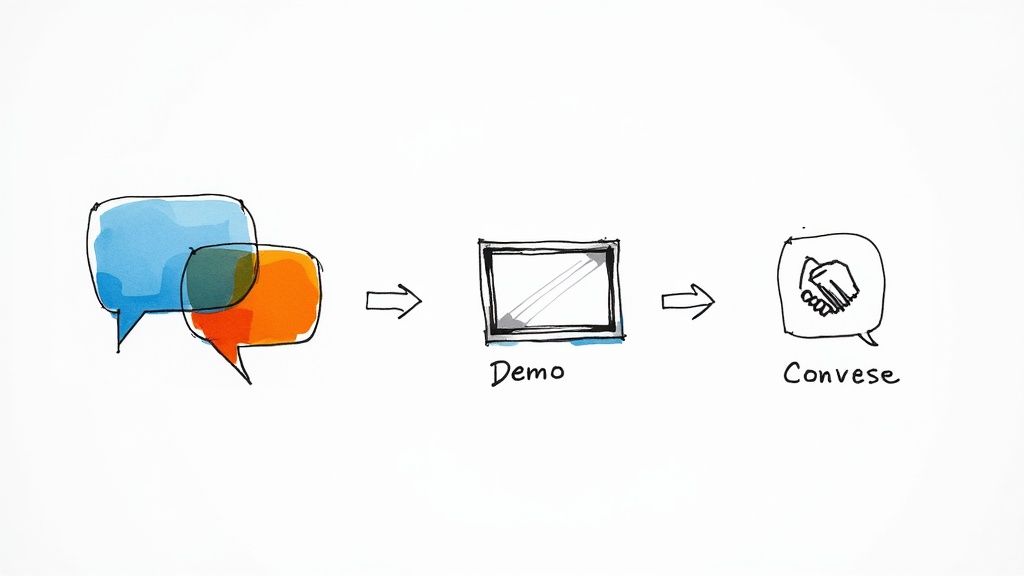
Drift didn't just sell a chatbot; they created and evangelized an entirely new B2B category: conversational marketing. Their approach was to show, not just tell, how real-time conversations could replace passive lead forms. They built a content engine to educate the market on a problem they didn't know they had, positioning their product as the only logical solution.
This strategy focused on creating content that both defined the category and demonstrated its immediate value. By publishing manifestos, detailed guides, and live-chat-focused webinars, Drift transformed their own website into the ultimate proof of concept, making their marketing a living product demo.
Target Audience: B2B marketing and sales leaders frustrated with low-quality leads from traditional forms.
Measurable Outcomes: Drift effectively created a new software category, generating massive search volume for terms like "conversational marketing." Their content directly fueled their sales pipeline by engaging prospects in real-time, significantly shortening the sales cycle for qualified buyers.
Key Tactics and Takeaways
Drift's success illustrates that the most powerful content marketing B2B examples often involve teaching your audience a new, better way to operate.
Create the Category: Don't just compete; define a new game. Publish a manifesto or a definitive guide that introduces a new philosophy and terminology, making your brand synonymous with the concept.
Integrate Product into Content: Embed your own tools within your content. Use webinars, blog posts, and guides to showcase your product in action, bridging the gap between education and conversion seamlessly. For a deeper dive into the principles behind this approach, you can explore understanding conversational marketing.
"Dogfood" Your Philosophy: Practice what you preach. Drift replaced their own lead capture forms with their chat tool, proving its effectiveness and creating an authentic user experience that built immense credibility.
This method turns your content from a passive asset into an active sales tool, initiating conversations with high-intent buyers the moment they show interest. By focusing your content marketing in B2B on education and demonstration, you can build a powerful, self-reinforcing growth engine.
4. Okta's Security-Focused Educational Content
Okta didn’t just sell identity management software; they became a leading voice on digital security itself. Instead of focusing on product features, they built a powerful B2B content marketing engine around a core enterprise fear: navigating the complex and ever-changing world of cybersecurity threats. This strategy established them as a trusted advisor, not just another vendor.
Their approach was to demystify complex security topics for technical and business leaders. By publishing in-depth research, threat reports, and foundational guides, Okta addresses critical pain points long before a prospect considers a purchase. This educational content builds immense credibility in a high-stakes industry where trust is paramount.
Execution and Impact
Campaign Type: Educational Content / Thought Leadership
Target Audience: CISOs, IT directors, security architects, and CTOs concerned with identity, access, and compliance.
Measurable Outcomes: Okta's "Threatscape Report" is regularly cited by industry publications, generating high-authority backlinks. Their educational content fuels lead generation for their webinar series like "Identity 101," which warms up prospects by solving their immediate knowledge gaps.
Key Tactics and Takeaways
Okta’s model shows that when you educate your market on its biggest challenges, your solution becomes the logical next step.
Publish Original Research: Develop a flagship report based on proprietary data, like Okta's analysis of identity threats. This creates a unique asset that positions you as a primary source of industry intelligence.
Create '101' Educational Tracks: For complex B2B products, build a foundational content series (webinars, guides, videos) that explains core concepts. This empowers less technical decision-makers and builds a wider audience.
Partner with Industry Researchers: Collaborate with external security experts or researchers to co-author content. This adds third-party validation and credibility to your insights, accelerating trust-building.
By addressing your audience’s most significant anxieties with expert guidance, you build a relationship founded on trust, making the sales process feel more like a consultation than a pitch.
5. LinkedIn's B2B Content Strategy and Creator Fund
LinkedIn didn't just host professional conversations; it transformed its platform into the world's largest B2B content engine. Instead of being a passive resume repository, it became a dynamic ecosystem where professionals build authority and companies build trust through valuable content. This strategy brilliantly used their own platform to demonstrate the power of content for business, making them the ultimate case study.
The core idea was to make content creation central to professional development and business growth. They achieved this by publishing original research like their annual "Jobs on the Rise" report, launching LinkedIn Learning to upskill their user base, and directly investing in creators to foster high-quality, native content. This created a flywheel of engagement that also showcased the effectiveness of their advertising solutions.
Target Audience: B2B professionals, sales leaders, marketers, and executives looking to build their personal and company brands.
Measurable Outcomes: LinkedIn's content-first approach has driven massive user engagement, cementing its status as the premier B2B social network. Their original reports generate thousands of backlinks and media mentions, while the success of thought leaders serves as social proof for their marketing and sales products.
Key Tactics and Takeaways
LinkedIn proves that the best way to sell a marketing tool is to use it masterfully yourself. By empowering your community to create, you build a moat around your platform.
Practice What You Preach: Use your own platform as the primary channel for your content marketing. This authenticates your product’s value and provides a blueprint for your customers to follow.
Publish Authoritative Original Data: Conduct and publish industry-specific research. This positions your company as a definitive source of information, attracting high-authority links and earning media attention.
Empower Executive Voices: Encourage your leaders to build a consistent, authentic presence. A strong executive voice humanizes the brand and builds trust far more effectively than a corporate logo can. For those looking to deepen their LinkedIn presence, this guide on creating a LinkedIn content calendar can be invaluable.
By fostering a community of creators and leading by example, LinkedIn shows how to turn a platform into a thriving content hub. You can discover more on how to build a powerful B2B LinkedIn marketing presence by applying these very principles.
6. Mailchimp's 'The Futur' Content Acquisition Strategy
Mailchimp chose a different path to audience growth: instead of building from scratch, they bought one. By acquiring 'The Futur,' an established educational platform for creative entrepreneurs, Mailchimp instantly inherited a deeply engaged community that perfectly mirrored its ideal B2B customer profile. This strategy is a masterclass in accelerating content marketing by acquiring a trusted voice rather than creating one internally.
The approach allowed them to tap into an existing audience without the long, arduous process of building trust and authority. Instead of just selling email software, they became a patron of the creative community, positioning their brand as an essential partner in small business growth. This is one of the more innovative content marketing B2B examples of scaling reach through strategic acquisition.
Target Audience: Creative entrepreneurs, freelance designers, and small agency owners.
Measurable Outcomes: The acquisition brought The Futur’s hundreds of thousands of YouTube subscribers and a highly engaged email list directly into Mailchimp's ecosystem, dramatically increasing brand reach and lead generation potential among a core demographic.
Key Tactics and Takeaways
Mailchimp’s move proves that sometimes the fastest way to build an audience is to buy a pre-built, loyal one. It's a powerful shortcut to establishing topic authority and trust.
Acquire, Don't Always Create: Identify content creators, niche blogs, or media properties that have already captured your target audience. An acquisition can be a more efficient investment than years of organic content creation.
Preserve Editorial Independence: To retain the audience's trust, allow the acquired property to maintain its unique voice and editorial freedom. Heavy-handed branding can alienate the community you just paid to reach.
Integrate and Elevate: Find natural ways to connect the acquired content to your product. Mailchimp cross-promoted its tools within The Futur's educational content, showing how its platform helps creative entrepreneurs succeed.
7. Moz's SEO-Driven Content and Whiteboard Friday Series
Moz built its empire not just by selling SEO software, but by becoming the definitive educational source for the entire industry. They pioneered a strategy of giving away immense value for free, centered around one core belief: teach people SEO, and they will use your tools to do it. This approach transformed a complex technical discipline into an accessible marketing function, establishing Moz as the trusted guide.
Their strategy was to dominate search engine rankings for every SEO-related query imaginable. They achieved this by creating a powerful mix of evergreen guides, original research, and their now-legendary Whiteboard Friday video series, making their brand synonymous with SEO expertise.
Execution and Impact
Campaign Type: Educational Content Engine / Brand-Building Video Series
Target Audience: Digital marketers, SEO specialists (from beginner to advanced), and agency owners.
Measurable Outcomes: The "Beginner's Guide to SEO" has earned tens of thousands of backlinks and consistently ranks on page one for its target terms. The Whiteboard Friday series built a loyal, weekly audience, driving millions of views and solidifying Moz's authority, directly fueling tool sign-ups.
Key Tactics and Takeaways
Moz’s success is a blueprint for how deep expertise, consistently shared, can build an unbeatable marketing moat. Their content not only attracts users but also educates them on the importance of the very problem their software solves.
Create a Signature Series: Develop a recurring, branded content series like Whiteboard Friday. This trains your audience to expect value from you consistently, turning passive readers into an engaged community.
Build Foundational "Library" Content: Invest heavily in creating massive, definitive guides on core topics (e.g., "The Beginner's Guide to..."). These evergreen assets become long-term organic traffic generators and backlink magnets.
Pair Education with Product: Seamlessly integrate mentions and demonstrations of your tool within your educational content. Show users how to apply the concepts you're teaching, making your product the natural next step.
Atlassian’s genius lies in treating documentation and user education not as a cost center, but as a primary marketing engine. Instead of a hard sell, they built a comprehensive content ecosystem aimed squarely at their technical audience of developers and project managers. Their strategy is centered on a simple, powerful principle: empower users to solve their own problems, and they will become your most dedicated advocates. This approach turned their products into indispensable tools for technical teams worldwide.
The core of their strategy is a self-sustaining loop of high-quality documentation, best practice guides, and a vibrant community forum. This dual focus on official resources and user-generated content creates an environment where product adoption feels natural and collaborative. This makes their content an essential part of the product experience, not just marketing material.
Execution and Impact
Campaign Type: Product-Led Content / Community Education
Target Audience: Software developers, project managers, IT operations teams, and product managers.
Measurable Outcomes: The Atlassian Community boasts hundreds of thousands of active members, significantly reducing support ticket volume. Their extensive documentation and guides for Agile and DevOps methodologies rank for thousands of high-intent keywords, driving organic product discovery and adoption.
Key Tactics and Takeaways
Atlassian’s success shows that for technical products, the best marketing is often world-class education and peer-to-peer support. This is one of the most effective content marketing B2B examples for companies with a user base that values expertise and self-service.
Elevate Documentation to Marketing: Treat your user guides, tutorials, and API documentation as top-of-funnel marketing assets. Invest in clarity, searchability, and comprehensive examples to attract and retain technical users.
Foster a Community Hub: Create a dedicated space like the Atlassian Community for users to ask questions, share solutions, and build connections. This not only generates a vast library of user-generated content but also builds a powerful network effect around your brand.
Create Clear Learning Paths: Don't just dump information. Organize your content into structured guides and learning paths that help new users master your tools and the methodologies they support, like Agile or DevOps.
9. Shopify's Business and Entrepreneurship Content Strategy
Shopify didn't just build a platform for merchants; they built an entire support system for entrepreneurship itself. Instead of focusing on product features, they created a powerful content engine dedicated to one core principle: if our customers succeed, we succeed. This philosophy transformed them from a simple software tool into an indispensable partner for anyone starting or scaling an online business.
Their strategy was to address the entire entrepreneurial journey, not just the part that involves their platform. From the initial spark of an idea to advanced scaling challenges, Shopify created free, accessible resources like their blog, the Shopify Masters podcast, and practical tools like business name generators. This approach is one of the most powerful content marketing B2B examples because it builds brand loyalty by solving fundamental business problems.
Target Audience: Aspiring entrepreneurs, small business owners, and established eCommerce merchants.
Measurable Outcomes: The Shopify Blog is a top traffic source, attracting millions of potential customers searching for business advice. The Shopify Masters podcast has built a dedicated community, and their free tools generate high-intent leads by solving immediate, practical problems for their target audience.
Key Tactics and Takeaways
Shopify's model demonstrates that empowering your audience's broader ambitions creates a deep, lasting connection to your brand.
Solve Problems Beyond Your Product: Create content that addresses your customer's wider business challenges, not just how to use your software. Think about their financial, marketing, and operational pain points.
Feature Customer Success Stories: Use podcasts, case studies, and blog posts to spotlight real customers. This provides powerful social proof and makes their success feel attainable to your audience.
Offer Free Foundational Tools: Develop simple, free tools like calculators, templates, or generators that solve a common early-stage problem. This provides immediate value and serves as a low-friction entry point into your ecosystem.
By positioning your brand as a foundational partner in your customer's journey, you ensure they see your product not as a cost, but as an essential component of their growth.
10. Unbounce's Conversion-Focused Content and Data Studies
Unbounce didn't just sell a landing page builder; they sold the science of conversion. Instead of focusing solely on product features, they established themselves as the leading authority on Conversion Rate Optimization (CRO) through original, data-rich content. Their strategy was to prove their value with evidence before asking for a sale, making their tool the logical next step for anyone serious about improving conversions.
They built their reputation by publishing proprietary research and providing free, high-utility tools. Their annual Conversion Benchmark Report became a go-to resource for marketers, while their CRO guides and playbooks educated their audience on the principles behind their product. This created an ecosystem where Unbounce was both the teacher and the solution.
Execution and Impact
Campaign Type: Data-Driven Content & Free Tool Lead Generation
Target Audience: Digital marketers, performance marketers, and growth-focused teams wanting to improve campaign ROI.
Measurable Outcomes: The annual Conversion Benchmark Report generates thousands of backlinks and media mentions, cementing their authority. Free tools like the Headline Analyzer have attracted over a million users, creating a massive top-of-funnel audience for their paid products.
Key Tactics and Takeaways
Unbounce’s approach shows that when you provide tangible value and hard data, your product becomes an indispensable part of your audience’s workflow.
Invest in Original Research: Conduct and publish proprietary data studies, like an annual benchmark report. This content is a powerful magnet for high-authority backlinks and positions you as a definitive expert.
Create Value-Driven Free Tools: Develop simple, free tools that solve a specific pain point for your audience (e.g., a headline analyzer or a popup quiz maker). This demonstrates immediate value and serves as a low-friction entry point to your brand.
Tie Content to Business Outcomes: Every piece of content, from a blog post to a major report, should be directly linked to a clear business outcome like lead generation or product trial sign-ups.
This strategy of giving away valuable data and tools builds immense credibility. To build a similar foundation, startups can benefit from an integrated marketing strategy for startups that prioritizes value-first content.
B2B Content Marketing — Top 10 Strategy Comparison
Strategy
🔄 Implementation complexity
⚡ Resource requirements
📊 Expected outcomes & ⭐ quality
Ideal use cases
💡 Key advantages
HubSpot's Inbound Methodology Content Hub
Very high — pillar content + clusters, long-term program
Very high — large content ops, SEO, course production
Massive organic traffic, qualified leads; long ROI timeline (⭐⭐⭐⭐)
B2B SaaS scaling, brand authority builds
Free education + topic clusters drive sustained lead funnel
Original studies + free tools demonstrate measurable ROI
Your Next Move: Turning These Examples into Your Strategy
The collection of content marketing b2b examples we've explored reveals a powerful truth: success isn't about volume, it's about strategic focus. From HubSpot’s educational empire to Atlassian’s developer-centric community, each leader carved out a distinct territory. They didn't just create content; they built a strategic asset that directly served their ideal customer and reinforced their market position.
These companies teach us that the most effective B2B content marketing isn't about chasing every trend. It's about making a deliberate choice based on your unique strengths, your audience's deepest needs, and your specific business goals.
Distilling the Core Principles
As you move from inspiration to action, remember the common threads that connect these successful campaigns. These are the foundational pillars you can build your own strategy upon.
Solve, Don't Sell: Every standout example, from Moz's "Whiteboard Friday" to Okta's security reports, prioritizes solving a genuine problem for their audience. The sale is a natural byproduct of providing immense value and building trust first.
Own a Niche: You don't need to be the definitive voice on all of marketing, but you can become the go-to resource for a specific sub-discipline. Drift didn't just talk about marketing; they evangelized "conversational marketing" until they owned the category.
Translate Data into Stories: Unbounce's conversion benchmark reports are a masterclass in this. They transformed proprietary data into an invaluable industry resource, generating authority and endless content opportunities. What unique data do you possess?
Build a Community, Not Just an Audience: LinkedIn and Atlassian demonstrate that empowering your users to create, share, and connect builds a powerful, self-sustaining ecosystem. Content becomes a tool for connection, not just consumption.
From Blueprint to Build
So, where do you begin? The path forward isn't to copy these playbooks verbatim. It is to internalize their strategic intent and apply it to your unique situation. Don't ask, "How can we make a content hub like HubSpot?" Instead, ask, "What educational ecosystem can we build that our specific customers desperately need?"
Your mission is to find the intersection of what your audience cares about and what only your company can uniquely provide.
Your core challenge: Instead of trying to replicate all ten strategies, identify the one that resonates most with your business model and audience. Commit to being the best in the world at that single approach.
Will you define a new category like Drift? Will you turn your unique data into industry-defining reports like Unbounce? Or will you build a hyper-focused educational platform for your niche like Atlassian did for developers?
The answer lies in clarity and commitment. Great B2B content marketing isn't about doing more; it’s about making a single, focused, and strategic move that creates a lasting impact. That is how you turn these examples into your business advantage.
Ready to define the single most powerful content strategy for your B2B SaaS? At Big Moves Marketing, I help founders and sales teams translate complex product features into a focused content engine that wins deals. If you're ready to build a content strategy that drives adoption and revenue, let's connect and map out your next big move. Big Moves Marketing
Related resources
Explore Big Moves Marketing services and resources:
%20png%20copy.avif)





%20-%20white.svg)