%20png%20copy.avif)

A marketing agency for SaaS is a specialized partner that aligns demand generation, user acquisition, and revenue tactics with the unique economics of subscription software businesses. Unlike general digital agencies, SaaS-focused firms track metrics like customer acquisition cost (CAC), lifetime value (LTV), and pipeline velocity rather than raw impressions or click volume. The difference matters because SaaS growth depends on compounding retention and expansion, not one-time conversions. Agencies that understand this distinction drive measurably better outcomes for founders and marketing leaders who need qualified pipeline, not just traffic.
A SaaS marketing agency builds and executes the full acquisition and retention engine that most internal teams lack the bandwidth to run alone. The core services span SaaS SEO, paid advertising on Google Ads and LinkedIn, content marketing, conversion rate optimization, and account-based marketing (ABM). Each service is calibrated to SaaS funnel stages: awareness, trial or demo activation, conversion, and expansion.
SaaS marketing agencies focus on metrics like CAC, LTV:CAC ratio, and payback period rather than lead volume or impressions. That focus changes how campaigns are built. A campaign optimized for demo bookings looks completely different from one optimized for page views, and the reporting structure reflects that difference.
The service mix also shifts based on your go-to-market model. Product-led growth demands high-volume trial acquisition, while sales-led SaaS focuses on qualified demo requests with enterprise intent signals. An agency that treats both models identically will underperform in both. The right partner asks which motion you run before recommending a single tactic.
Modern SaaS SEO has also evolved significantly. SaaS SEO now builds entity strategies and structures content for AI-driven search relevance, not just keyword rankings. That shift means agencies need to understand how search engines interpret topical authority, not just how to place keywords in headers.
Pro Tip: Integrate your paid and organic channels from day one. Paid search reveals which keywords convert fastest. Feed those terms directly into your SEO content calendar to compound returns over time.
Choosing the wrong agency costs more than the retainer. It costs you months of misaligned execution and pipeline you never built. The evaluation process deserves the same rigor you apply to hiring a VP of Marketing.
Pro Tip: Request a 90-day plan before signing any contract. A credible SaaS agency will map out specific channel pilots, measurement milestones, and success criteria. Vague “strategy development” phases in month one are a red flag.
Watch for agencies that promise immediate organic growth. Early organic traction takes three to six months, and promises of faster results typically indicate channel activity rather than real revenue systems. Set expectations accordingly and hold your agency to pipeline metrics, not activity metrics.
The most effective channel mix for SaaS combines short-cycle paid acquisition with long-cycle organic compounding. No single channel wins alone. The goal is a system where each channel reinforces the others.

Top SaaS marketing channels combine Google Search, LinkedIn Ads, programmatic SEO, content marketing, and ABM to balance short and long sales cycles. The weighting between channels depends on your average contract value (ACV) and sales cycle length.
Google Search PPC captures buyers who are actively evaluating solutions. For SaaS companies with ACVs above $10,000, this channel often delivers the fastest qualified pipeline. LinkedIn Ads reach B2B decision-makers by title and company size, making it the preferred channel for enterprise SaaS with long sales cycles and multiple stakeholders.
Programmatic SEO generates compounding organic traffic through scaled landing pages targeting integrations, comparisons, and use-case queries. A SaaS company with 200 integration partners can build 200 targeted landing pages that each rank for specific buyer searches. That scale is impossible to replicate with paid spend alone.

Content marketing builds pipeline through educational assets that address buyer questions at every funnel stage. The best SaaS content programs produce case studies, technical guides, and comparison content that sales teams use to close deals faster.
| Channel | Best for | Primary metric |
|---|---|---|
| Google Search PPC | Bottom-of-funnel, high-intent buyers | Demo requests, trial signups |
| LinkedIn Ads | Enterprise B2B, long sales cycles | Qualified pipeline, MQL volume |
| Programmatic SEO | Scalable organic acquisition | Organic traffic, trial signups |
| Content marketing | Mid-funnel nurture, thought leadership | Pipeline influence, time-to-close |
| ABM display | Named account penetration | Account engagement, pipeline from targets |
| Lifecycle email | Trial-to-paid conversion, expansion | MRR growth, churn reduction |
Analytics for content marketing help SaaS teams identify which content assets directly influence pipeline, so budget flows to what converts rather than what gets shared.
The best SaaS agency relationships function as an extension of your internal team, not a vendor operating in a separate lane. Agencies that integrate marketing with product activation and sales processes improve qualified pipeline velocity and customer acquisition efficiency. That integration requires shared data, shared goals, and regular cross-functional communication.
Operational alignment means the agency has access to your CRM, understands your sales stages, and knows what a qualified opportunity looks like to your sales team. Without that context, agencies optimize for metrics that feel good but do not move revenue.
“The agencies that drive real SaaS growth are the ones that sit in your pipeline reviews, understand your churn drivers, and adjust campaigns based on what sales is actually closing. They treat your revenue number as their number.”
Effective integration covers several specific areas:
For SaaS founders building their B2B SaaS growth strategy, the agency relationship works best when the agency owns channel execution and the internal team owns product and sales context. Clear ownership prevents duplication and gaps.
Partnering with a specialized agency can produce significant results when this integration works well. Reported cases show SaaS firms achieving up to 2,975% audience growth and generating millions in pipeline within short timeframes through agency partnerships built on this model.
A specialized SaaS marketing agency drives measurable pipeline growth by aligning channel execution with SaaS unit economics, GTM motion, and product activation data.
| Point | Details |
|---|---|
| Metrics over vanity | Evaluate agencies on CAC, LTV:CAC ratio, and pipeline impact, not impressions or follower counts. |
| GTM model fit | Confirm the agency understands your product-led or sales-led motion before any campaign begins. |
| Channel mix matters | Combine Google Search PPC, LinkedIn Ads, programmatic SEO, and content marketing for compounding returns. |
| Integration drives results | Agencies connected to your CRM and sales process improve pipeline velocity and acquisition efficiency. |
| Organic takes time | Expect three to six months for organic traction; hold agencies to pipeline benchmarks, not activity reports. |
The most common mistake I see SaaS founders make is hiring an agency before they have clear positioning. An agency can run campaigns, but it cannot manufacture a compelling reason for buyers to choose you over alternatives. If your messaging is vague, paid spend amplifies that vagueness at scale. Fix positioning first, then bring in execution.
The second mistake is measuring agencies on activity instead of outcomes. I have seen founders celebrate weekly blog posts and LinkedIn impressions while their pipeline sat empty. The only number that matters is qualified pipeline that converts to revenue. Every other metric is a proxy, and proxies can be gamed.
Patience is genuinely required for organic channels. Three to six months is not a hedge. It is the actual timeline for content and SEO to build enough authority to generate consistent inbound. Founders who understand this set realistic expectations and give their agency the runway to compound results. Founders who do not end up churning through agencies every quarter and never build the organic engine that would lower their CAC permanently.
The agencies worth keeping are the ones that bring you bad news fast. If a channel is not working, you want to know in week three, not month four. Transparency about what is not working is a stronger signal of agency quality than any case study.
If you want a deeper look at how B2B SaaS marketing strategy has shifted in 2026, the frameworks for channel prioritization and positioning have changed more in the last 18 months than in the previous five years combined.
— Veb
Bigmoves is a B2B marketing consultancy built specifically for SaaS and technology companies that need more than campaign execution. Led by Veb, with 17 years of experience across more than 75 startups and enterprises, Bigmoves delivers go-to-market strategy and positioning work that gives your campaigns something worth saying.
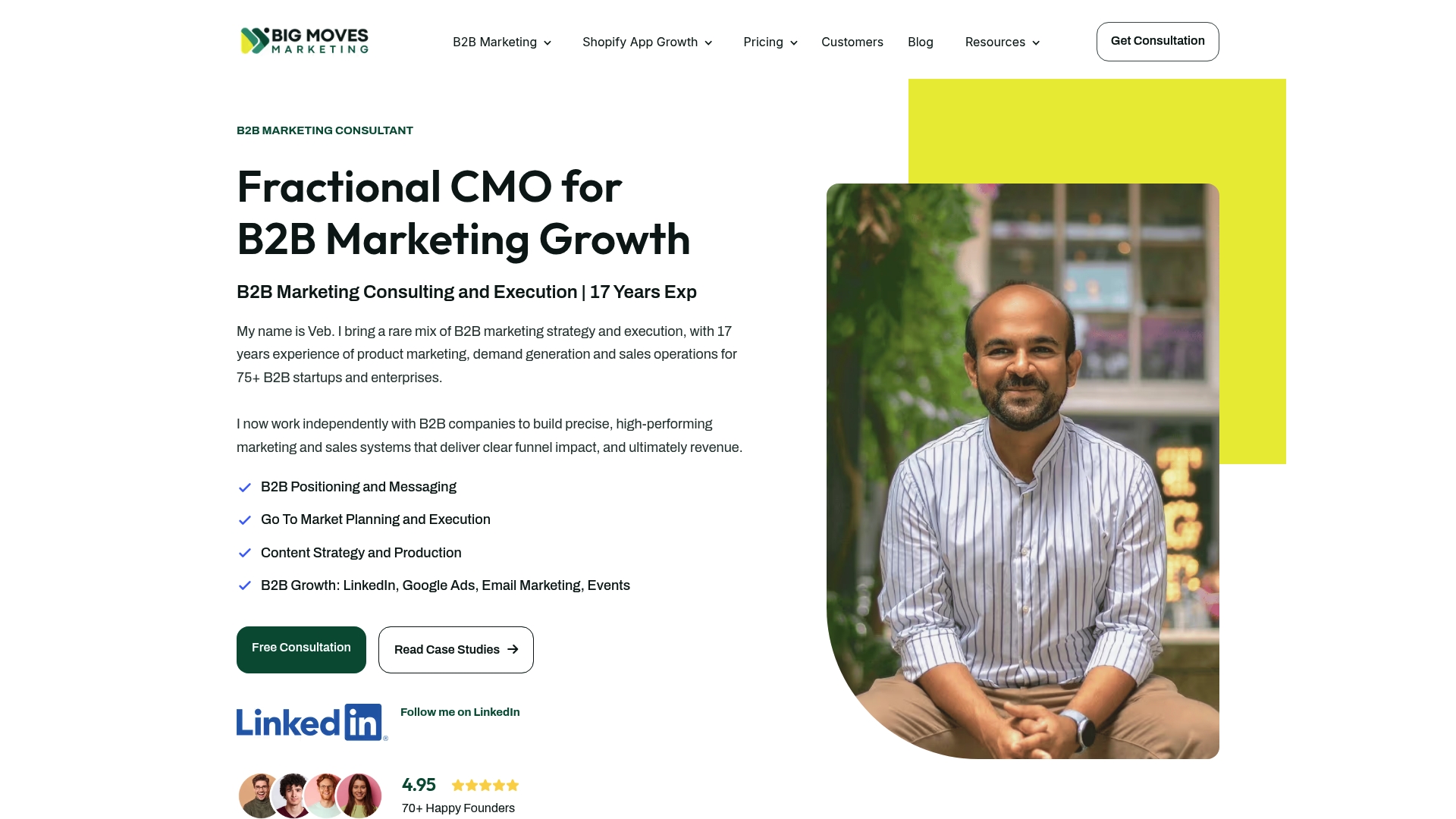
The firm’s services cover positioning and messaging, fractional CMO leadership, website deployment on Webflow, and pilot-led channel execution across LinkedIn, Google Ads, email, and webinars. Every engagement starts with the unit economics of your SaaS business and builds outward from there. If you are a founder or marketing leader who needs a partner accountable to pipeline, not just deliverables, Bigmoves is worth a conversation.
A SaaS marketing agency specializes in demand generation, user acquisition, and revenue growth for subscription software companies. It focuses on SaaS-specific metrics like CAC, LTV, and pipeline velocity rather than general marketing KPIs.
Paid channels can generate qualified pipeline within weeks, while organic channels like SEO and content marketing typically take three to six months to show meaningful traction.
Prioritize agencies with proven SaaS case studies showing pipeline impact, clear attribution models, and direct experience with your go-to-market motion, whether product-led or sales-led.
Effective SaaS marketing measurement tracks demo bookings, trial signups, CAC payback period, and qualified pipeline by source, not just impressions or traffic volume.
The best agencies integrate directly with your CRM and sales process, aligning campaign targeting and messaging with active sales motions to improve pipeline quality and conversion rates.


%20-%20white.svg)