%20png%20copy.avif)
Most B2B SaaS founders run marketing like a checklist of random tactics. Run ads. Write blog posts. Send an email blast. Hope something sticks.
This approach is a reliable way to burn cash with nothing to show for it. The most common point of failure I see in early-stage companies isn't a lack of effort; it's the absence of a coherent strategy.
Disconnected tactics generate motion, not progress. You're just throwing spaghetti at the wall. A high-performing software as a service marketing strategy, in contrast, is an integrated system. Every component reinforces the others, all driving toward a single business objective.

The "growth hacking" mindset has done significant damage. It encourages founders to chase shiny objects and copy playbooks from Twitter. This creates a marketing function that is perpetually busy but never effective, generating vanity metrics that don't map to revenue.
A real system is built on first principles. It starts by answering three fundamental questions, in this precise order:
Only after answering these questions can you build a plan that works. A structured approach ensures your marketing efforts compound over time. This requires mastering your SaaS product marketing strategy.
The purpose of marketing isn't to "get the word out." It's to create a direct, measurable line from a market insight to qualified pipeline. Everything else is a distraction.
This reorients the entire function. Marketing stops being a cost center focused on activity and becomes a strategic engine for business outcomes. You're building a durable growth machine, not just running campaigns.
This requires discipline. It means choosing strategic clarity over tactical novelty. It means moving from a scattered to-do list to a documented, operational system. You can start building this system with our SaaS marketing plan template, designed for B2B founders.
Most B2B SaaS founders get positioning wrong. They treat it as a branding exercise—a task for a junior marketer to invent a clever tagline.
This is a critical, often fatal, misunderstanding. Positioning is not a marketing task. It is a company-level strategic decision that dictates where you compete and how you win.
When positioning is delegated or rushed, your website fills with meaningless platitudes about "efficiency" and "collaboration." Your messaging becomes indistinguishable from competitors, and your sales team is forced into feature-by-feature battles where the only remaining lever is price.
Good positioning makes the competition irrelevant.
Weak positioning almost always starts with a poorly defined Ideal Customer Profile (ICP). Most teams stop at firmographics—company size, industry, geography. That is useless. Building a software as a service marketing strategy on such a shallow foundation is like building a skyscraper on sand.
You must go deeper. Focus on the triggers and the acute pain that signal genuine buying intent. Your ICP is not a company; it's a specific person inside that company dealing with a specific, expensive problem right now.
This is the required level of detail. Anything less is expensive guesswork.
Positioning is the act of deliberately defining a narrow, defensible space in the market where you are the obvious and only choice for a specific type of customer with a specific type of problem.
Strong positioning is built on four pillars that must align perfectly. Getting this right is non-negotiable before executing any go-to-market motion. At Big Moves Marketing, we guide founders through a rigorous process to achieve this clarity.
Here is the framework:
This is not a theoretical model for a slide deck. It's a practical tool for aligning your product, marketing, and sales teams to tell a single, powerful story.
This is the foundational work that precedes everything else. It requires disciplined customer interviews, a brutally honest market assessment, and the courage to make sharp strategic choices. The global SaaS market is projected to hit nearly $793.10 billion by 2029, and with customer acquisition costs increasing by over 60% in some sectors, you cannot afford to be sloppy. Sustainable growth requires a sniper rifle, not a shotgun. For a closer look at this process, see our deep dive on what is product positioning.
The outcome is not just better messaging. It's company-wide clarity. It’s an instruction manual that equips your entire organization—from engineers to sales reps—to operate from the same playbook, articulate value flawlessly, and close the deals you were built to win.
Most founders misunderstand demand generation. They equate it with lead generation—another way to cram names into the top of the funnel. This is a costly mistake that leads to bloated acquisition costs, frustrated sales teams, and anemic pipelines.
An effective software as a service marketing strategy doesn't just harvest existing demand. It creates the conditions for demand to grow. You must build a system that both creates demand and captures demand. These are two different, equally critical functions.
Here is the fundamental error B2B SaaS companies make: they allocate their entire marketing budget to demand capture. They chase high-intent keywords, target competitor names, and create content that only speaks to the small fraction of the market ready to buy now. This is not wrong, but it is dangerously incomplete.
Demand Capture: This targets the 3-5% of your market actively seeking a solution. They have a known problem and are searching for answers. Channels like Google Ads, review sites, and SEO targeting "alternative to" keywords are pure demand capture.
Demand Creation: This is the long-term strategic play. It's about educating the other 95% of your market—those not looking to buy today. You make them aware of a problem they didn't know they had or reframe an old problem in a new light. This is how you build authority and become the only logical choice when they are ready to buy.
Ignoring demand creation means fighting over scraps. You enter a bidding war with every competitor for the most expensive leads. Your acquisition costs will skyrocket.
This entire approach must be built on your strategic positioning. It starts with defining your category, your customer, and the problem you solve.
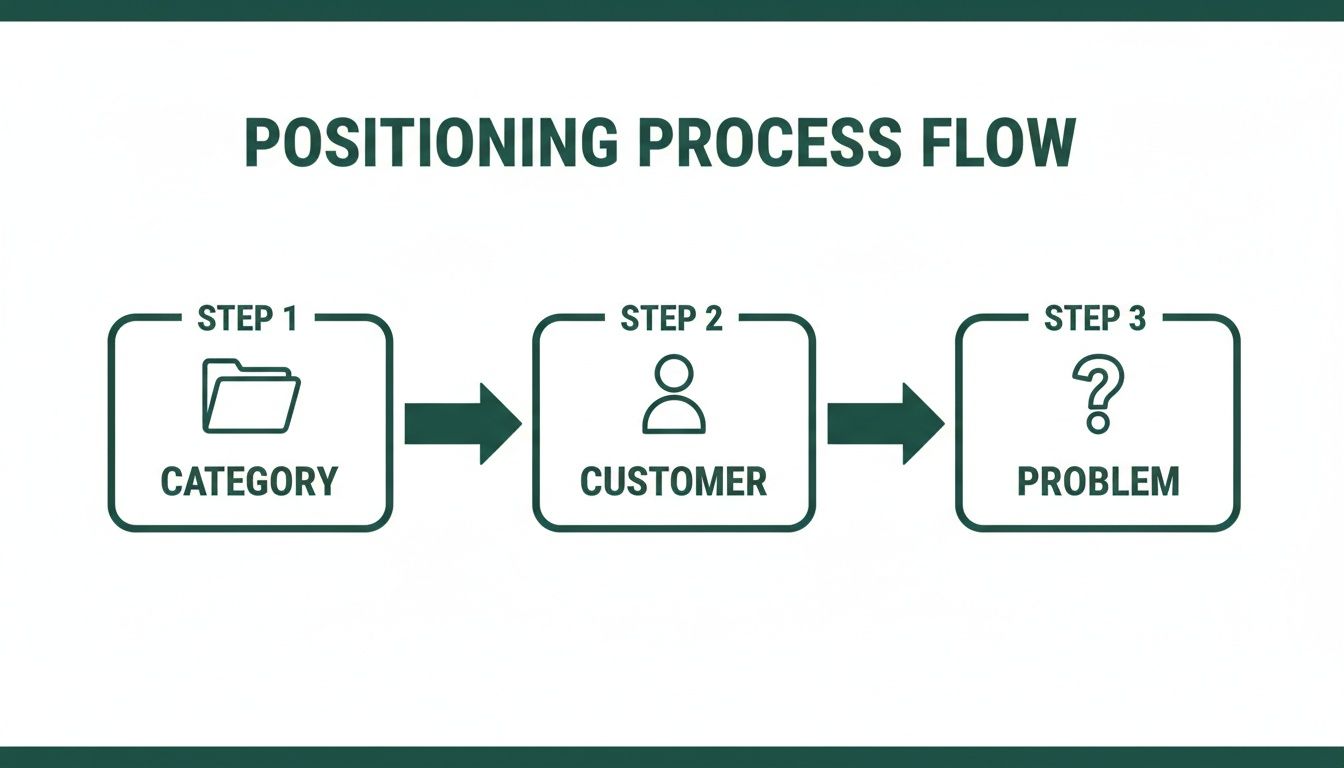
This structured thinking prevents your demand gen efforts from becoming chaotic. It all comes back to who you serve and what pain you eliminate.
The content for each motion must be fundamentally different. Using the wrong content for the wrong channel is a massive waste of resources.
Your demand capture content validates a choice the buyer is already considering. Your demand creation content changes how the buyer thinks in the first place.
Demand capture content is direct and persuasive. Examples include:
Demand creation content is educational and insightful. This includes:
The B2B buying process has changed. Research indicates that 70% of the purchase journey occurs before a prospect speaks to sales. Your content is now doing the heavy lifting. The best SaaS companies understand this and build interactive tools or self-service demos to guide this independent research.
A functional engine requires a balanced portfolio. You need enough demand capture to hit near-term pipeline goals, while consistently investing in demand creation to build a long-term, defensible moat.
For a deeper look at this model, read our guide on B2B demand gen. Getting this balance right separates companies that scale predictably from those that lurch from one quarter to the next.
Most early-stage SaaS founders are obsessed with acquiring new logos. It's an understandable impulse, but it's also a trap. A marketing strategy that ends at contract signature is not a strategy; it's an expensive way to fill a leaky bucket.
Durable SaaS companies are not built on acquisition alone. They are built on retaining and expanding their existing customer base. The math is brutal. Your most powerful growth engine isn't the next customer you win; it's the one you've already earned.
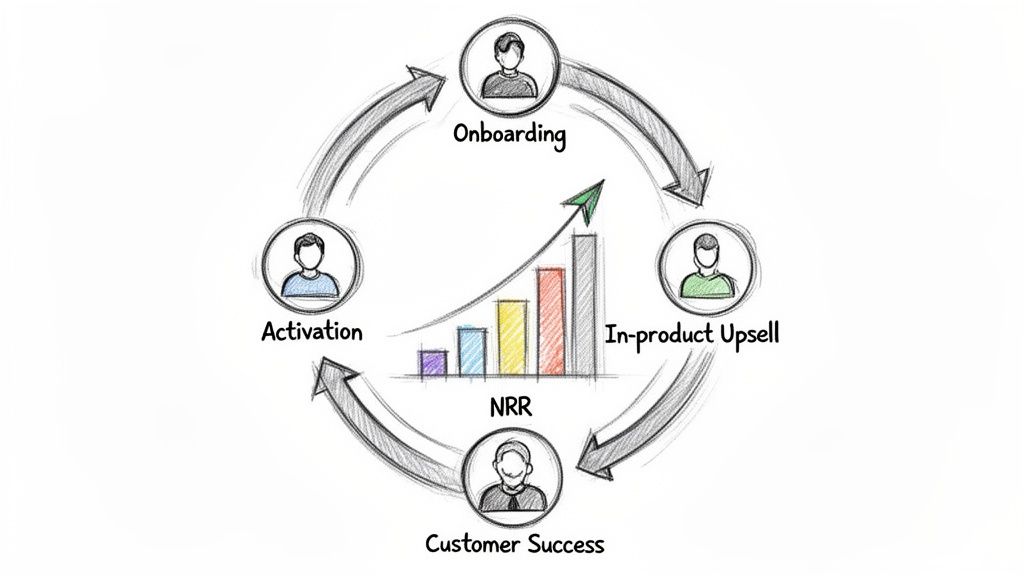
The single metric separating good SaaS businesses from great ones is Net Revenue Retention (NRR). NRR measures the revenue generated from a customer cohort over time, accounting for both churn and expansion.
When NRR exceeds 100%, something powerful happens: your existing customer base generates net-new growth on its own. An NRR of 120% means you could stop acquiring new customers and still grow 20% annually. This is the financial leverage that builds lasting companies.
The health of a SaaS company isn't measured by how fast you pour leads into the funnel. It's measured by how well you turn existing customers into your primary source of growth.
This is not just a job for Customer Success. Marketing has a critical role in driving NRR, meaning your strategic thinking must extend far beyond the initial sale.
Driving expansion revenue isn't about sending generic "new feature" emails. It's about systematically ensuring customers succeed with your product, which naturally creates opportunities for them to use it more.
The data is conclusive. Top SaaS companies generate more than 50% of their new Annual Recurring Revenue (ARR) from existing customer expansion. The best aim for NRR rates above 120%, proving that the most efficient path to scale is through the customers you already have.
To illustrate this, let's compare two growth models.
The table below shows the long-term difference between an acquisition-only company and one that focuses on expansion.
The expansion-focused company doesn't just grow—it compounds. The small difference in NRR creates a massive revenue gap over time.
Driving this growth requires a tight partnership between Marketing, Product, and Customer Success. It’s a unified motion. A significant part of this is effective customer support, where AI-powered tools can improve customer satisfaction. See SupportGPT's homepage for an example.
Your marketing strategy must treat retention as a primary objective. For a deeper analysis, read our guide on SaaS customer retention strategies. This shift in mindset—from filling a leaky bucket to building a compounding revenue engine—separates the startups that burn out from the companies built to last.
Your positioning is a strategic hypothesis. Sales enablement is where that hypothesis meets market reality. Too many founders treat sales enablement as an afterthought—a folder of PDFs that marketing creates and sales ignores. This is a critical failure.
Effective sales enablement is not just content creation. It's arming your sales team with the precise messaging, tools, and context needed to win competitive deals. It's the essential translation layer between high-level strategy and battlefield execution. Without it, your entire go-to-market motion stalls.
The most common mistake is product-heavy enablement. Marketing teams create decks that are guided tours of the user interface, packed with feature lists. Sales reps are then forced to translate this on the fly, and the core value proposition is lost.
Your buyer does not care about your features. They care about their problems and the outcomes you deliver. Every piece of enablement collateral must be built around the customer's world, not your product's architecture.
Sales enablement is the operational bridge between marketing’s promises and sales’ reality. Its purpose is to make the value proposition clear, consistent, and compelling in every buyer interaction.
This means focusing on quality and utility over volume. A few high-impact assets your team actually uses are infinitely more valuable than a sprawling library of outdated documents.
For an early-stage B2B SaaS company, the goal is consistency and clarity. You do not need a massive content library. You need a core set of tools that ensures every sales rep tells the same powerful story, every time.
This is the non-negotiable toolkit to build first:
These assets form a system. The messaging guide informs the pitch deck, which is supported by battlecards and objection handlers. This is how you build a confident, effective sales organization.
Building this toolkit requires a disciplined approach, detailed in our guide to sales enablement best practices. The investment shortens sales cycles, increases win rates, and ensures your positioning survives contact with the customer.
Your company is drowning in data. Most of it is noise. Founders and marketing leaders fixate on vanity metrics—website traffic, social media likes, MQL counts—because they feel productive. But these numbers have a weak, often nonexistent, connection to revenue.
An effective software as a service marketing strategy isn’t measured by activity; it’s measured by its direct impact on the bottom line.
Chasing top-of-funnel metrics is a classic startup error. It creates a marketing function that generates activity but isn't accountable for growth. The team celebrates an MQL spike while sales complains about lead quality and the CFO questions the marketing budget.
To run marketing as a business unit, you need a dashboard that reflects reality. This means abandoning the obsession with activity and focusing exclusively on metrics that track the flow of money through your go-to-market engine.
These are the numbers that determine if your strategy is working. Only a handful truly matter for decision-making:
Customer Acquisition Cost (CAC): The total, fully-loaded sales and marketing cost to acquire one new customer. It is the ultimate measure of efficiency.
Lifetime Value (LTV): The total revenue you can reasonably expect from a single customer over their entire relationship.
LTV to CAC Ratio: The acid test for your business model. A healthy B2B SaaS company needs a ratio of 3:1 or higher. If it’s less, you're paying too much for unprofitable growth.
CAC Payback Period: How many months it takes to earn back the money spent to acquire a customer. In a cash-constrained environment, a shorter payback period (ideally under 12 months) is critical for scaling.
These metrics tie marketing activity directly to financial performance. They force a level of discipline that MQLs and traffic reports cannot.
The MQL model is broken for modern B2B SaaS. It incentivizes marketing to generate volume over value, creating friction with sales and burning budget on leads that will never close.
The modern B2B buyer's journey is not linear. They read your blog, listen to your podcast, see a LinkedIn ad, and talk to a colleague—all before filling out a form.
Attributing a six-figure deal to the "last touch," like a demo request, is simplistic and strategically dangerous. It provides a distorted view of what drives growth.
A more mature approach acknowledges that marketing’s job is to influence target accounts, not just generate leads. This means tracking metrics like pipeline created from your ICP and sales cycle velocity.
It’s about measuring marketing’s ability to warm up the right prospects. The goal is that when they finally engage with sales, they are already educated, qualified, and ready for a serious conversation.
Stop asking your marketing team for more leads. Start holding them accountable for generating qualified pipeline, lowering acquisition cost, and shortening the sales cycle. That is how you measure a marketing strategy that matters.
At Big Moves Marketing, we help B2B SaaS founders build growth engines based on strategic clarity, not vanity metrics. If you're ready to align your marketing with real business outcomes, let's connect. Find out more at https://www.bigmoves.marketing.
Explore Big Moves Marketing services and resources:



%20-%20white.svg)