Making a question open-ended doesn't make it good research. Ask why buyers prefer your platform and you've already told them what the finding should be. Their explanations may sound credible enough to become homepage copy, sales messaging, and a positioning strategy. The preference itself was never established.
For B2B SaaS leaders, question wording is a hidden source of strategic bias. Before debating interview volume or buying another research tool, inspect what your questions allow customers to say. A polished interview can still produce evidence for a conclusion your team wrote in advance.
Treating a qualitative question as a softer survey item misses its purpose. You're not collecting longer answers to familiar categories. You're investigating how someone interpreted a situation, evaluated alternatives, and made a decision under specific constraints.
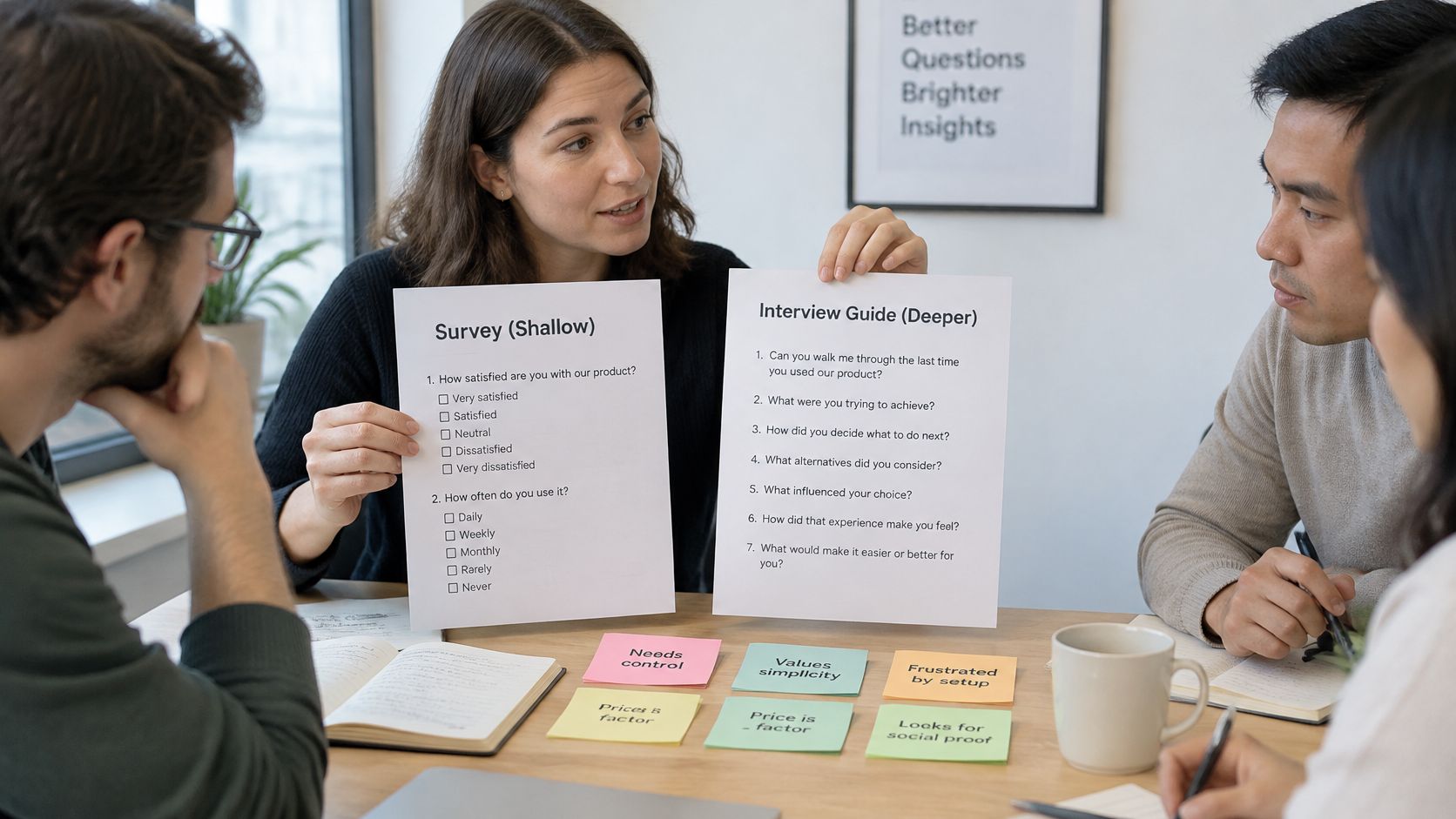
A survey tells you how many customers chose a path. A qualitative question helps explain why they took the back roads and what they were avoiding. For SaaS positioning, that distinction separates a feature preference from the organizational risk behind it.
The difference is between counting choices and examining how people made them.
Building on their studies of dying in US hospitals, Barney Glaser and Anselm Strauss's 1967 The Discovery of Grounded Theory established a systematic approach involving simultaneous collection and analysis, theoretical sampling, coding, constant comparison, memo writing, and theoretical saturation, as described in this methodological history of grounded theory.
You don't need to conduct a full grounded-theory study to adopt its underlying discipline: let participants' accounts change your explanation. Starting with how, what, or in what ways creates room for that discovery. Starting with whether a feature causes retention narrows the inquiry before you understand what retention means in the customer's workflow.
In practical B2B market research, distinguish the business decision from the question you ask. Your decision might concern enterprise positioning; the participant should describe an actual evaluation, not advise you on your category narrative. Resources such as 1chat's AI research for teams can support preparation, but your team must still define what evidence would change its mind.
Question test: Could an honest answer surprise you? If not, you may have a survey question in disguise, or a request for confirmation.
B2B teams often survey too early. They ask customers to rank familiar benefits before establishing whether those benefits explain the purchase. The result is tidy prioritization inside the company's existing assumptions.
Qualitative inquiry serves a different analytical purpose. It seeks depth, variation, and explanatory insight rather than population percentages or statistically representative relationships, as explained in this grounded-theory methodology paper. An interview can establish a credible account of a buying mechanism. It can't establish how common that mechanism is across your addressable market.
| Research situation | Right question form | Why this form wins |
|---|---|---|
| Unknown buying trigger | How did your team first notice the problem? | Reveals the sequence of events before any measurement |
| Comparison set unclear | Which alternatives did you seriously consider, and why did you drop them? | Surfaces the real competitive set, not the one the team assumes |
| Messaging needs buyer vocabulary | What words did your team use to describe the problem internally? | Captures language buyers use, which a closed list cannot |
| Churn or switching reasons unknown | Walk me through the decision to move off your previous tool. | Exposes the trigger and the tipping point, not just the stated reason |
| Known variable, need prevalence | How many accounts in your segment hold this view? | Use a survey: this is a quantity question once the variable is known |
Say your founder believes buyers purchase reporting software to save time. Interviews may reveal that finance leaders need defensible numbers before a board meeting. A survey limited to speed, convenience, and usability would never test that explanation.
Discover the mechanism first. Size the pattern afterward. Once you can define the variable and write answer options customers recognize, a survey becomes useful rather than premature.
If you can't yet name the variable, measurement will give you precision without understanding. Open-ended conversations let participants explain experiences in their own words and give the interviewer room to investigate unexpected issues.
An open question can still be leading, vague, or impossible to answer. Grammatical openness isn't the standard. Interpretive freedom within a useful boundary is.
Strong qualitative research questions define a phenomenon, population, context, and knowledge gap without prescribing the outcome. This guide to developing research questions recommends neutral wording, feasibility checks, and one or two master questions supported by tightly connected subquestions.
Consider this master question:
How do mid-market finance leaders decide whether to replace a spend-management tool they already run?
It identifies the participant, the decision, and the installed-product context. It doesn't assume dissatisfaction, switching intent, or preference for your platform. The resulting evidence could support a replacement narrative, reveal a reason to target new deployments instead, or expose a segment you shouldn't pursue.
Use what and how to investigate actions and interpretation. Why can help examine reasoning, but attach it to an actual event rather than asking participants to invent a general theory of their behavior.
| Weak question | What breaks | Stronger version |
|---|---|---|
| Why do buyers prefer our solution? | Presupposes preference and biases coding | How do technology buyers weigh the risks of replacing their current workflow? |
| Did you find onboarding easy? | Closed yes-or-no answer with no detail | Walk me through your first week after signing. |
| How many people on your team use the tool? | Quantity question, belongs in a survey | Who touches the tool in a typical week, and what do they do with it? |
| Was pricing too high, and did you need more features? | Double-barrelled, answer cannot be interpreted | Tell me about the last time price came up in a buying decision. |
| What is your AI strategy? | Invites a rehearsed position, not evidence | What did your team try before this, and what happened? |
The leading question creates trouble beyond the interview. Recruit only enthusiastic customers, ask them to explain their preference, then code their responses as differentiation. You've built a closed loop that excludes the strongest competing explanation: buyers may have selected you despite the attribute you're celebrating.
The compound pricing question creates a different problem. If someone agrees, you don't know whether price, missing capabilities, or their interaction mattered. The abstract strategy question invites an executive position statement rather than an account of work.
Feasibility is part of question quality. Can you reach the people who participated in the decision? Can their accounts answer the question? Does the scope fit the resources available?
Use demographics and psychographics to sharpen recruitment, not to substitute assumed attitudes for evidence. A job title tells you where to look. It doesn't tell you what that person feared losing.
An interview guide should protect the inquiry without controlling the participant's story. Write it around business decisions, then leave room for the customer's sequence of events.
Keep the relationship between the research problem and the final guide visible.
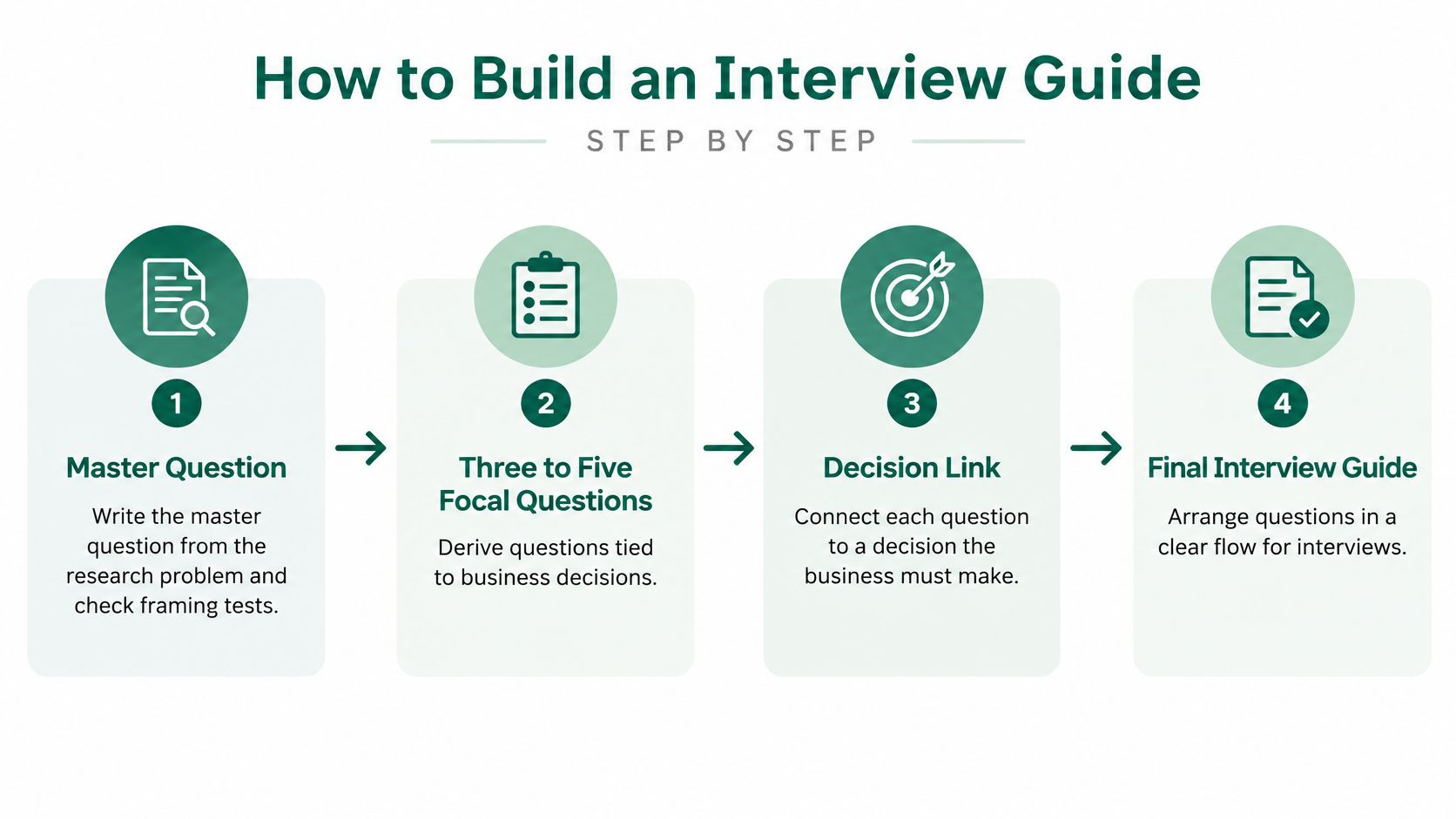
Write the master question. Start with the uncertainty blocking a decision, such as whether to position around operational control or financial assurance. Translate that uncertainty into an inquiry about how buyers act, not which message they like.
Derive a small set of focal questions. Cover the events you need to understand, including the trigger, evaluation, and approval. Beside each question, write the decision it informs, so interesting but irrelevant topics don't consume the interview.
Arrange a chronological conversation. Begin with a recent concrete event, then explore consequences, alternatives, decision criteria, and internal language. Chronology helps distinguish what triggered action from the justification participants developed afterward.
Attach short, neutral probes. Duke University's qualitative-interview guidance recommends prompts such as “Then what happened?”, “Can you give me an example?”, and “You mentioned that…” to deepen an answer without taking over. Use silence too; don't fill every pause with a suggested explanation.
Strip out outcome words. Delete adjectives such as easy, frustrating, and valuable unless the participant introduced them. Ask what happened before asking how they evaluated it.
Time the guide aloud. Rehearse the opening, consent explanation, transitions, and follow-ups rather than counting questions on a page. If your schedule only works when participants give brief answers, you've designed for coverage instead of depth.
Pilot with relevant participants. Cut or rewrite questions that repeatedly produce unsupported generalizations or one-word answers. Check whether participants understand the question as intended without needing your explanation.
Keep probes subordinate to the account. A long prompt can introduce a theory the participant never expressed. If they mention procurement, follow their account before supplying your preferred categories of risk, budget, or integration.
For operational planning, a user-research process should also specify recruitment criteria, recording consent, note ownership, and how findings will reach decision-makers. Otherwise, a carefully written guide can still produce an unusable collection of transcripts.
Use this video as a supplementary reference when preparing the interview conversation.
After the pilot, name the decision each remaining question informs. Remove questions whose answers wouldn't change anything your team does.
Use these templates as openings, not scripts. They avoid yes-or-no answers and evaluative words such as easy, valuable, or prefer. The Institute of Education Sciences field guide supports predominantly open-ended questioning and flexible probes that let participants explain experiences in their own words.
| Research goal | Opening question | Neutral probe |
|---|---|---|
| Buying trigger | Tell me about the last time your team started looking for a solution like this. | What happened right before that? |
| Vendor shortlist | Which options did you seriously consider, and which did you drop early? | Why did that one fall off the list? |
| Decision criteria | When the buying group disagreed, what did they argue about? | Whose view won, and what changed it? |
| Churn or switching | Walk me through the decision to move off your previous tool. | What would have had to be true for you to stay? |
| Value language | How did you describe this problem to your manager before you bought? | Which of those words would you not use now, and why? |
| Post-purchase value | Describe the first time the product changed how your week went. | What did you stop doing as a result? |
Some openings contain conditions you must establish first. Don't ask about disagreement before confirming that disagreement occurred. Don't ask what changed someone's week before establishing that the product changed anything.
If the condition is absent, use a neutral fallback: describe what happened after implementation. An answer that nothing changed is strategically important, especially when your messaging promises a substantial operational improvement.
The counterfactual staying probe is useful for exploring a switching explanation, but it isn't evidence that the account would have renewed. Likewise, language buyers use after implementation may reflect your onboarding and sales materials. Keep that separate from the words they used before encountering your company.
For competitive decisions, connect these prompts to a structured win-loss analysis template. Capture the alternatives buyers considered, including retaining the incumbent, using spreadsheets, or postponing the project. Don't force every account into a named-vendor contest.
Adapt to the participant's position in the decision. An economic buyer can explain approval criteria and financial exposure. A daily user can reconstruct workarounds and implementation consequences. A security reviewer can describe evidence requirements and exceptions.
Ask each person about events they directly participated in. A champion's explanation of why legal delayed approval is a lead to investigate, not a substitute for legal's account. When templates contain multiple clauses, deliver them separately and let the participant finish before asking the follow-up.
In a group, the first confident answer can become the reference point for everyone else. A dominant buyer may set the vocabulary while quieter participants decide whether disagreement is worth the social cost. Design the session to preserve independent reactions before discussion begins.
Start with individual written responses. Then introduce a concrete stimulus, such as competing headlines, a competitor's landing page, or a product screenshot. Ask what participants notice and how they interpret it before asking which version they would choose.
For a hypothetical headline test, show competing messages and ask which a CFO would reject first. Then investigate the risk behind that rejection. A message about automation might signal efficiency to a user but loss of control to an approver.
Use groups for shared vocabulary, not private truth. Agreement in the room doesn't establish agreement across the buying committee.
Don't assemble competitors who can't discuss their operations candidly. Don't place a subordinate in a session where a senior decision-maker will hear their criticism. Use individual interviews for politically sensitive accounts, then test non-sensitive interpretations in a group if collective discussion adds value.
Picking a quota and stopping there confuses a scheduling decision with an analytical judgment. Saturation depends on what the question requires you to understand, not whether participants repeat familiar phrases.
The planning benchmarks below distinguish identifying themes from understanding their meanings and relationships. The saturation-type counts come from an integrative review of qualitative saturation, which reports approximately 9 interviews for themes, 24 for meanings, 20 to 30 or more for theory, and 20 to 40 per site for metathemes.
| Saturation type | Typical interview count | What must be established |
|---|---|---|
| Theme saturation | About 9 | A high number of recurring themes identified |
| Meaning saturation | About 24 | How participants interpret each theme, including variation |
| Theoretical saturation (grounded theory) | 20 to 30 or more | Major themes, their variants, meanings and relationships |
| Metatheme saturation | 20 to 40 per site | Patterns that hold across sites or segments |
For practical planning, a review of qualitative sample-size guidance supports an initial range of 9 to 17 interviews for a narrow, relatively homogeneous B2B segment and 20 to 40 for broader cross-segment work.
| B2B planning scope | Initial interview range | What to investigate |
|---|---|---|
| Narrow B2B segment, planning start | 9 to 17 | Repeated pain points in one homogeneous group |
| Broad cross-segment B2B work | 20 to 40 | Role-based differences between buyers, users and reviewers |
Code interviews as they arrive. Use a spreadsheet with participants as rows and emerging codes as columns, recording supporting evidence and contradictory cases. Mark whether each interview adds a new concept, deepens an existing explanation, or repeats something already understood.
Write a memo after each conversation describing what surprised you and what you need to investigate next. Group codes into themes after you have enough accounts to compare, then test those themes across roles.
Repeated mentions of risk aren't sufficient if users mean workflow disruption while approvers mean audit exposure. Continue where explanations remain incomplete, and document any recruitment gaps you couldn't resolve.
Benchmarks are planning tools, not stopping laws. Stop when additional interviews no longer add material analytical information relevant to the decision, not when the transcript starts sounding familiar.
AI can draft fluent questions without understanding the decision your team needs to make. Review every proposed probe for imported assumptions, especially categories the participant hasn't raised. A question about compliance anxiety can create that frame instead of discovering it.
A 2025 Carnegie Mellon study involving 19 qualitative-research practitioners found that LLMs can merge different people's perspectives into a single response, potentially conflating attitudes that differ by role or context. That's a validity problem, not a speed problem. Preserve the distinction between buyer, user, and reviewer accounts when drafting or analyzing.
Treat AI output as a proposal that requires human review.
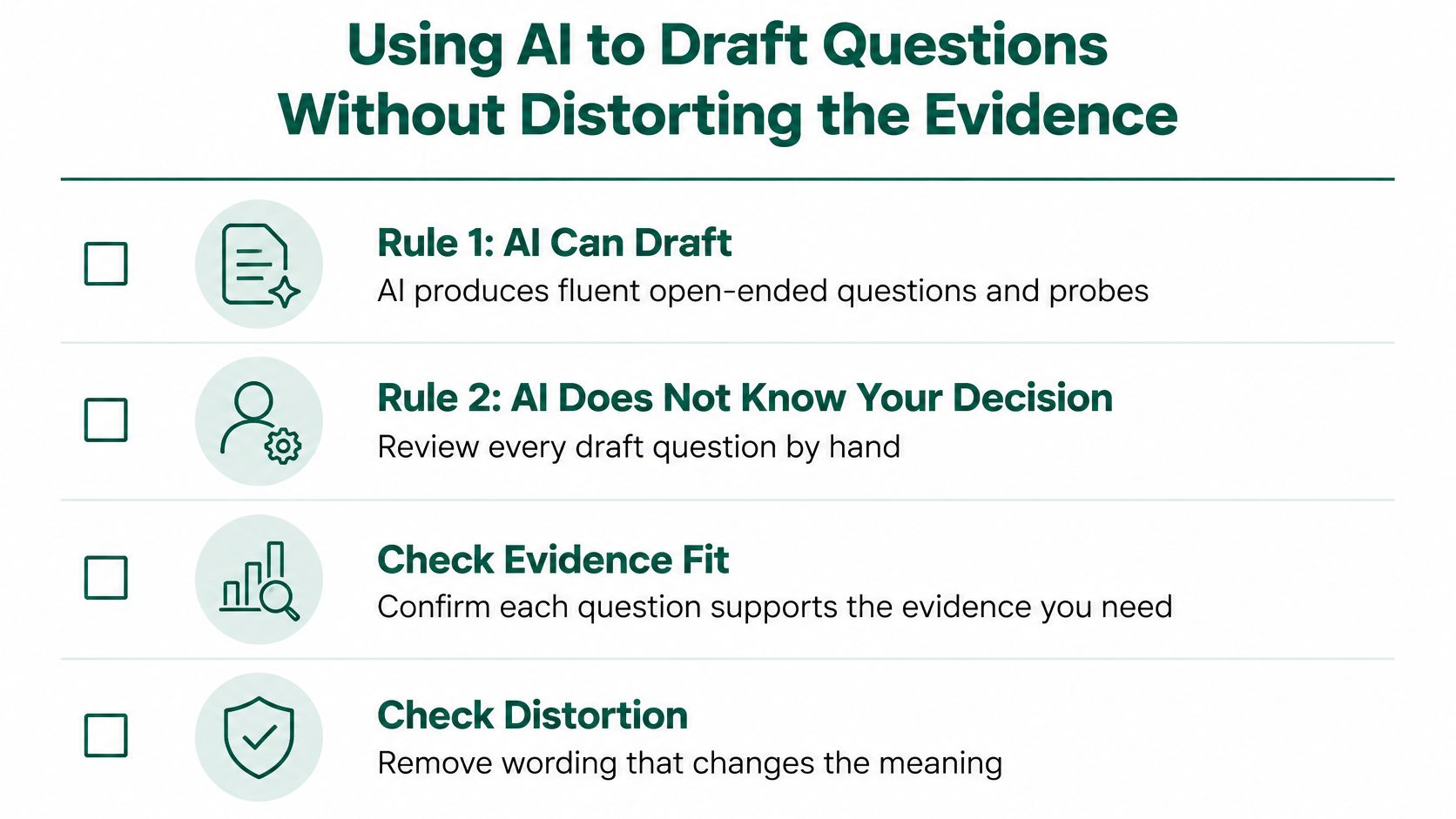
Use GenAI prompts for B2B marketers as drafting aids, not evidence. During pilots, compare AI-drafted and human-drafted probes and log which you reject and why. Keep only wording you can defend to a participant without disguising whose assumptions it contains.
Big Moves Marketing provides strategic growth guidance, audience-grounded positioning, and senior marketing leadership for B2B technology teams. Visit Big Moves Marketing to discuss the customer questions behind your next positioning or go-to-market decision, before committing budget to a message your interviews never tested.