%20png%20copy.avif)

Most founders treat demographics and psychographics like a marketing 101 debate. It isn’t. It’s a revenue problem.
If your GTM is built mostly on job titles, company size, industry, and geography, you’re not understanding buyers. You’re sorting lists. That’s useful, but it’s nowhere near enough to produce message-market fit, strong pipeline, or consistent conversion across channels.
The mistake is simpler. Teams use demographics as a crutch because they’re easy to collect and easy to put into slides. Psychographics are messier. They force you to ask harder questions about motivation, fear, internal politics, urgency, and professional identity. That’s exactly why they matter more.
A lot of SaaS teams think they have an ICP because they can describe a buyer in demographic terms. They say things like mid-market, North America, VP-level, B2B software, maybe post-Series A. That’s not understanding. That’s filtering.
You can target the right account and still miss the deal completely. You can land in the right inbox, hit the right company size, and still write messaging that feels irrelevant because it doesn’t speak to the buyer’s actual decision logic. That’s where pipeline quality goes sideways.
The popular advice around ICP building often reinforces this problem. It tells teams to define the market by role, revenue band, employee count, and geography, then assumes the rest will sort itself out. It won’t. If you want a cleaner way to think about ICP construction, start with this breakdown of what an ICP in marketing should actually do.
Demographics feel rigorous because they’re structured. You can export them from LinkedIn Sales Navigator, enrich them with Clearbit or ZoomInfo, and turn them into dashboards. Founders love that because it looks precise.
But deals don’t close because a prospect matched a filter.
They close because your message matched a priority, a fear, a career goal, or a risk threshold that already existed inside the buyer.
Most B2B teams don’t have a lead quality problem. They have an interpretation problem.
They assume demographics are the primary input and psychographics are a nice layer on top. I’d flip that. In B2B SaaS, psychographics should shape positioning, messaging, creative, and sales narrative. Demographics should constrain where you aim that narrative.
That distinction matters most when you’re post-founder-led-sales and trying to make GTM repeatable. At that point, vague messaging stops being survivable. Your website, outbound, paid, and sales process all need the same buyer logic underneath them.
If that logic is missing, you get the classic symptoms:
The point isn’t that demographics are useless. They aren’t. The point is that demographics are often asked to do a job they can’t do. They can help you find the crowd. They can’t tell you what the crowd cares about.
Demographics are a sorting tool. In B2B, that usually means firmographics plus role data. Industry, company size, geography, growth stage, tech stack, seniority, job function. Useful? Yes. Sufficient? Not even close.
If you’re working on segmentation, this framework for B2B market segmentation is a good baseline. Just don’t stop there.
Demographics answer a narrow set of questions:
| Question | What demographics can do | What they can’t do |
|---|---|---|
| Who fits the market? | Identify plausible accounts and roles | Explain why they buy |
| Where should budget go? | Help define reach and channel boundaries | Tell you what message will convert |
| How should teams prioritize lists? | Support account selection and territory planning | Predict internal urgency or objections |
That’s why a lot of supposedly data-driven GTM work feels shallow. Teams build a perfect list of targets, then write generic copy that could apply to anyone in the category.
The result is predictable. Your campaign reaches people who can buy, not people who feel compelled to buy.
There’s another reason this matters now. The old playbook assumed that if you widened the funnel enough, growth would follow. That assumption is getting weaker.
The Congressional Budget Office projects the U.S. population will increase from 350 million in 2025 to 367 million in 2055, and notes that the population will be “smaller and grow more slowly over the next 30 years, on average, than the agency previously projected it would” in its population growth projections. For B2B teams, the implication is straightforward. A generic “more top of funnel” strategy becomes less reliable when market growth slows.
You don’t win by targeting broader. You win by understanding better.
Practical rule: Use demographics to size the pond. Don’t expect them to tell you which fish will bite, or why.
That’s the mistake behind a lot of weak demand gen. Teams know where to point LinkedIn Ads or outbound sequences, but they don’t know which narrative belongs to which buyer mindset.
A VP of Revenue at one company may care about faster pipeline visibility because board pressure is rising. Another VP of Revenue with the same title and company size may care more about rep adoption because the last tool rollout failed. Demographically identical. Strategically different.
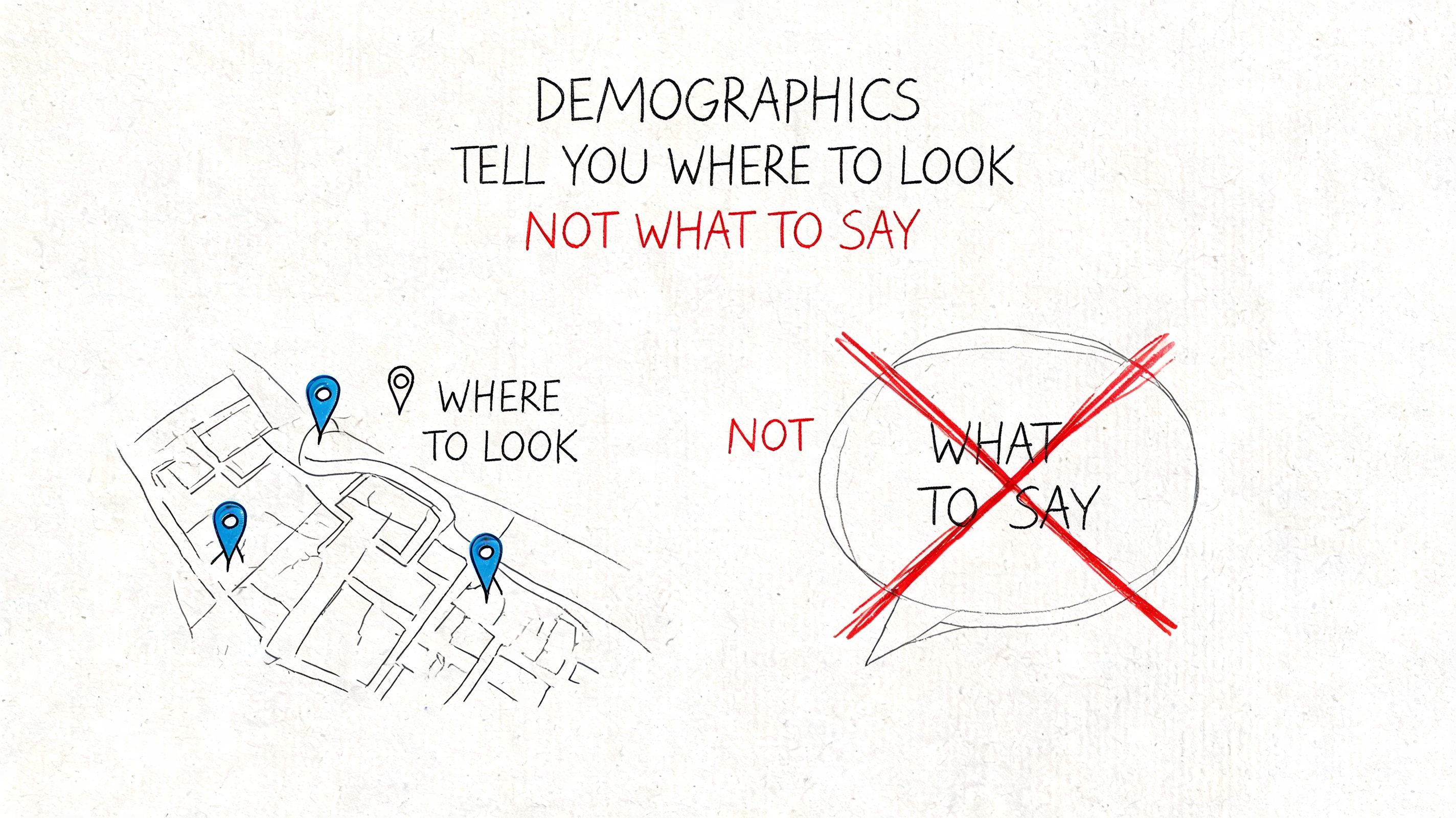
That’s why the map analogy matters. Demographics show location. They don’t show terrain.
A useful visual explanation sits below. The point isn’t the platform. The point is the distinction.
Psychographics in B2B have been misunderstood for years. Too much of the content on this topic borrows consumer language and turns it into fluff. No, your buyer’s favorite hobby isn’t the issue. Their professional worldview is.

Psychographics in a SaaS buying context means the beliefs, motivations, fears, and identity-level factors that shape how someone evaluates change. It’s not about trivia. It’s about how they make trade-offs under pressure.
A good B2B psychographic profile answers questions like these:
This is the layer frequently skipped by teams. They build personas that read like CRM exports. Title, tenure, function, company type. Then they wonder why the messaging sounds interchangeable.
A better input for messaging is the buyer’s professional self-concept. Are they an operator trying to remove friction? A leader trying to gain political capital? A skeptic who’s seen too many failed tools? An ambitious executive trying to attach their name to a successful transformation?
If you want a product lens on this, Rite NRG has a useful guide for SaaS founders on product love because it gets at a related truth. People don’t commit to products just because the feature list is rational. They commit because the product fits a deeper set of expectations, identity, and felt progress.
Here’s a practical model I’ve seen work in B2B SaaS.
Some buyers want tools that make them look smart, modern, and ahead of the curve. They’re not buying software. They’re buying momentum and reputation.
Messaging for this segment should talk about strategic advantage, speed to insight, category leadership, and visible wins.
This buyer isn’t anti-change. They’re anti-regret. They care about proof, implementation confidence, governance, and avoiding failure in front of peers.
Your message should reduce uncertainty. Focus on reliability, control, adoption path, and operational clarity.
A lot of enterprise messaging fails because it assumes every buyer wants transformation. Many just want a safe decision they can defend internally.
This group wants to remove friction. Less manual work. Fewer broken handoffs. Cleaner workflows. Better reporting.
They respond to operational simplicity and execution quality, not abstract vision statements.
These buyers want a direct line from your product to business outcomes. They think in terms of company priorities, not just team pain.
That might mean clearer revenue visibility, faster product delivery, stronger expansion readiness, or better cross-functional coordination.
There’s also a modern signal worth paying attention to. SalesFuel’s AudienceSCAN 2025 study, based on responses from more than 20,000 U.S. adults, found that AI Proponents account for 27.8% of U.S. adults and are 75% more likely than the average U.S. adult to use ChatGPT or other AI tools to search the internet, as described in its write-up on psychographics over demographics. That’s useful because it shows a segment defined by behavior and belief, not by age or title.
The same principle applies in B2B. The most useful segmentation often comes from mindset, not role label.
For a sharper persona process, this article on using buyer personas to accelerate B2B marketing and sales is worth revisiting through a psychographic lens.
Most weak pipeline isn’t caused by bad targeting. It’s caused by message mismatch.
You reached the right buyer segment demographically, but the message spoke to the wrong motivation. That’s a much more common failure than founders want to admit.
Take a familiar SaaS scenario. You’re selling a platform to engineering leaders. Your LinkedIn targeting is fine. VP Engineering, Head of Platform, Director of DevOps, companies above a certain size, right regions, right verticals.
Then the ad says “cut costs and consolidate tooling.”
That message might work for a finance-led buying motion. It may fall flat with an engineering leader whose real concern is release velocity, developer experience, or reducing architectural drag. Same account. Same persona family. Different decision logic.
Teams often confuse relevance with reach. The campaign looks well targeted because the filters are correct. But the buyer reads the message and thinks, “That’s not my problem.”
A lot of ABM programs suffer from exactly this. The account list is tight. The personalization looks professional. The narrative is still generic because the team never mapped the psychographic differences inside the account.
In multi-threaded deals, two people with nearly identical demographics can need completely different stories.
One VP of Sales may care about quota attainment and forecast confidence. Another, in the same role, may care more about rep retention and process stability after a painful reorg. If you use one value prop for both, one of them will feel misunderstood.
That’s why hybrid segmentation matters. According to DataDiggers’ discussion of psychographics vs demographics, combining demographics with psychographics can yield 3 to 5 times higher campaign ROI, and a Shopify app example showed 2.5 times more installs when the messaging targeted a psychographic cluster centered on “financial freedom” rather than demographics alone.
The point isn’t the consumer example. The point is the mechanism. Better performance came from hitting the actual decision trigger.
If your demand gen team talks about personas and your sales team talks about “what prospects actually care about,” and those are two different things, your GTM model is split in half.
Here’s the operational consequence of that split:
The best teams don’t choose between demographics and psychographics. They assign each a job. Demographics narrow the field. Psychographics decide the narrative.
That’s the model most founders should adopt. Not because it sounds impressive, but because it aligns with how enterprise and mid-market buying genuinely works.
Psychographic insight isn’t hard because it’s mysterious. It’s hard because organizations often don’t build a collection system. They treat it like a side project, or worse, a workshop exercise.
Research on this gap makes the issue plain. Most companies collect demographic data but treat psychographic research as a separate, costly effort. The more useful path is to systematize collection and embed it into GTM, creating a flywheel from sales calls, interviews, and product usage, as described in this article on the integration challenge of demographics and psychographics.
If you’re serious about GTM clarity, stop thinking of psychographics as “research.” Think of it as infrastructure.
You already have the raw material. Sales calls. Demo notes. Lost deal summaries. Product onboarding behavior. Customer success conversations. Support tickets. Founder calls with prospects. The problem isn’t access. It’s that nobody’s extracting patterns in a repeatable way.
This matters in every channel, including offline environments. If your team shows up at events or conferences, you should treat booth conversations the same way you treat discovery calls. The surface interaction might be visual or experiential first, which is why even practical event assets like Exhibition Stand Design matter more than teams think. They influence who stops, what they assume, and which motivations they reveal in person.
You don’t need a giant research budget. You need disciplined inputs.
Use the obvious sources for this layer. LinkedIn Sales Navigator for role and seniority. Your CRM for stage and source patterns. Enrichment tools like Clearbit or ZoomInfo for account context. Website analytics and self-reported form fields for basic segmentation.
Keep this layer clean and boring. Its job is market structure.
Often, teams struggle with this. Use multiple sources, but don’t overcomplicate the taxonomy.
Review sales calls
Pull recordings from Gong, Chorus, or whatever your team uses. Look for repeated language around urgency, risk, internal blockers, desired outcomes, and alternatives considered.
Run win and loss interviews
Ask direct questions. What problem made this urgent? What nearly stopped the purchase? What would have happened if you did nothing? What mattered personally in making this decision?
Mine onboarding and product behavior
Usage patterns often reveal motive. Some customers obsess over automation first. Others go straight to reporting, governance, or collaboration. That tells you what job they hired the product to do.
Pull signal from customer-facing teams
Sales, success, support, and founders all hear different versions of the same truth. Put those insights in one place. Not scattered across Slack.
Field note: If psychographic insight only lives in the head of your best salesperson, you don’t have insight. You have dependence.
A few practical rules help:
If you need a rigorous interview process, this guide on how to conduct user research is a practical place to tighten your approach.
Collected data is useless if it dies in a Notion doc. The work only matters when it changes your positioning, homepage, sales narrative, and campaign creative.
Teams often fail at this translation step. They gather interviews, collect notes, and produce a persona deck that nobody uses. That happens because the output is descriptive, not directional.
A weak persona looks like this:
| Persona type | Example |
|---|---|
| Demographic-only | VP Marketing at a mid-market SaaS company in North America. Focused on growth. |
| Usable persona | VP Marketing under pressure to prove pipeline quality, skeptical of channel sprawl, wants tighter attribution they can defend internally. |
The first tells you who they are. The second tells you how to speak to them.
A usable persona should include:
That’s the difference between a pretty persona and a practical one.
For teams rebuilding their narrative, this guide on how to build a B2B messaging framework that works is the right next step.
Once you have a few real psychographic segments, build a matrix that maps each one to a message.
| Psychographic segment | Hook | Pain point | Value prop angle | CTA style |
|---|---|---|---|---|
| Innovator CTO | Move faster without adding architectural drag | Slow delivery, fragmented tooling, lost momentum | Speed, extensibility, strategic advantage | See how the system fits your stack |
| Risk-aware CFO | Reduce exposure without creating rollout chaos | Cost opacity, tool sprawl, implementation risk | Control, clarity, defensibility | Review the business case |
| Efficiency-led operator | Remove manual work that keeps breaking execution | Handoffs, reporting gaps, operational friction | Simplicity, reliability, workflow clarity | See the process in action |
| Career-focused functional leader | Show visible progress fast | Pressure to deliver wins and justify decisions | Momentum, adoption, internal credibility | Explore a focused pilot |
This matrix does more than improve copy. It helps resolve channel decisions.
An innovation-driven technical buyer may respond to deep product pages, peer discussion, or detailed comparison content. A risk-sensitive executive may need tighter ROI framing, proof structure, and internal-sales-ready material. Same company. Different path.
Don’t ask, “What message should we use for this persona?” Ask, “What belief has to change for this buyer to move?”
That question usually forces better messaging. It moves the team away from feature descriptions and toward decision psychology.
Many organizations don’t need a bigger rebrand exercise. They need a better diagnosis of why buyers move.
The cleanest mental model is this. Demographics define the market boundary. Psychographics define the purchase logic. If you mix up those jobs, your GTM starts to look organized while underperforming.
Start here.
You don’t need a huge taxonomy to improve performance. You need a repeatable way to connect buyer motive to message.
A lot of founders overcomplicate this because they think “better segmentation” means more categories. Usually it means fewer categories and sharper distinctions. Not more personas. Better ones.
If your team can answer these three questions clearly, your GTM is already getting stronger:
That's the fundamental work behind demographics and psychographics. One helps you find the account. The other helps you earn the conversation.
If your team is stuck with fuzzy positioning, weak message-market fit, or pipeline that looks decent on paper but doesn’t convert, Big Moves Marketing helps founders and GTM leaders tighten the thinking before they waste more budget. The focus is simple. Clear positioning, sharper messaging, and GTM decisions built on how buyers actually choose.
Explore Big Moves Marketing services and resources:



%20-%20white.svg)