%20png%20copy.avif)
Most win loss analysis templates are a waste of time. They’re spreadsheets where sales reps log a one-word reason like ‘price’ or ‘feature gap’ before moving on.
If you want to uncover the strategic intelligence hiding in your deals, you need a system, not just a document. You need to diagnose the why behind the what.
For most B2-B SaaS companies, win-loss analysis is a box-ticking exercise. It produces noisy, unactionable data that confirms existing biases.
The flaw isn’t the template; it's the entire approach.
Founders relegate this function to sales ops, treating it as a chore. They fail to see it for what it is: the cheapest, fastest source of strategic intelligence a growth-stage company can access.
A deal marked “lost on price” is almost never about the money.
It’s about a failure to build sufficient value. It’s a weak business case that couldn’t survive CFO scrutiny. It’s a champion who wasn’t equipped to fight for the budget internally.
These are the real issues a simple spreadsheet cell will never capture.
The goal isn't to document the stated reason for a loss. It's to understand the unspoken dynamics of the buying committee, the customer's perceived risk of switching, and the hidden factors that drove the final decision.
That’s where strategic advantage lies. It’s found in the nuances of the buyer’s internal politics, their fear of a painful implementation, or the fact that a competitor's sales process inspired more confidence. A template won’t get you there. A rigorous system will.
An effective program isn’t about blaming sales or product. It’s a diagnostic tool for your entire go-to-market engine. Done right, it answers the questions that actually move the needle:
This mindset shift elevates win-loss from a reactive, administrative task to a proactive, strategic function that fuels growth.
A high-signal win-loss analysis program is a system, not a spreadsheet. Most teams get this wrong from the start, defaulting to a low-value data entry task they shove onto the sales team. This approach isn't just suboptimal; it's fundamentally broken and guarantees misleading feedback.
The single most critical failure? Having the account executive conduct the interview. Prospects almost never give direct, honest feedback to the person who just tried to sell them something for three months. They’ll soften the blow or offer a convenient excuse like "price" to sidestep an awkward conversation.
That politeness pollutes your entire dataset, filling it with well-intentioned fictions instead of the hard truths you need to improve.
This flowchart shows how this common but flawed process inevitably leads to poor strategic choices.
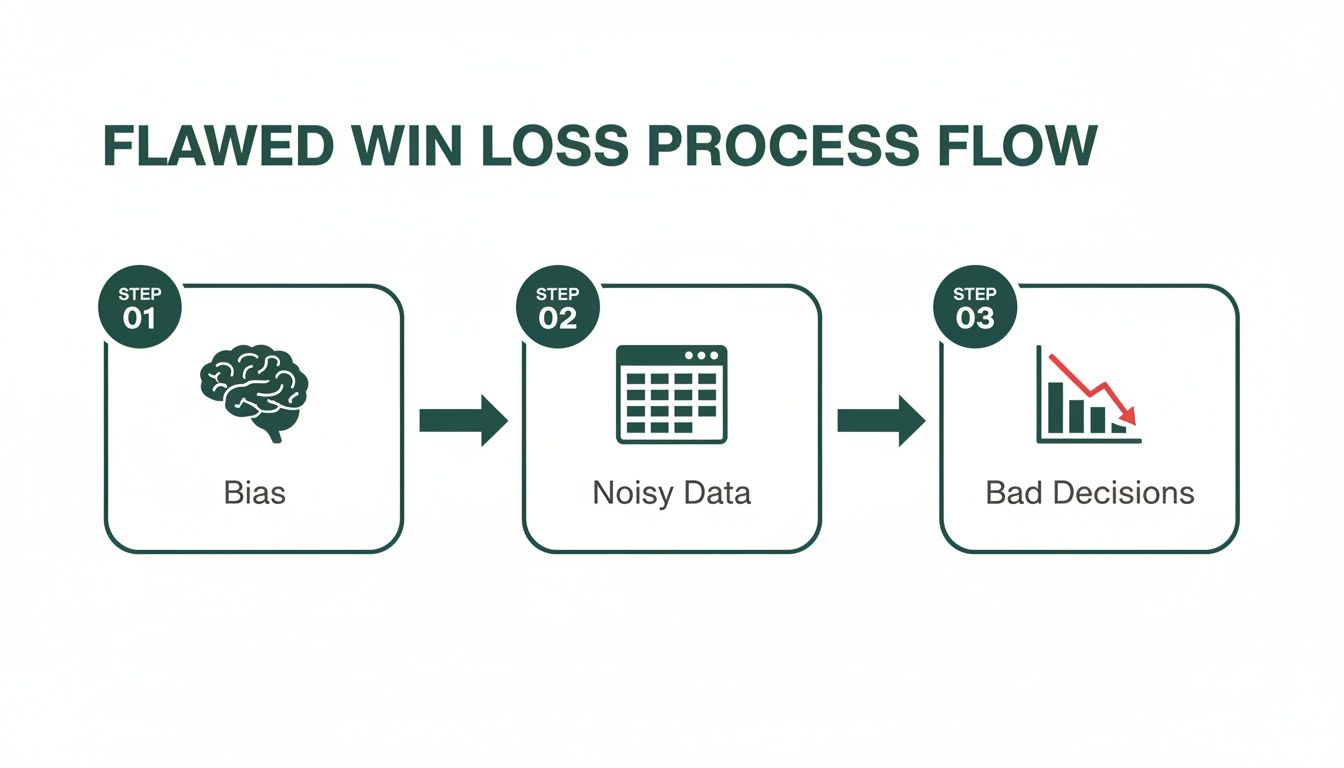
It's a straight line from inherent sales bias to corrupted data, which then fuels misguided decisions across product, marketing, and the C-suite.
To get the unfiltered truth, you must operationalize the program correctly. This isn't about bureaucracy; it's about establishing clear ownership and a non-negotiable interview protocol.
First, ownership for the win-loss program cannot sit with sales. It belongs to a function with a vested interest in strategic insights—typically product marketing, a founder, or the head of growth. This person owns the entire system, from triggering interview requests to synthesizing findings for leadership.
Next, the protocol must be simple and consistent. Define clear triggers for an interview request. Don't leave it to chance. For example, interview every deal lost above a certain ACV or any loss against a key competitor. This removes ambiguity and ensures a steady, valuable flow of interviews.
The entire process must be built around one core principle.
The person who ran the deal cannot run the interview. A neutral, third-party interviewer is the only way to get the real story. This is non-negotiable.
This interviewer could be from product marketing, a founder not involved in the deal, or a trusted external consultant. Their sole objective is intelligence gathering, not defending a sales cycle. This separation is the key to unlocking honest feedback on everything from your sales process and messaging to your product's perceived value.
It’s the same objective approach required to conduct effective user research, and it's just as vital here.
While sales reps cannot conduct interviews, they are the source of initial data. The process for them must be brutally efficient. Do not ask them to fill out ten different CRM fields; they won't do it, or they'll do it poorly.
Implement a simple, two-step process:
This structure respects the sales team's time while ensuring the program owner gets the raw material needed to go deeper. It turns a burdensome admin task into a clean, systematic handoff.
Despite the proven impact of a well-run program, shockingly few companies get this right. Only about 20% of companies have robust win-loss systems. The research underscores what they're missing: firms with formalized programs see 15-30% higher win rates, and those that share insights across product, marketing, sales, and executive teams achieve 18% higher year-over-year growth.
Building this system isn't about adding red tape. It’s about engineering a pipeline for raw, qualitative intelligence that feeds directly into your product and go-to-market strategy. It is the most direct path to understanding how the market truly values—or fails to value—what you’ve built.
This is where the real work begins. The interview is your chance to get the real story, but only if you ask the right questions. Standard, paint-by-numbers questions yield standard, useless answers—the kind that fill a spreadsheet but offer zero strategic value.
If you just ask, "Why did you choose our competitor?" you'll get a polite, sanitized, and unhelpful response. Your job is to dig deeper.
The goal isn't to run through a checklist. It's to deconstruct the buyer's actual journey, piece by piece. This means moving beyond surface-level questions to prompts that reveal real decision drivers, messy internal politics, and the moments of friction or clarity that sealed the deal. Done right, this turns a generic feedback exercise into an intelligence-gathering mission.

Most win-loss interviews barely scratch the surface. A high-leverage interview peels back the layers to understand the context surrounding the decision. Your questions must be open-ended, non-leading, and focused on helping the buyer reconstruct a timeline of events and emotions from their perspective.
The real insights rarely come from a single, perfect answer. They emerge from patterns across multiple conversations. What you're looking for is the ground truth—how your company is actually perceived and experienced in the market. This truth is often uncomfortable, but it's always valuable.
Asking the right question for the right scenario is everything. A question for a "win" will fall flat for a "no decision." Here’s a breakdown of how to tailor your questions to get to the core of what happened.
These questions are designed to open a conversation, not just get a one-word answer. They invite the buyer to tell a story, and the most valuable insights are hiding in that story.
When you lose to a competitor, your mission is to diagnose specific gaps in your product, process, or perception. Avoid any framing that sounds defensive. Your tone should be that of a neutral researcher trying to understand a complex system.
Analyzing wins is as important as dissecting losses. Never assume you won for the reasons you think. Understanding your actual strengths is the only way to systematically double down on them.
A critical mistake is assuming every deal marked 'lost' was a fair fight. Often, the deal was winnable, but a failure to understand the buyer's true evaluation criteria led you astray.
An analysis of 100,000 B2B decisions found that 53% of deals marked 'lost' were actually winnable. The disconnect lies in failing to see past the surface, which these targeted interview questions are designed to prevent.
Losing to the status quo is the most important type of loss to analyze. It means the pain of changing outweighed the perceived value of your solution—a fundamental breakdown in your go-to-market motion.
A great win-loss program doesn't end when the interview is over. That’s where it begins. The real work is translating raw interview notes into a structured format that reveals patterns.
A simple spreadsheet can work, but its design is everything. Most templates are just data logs. An effective win loss analysis template, however, is a system for turning qualitative feedback into quantitative trends.
This is where most teams stumble. They collect interesting quotes but have no systematic way to aggregate them. One-off anecdotes don't drive strategy. You need to see the forest for the trees.
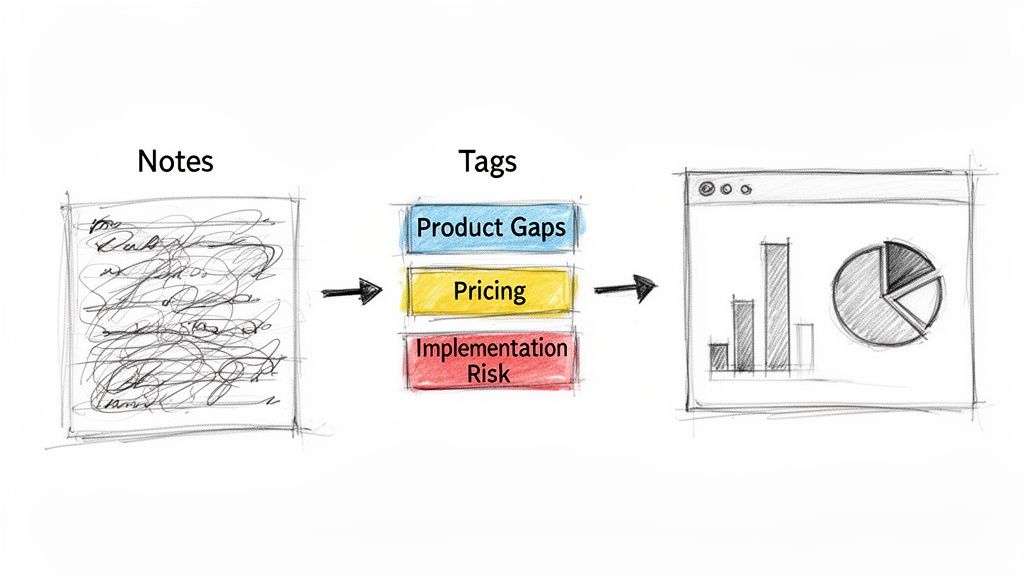
The core of a powerful template is a consistent tagging system. After each interview, the program owner distills the conversation down to its primary and secondary themes. This isn't about capturing every word; it's about pinpointing the fundamental reasons behind the outcome.
This process transforms individual stories into a workable dataset. It bridges qualitative gut feelings and quantitative proof.
Here are the essential data points and thematic tags your template must capture:
Quantitative Deal Data:
Qualitative Thematic Tags:
Don't create dozens of overly specific tags. Start with five to seven core themes that map directly to your go-to-market teams. This forces clarity and avoids analysis paralysis.
This tagging system is the engine of your program. It allows you to move beyond "we lost a deal because of X" to "we are systemically losing deals over $50k to Competitor Y because they perceive our implementation as too risky." That is an actionable insight.
Once you have a few dozen deals logged and tagged, your template becomes a powerful analytical tool. It’s easy to build a simple dashboard in Google Sheets or your BI tool to visualize trends and get answers to the questions that keep founders up at night.
This dashboard should be designed to give you a clear signal on your most pressing GTM questions. For context on how this fits a broader strategy, our guide on building a competitive analysis framework is a useful resource.
Your dashboard should answer questions like these:
What are the top three reasons we lose, broken down by competitor?
This will show if product gaps are killing you against Competitor A, while your sales process is the problem against Competitor B.
How does our primary loss reason change for deals over $100k ACV?
You might discover that for smaller deals you lose on features, but for enterprise deals you lose on brand credibility. That's a game-changing insight for your upmarket strategy.
What are the top two themes from our won deals?
This tells you what your true differentiators are in the eyes of the market. It allows you to double down on what’s actually working in your marketing and sales messaging.
By structuring your template this way, you elevate it from a static record into a living decision-support system. It stops being a place where data goes to die and becomes the source of truth that informs your positioning, product roadmap, and sales enablement.
Insight without action is an expensive hobby. It’s the spreadsheet that gathers dust, the report that gets filed away, the meeting that ends with nods but zero follow-through. This is where most win-loss programs die a quiet death.
The entire point of this exercise is to forge a relentless feedback loop between the market and your go-to-market engine. Raw intelligence must be hammered into concrete operational changes. Otherwise, you’re just running a history project.
The most effective system I’ve seen for this is a dedicated quarterly GTM diagnostic meeting. This isn't an add-on to another meeting; it's a standalone, 90-minute session with a singular focus.
Attendance is non-negotiable for the CEO and the heads of product, marketing, and sales. The agenda is brutally simple:
This meeting is the accountability mechanism. It makes it impossible for leadership to ignore the unfiltered voice of the market.
The output of this meeting must be specific, assigned tasks—not cloudy strategic goals. This is the difference between motion and progress.
When the data shows a problem, the first answer is rarely the right one. A recurring 'pricing objection' doesn't mean you should lower your price. It means your value proposition is failing. The resulting action should be a task, not a strategy change.
Here’s how this plays out:
Another example:
This process directly sharpens every part of your growth strategy. Insights from lost deals can pinpoint bottlenecks, helping shave weeks off your sales cycle. When you start winning better-fit customers, the financial impact is huge. Bumping your average CLV from $100,000 to $120,000 with just 50 new customers a year nets an extra million in long-term value. You can find more data on the financial impact of win-loss analysis on thirdside.com.
This quarterly cadence creates a powerful flywheel. Actions taken in Q1 directly impact sales cycles in Q2. The win-loss analysis of those Q2 deals then shows if your actions worked, feeding fresh insights into the Q3 diagnostic.
This is how your go-to-market strategy for SaaS transforms from a static plan into a dynamic, learning system. You make smarter bets on your product roadmap. You refine positioning with the real-world language your customers use. You equip sales with the precise tools they need to win the deals they are in today—not six months ago.
This closed-loop system builds a decisive competitive advantage. While your rivals operate on stale assumptions, you execute based on a direct feed of what your market wants, fears, and values.
Even with a clear process, founders and revenue leaders have sharp questions about getting a win-loss program off the ground. These are the most common ones I hear.
A neutral third party. This could be someone from product marketing, a founder not involved in that specific deal, or an outside consultant.
The one rule: sales reps never interview their own lost deals. It doesn't work. Prospects will soften their feedback to avoid an awkward conversation. You’ll get the polite answer, not the real one.
The goal is unfiltered honesty, which requires complete separation from the sales process.
For a 20-30 minute call with a B2B decision-maker, a $75-$150 gift card is the sweet spot. Anything less can feel insulting for their time.
The framing of the request is key. You're not "buying" their time; you're compensating them for their expert feedback. Make it clear that their candid insights will directly shape your product. The ROI on this small expense is massive.
The incentive isn't just a payment. It's a signal that you value their expertise and take this process seriously. Getting the framing right improves response rates.
Don't wait for statistical significance. This is a common mistake that leads to paralysis.
Just start. Aim for 5-7 interviews for wins and 5-7 for losses, focused on a key competitor or market segment.
Even with that small number, you will almost certainly uncover two or three powerful, recurring themes you can act on immediately. The point isn't to publish an academic study; it's to gain a directional advantage and make smarter GTM decisions faster than your competition. Consistency is more important than volume.
Absolutely. These are the most valuable and revealing interviews you can do.
Losing to a competitor means your solution was outmatched on some dimension. Losing to "no decision" means the pain of sticking with the status quo was less than the perceived pain of switching to your solution.
That’s a critical failure in your ability to build value and create urgency.
These interviews expose systemic issues with:
For any SaaS business trying to displace an existing process, understanding these failures is everything. They force you to confront the hardest truths about your go-to-market strategy.
A robust win-loss analysis template is just the start. Turning market feedback into a competitive advantage requires a system that connects insight to action. Big Moves Marketing works with B2B SaaS founders and GTM leaders to build these systems, driving clarity and focus into their positioning, messaging, and sales enablement efforts. Learn more at https://www.bigmoves.marketing.
Explore Big Moves Marketing services and resources:



%20-%20white.svg)