%20png%20copy.avif)

Three agencies stand out for B2B tech and SaaS companies in 2026: Bigmoves, Kalungi, and Olivine. Each takes a distinct approach to positioning, messaging, and go-to-market execution. The table below gives you a fast side-by-side.

| Agency | Specialization focus | Key services | Typical client | Pricing model | Notable results |
|---|---|---|---|---|---|
| Bigmoves | B2B SaaS and tech positioning, GTM execution | Positioning, messaging, GTM planning, demand gen, Webflow website build, fractional CMO | Mid-market and scaling SaaS/tech companies | Project-based and retainer; fractional CMO engagements (pricing details are variable and not specified in sources) | Numerous startups and enterprises served; led by extensive B2B SaaS experience |
| Kalungi | Early-stage B2B SaaS | Full-service product marketing, demand gen, content, sales enablement | Seed to Series B SaaS | Fractional CMO retainer | Documented pipeline growth for SaaS startups |
| Olivine | Product launches for growth-stage SaaS | Positioning, launch strategy, sales enablement, competitive research | Growth-stage and enterprise SaaS | Project-based and retainer | Launch execution for multiple SaaS product lines |
None of these are general branding shops or demand generation agencies. They focus specifically on the product marketing layer: the positioning, messaging, and launch infrastructure that makes everything else work. A demand gen agency fills the top of the funnel. A branding agency shapes visual identity. A product marketing agency builds the strategic foundation both depend on.
The core job is making sure the right people understand why your product is the right choice, and giving your sales team the tools to close on that message. Here is what that looks like in practice:
What separates a product marketing agency from a general marketing firm is the depth of focus on the buyer’s decision-making process. General agencies optimize campaigns. Product marketing agencies build the strategic layer that tells those campaigns what to say and who to say it to.
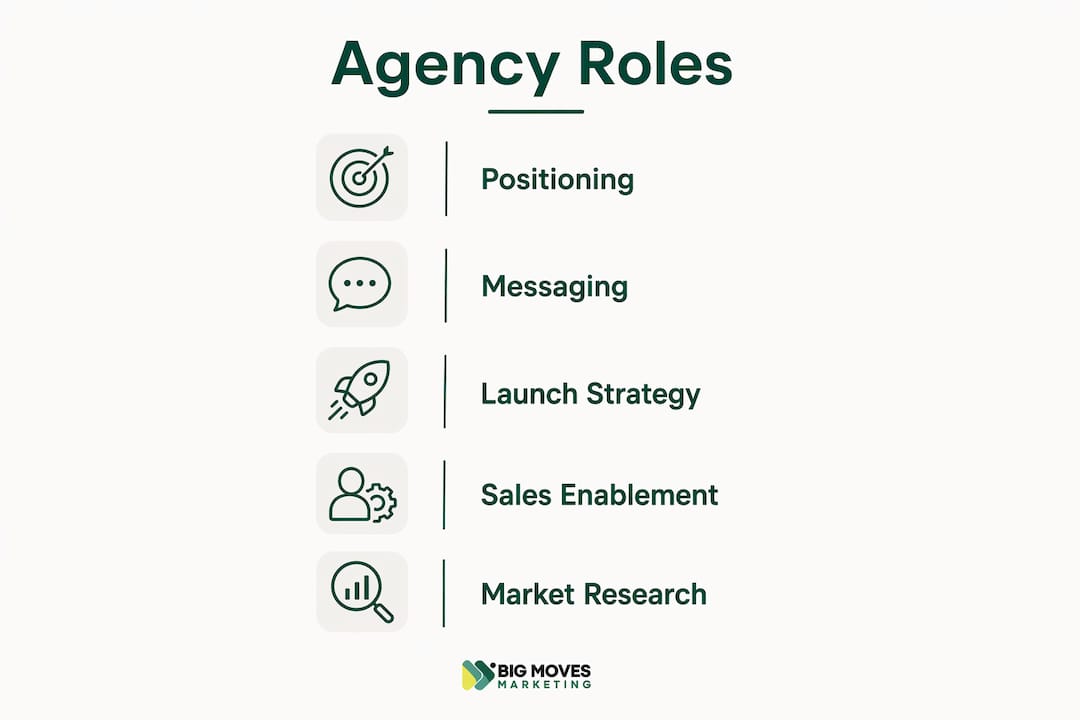
Start with specialization, not portfolio size. An agency with ten SaaS launches under its belt will outperform a generalist with fifty consumer brand campaigns every time. Here is what to evaluate:
Red flags to watch for:
On timeline: from initial contact to active campaign work, expect several weeks, typically a month or two. Discovery, positioning workshops, and asset development take time. Agencies that promise a launch in two weeks are skipping the work that makes launches succeed.
Pro Tip: Before briefing any agency, define one ideal customer profile and one primary problem your product solves. Agencies that receive a focused brief produce sharper positioning. Those handed a broad “we serve everyone” brief will either ask you to narrow it or produce messaging that fits no one.

Product marketing agency pricing in the US follows four main structures. Understanding which model fits your situation saves you from overpaying for flexibility you do not need or underbuying the depth you do.
Pricing varies widely by agency size, seniority, and scope. Boutique B2B SaaS specialists tend to charge more per hour than generalists, but deliver faster because they are not learning your category from scratch.
Key contract questions to ask before signing:
The value drivers in agency work are expertise, speed, and focus. A specialist agency that has positioned fifteen SaaS security products will compress months of learning into weeks. That speed has real dollar value when your launch window is fixed.
Most B2B SaaS launches underperform not because the product is weak, but because the launch strategy is assembled at the last minute. The fix is a repeatable system, not a better checklist.
The first distinction to get right: a launch strategy sets the strategic framing, the ICP, the positioning, the channels, and the success metrics. A launch plan is the tactical task list that executes it. Skipping the strategy and jumping to the plan is the single most common launch mistake.
Atlassian recommends starting launch planning 6-12 months prior to go-live for complex B2B SaaS products. That window allows time for customer research, messaging validation, sales enablement creation, and internal alignment. Pre-launch preparation is where the outcome is largely determined.
A repeatable launch system has five components:
A practical B2B SaaS go-to-market playbook builds this system around a single customer segment first, validates the channel, then scales. The companies that win their launch window are not the ones with the biggest budgets. They are the ones with the tightest ICP, the sharpest message, and the discipline to keep executing after the initial excitement fades.
For post-launch, build a 90-day measurement cadence into every launch plan. Review metrics at each interval, identify what worked, and document it. That documentation becomes the foundation of your next launch, and the one after that. The goal is a system that gets faster and more accurate with each cycle, not a one-off campaign that starts from zero every time.
If you are a founder, CMO, or growth leader at a scaling SaaS or B2B tech company, Bigmoves offers something most agencies do not: senior-level strategy and hands-on execution from a team that has spent 17 years exclusively in B2B tech and SaaS, across numerous companies.
The work covers the full product marketing stack: positioning and messaging development, go-to-market website builds on Webflow, demand generation across LinkedIn, Google Ads, email, and webinars, and fractional CMO engagements for companies that need strategic leadership without a full-time hire. Every engagement starts with a focused brief: one ICP, one core message, one channel to validate before scaling.
No bloated retainers for work you do not need. No junior teams learning your category on your budget. If your next product launch needs sharp positioning and a system built to repeat, book a consultation with Bigmoves to scope the right engagement.
A product marketing agency develops positioning, messaging, and launch strategy for a product, then equips sales and marketing teams to execute against that strategy. The focus is on the buyer’s decision-making process, not just campaign execution.
Demand generation agencies fill the top of the funnel with leads. A product marketing agency builds the strategic foundation: the positioning, messaging, and sales enablement that tells demand generation what to say and who to target.
From initial contact to active campaign work, expect several weeks, typically a month or two for discovery, positioning, and asset development. For complex B2B SaaS products, Atlassian recommends starting launch planning 6-12 months before go-live.
Prioritize documented GTM frameworks, measurable case studies from companies at your stage, and a clear process for positioning and sales enablement. Avoid agencies that skip strategy and jump straight to tactics.
Yes. Bigmoves covers positioning and messaging development through to website build, demand generation, and fractional CMO leadership, making it suited for SaaS and B2B tech companies that need both strategic clarity and hands-on execution.
The strongest product marketing agencies combine specialized B2B SaaS expertise, documented GTM frameworks, and measurable launch systems to drive product-market fit and sustained revenue growth.
| Point | Details |
|---|---|
| Specialization beats size | Choose an agency with direct B2B SaaS experience at your stage, not a generalist with a large portfolio. |
| Strategy before tactics | Define positioning, ICP, and success metrics before building any launch assets or campaigns. |
| Launch planning timeline | Atlassian recommends a 6-12 month planning window before launching complex B2B SaaS products. |
| Measure at 7, 30, and 90 days | Track feature activation and pipeline influence at each interval, then run a retrospective to improve the next launch. |
| Bigmoves for B2B SaaS | Bigmoves offers senior-led positioning, GTM execution, and fractional CMO services for scaling SaaS and tech companies. |



%20-%20white.svg)