%20png%20copy.avif)

Most founders think they need better marketing execution. They usually need better sequencing.
The common advice is wrong because it starts too late. It starts with channels, content calendars, ad platforms, and campaign ideas. That isn't strategy. That's production. If you choose tactics before you choose the market, the problem, the buyer, and the buying motion, you're just scaling ambiguity.
A real B2B marketing strategy is an operating system for growth. It tells your team who you serve, what problem you want to own, how your buyers make decisions, where you'll meet them, what proof they need, and how marketing and sales will move together. Get that sequence right and channels start compounding. Get it wrong and even good execution looks broken.
Founders lose quarters this way. They call the channel mix a strategy, keep shipping activity, and wonder why growth stays uneven.
If your plan is “SEO, LinkedIn, email, and webinars,” your team does not have strategic direction. It has a production schedule. That distinction matters because channels only amplify the decisions made before them. Strong upstream decisions make average execution productive. Weak upstream decisions make even good execution expensive.
A real B2B marketing strategy works like an operating system for growth. It sets the order of decisions and forces trade-offs early. Which market are you willing to win first? Which buyers inside that market feel the problem sharply enough to act? What do you want to be known for? What proof does each stakeholder need before sales gets a real shot? Which path turns attention into qualified pipeline without creating friction between marketing and sales?
Sequence decides performance.
B2B SaaS teams usually reverse that sequence. They launch campaigns before they tighten the ICP. They publish content before they define a sharp market position. They ask sales to follow up on leads before they agree on what a good account looks like. Then they treat poor conversion as a channel problem instead of a strategy problem.
That is why tactics disappoint. A loose ICP produces weak positioning. Weak positioning produces safe messaging. Safe messaging makes every paid click, outbound touch, and content asset less effective. By the time the team tries to fix performance, it is already paying to distribute confusion.
The better approach is blunt and far more effective. Set the strategic spine first, then build execution on top of it.
A serious growth team should be able to answer a small set of questions without debate:
If those answers are fuzzy, adding more tactics will not fix the problem. It will scale the problem.
The companies that grow efficiently do not treat strategy as a checklist of programs. They use it as the logic that connects positioning, messaging, channels, pipeline creation, and sales execution into one system. That is the standard. Anything less is motion without control.
B2B teams rarely fail because they picked the wrong channel. They fail because they started with channels at all.
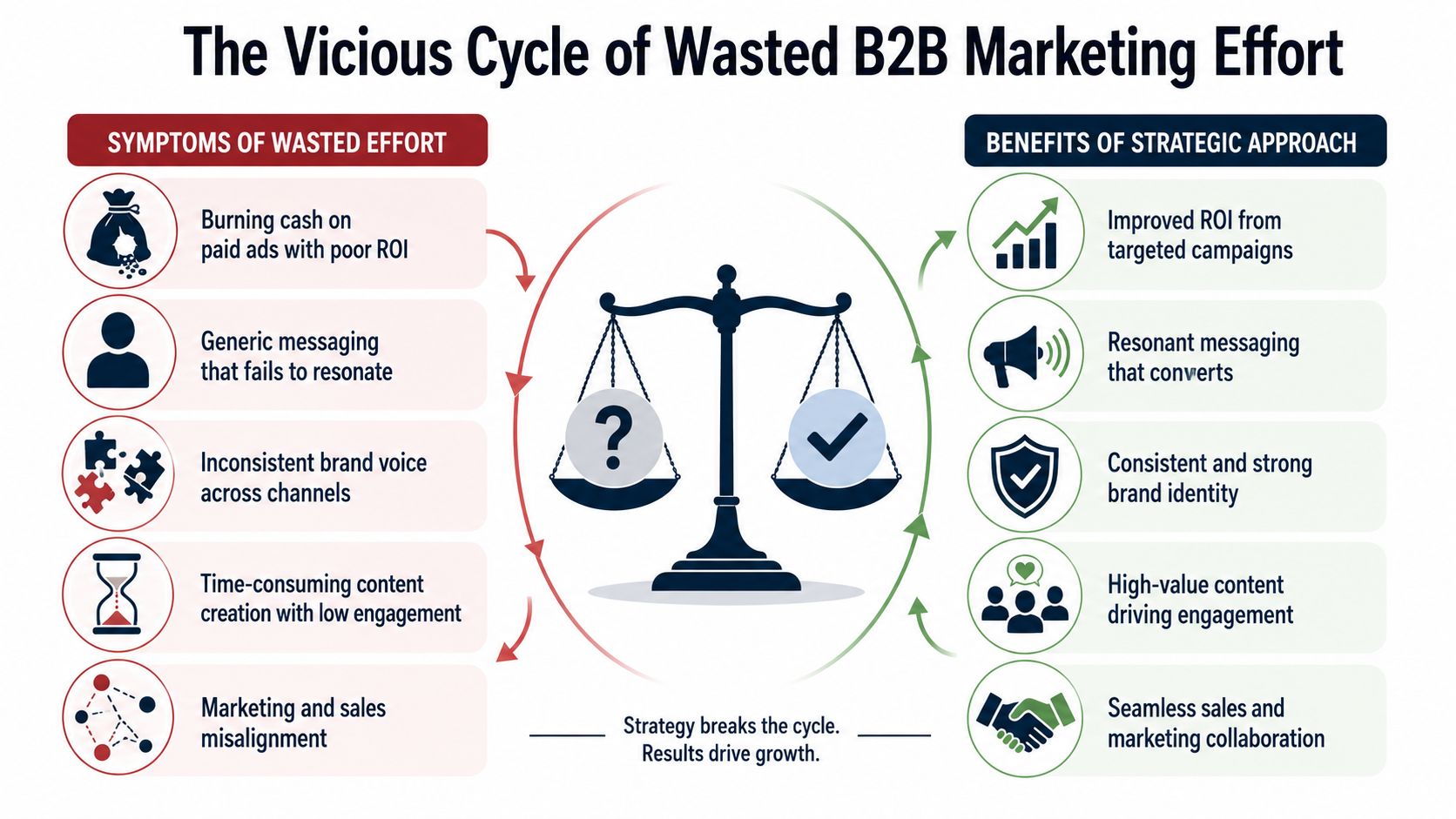
What founders call a marketing problem is usually a decision-order problem. The company runs paid search before it has a clear market position. It publishes content before it knows which buying triggers matter. It asks sales to chase volume before anyone has defined the accounts worth winning. The result is predictable. Activity goes up. Efficiency goes down.
The waste shows up in familiar ways:
These are not separate issues. They are one system failing in sequence.
Buyers do not experience your company as a set of disconnected campaigns. They experience a pattern of claims, proof, and follow-up across search, social, email, the website, review sites, and sales conversations. If that pattern is inconsistent, confidence drops. If it is generic, urgency disappears. If it ignores the actual buying group, deals slow down long before a rep gets a serious shot.
That is why random execution underperforms. A weak strategy poisons every downstream choice.
Teams buy traffic before they know what the market should remember about them. They ask writers for thought leadership before they define the objection that content needs to remove. They send outbound sequences that sound polished but say nothing distinct. None of this compounds because the company has no message spine holding the motion together.
Founders should treat clarity as a growth constraint, not a branding exercise. If you need a practical way to tighten account selection first, use an ideal customer profile template for B2B teams. If your audience definition is still broad or fuzzy, this guide on how to identify target audience is a useful starting point.
The true cost is not wasted spend. It is wasted organizational effort.
| Common move | What it feels like | What it usually creates |
|---|---|---|
| Launch more campaigns | Progress | More volume against the same unclear position |
| Add more channels | Coverage | More inconsistency |
| Publish more content | Momentum | More assets without a clear buying job |
| Push for more leads | Growth | More low-fit pipeline for sales to sort through |
A real B2B marketing strategy works like an operating system. It decides the order of decisions, what the company will say, where it will say it, and which opportunities deserve resources. Get that sequence wrong and every tactic becomes more expensive than it looks.
Most B2B companies don't have an ICP. They have a loose preference.
They say things like “mid-market SaaS,” “operations teams,” or “Series A to enterprise.” That's not useful. It doesn't tell marketing which accounts deserve budget, which message should anchor the homepage, or why sales wins one segment faster than another.
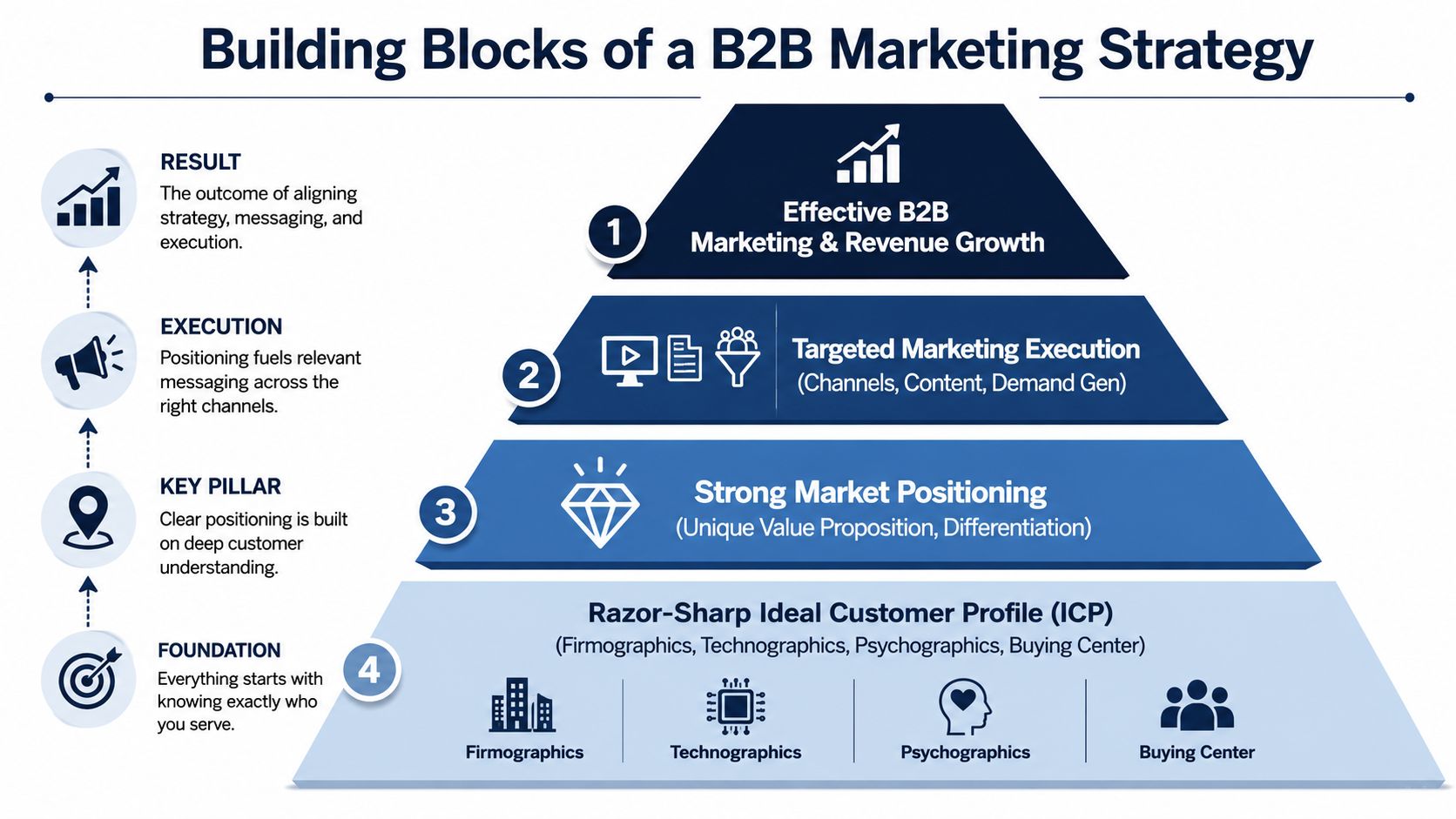
A useful ICP isn't a market category. It's a pattern of companies that buy for similar reasons, with similar urgency, through a similar decision process.
Forrester recommends structured buyer-network mapping. That means mapping the members of the buying network, their needs, motivations, and preferences so messaging and campaign design reflect how organizations buy, as outlined in its guidance on B2B marketing strategy.
That matters because B2B purchases rarely hinge on one persona. You need to know who feels the pain, who owns budget, who blocks risk, who validates technical fit, and who influences the shortlist.
A sharper ICP usually includes more than firmographics:
If your team needs a practical starting point, this ideal customer profile template is the kind of operational document you want. Not a slide. A working tool.
A separate but useful exercise is to identify target audience with more discipline than the usual persona worksheet. The point isn't marketing theater. The point is better market selection.
Once the ICP is clear, positioning gets easier and harder at the same time.
Easier, because you know who you're speaking to. Harder, because now you have to choose. Good positioning excludes. It says: for this buyer, in this situation, with this problem, we are the best fit because we solve it in a way alternatives don't.
That's why positioning can't be delegated to homepage copy alone. It's a company decision. It shapes packaging, roadmap emphasis, proof strategy, objections handling, pricing context, and what content deserves investment.
Here is a useful test:
| Weak positioning | Strong positioning |
|---|---|
| Describes the product | Frames the buyer's problem |
| Tries to appeal to everyone | Makes one segment feel specifically understood |
| Uses category clichés | Creates a clear angle on the market |
| Sounds polished | Changes how the buyer evaluates options |
Later in the section, watch this short explainer for a practical lens on sharpening market focus and message.
The raw material needed for strong positioning often already exists within an organization, but isn't organized.
Start with sources that reveal real decision logic:
Then force synthesis. What pain appears before buyers search? What event creates urgency? What internal metric or operational failure turns your product from nice-to-have into necessary? Which buyer says yes first, and which buyer needs reassurance after that?
A strong B2B marketing strategy starts by understanding the buying network, not by guessing which channel might save you.
Positioning lives in leadership conversations. Messaging architecture lives in the market.
If your company can't turn strategic choices into repeatable language, every team improvises. Marketing writes one version. SDRs write another. AEs pitch a third. The website ends up sounding like a compromise between product, sales, and the last homepage rewrite.
Messaging architecture should do one job. It should make your position usable.
At minimum, it needs these layers:
This isn't a copy deck. It's an operating document. Product marketing, content, paid media, founder-led sales, SDR outbound, and AE discovery should all pull from the same spine.
If you want a practical reference for how to structure that spine, this B2B messaging framework that works is the right kind of model. Keep it simple enough to use. Detailed enough to stop improvisation.
Founders often resist tighter messaging because they're afraid of shrinking the market. In practice, the opposite usually happens. Broad messaging attracts attention from people who will never buy. Narrow messaging creates recognition with the people who might.
Bain's work on underserved segments makes the strategic point clearly. Successful go-to-market models are designed around the economics of serving each segment, and a narrower segment can be more attractive when larger competitors serve it inefficiently, as discussed in Bain's piece on underserved small-business markets.
That logic applies well beyond small business. In SaaS, a niche can outperform a broad ICP when:
Broad positioning makes internal teams feel safe. Narrow positioning makes buyers feel understood.
A useful way to pressure test your messaging is to ask whether each layer answers a different strategic need.
| Message layer | What it must answer |
|---|---|
| Core proposition | Why should this market care at all |
| Pillars | Why should they believe the promise |
| Persona variants | Why does each stakeholder say yes |
| Proof | Why is this credible now |
| Objection handling | Why won't the usual concerns kill momentum |
Most weak messaging fails because it jumps from product features straight to top-funnel content. It skips the middle layer that makes the story coherent.
Your buyers don't need more content. They need message consistency from first click to late-stage evaluation.
Channel strategy should be boring in the best way. It should follow the buyer.
Too many teams build their channel mix around whatever seems hot, whatever the last hire knows, or whatever the board expects to see. That's how companies end up posting daily on channels their buyers barely use while neglecting the places where buying intent shows up.
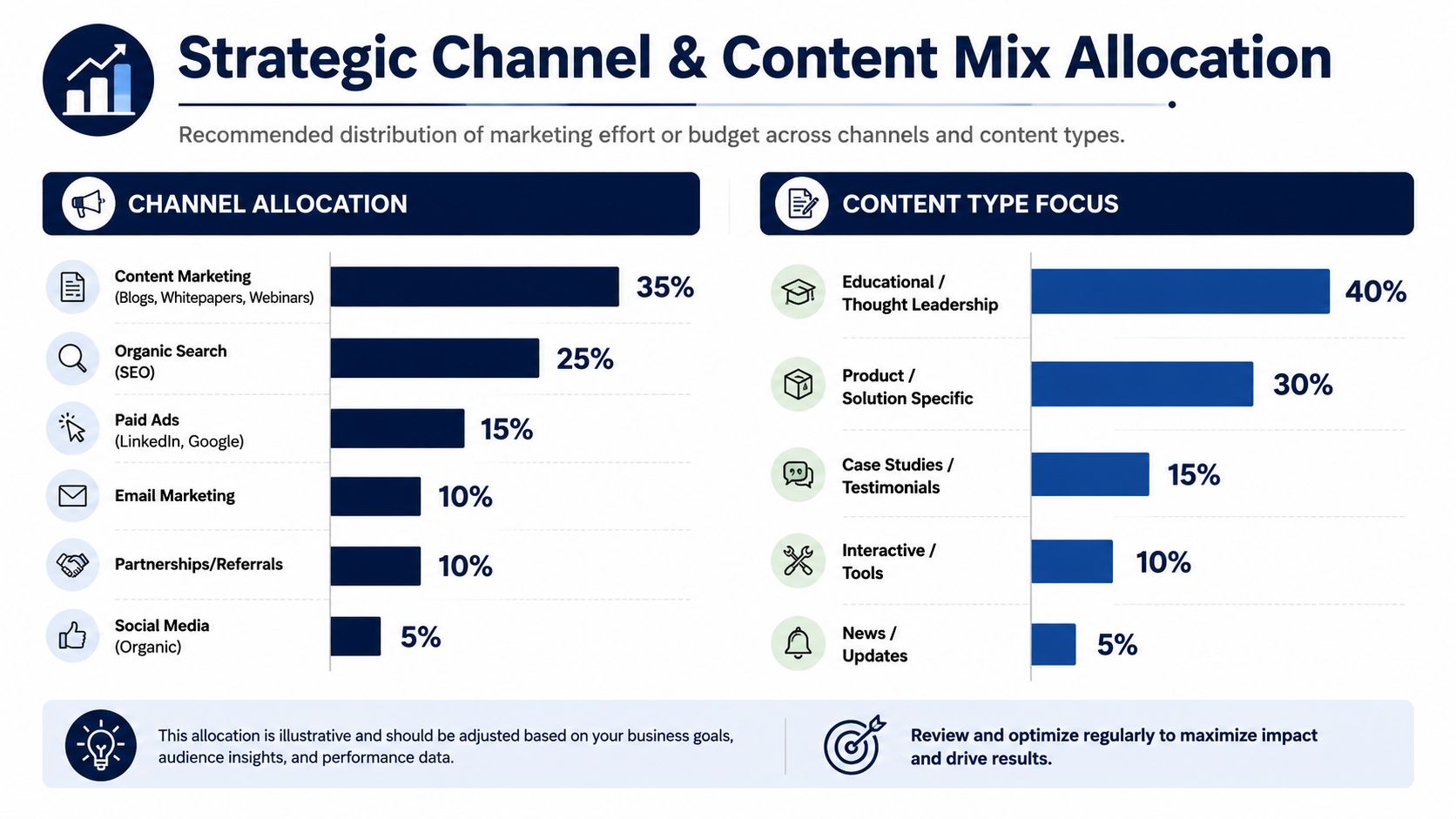
The cleanest way to make channel decisions is to separate two jobs.
Demand creation puts your point of view, problem framing, and credibility in front of accounts before they are actively shopping.
Demand capture makes sure you show up when buyers decide to research solutions.
Those are different motions. They need different assets, timelines, and success criteria.
Coalition Technologies reports that 74% of B2B marketers say content marketing helped generate more leads, email returns about $36 for every $1 spent, highly personalized emails can produce 30% higher open rates, and SEO can reach an average close rate of nearly 15% compared with about 2% for cold calling in its 2025 B2B marketing statistics. The same body of evidence fits what many growth teams already see in practice. Digital-first, content-led execution works because buyers educate themselves long before they want a demo.
HubSpot's 2026 marketing statistics, as cited in the verified data, show that in 2024 the top ROI-driving channels for B2B brands were the website, blog, and SEO, followed by paid social media content and social shopping tools. That's directionally useful because it reinforces a point founders still ignore. Your website and search presence are not support assets. They're part of the core go-to-market system.
A practical channel model looks like this:
A useful reference point for evaluating trade-offs across options is this guide to B2B marketing channels. The important part isn't the list. It's the selection logic.
Content should serve both demand creation and demand capture. Often, teams produce assets without assigning them a job.
A better model is:
If video is part of your distribution mix, don't treat it as a side experiment. Think about formats, narrative, and repurposing with more discipline. This overview of BlitzReels for video content strategy is a useful prompt for that planning.
The mistake isn't choosing the wrong channel. It's choosing channels before you know what role each one should play.
A strategy document that doesn't change pipeline behavior is dead weight.
Activation is where most companies expose whether the strategy is real. If the only output is a revised homepage and a few campaign briefs, the company hasn't built an operating system. It has run a messaging exercise.
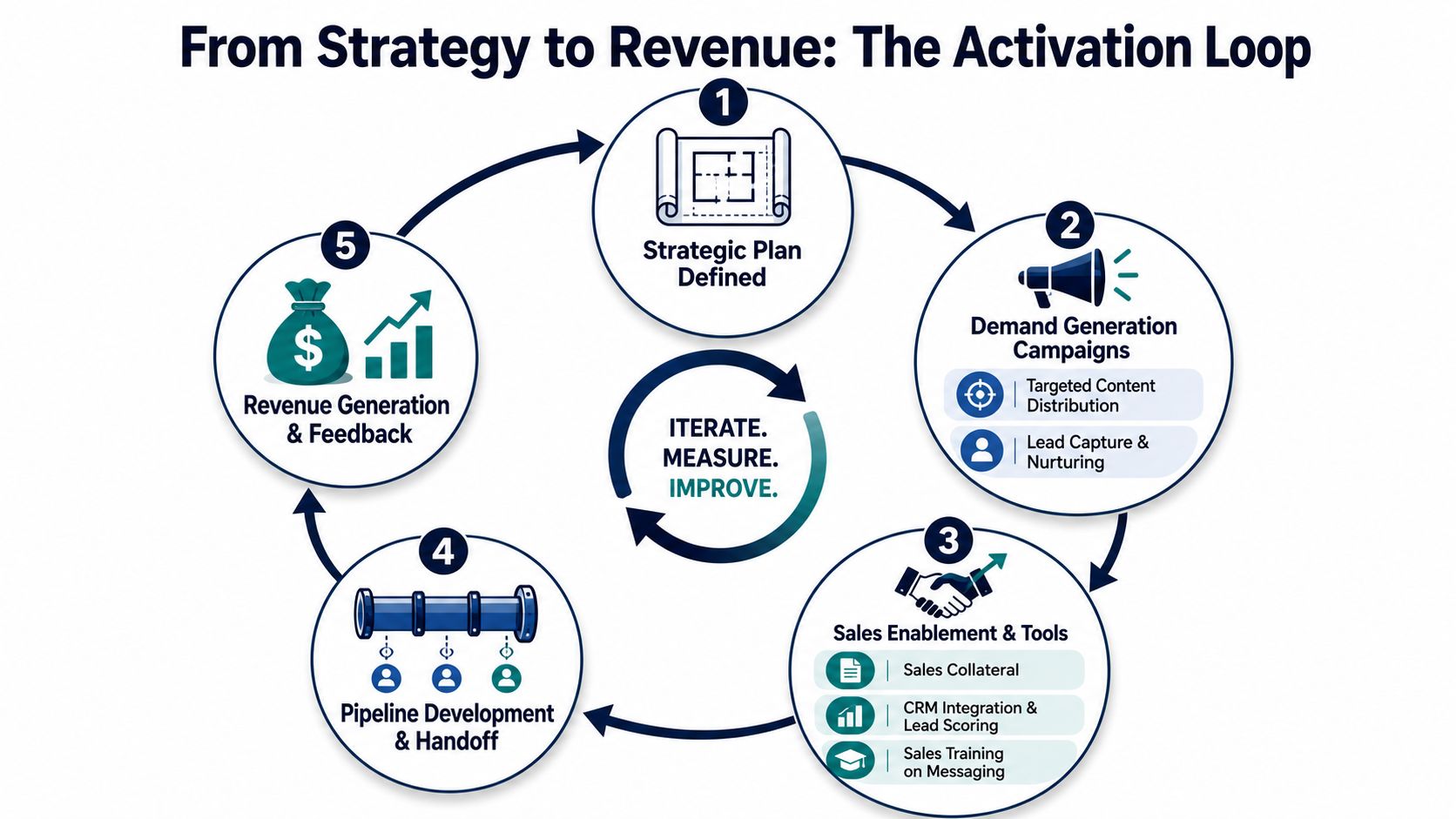
For high-consideration SaaS categories, ABM is often the cleanest way to activate a real B2B marketing strategy because it forces alignment around accounts, stakeholders, and coordinated plays.
Salesforce guidance suggests building a tier-one list of at least 200 target accounts and coordinating outreach across channels in its B2B marketing guide. That recommendation matters less as a magic threshold and more as a behavioral constraint. It forces focus. It tells the company which accounts deserve personalized attention and prevents budget from drifting into broad, low-fit acquisition.
A workable activation model usually includes:
Marketing often hands sales polished assets that don't help close deals. Sales often creates ad hoc decks that drift from the company's position. Both are avoidable.
Your sales enablement should come directly from the messaging architecture. That means:
| Asset | What it should do |
|---|---|
| One-pagers | Frame the problem and the fit fast |
| Battlecards | Help reps handle competitor pressure and objection patterns |
| Discovery prompts | Pull out the pain that your product is built to solve |
| Follow-up emails | Reinforce the same value pillars buyers saw in marketing |
| Case-study summaries | Supply proof that maps to segment and use case |
When these assets are disconnected from positioning, sales starts freelancing. Win rates suffer because every rep tells a slightly different story.
One option some growth-stage teams use at this stage is a strategic partner that can connect positioning, messaging, website structure, and early channel tests in one motion. Big Moves Marketing's demand gen strategy perspective sits in that category.
Marketing should not hand sales “leads.” It should hand sales context, momentum, and message continuity.
Activation improves when you treat each campaign as a learning system.
After launch, ask practical questions:
Strategy becomes operational. Marketing learns from sales conversations. Sales benefits from stronger proof and sharper language. The next play gets tighter.
Without that loop, demand gen and sales enablement drift apart again. And drift is expensive.
Bad measurement doesn't just waste reporting time. It drives bad strategy.
If your dashboard rewards activity, your team will produce activity. More content. More campaigns. More leads. None of that matters if the wrong accounts enter the funnel, opportunities stall, or sales has to rebuild the story from scratch in every deal.
A B2B marketing strategy should be judged by business outcomes the leadership team can act on: pipeline quality, sales efficiency, and revenue contribution by segment.

A lot of startup reporting is performance theater. It highlights what marketing can count fast instead of what leadership needs to decide next.
As noted earlier, account-based models force a better standard. They push teams to measure progress at the account and buying-group level, because that is where revenue decisions happen. That means your reporting should answer harder questions. Are the right accounts entering pipeline? Are they advancing? Are more stakeholders engaging over time? Is sales getting into deals with better context and stronger proof?
That is the shift that matters. Strategy is not validated when a campaign performs. Strategy is validated when the market responds in the sequence you intended.
A clean executive view should stay narrow:
If you need a tighter framework for revenue-first reporting, this guide on measuring marketing ROI across pipeline and revenue is aligned with that approach.
Do not wait for annual planning to find out your strategy is off.
Review performance on a fixed cadence and diagnose the failure at the right layer. If you skip that discipline, teams start changing channels before they fix positioning, rewriting ad copy before they fix ICP, and blaming sales before they fix proof.
Use a simple decision table:
| If you see this | Recheck this first |
|---|---|
| Good traffic, weak conversion | Positioning and page-message fit |
| High lead volume, poor opportunity quality | ICP definition and targeting filters |
| Strong meetings, weak pipeline progression | Sales enablement and proof gaps |
| Uneven channel performance | Channel-job mismatch |
| Long cycles with repeated objections | Messaging architecture and stakeholder coverage |
Weak teams respond to bad numbers by changing everything. Strong teams isolate the failure point.
If pipeline volume is healthy but win rates are soft, the problem usually sits in message credibility, stakeholder coverage, or proof. If paid campaigns generate form fills but few qualified opportunities, the issue usually starts higher up the chain with targeting or positioning. If one segment converts fast and another drags, stop averaging the data and make segment-level decisions.
That is the advantage of treating strategy like an operating system. You can trace the failure back to the decision that created it.
A strong B2B marketing strategy starts with sharp choices, turns those choices into coordinated execution, and improves through disciplined review. Measurement is not the last step. It is the control system that keeps the whole motion aligned.
If your team has traction but your growth motion still feels fragmented, Big Moves Marketing can help you tighten the sequence. That usually means clarifying ICP and positioning, turning them into a usable messaging system, and aligning website, channels, and demand generation around the same buying logic so marketing and sales stop working from different stories.





%20-%20white.svg)