%20png%20copy.avif)
A marketing strategy for a new product is a deliberate plan that connects your product’s unique value to the right customers through coordinated messaging, sales enablement, and channel execution. In B2B technology, this plan determines whether your launch builds real pipeline or disappears into market noise. Launch failure often results from weak foundational work on market problems and internal misalignment. Get the foundation right, and everything else compounds.
A go-to-market strategy, the industry term for this coordinated launch plan, requires three things working together: a precise Ideal Customer Profile (ICP), a clear value proposition, and a phased execution plan. Most B2B tech teams skip one of these. The result is a launch that generates activity but not revenue.
The core insight is simple. Customers do not buy features. They buy solutions to problems they feel every day. Your marketing strategy must start there and work outward.

The ICP is the single most important input to your launch plan. It defines exactly who experiences the problem your product solves, at what scale, and with what urgency. A buyer persona describes a fictional character. An ICP describes a real company type, role, and situation where your product creates measurable value.
Building a precise ICP requires four steps:
Pro Tip: Record every customer interview with permission and transcribe it. The exact words buyers use to describe their problems are your best copywriting source. Use those phrases verbatim in your headlines and email subject lines.
The ICP also determines which channels you use, which content you create, and how your sales team qualifies leads. Every downstream decision flows from it.
Positioning is the claim you own in your buyer’s mind. Messaging is how you express that claim across every touchpoint. Most B2B tech teams write messaging that lists features. Buyers read it and feel nothing.
Effective product positioning answers one question: “Why should this specific buyer choose this product over every alternative, including doing nothing?” The answer must be grounded in the problem, not the product.
Build a messaging matrix to organize this work:
Personalization and social proof outperform feature lists in engaging B2B buyers with short attention spans. Buyers trust peers more than vendors. Build that trust into your messaging from day one.
Pro Tip: Test your positioning with five people outside your company. Ask them to explain back what your product does after reading your homepage. If they struggle, your messaging needs work before launch.
Aligning positioning across marketing, sales, and product is not optional. When sales uses different language than marketing, buyers notice. Inconsistency signals immaturity and erodes trust.
A go-to-market launch plan covers three distinct phases: pre-launch (4–12 weeks), launch (1–2 weeks), and post-launch. Each phase has different goals, activities, and success metrics.
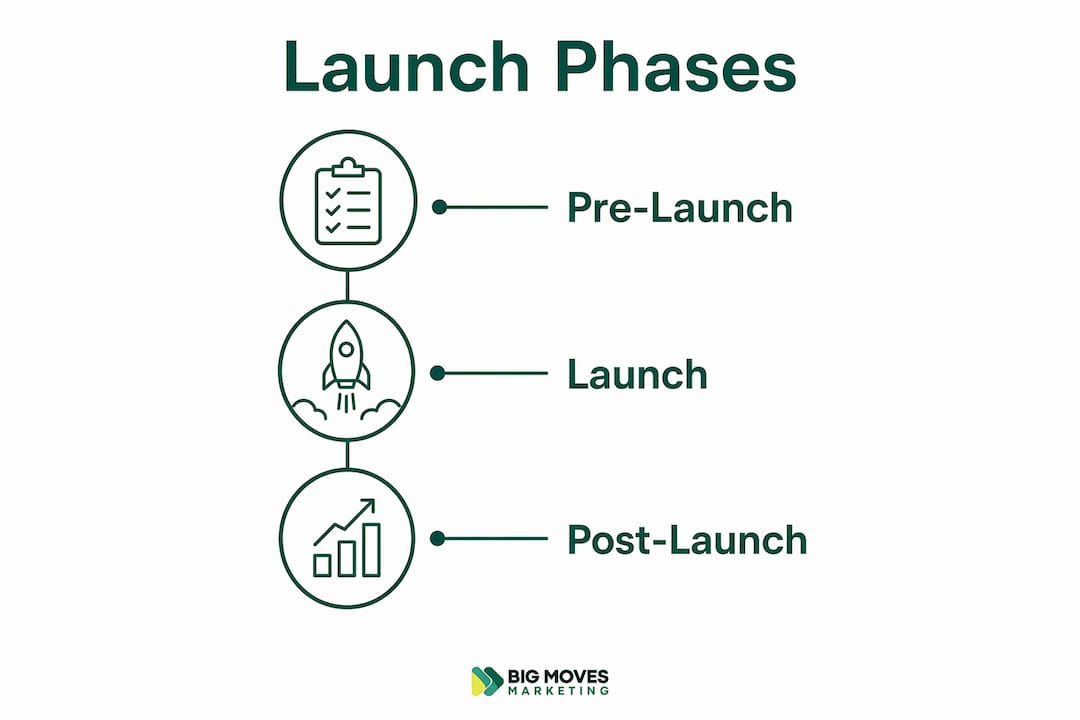
| Phase | Duration | Primary Goal | Key Activities |
|---|---|---|---|
| Pre-launch | 4–12 weeks | Build awareness and pipeline | Beta program, waitlist, teaser content, sales training |
| Launch | 1–2 weeks | Drive conversions and press | Coordinated channel push, PR, live events, email campaigns |
| Post-launch | Ongoing | Retain, expand, and refine | Feedback loops, case studies, upsell sequences, KPI review |
Mapping these phases improves budget management and team clarity. Without this structure, teams front-load effort at launch and lose momentum within two weeks.
The pre-launch phase is where most of the real work happens:
Post-launch, the goal shifts to maintaining momentum. Engaging early users via short interviews reveals what messaging resonates and what the product still needs. Set a 30-day, 60-day, and 90-day KPI review cadence. Adjust channel spend based on what converts, not what looks good in dashboards.
Channel selection is where most B2B tech launches go wrong. Teams copy what competitors do without checking whether those channels reach their own ICP. This is the “channel trap,” and it wastes budget fast.
Channel selection must be based on where your ICP actually spends time, not on competitor activity. Audit your existing customers first. Where did they first hear about you? What content did they consume before buying? Those answers tell you more than any industry benchmark.
The most effective channel mix for B2B tech launches combines three layers:
Long-term marketing success in B2B tech relies on layering these channels in sequence. Start with owned and earned. Add paid after you know what message converts. This sequence protects budget and accelerates learning.
Pro Tip: Run a 30-day LinkedIn content test before your launch. Post five problem-focused pieces and measure engagement by role and company size. The posts that get the most comments from your ICP tell you exactly what messaging to use in your paid campaigns.
Sales enablement is a critical but often overlooked component of launch success. Sales teams that receive messaging and training late close fewer deals and create inconsistent buyer experiences.
Start sales enablement at least four weeks before launch. Give your team:
Preparing sales teams with clear content for objection handling and positioning reduces ramp time and increases close rates. Sales confidence comes from clarity, not enthusiasm.
A product launch is an organizational exercise that extends beyond product, marketing, and sales. Customer success, support, and operations all need to articulate the value proposition consistently. A buyer who hears one message from marketing and a different one from support loses confidence immediately.
A successful new product launch in B2B tech requires a precise ICP, aligned messaging, a phased go-to-market plan, and sales enablement that starts well before launch day.
| Point | Details |
|---|---|
| ICP precision drives everything | Build your Ideal Customer Profile from real interviews and validated data, not assumptions. |
| Positioning beats features | Lead with the problem you solve and the outcome you deliver, not a feature list. |
| Phase your launch plan | Structure pre-launch, launch, and post-launch phases with distinct goals and KPIs for each. |
| Avoid the channel trap | Choose channels based on where your ICP spends time, not what competitors are doing. |
| Sales enablement starts early | Give sales the messaging matrix, objection responses, and customer stories at least four weeks before launch. |
After working with over 75 startups and enterprises at Bigmoves, the pattern I see most often is this: teams spend months building the product and two weeks planning the launch. That ratio is backwards.
The launches that generate real pipeline share one quality. They treat marketing as an organizational exercise, not a campaign. Every team, from product to support, can explain the value proposition in one sentence. That consistency compounds across every buyer touchpoint.
The second lesson is harder to accept. Most B2B tech teams fall in love with their product’s features. They write copy about what the product does instead of what the buyer gets. Buyers do not care how the feature works. They care whether their problem goes away. Rewriting your messaging around outcomes feels uncomfortable at first. It works every time.
The third lesson is about timing. The best time to start your pre-launch content and sales enablement is the moment you know what problem you are solving. Not when the product is ready. Not when the roadmap is locked. Now. The teams that start marketing activities early build warm audiences that convert at launch. The teams that wait start from zero on launch day.
Measure everything from day one. Set KPIs before launch, not after. Post-launch data only has value if you have a baseline to compare it against.
— Veb
Building a launch plan that actually converts takes more than a checklist. It takes clear positioning, a validated ICP, and a team that executes in sequence.
Bigmoves works with B2B SaaS and technology companies to build the go-to-market strategy that connects product value to pipeline. From ICP development and messaging matrices to channel execution and sales enablement, the work is built for founders, CMOs, and growth teams who need results fast. If your next launch needs a clear plan and experienced execution, Bigmoves’ fractional CMO services give you senior marketing leadership without the full-time cost.
A marketing strategy for a new product is a coordinated plan that aligns your product’s value proposition with a specific target audience through messaging, channel selection, and sales enablement. It covers pre-launch, launch, and post-launch phases.
Start pre-launch marketing 4–12 weeks before your launch date. This window covers beta programs, waitlist building, teaser content, and sales training, all of which require time to generate results.
An ICP defines the specific company type, role, and situation where your product creates the most value. It drives every downstream decision, from channel selection to messaging to sales qualification criteria.
Audit where your existing customers first discovered you and what content they consumed before buying. Base channel investment on that data, not on what competitors appear to be doing.
Sales enablement for a launch should include a one-page positioning summary, a competitive differentiation guide, objection responses, email and call scripts, and access to early customer testimonials or beta case studies.


%20-%20white.svg)