%20png%20copy.avif)

Outsourced SDRs are not a shortcut. They're a test of whether your company knows who it sells to, what counts as a qualified conversation, and who owns the handoff when a meeting is booked. Most founders buy the wrong thing. They think they're buying activity. They're really buying an operating model, and if the model is weak, the pipeline will be weak too.
The hard truth is that outsourced SDR programs often fail before the vendor ever gets good at the work. Meetings show up, calendars fill, and then the calendar noise starts. No-shows rise. AEs stop trusting the meetings. The founder blames the provider. In most cases, the buyer set the program up to fail with vague ICPs, fuzzy qualification, weak CRM discipline, and no shared definition of a real sales-accepted meeting.
Treat this as a decision guide, not a vendor directory. If you want a list of agencies, you'll end up comparing brochures. If you want a useful outcome, you need to compare economics, control, qualification depth, and handoff quality. That's where outsourced SDRs either earn their keep or steadily drain time.
Founders usually don't buy outsourced SDRs because they love outsourced SDRs. They buy them because they want pipeline now, without the pain of hiring and managing an internal team. That instinct is understandable. It's also where bad decisions start.
The common failure pattern is predictable. A founder signs a retainer, the vendor starts sending meetings, and everyone feels productive for a few weeks. Then the weak spots show up. The meetings don't fit the ICP, AEs burn time disqualifying people, and the “pipeline” never becomes revenue. The vendor points at booked meetings. The buyer points at bad outcomes. Both are looking at the wrong layer.
Practical rule: if your internal team can't define a qualified meeting in one paragraph, don't outsource yet. You'll just scale ambiguity.
The root problem is rarely the vendor alone. It's the system around the vendor. If your ICP is broad, your qualification criteria aren't documented, your CRM is inconsistent, and your AEs don't give structured feedback, the provider has no stable target to hit. You'll get activity. You won't get reliable conversion.
That's why the right question isn't “which outsourced SDR agency is best?” It's “is our operating model ready for an outsourced SDR motion?” The answer depends on whether you can govern the handoff, inspect quality, and force the program to optimize for revenue outcomes instead of vanity metrics. The vendor is only one input. The buyer owns the rest.
An outsourced SDR is a third-party sales development function, contracted rather than employed, that owns outbound prospecting, qualification, and meeting-setting against a defined ICP and handoff SLA. That definition matters because founders often confuse the label with anything that touches lead generation. It isn't the same thing.
The category exists because sales development became a distinct role as go-to-market work specialized. The modern outsourced model grew alongside that specialization, then became more standardized through the Predictable Revenue era, when appointment-setting and lead-qualification became easier to buy as a service. The point was never just cheaper labor. It was to separate prospecting from closing so companies could scale faster with less internal overhead as described in the industry overview of the category.
An outsourced SDR team should be judged on whether it creates qualified conversations that the AE team can use. It's not a catch-all for every outbound motion. A lead-gen agency may care more about list volume and form fills. An AI SDR platform automates parts of outreach, but it doesn't carry human judgment through messy qualification. Inside sales outsourcing goes broader, often into closing and adjacent revenue work.
If you don't separate those terms, you'll buy the wrong thing and blame the wrong layer when it breaks. That's how teams end up comparing a human outbound motion to software automation, then wondering why the numbers don't line up.
| Service Type | Primary Deliverable | Qualification Depth | Typical Buyer Stage |
|---|---|---|---|
| Outsourced SDRs | Qualified meetings and handoff | Medium to high, depending on the program | Pre-PMF to Series C, especially when pipeline speed matters |
| B2B Lead-Gen Agency | Leads and list activity | Low to medium | Early-stage demand capture or top-of-funnel support |
| AI SDR Platform | Automated outreach and research support | Low without human supervision | Teams with a working outbound motion already in place |
| Inside Sales Outsourcing | Meetings, follow-up, or closing support | Variable, often broader than SDR work | Companies needing broader revenue coverage |
The strongest programs are narrow in scope and strict in definition. They own one job well. They don't pretend to replace your sales process.
If you're comparing outsourced SDRs, don't compare providers first. Compare operating models. The model determines your cost, control, qualification depth, and time-to-launch. Most bad decisions come from choosing a provider before choosing the right shape of the work.
Domestic agencies are usually the cleanest fit for complex B2B SaaS. They cost more, but the team is easier to manage, the timezone overlap is real, and the qualification tends to be stronger when the sales motion needs nuance. Offshore BPOs are cheaper, but language friction and lower trust can hurt enterprise conversations. Freelance SDR pods sit in the middle. They're flexible, but the founder often becomes the manager by default. AI SDR platforms are useful, but they're a layer, not a substitute for human judgment.
If you already have an internal motion and just need more top-of-funnel throughput, AI can multiply output. If you need someone to handle messy account context, cross-functional handoff, and buyer pushback, AI alone won't get it done. The question is not whether the tool is advanced. The question is whether the motion needs a person who can reason.
The right frame is simple. Buy the model that matches the quality of your ICP, the maturity of your sales playbook, and the amount of founder attention you can spare. If the answer to any of those is “not much,” don't buy a complex model and hope it self-manages.
| Operating Model | Cost per SDR / Month | Control & Collaboration | Qualification Depth | Time-to-Launch |
|---|---|---|---|---|
| Domestic Agency | Higher, usually the premium option | High, easier collaboration and feedback | Strong for nuanced SaaS motions | Moderate |
| Offshore BPO | Lowest | Lower, more management friction | Thin to moderate | Fast |
| Freelance SDR Pod | Mid-range | Medium, founder-managed unless tightly run | Variable | Fast to moderate |
| AI SDR Platform | Software-based, not a full rep cost | High on the tool side, low on human judgment | Low on its own | Fast |
If you want a deeper alignment framework for sales and marketing handoff, this guide on aligning B2B marketing and sales is the right companion read.
The retainer only looks cheap if you ignore the full cost of doing the work in-house. A proper in-house SDR seat carries salary, benefits, tools, management overhead, recruiting, ramp time, and turnover. One operating benchmark puts fully loaded in-house SDR cost at roughly $140,000 to $150,000 annually per rep, while managed outsourced programs are commonly priced around $4,000 to $12,000 per month per SDR-equivalent or roughly $42,000 to $96,000+ per year per the outsourced SDR economics benchmark. Another industry guide puts typical monthly retainers at $3,000 to $14,000, with one-time setup fees of $1,500 to $5,000 and per-meeting pricing of $300 to $1,200 in the outsourced SDR pricing guide.
The economic reason outsourcing exists is simple. You're buying a managed output, not a person plus all the machinery around them. A good provider should absorb recruiting, first-line coaching, outreach infrastructure, and replacement risk. That matters because hiring an SDR isn't just payroll. It's management time, tool stack, ramp, and the cost of starting over when they leave.
The market is large because the model solves a real problem, but the category still underperforms when buyers confuse monthly fee with total operating cost. A loaded internal seat can be expensive, and a cheap outsourced program can become expensive if it creates junk meetings that your closers have to clean up. Cost per held meeting, not cost per booked meeting, is the number that matters.
For a mid-market SaaS team selling into a $50K ACV motion, the math gets ugly fast if the meetings don't convert. That's why some providers are now judged on pipeline created, not call volume. If your provider won't talk about held meetings, SAL quality, and downstream conversion, they're selling activity, not revenue.
The lowest monthly fee is often the most expensive option once your AEs start spending time on bad meetings.
| Model | Monthly Cost / Rep | Setup Fee | Cost / Meeting | Ramp to Quota | Pipeline / Rep / Month |
|---|---|---|---|---|---|
| In-house SDR | Highest when fully loaded | Recruiting and onboarding apply | Often obscured by internal overhead | Slow, with meaningful ramp | Variable, depends on management quality |
| Domestic Outsourced SDR | Mid to high | Often includes setup work | Usually tied to quality and scope | Faster than in-house | Stronger when qualification is tight |
| Offshore Outsourced SDR | Lowest upfront | Lower setup, but hidden friction can appear later | Looks cheap, can become costly in rework | Fast, but quality risk is higher | Unstable if targeting is weak |
| AI-assisted SDR motion | Software plus human oversight | Tool setup and integration | Low on simple tasks, weak on judgment | Fast to deploy | Limited by human follow-through |
If you're comparing service providers against your internal motion, use the same standard everywhere. This lead-generation comparison framework is useful if you're trying to separate real sales development from generic lead capture.
LatHire is useful when the problem isn't just hiring an SDR, it's getting the right person in place fast without creating more administrative drag. It's Latam's largest AI-powered hiring platform that connects US and Canadian companies with pre-vetted Latin American professionals across technology, marketing, sales, and operations. The platform combines proprietary AI assessments, skills evaluations, and human-led background checks, which is the kind of screening process you want when you're trying to avoid a weak sales hire.
If you're deciding whether to outsource SDRs or hire a core rep, LatHire can help with the latter path by speeding the search and reducing cross-border hiring friction. It says it can match companies with qualified candidates in as fast as 24 hours and handle HR, international payroll, benefits, and legal compliance, which matters if you're trying to avoid turning hiring into a side project. That kind of support is most useful when you want a permanent SDR seat, but don't want to burn weeks on sourcing and admin.
If you'd rather hire directly than buy a managed service, the hire sdrs resource is the right place to start. It fits teams that want a more controlled internal motion and need the hiring process to move quickly without losing rigor.
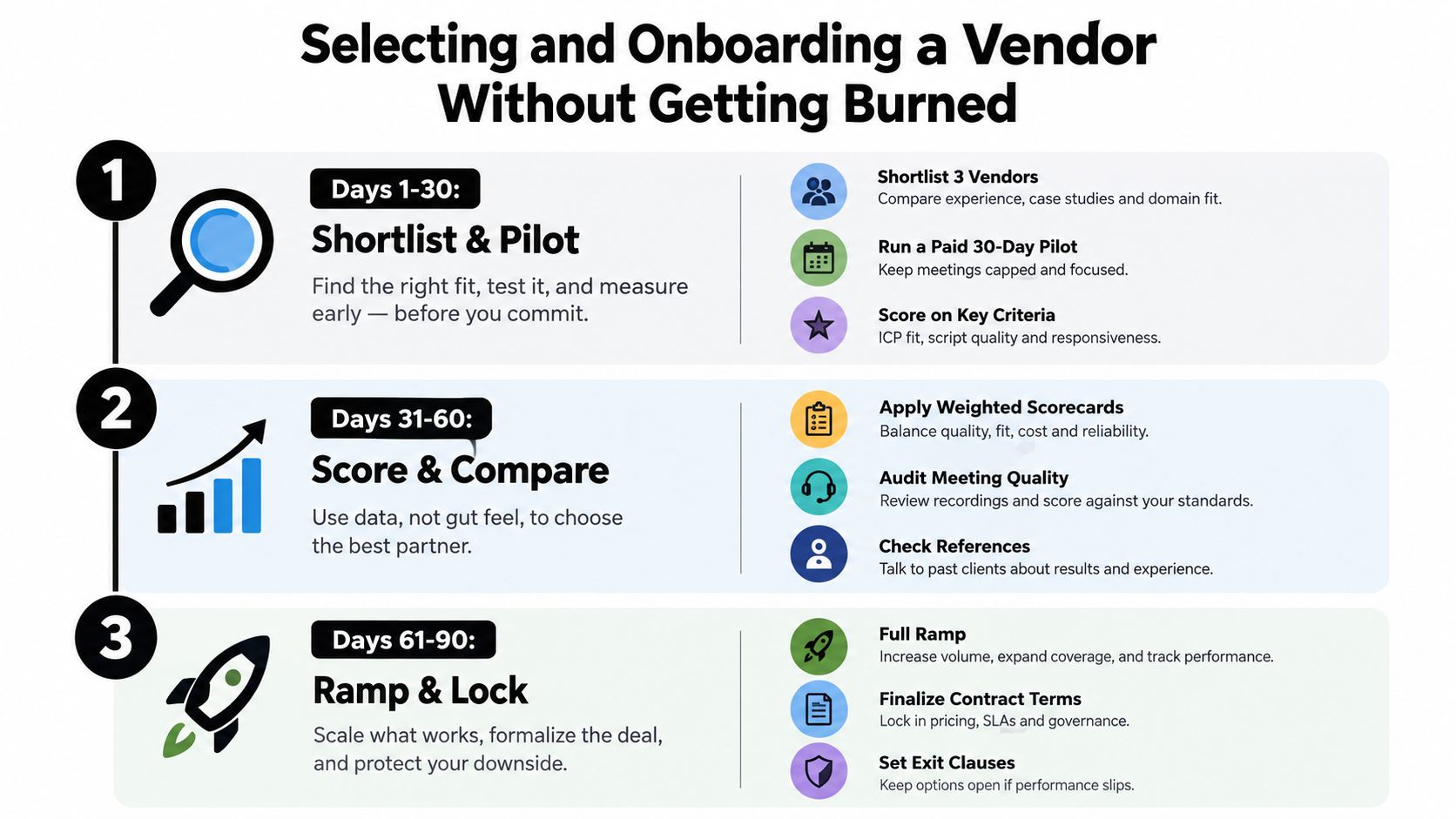
The first 30 days should be a buying exercise, not a full launch. Shortlist three vendors, run a paid pilot with capped meetings, and judge them on ICP fit, script quality, reply behavior, and how quickly they respond to feedback. If a provider won't do a constrained pilot, that's usually because they know the program only looks good when nobody is inspecting it closely.
Your pilot should force the provider to earn trust on quality, not volume. Ask for the account list before outreach starts. Ask for the draft messaging before it goes live. Ask for the delivery and reply handling logic before the first sequence launches. If they can't show you the work, they're not a partner. They're a black box.
Here's the right way to think about the first month. You're not buying meetings yet. You're buying evidence that the vendor can understand your market, write to your buyers, and respect the qualification bar you've set. If they miss on targeting, no amount of call volume will fix it.
Once you pick one vendor, formalize the ICP and persona documentation, confirm the tooling stack, and run the launch with daily QA on calls and emails. Weak vendors often start drifting into their own habits at this stage. If you don't inspect sequences, messaging, and notes, they'll optimize for convenience instead of fit.
Use this period to decide whether the provider can work inside your system or only outside it. If they can't log clean data, follow your CRM rules, or explain their targeting logic in plain English, the program won't hold up. A provider that resists transparency will eventually create internal distrust.
By day 90, you're not looking for perfection. You're looking for ramp against a defined steady-state target. A healthy pilot should be moving toward the agreed standard, not coasting on “activity” language. If the quality is still weak, exit early. Don't let sunk cost turn into annual regret.
The best contracts make this easy. They define qualification criteria, show-rate expectations, reporting cadence, data ownership, and cure periods. They also make exit cheap if the program isn't working. That's how serious operators buy.
If your SLA only tracks dials and demos, you have built a system that rewards motion, not outcomes. A vendor can look busy while sending your AEs meetings that should never have made it through qualification. Write the SLA so rejected meetings trigger a documented cure period, not a billing dispute.
Start with meeting quality. Use a clear qualification standard, such as BANT or MEDDIC, and define the persona, account type, and buying relevance in writing. Then set a show-rate floor and a conversion standard from sales-accepted lead to sales-qualified lead. A healthy program should be judged by the downstream quality of the meetings, not just the number booked.
The reporting cadence should be simple and strict. Weekly activity, monthly performance review, and quarterly business review is enough for a program of fewer than five SDR-equivalents. Larger programs usually need a mid-month quality check. Anything less makes the vendor hard to inspect. Anything more usually means the meetings are not good enough to discuss at a higher level.
If your vendor cannot tell you which meetings were accepted, which were rejected, and why, the dashboard is lying to you.
The internal reporting structure matters too. Your team needs rep-level data and program-level data side by side. The reps need feedback. The business needs trend lines. If you cannot see both, you cannot manage the motion. For teams formalizing their lead stages, this definition of a marketing qualified lead helps sharpen the handoff boundary.
| Metric | Definition | Benchmark | Reporting Frequency | Escalation Trigger |
|---|---|---|---|---|
| Meeting Quality | Qualification against your agreed standard | BANT or MEDDIC, specific persona, named account | Weekly and monthly | Rejected meetings rise or persona drift appears |
| Show Rate | Meetings that take place | 70% floor | Weekly | Falling show rate for two review cycles |
| SAL-to-SQL Conversion | Accepted leads becoming qualified opportunities | 60%+ for healthy programs | Monthly | Falling below the floor or inconsistent by rep |
| Activity Metrics | Calls, emails, touches | Secondary only | Weekly | When activity rises but outcomes do not |
| Qualified Pipeline Created | Revenue-relevant opportunity created | Program-specific | Monthly and quarterly | Flat pipeline despite rising activity |
The contract should also spell out data ownership, IP ownership of copy and workflows, and termination for cause. If you cannot export the history, you do not really own the motion. If you cannot fire the provider without a long lock-in, the contract favors them, not you.
The failure modes are boring, which is why they're dangerous. They rarely look like a collapse. They look like a steady loss of trust. The dashboards stay green while the sales team stops believing the pipeline.
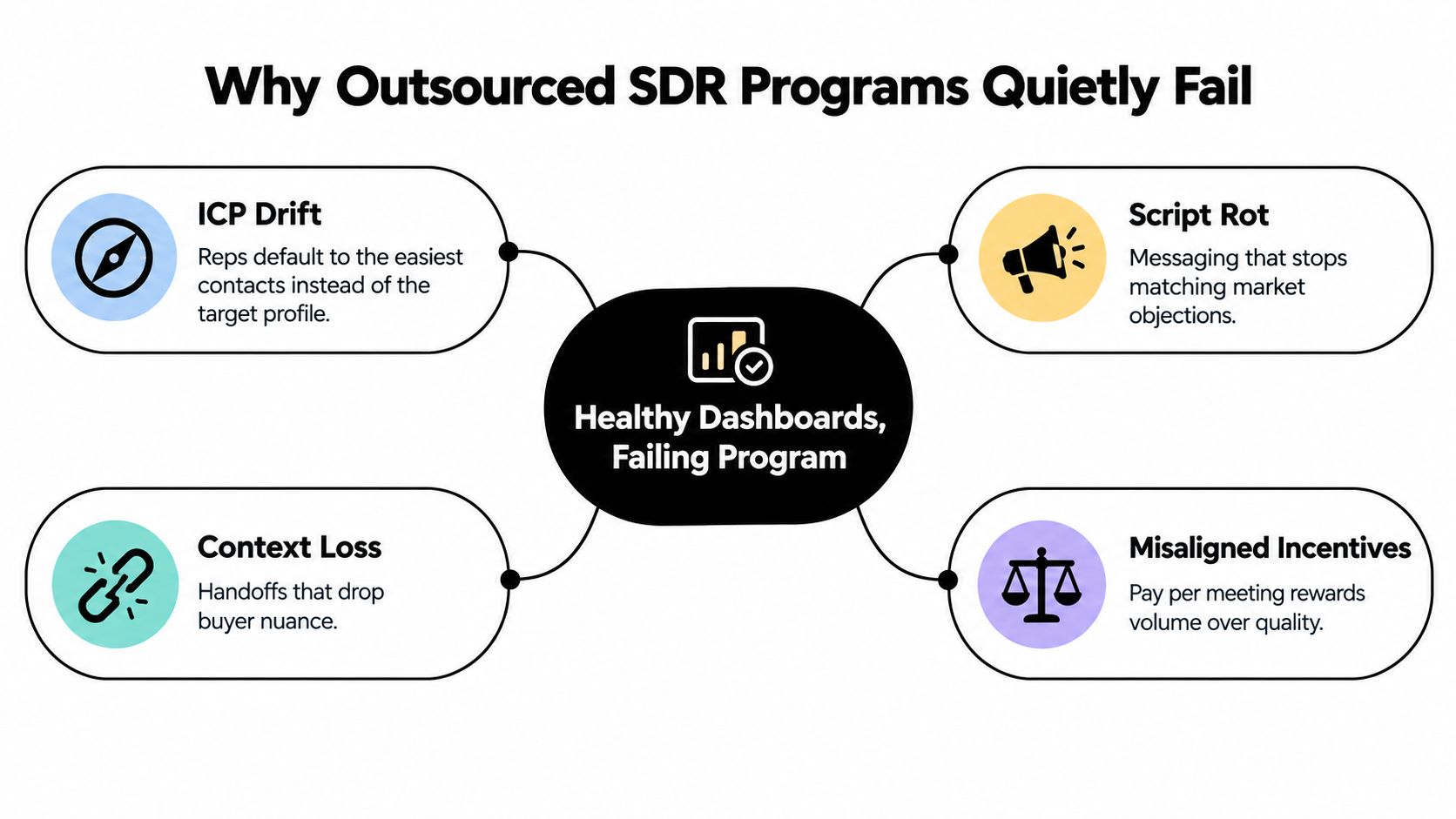
ICP drift happens when reps chase the easiest accounts instead of the right ones. Script rot happens when outreach no longer matches the objections buyers raise. Both are usually management failures first. The vendor follows the incentives you set, then tells you what those incentives produce.
The warning sign is obvious. Meetings get easier to book and harder to convert. That is not progress. It is dilution.
The handoff is where most outsourced SDR programs break. SDRs book meetings that look fine on paper, but the AE does not trust the context, so follow-up stalls. Once the sales team starts rejecting meetings without structured reasons, the provider loses the feedback loop it needs to improve.
For a practical view of the upstream motion, see this guide to outbound lead generation.
If the vendor gets paid for bookings, it will maximize bookings. If it gets paid for quality, it will optimize quality. That is basic incentive design.
Compliance is the other quiet killer. CAN-SPAM, GDPR, and DNC handling can create risk that shows up later, after the activity report has already been celebrated.
The fix is the same every time. Tighten the ICP. Tighten the definition of a qualified meeting. Force transparent handoff. Inspect the work early. If you wait until month six, you are not managing a program. You are cleaning up a mistake.
Don't choose on budget alone. Budget is usually the excuse for a deeper problem, which is that the company is not ready to hand off the motion. The key decision comes down to stage, ICP clarity, and founder attention. If those are weak, outsourcing just scales confusion.
If you're Series A or earlier and the ICP is still soft, keep sales development founder-led until the qualification logic is repeatable. You can outsource narrow tasks, but do not hand over the core motion yet. If you're Series B or beyond with a documented ICP and a proven AE motion, a hybrid model usually makes sense. Keep a small in-house pod close to product, then add an outsourced team for net-new logos or specific segments. If you're capital-constrained or pre-PMF, run one vendor pilot with strict exit terms instead of locking into a long retainer.
That framework is closer to reality than the usual in-house versus outsourced debate. The decision comes down to whether the company can supervise the work well.
| Stage & Readiness | Recommended Model | Rationale | Key Trigger to Revisit |
|---|---|---|---|
| Pre-PMF, fuzzy ICP, no playbook | Founder-led or very limited pilot support | You do not know enough yet to delegate the core motion | When qualification is repeatable and the ICP stabilizes |
| Series A, pipeline pressure, limited SDR management | Outsourced SDR pilot | Fastest way to test message-market fit without building a full system | When one segment proves repeatable and needs deeper control |
| Series B, documented ICP, proven AE motion | Hybrid | Keeps product intimacy while adding scalable outbound coverage | When the internal pod can manage quality and segmentation cleanly |
| Series C and beyond, clear segments | Hybrid or in-house core | More control, more institutional knowledge, stronger long-term operating discipline | When the company wants deeper ownership of the motion |
| Highly constrained or niche markets | Founder-led with selective outsourcing | Too much nuance for a blind handoff | When the company can define qualification and handoff precisely |
Use this build-vs-buy decision framework if you want a broader operating lens, because the SDR question is usually one part of a larger staffing decision.
The test is simple. If you cannot explain your ICP, your qualification bar, and your handoff rules without opening a slide deck, do not outsource. If you can explain them clearly and your team still cannot execute consistently, outsource the motion and keep ownership of the standard.
If you're evaluating outsourced SDRs right now, do not start with vendor demos. Start by defining the meeting you want, the handoff you can trust, and the metrics you will enforce. If you want a strategic partner that helps you think through positioning, pipeline design, and whether to build, buy, or blend, Big Moves Marketing can help you pressure-test the model before you sign a retainer.




%20-%20white.svg)