%20png%20copy.avif)
Most B2B SaaS companies define an MQL to make the marketing dashboard look healthy. That's backwards. A marketing qualified lead should exist to protect sales capacity, not to reward marketing for generating more contacts.
A loose threshold burns qualified meeting slots, delays follow-up, and teaches SDRs to distrust marketing's handoffs. The right question isn't, “How many MQLs did we create?” It's, “How much credible pipeline did we create per hour of sales attention?”
The modern MQL concept came from inbound marketing and became widely used as companies moved from broad outbound tactics toward content-led demand generation. It's now more than 25 years old, but the basic job remains the same: identify when a prospect has moved beyond casual interest and deserves a more deliberate next step. The problem is that many teams stopped measuring whether that next step creates pipeline.
Most MQL definitions are written around activity because activity is easy to count. A form submission, webinar registration, ebook download, or email click becomes a convenient event in a marketing automation platform. The system assigns a label, the dashboard improves, and sales receives another contact without enough evidence to justify the interruption.
That isn't qualification. It's administrative optimism.
Every weak MQL consumes more than an SDR's time. It occupies a follow-up slot that could have gone to a better-fit account, stalls a cadence when the contact doesn't respond, and lowers confidence in every future handoff. Reps eventually protect themselves by routing leads to nurture, ignoring alerts, or rejecting contacts without investigating them. Marketing then sees poor sales acceptance and responds by creating more leads, which makes the underlying problem worse.
The operating test: An MQL definition is useful only if it helps sales spend time where a credible buying conversation is possible.
The SaaS lead generation model is broken when the system rewards lead volume while sales carries the cost of poor qualification. Founders should challenge any dashboard that celebrates MQL growth without showing what happened after the handoff. A high count can mean stronger demand, or it can mean marketing lowered the threshold.
The benchmark gives leaders a useful warning. The average MQL-to-SQL conversion rate is reported at about 13%, meaning roughly 87% of MQLs don't reach sales-qualified status (LeadResponse's lead qualification benchmarks). That doesn't make every MQL worthless. It does prove that an MQL is an imperfect prediction, not a sales opportunity.
Healthy B2B performance is often described as closer to 15%, with broader benchmark ranges around 12% to 21% (the same lead qualification benchmark source). Use those figures as calibration prompts, not targets to chase blindly. Your actual threshold should reflect your segment, product complexity, sales motion, and the amount of sales capacity available.
The practical shift is simple. Stop asking marketing to maximize MQLs. Ask marketing to produce sales-accepted pipeline while giving sales a clear rejection reason when the definition fails.
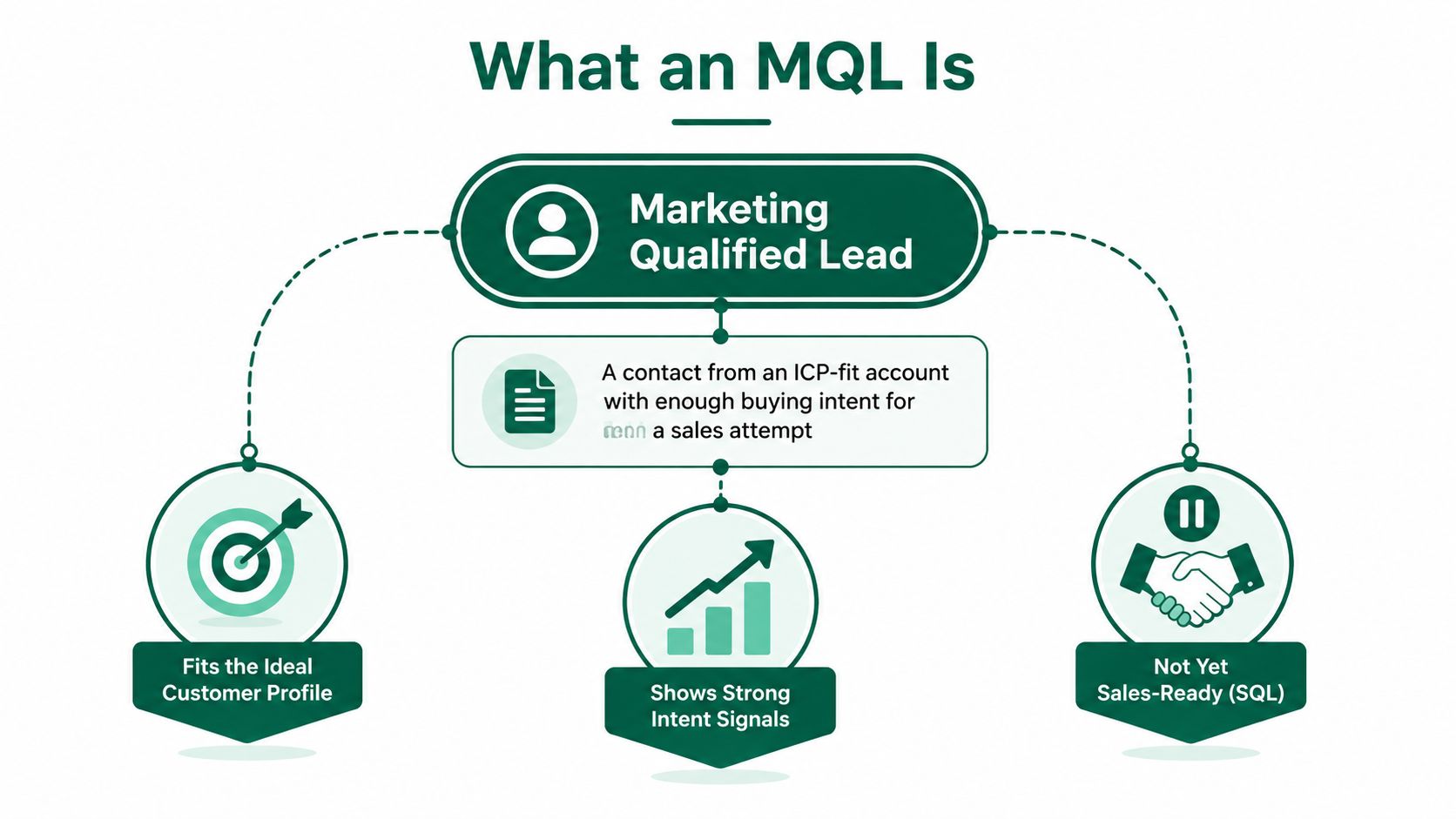
A marketing qualified lead, or MQL, is a contact from an account that fits your ideal customer profile and has shown enough buying intent to justify an initial sales attempt, without yet being confirmed as sales-ready.
That definition has three parts. The account must fit the ICP. The contact must show meaningful behavior. The evidence must be strong enough to warrant attention, but not so strong that marketing should pretend the prospect is already an opportunity.
A newsletter subscriber is a lead. A rented contact list is a lead. Someone who downloads one educational asset is usually a lead with an observable action, not automatically an MQL. The MQL status appears only after your documented criteria establish a credible combination of fit and interest.
Marketing owns the judgment at this stage. That doesn't mean marketing gets to invent the criteria in isolation. Sales should help define what evidence makes a conversation worthwhile, and both teams should agree on what happens when a contact doesn't meet the threshold.
An MQL is not the same as an SQL. The MQL is a bridge between initial demand capture and sales-confirmed readiness. It separates casual awareness from actionable interest, while leaving room for discovery to confirm need, authority, budget, timing, and buying context.
The definition has also evolved. Earlier models relied heavily on single actions such as a whitepaper download or webinar attendance. Modern buying journeys are more self-directed, so stronger definitions combine multiple touches, firmographic fit, role, account context, and negative filters. Some teams now evaluate an account and its engaged contacts together rather than treating one isolated person as the whole opportunity.
For a practical explanation of the qualification mechanics, qualify leads with SupportGPT offers useful context on combining signals without treating every interaction as purchase intent. You can also use this B2B lead qualification framework to turn the definition into an operating rule.
The final test is downstream. An MQL exists because it should predict a worthwhile sales action and, eventually, pipeline. If the label only proves that marketing activity occurred, it's not doing its job.
The cleanest way to stop stage confusion is to assign each label a distinct question.
An MQL answers, “Has marketing seen enough fit and intent to recommend a sales attempt?” An SQL answers, “Has sales engaged and confirmed a legitimate opportunity worth active pursuit?” A PQL answers, “Has product usage shown that this user or account is reaching meaningful value and may need a commercial conversation?”
Unqualified inbound is everything that hasn't earned one of those statuses. It may include content subscribers, early researchers, poor-fit companies, students, competitors, or contacts whose behavior lacks enough context.
| Stage | Owner | Required Evidence | Typical Signal |
|---|---|---|---|
| MQL | Marketing | ICP fit plus documented intent threshold | Pricing-page visits, webinar attendance, repeat content engagement |
| SQL | Sales | Sales confirmation of a legitimate buying conversation | Discovery confirms need, authority, and a credible path forward |
| PQL | Product and growth, with sales involvement when appropriate | Product activation or usage indicates commercial potential | Meaningful use within a self-serve or PLG motion |
| Unqualified inbound | Marketing nurture or no active owner | Initial interest without sufficient fit or intent | Newsletter signup, isolated download, generic inquiry |
The common mistake is treating MQL and SQL as interchangeable. That destroys accountability. Marketing becomes responsible for a stage it can't fully validate, while sales gets blamed for rejecting contacts that were never ready for direct engagement.
In a sales-led SaaS motion, the MQL is the gap between initial capture and meaningful sales ownership. Once an AE or designated sales owner has taken responsibility and confirmed the opportunity, the lead can become an SQL. In a product-led motion, a PQL may bypass some traditional MQL logic because the product itself supplies stronger evidence than content engagement.
The labels should also remain stable across quarters. A useful HubSpot lifecycle mapping guide can help teams map lifecycle stages without allowing CRM terminology to drift. The tool matters less than the discipline. Each stage must have an owner, evidence standard, and next action.
If your CRM marks every high-scoring contact as an SQL, your reports are overstating sales readiness. If it marks every product user as an MQL, your marketing team is obscuring the difference between product value and buying intent.
Single-axis scoring fails because it confuses one type of evidence with the whole decision. A prospect can show intense engagement and still be a terrible customer fit. Another can match the ICP perfectly but show no sign that a purchase is under consideration.
A durable MQL model uses two axes:
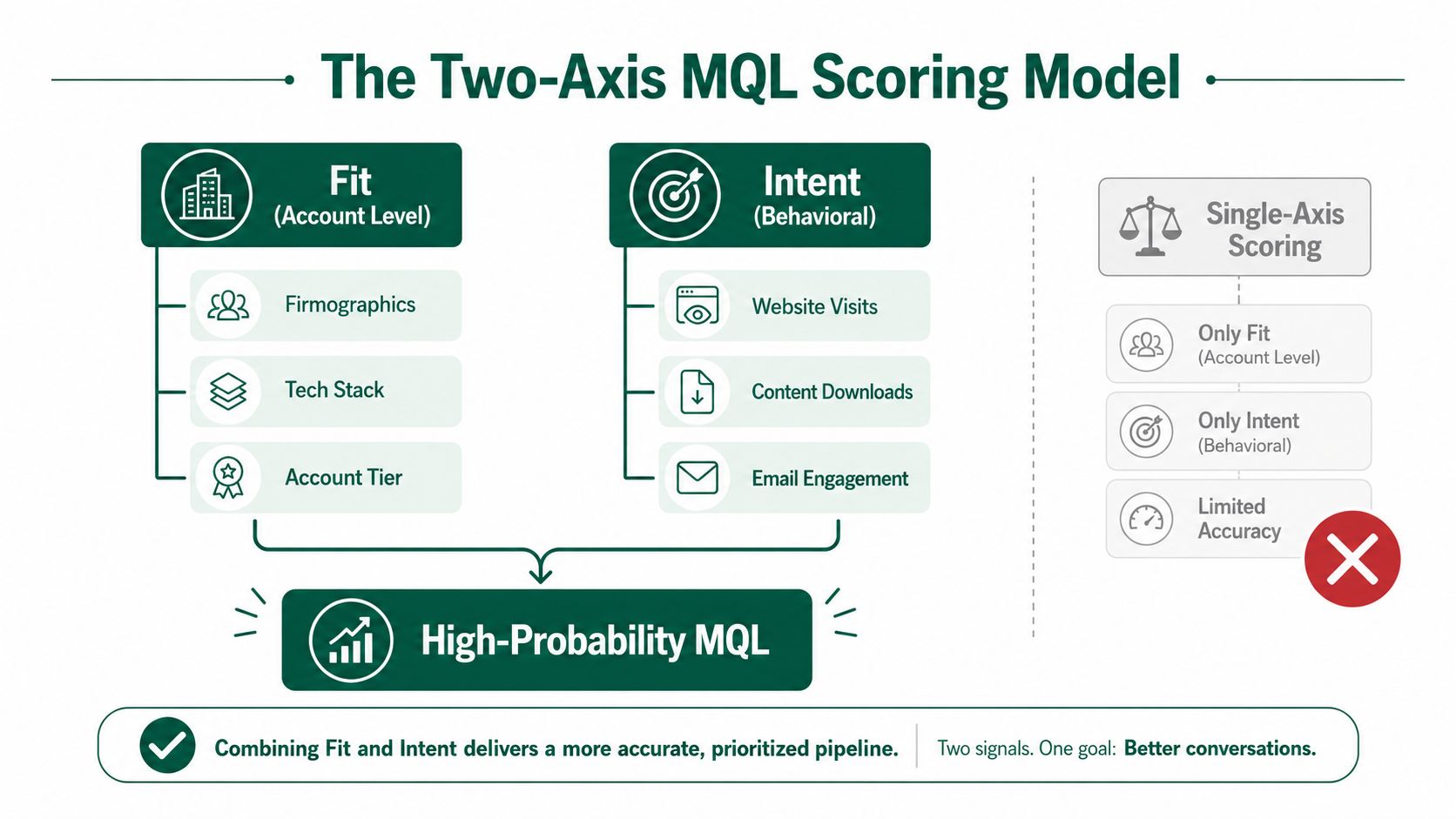
Fit can include company size band, industry, geography, technology stack, use case, account tier, and role. A director, VP, or operational owner may carry more relevance than a student or individual contributor, depending on your product. Intent can include repeat visits to pricing, meaningful time on demo or comparison pages, multiple content downloads, webinar participation, ROI calculator requests, or a direct inquiry.
Assign numeric weights only after deciding what each signal means. A pricing-page visit should not automatically qualify someone. A pricing-page revisit from an ICP-fit account, combined with a relevant role and a request for evaluation material, carries a different meaning.
Use separate fit and intent fields in the CRM instead of hiding everything inside one opaque score. Then set a threshold that requires enough evidence on both axes. A contact should not qualify just because one category overwhelms the other.
Negative filters are equally important. Suppress or subtract from contacts that are clearly outside the buying motion, including:
For teams evaluating automation, this practical AI lead scoring guide provides useful context on using models without surrendering judgment to a black box. Your ideal customer profile template should supply the fit rules before anyone assigns points.
Review the model after enough leads have moved through it to expose false positives and false negatives. A 90-day review can identify which signals create sales acceptance, which sources create noise, and where the threshold needs adjustment. Don't let the score become a permanent label that no one challenges.
Consider two fictional SaaS companies selling revenue operations software. Both receive a content download. Only one should create a sales task.
In the weak example, a ten-employee agency downloads a general whitepaper. The contact is a junior researcher, the company sits outside the ICP, and no other buying behavior appears. A form-fill-based system creates an MQL anyway. The SDR sees a name, an email address, and a generic asset title. There's no account fit and no reason to believe a sales conversation is timely.
In the disciplined example, a VP of Revenue Operations at a 400-person SaaS company revisits the pricing page twice and requests an ROI calculator. The account matches the target segment, the role has direct relevance, and the behavior indicates evaluation rather than casual learning. The SDR sees the account profile, the role, the relevant pages, and the recommended reason for outreach.
| Scenario | Fit Signals | Intent Signals | Score | Outcome |
|---|---|---|---|---|
| Agency whitepaper download | Ten-person agency, junior researcher, outside target profile | One educational download | Low fit, low intent | Remains in nurture |
| SaaS pricing evaluation | VP of Revenue Operations, 400-person SaaS, target segment | Pricing-page revisits plus ROI calculator request | High fit, high intent | Routed for sales attempt |
| Mid-market operations research | Relevant industry and operational role | Webinar attendance followed by comparison-page visit | Strong fit, developing intent | MQL with contextual outreach |
| PLG expansion signal | Existing account using the product in a relevant team | Usage pattern suggests broader departmental need | Product-led fit plus account intent | Routed according to expansion rules |
The scores above are deliberately expressed as qualitative combinations, not invented universal point values. Your score should be tied to evidence from your own funnel.
A good MQL record answers three questions before the rep opens the lead:
A mid-market contact may qualify with fewer signals than an enterprise account if the buying motion is simpler. A PLG user may need product activation evidence rather than content engagement. The definition should adapt to the motion without lowering the standard.
The litmus test is blunt: would a senior rep pick up the phone after reading the record? If the answer is no, marketing hasn't created an MQL. It has created a task.
A vague handoff protects no one. Marketing marks a contact as qualified, sales receives an alert, and the prospect waits while teams argue over ownership. Treat the MQL definition as a sales-protection mechanism. Volume matters only when it produces pipeline that sales can work.
An SLA must specify the operational sequence: who owns the lead, how quickly that person responds, what outreach standard applies, and how the lead is dispositioned. The attached flow shows less than one hour for response and three attempts in five days as process examples. Set your own requirements from funnel evidence rather than copying the visual.
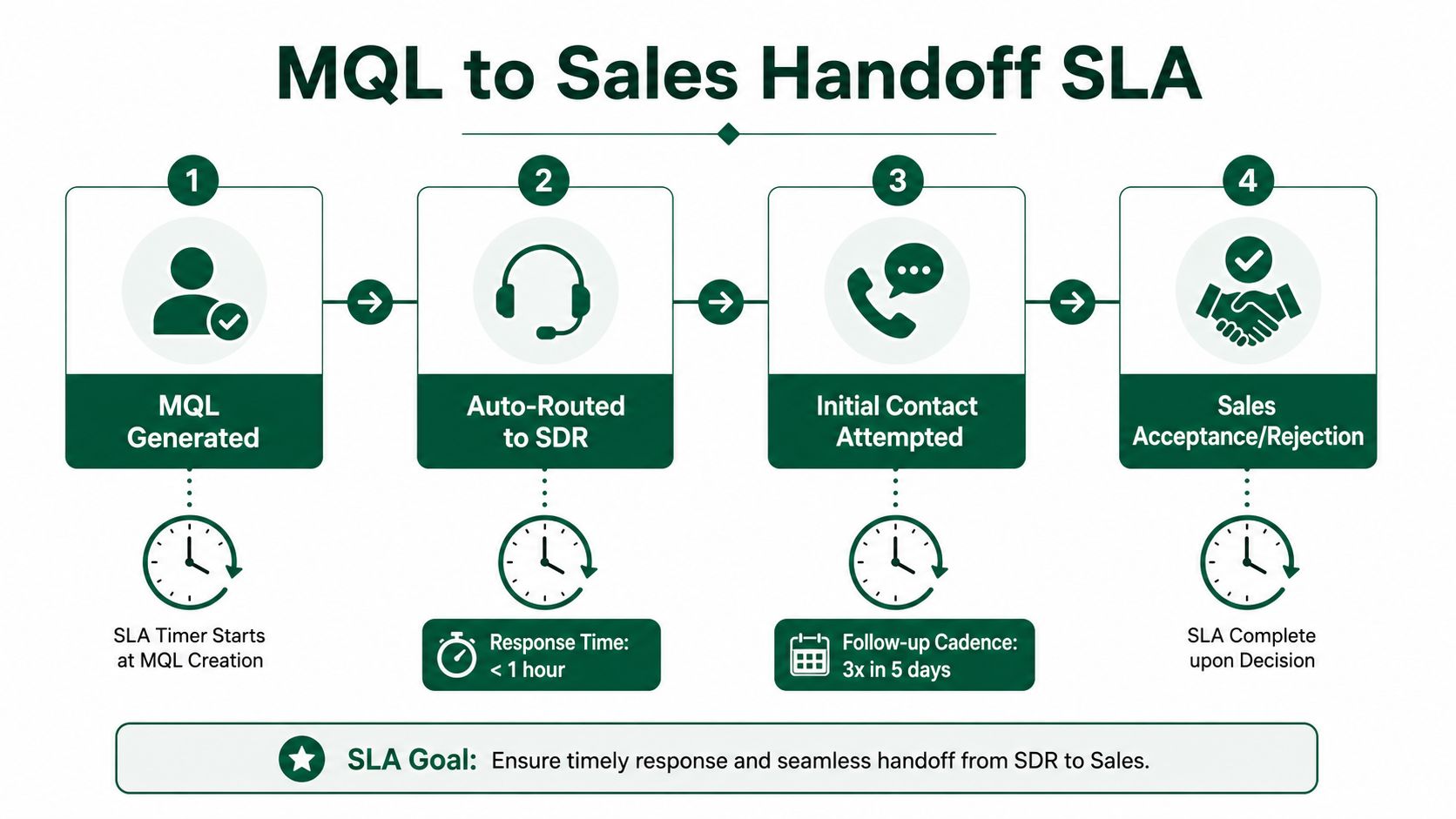
The CRM record should show account fit, contact role, recent intent signals, source, score components, and a suggested opening. Sales then selects a clear status, such as accepted, rejected for fit, rejected for timing, recycled to nurture, or duplicate.
Routing should match the account's commercial context. Use segment, geography, product line, named-account ownership, and territory to assign leads. Round-robin routing can suit lower-value volume, but it creates distrust when a high-value account reaches a rep who lacks ownership or account context.
Document the B2B marketing and sales alignment process in the CRM. A recurring meeting cannot replace visible rules, assigned owners, and recorded decisions.
Track the measures that expose pipeline quality:
LeadResponse reports an average MQL-to-SQL benchmark of about 13% across industries (LeadResponse's qualification statistics). Use that figure as context for comparison. Set targets from your own funnel, and reject any goal that encourages weak leads into the sales queue. An improving rate matters only when sales acceptance and opportunity quality improve with it.
Review performance weekly. Recalibrate the definition with marketing and sales every quarter. Marketing owns the model, sales owns the acceptance decision, and leadership owns the shared economic outcome.
The same defects appear across early-stage and growth-stage SaaS teams. They rarely require a new tool. They require a rule that someone failed to define.
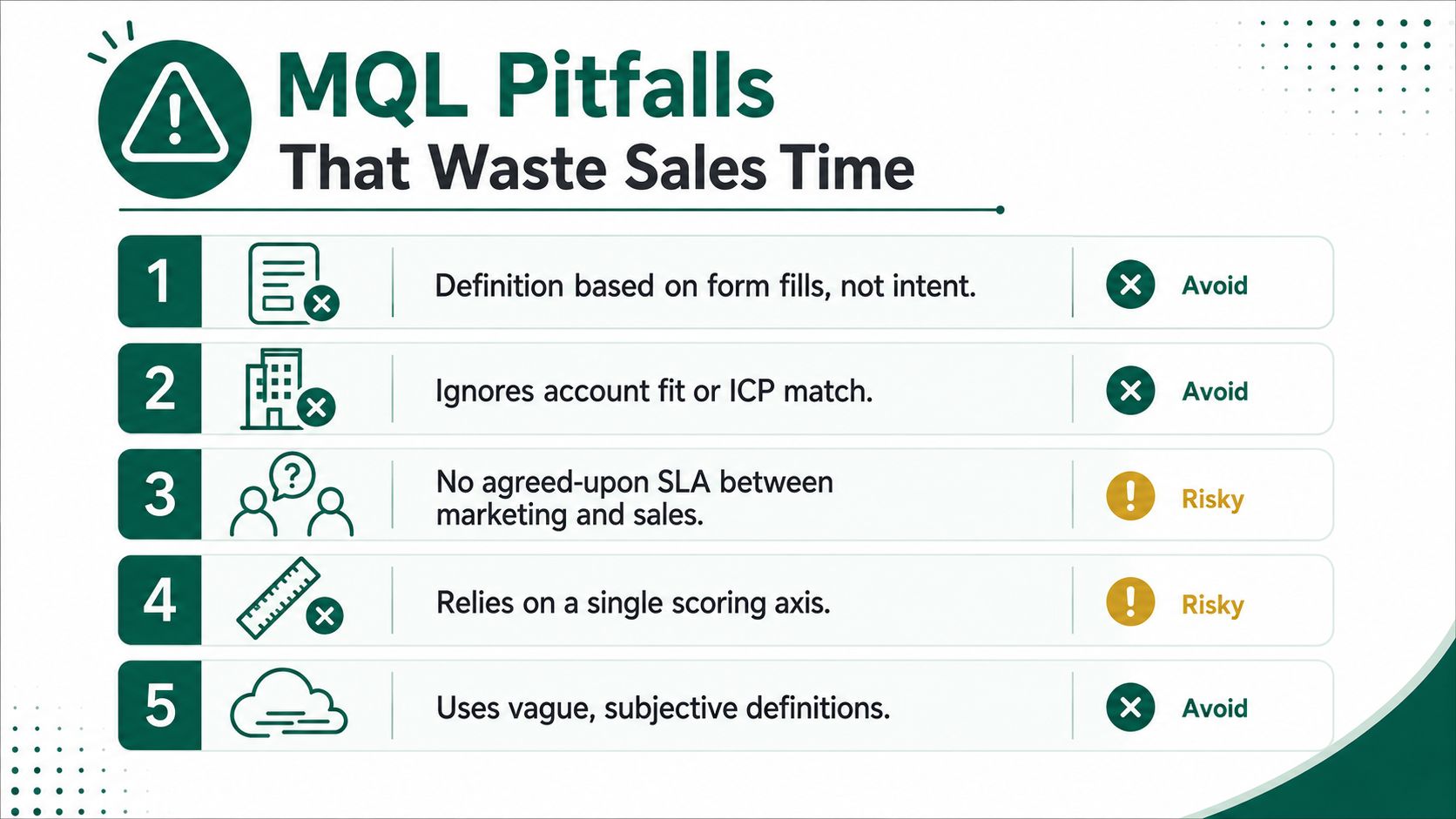
The most damaging mistake is rewarding MQL volume as if it equals revenue. That incentive pushes marketers to lower thresholds, add weak activities, and defend output rather than improve pipeline quality.
A useful constraint: Every MQL rule should answer what sales does next and what evidence would cause sales to reject it.
A score is not a strategy. A workflow is not qualification. Automation can execute a bad definition faster, but it can't make the definition sound. MQL success means sales-accepted pipeline contribution, not a larger number in a marketing report.
Rebuilding qualification doesn't require a consulting project. It requires a short operating cycle, direct sales input, and a written decision that someone owns.
Pull the latest MQL cohort available to your team and label each record with sales input. Separate accepted contacts from rejected ones, then classify the rejection reason. Look for patterns in account fit, role, source, behavior, timing, and data quality.
Don't begin by redesigning the score. First identify what your current definition gets wrong. A marketing automation workflow should support the process after the rules are clear, not substitute for the decisions.
Write the ICP criteria in plain language. Define the account characteristics that qualify for attention, the roles that matter, and the behaviors that indicate evaluation. Then separate positive signals from negative filters.
Create fit and intent fields rather than one unexplained total. Set a threshold that requires evidence in both categories, and define exceptions for PLG, expansion, named accounts, and high-intent requests.
Document routing by segment, geography, product line, and account ownership. Write the SLA, acceptance statuses, rejection reasons, and nurture rules into the CRM. Every MQL should arrive with enough context for a rep to understand why it was routed.
Assign one marketing owner and one sales owner. Shared responsibility without named ownership becomes nobody's responsibility.
Instrument MQL-to-SQL conversion, MQL-to-opportunity conversion, sales acceptance, rejection reasons, and pipeline created. Review the first results with sales and adjust the threshold only when the evidence supports a change.
Put the final marketing qualified lead definition in writing. Schedule a quarterly review so the model can respond to changes in product, ICP, buying behavior, and sales capacity without drifting informally.
Big Moves Marketing helps B2B SaaS founders and revenue leaders clarify positioning, define qualification thresholds, and connect demand programs to measurable pipeline rather than MQL volume. If your sales team distrusts the current handoff, visit Big Moves Marketing to discuss a practical growth system built around clearer decisions and less wasted sales motion.



%20-%20white.svg)