%20png%20copy.avif)
A strong B2B brand isn't about a flashy logo or a clever tagline. It's the entire framework that dictates how your business is perceived by other businesses. For SaaS and AI startups, it’s the blueprint for building trust, creating real distinction, and making sure your solution is seen as the only logical choice in a crowded market.
In the world of B2B technology, a great product is just the entry fee. The real challenge is communicating your value in a way that actually resonates with complex buying committees, long sales cycles, and decision-makers who have done their homework. A well-defined brand strategy is what moves your company beyond a list of features, transforming it into a trusted partner.
This isn’t just theory; it’s where the market is headed. A recent survey showed that 40.0% of B2B marketers plan to increase their brand-building budgets in 2025. For founders, this is a clear signal: memorable positioning and strong brand awareness are becoming critical differentiators. Winning on product features alone is getting harder by the day.
This guide lays out a practical, hands-on framework for building a commanding brand from the ground up. It’s the exact process I’ve used to help countless startups define their audience, craft powerful messaging, and launch with incredible impact.
The process is straightforward and breaks down into three core phases: Define your foundation, Craft your identity, and Launch your brand into the market.
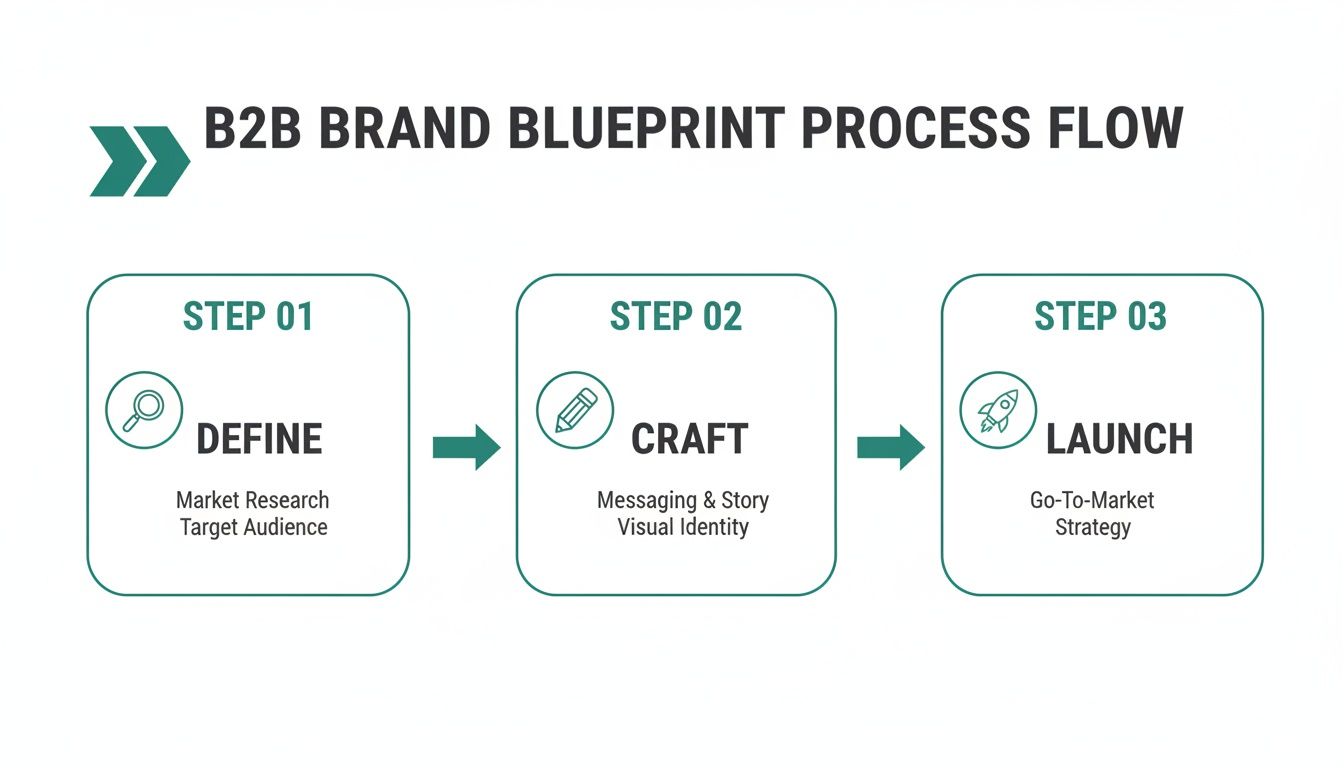
Each stage builds directly on the last, ensuring your brand is not only authentic but also strategically designed to drive real business growth. Think of this as your playbook for turning a promising product into a dominant brand.
Your brand is the sum of all experiences a customer has with your company. A great strategy ensures those experiences are consistent, memorable, and aligned with your business goals.
To give you a quick preview, here's a look at the core components we'll be building throughout this guide. Each piece is a critical pillar in constructing a brand that not only looks good but performs.
This table outlines our roadmap. We’ll cover everything from identifying your precise customer profile to building sales enablement tools that truly empower your team.
As you get started, it can be helpful to explore a variety of 10 actionable brand development strategies to see what might work for your specific situation.
Let's build a brand that makes you unforgettable.
Your entire B2B brand strategy is built on one thing: a deep, almost obsessive understanding of your business customer. Before you write a single line of copy or pick a single color for your logo, you have to go beyond surface-level data and build a rich, actionable Ideal Customer Profile (ICP).
This isn't just about knowing their job title and company size. It's about getting inside their head to understand the human drivers behind what are often complex, high-stakes business decisions.
Get this part wrong, and you’ll end up with a brand that tries to speak to everyone but connects with no one. B2B purchases, especially for SaaS and AI, aren’t impulsive. They involve multiple decision-makers, serious budgets, and long evaluation cycles. Your brand’s job is to connect with the very real people navigating that messy process.
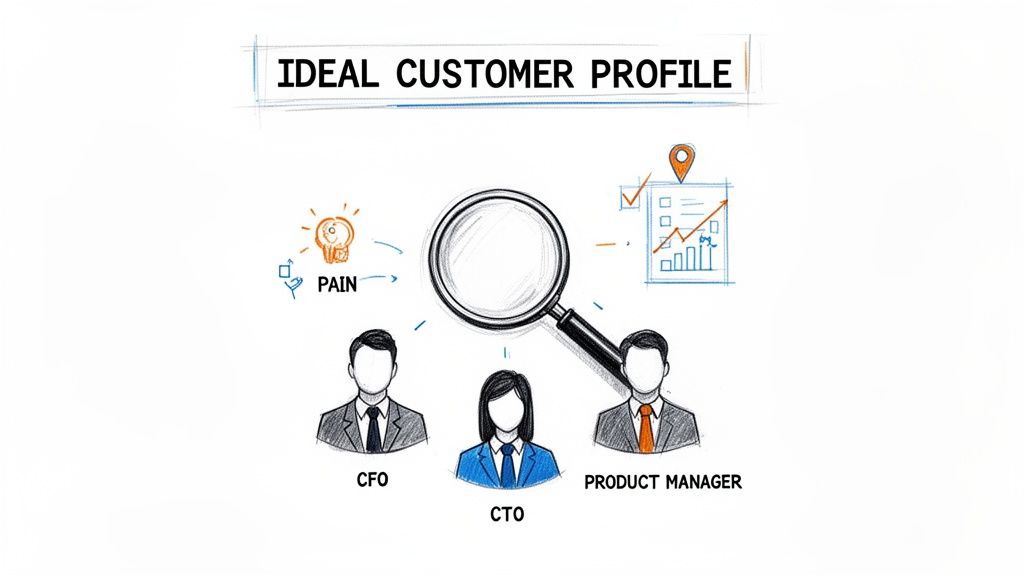
A true ICP is a portrait of the company—and the people inside it—that gets the absolute most value from your solution. This means digging deeper than firmographics like employee count and industry to uncover the real-world problems and professional ambitions that keep them up at night.
You need to start asking better questions:
Answering these turns your ICP from a stale document into a strategic weapon that guides every single decision you make.
An effective Ideal Customer Profile doesn't just describe who your customers are today. It defines who your most profitable and successful customers should be, creating a clear target for your entire organization.
Spreadsheets and analytics can tell you what your customers are doing, but only real conversations can tell you why. The most powerful, game-changing insights I’ve ever seen have come directly from talking to current customers, prospects who ghosted us, and even people who chose a rival.
The trick is to frame these calls as genuine discovery sessions, not sales pitches in disguise. I’ve found that a simple, open-ended approach gets people to open up about their world, not just their opinion of my product.
A Few Questions I Always Ask:
These interviews give you the raw material—the exact words, the specific frustrations, the success metrics that matter—that will become the fuel for your brand messaging. You'll literally hear the language they use to describe their problems, which is the secret to sounding like you truly get them.
Your ICP shouldn’t be a PDF that gets created once and then forgotten in a shared drive. It’s a living, breathing document that gets smarter as you learn more about your market.
Pull everything together—insights from interviews, notes from sales calls, industry data—into a clear, shareable profile.
If you're looking for a solid framework to get started, you can download a comprehensive ideal customer profile template here. It'll help you structure your research and make sure you're not missing any critical pieces.
This document becomes the North Star for your marketing, sales, and product teams. It’s how you ensure every ad is relevant, every sales call hits home, and every new feature is built for the right people. It’s how you build a brand that actually matters.
Now that you know exactly who you're talking to, it's time to figure out what you're going to say that makes you different. Let's be honest, the B2B market is overflowing with solutions. Being just a little bit better than the next company is a surefire way to be ignored.
The goal isn’t to be incrementally superior; it’s to be fundamentally distinct.
This is all about positioning. It’s the art of claiming a specific, memorable piece of real estate in your customer's mind. When they think about the problem you solve, your brand should be the first one that pops into their head, for a very specific reason.
Before you can plant your flag, you need to understand the terrain. This means looking beyond your direct opponents to see what other solutions—or even workarounds—your ideal customers are using right now.
I've seen it a hundred times: a startup’s biggest rival isn’t another slick software company. It's a cobbled-together spreadsheet, an overworked intern, or just plain old inertia.
Start by figuring out what attributes actually matter to customers in your space. For a B2B SaaS tool, this might come down to:
Try plotting your rivals on a simple two-axis grid using these attributes. You’ll often find they're all clustered in one corner, leaving a huge, underserved area wide open. That's your "white space." It's your opportunity to offer something no one else is.
If you want a practical way to visualize this, our positioning map template can walk you through creating one.
Once you’ve got a clear view of the market, you can nail down your unique position in a single, powerful statement. This isn't some fluffy marketing tagline you put on a t-shirt. It's an internal North Star that guides every single decision you make—from product development to sales emails.
A solid positioning statement forces you to be brutally clear and concise. It makes you name your target, define their pain, state your unique value, and explicitly call out the alternative you’re trying to replace.
Here’s a simple framework to help you build one, along with a fictional example for an AI sales tool to show you how it works.
Positioning Statement Framework
Getting this specific is more critical than ever. The latest B2B marketing trends show a massive shift toward AI-driven personalization and account-based marketing (ABM). In fact, 75% of marketers say ABM improves their upsell opportunities, while strong personalization can boost revenue by up to 15%.
A generic brand position just won't cut it anymore. Your strategy has to be sharp enough to fuel highly targeted, personalized outreach that actually resonates.
Your positioning statement is your high-level promise. But a promise is just words until you back it up with a clear messaging hierarchy and tangible proof. This is how you ensure your brand story is consistent and believable at every single touchpoint, from a keynote speech down to a feature description on your pricing page.
Think of your messaging as a pyramid:
For instance, if a SaaS company's promise is "Effortless Compliance for Finance Teams," its value pillars could be "Automated Reporting," "Ironclad Security," and "Audit-Ready Trail." Each of those pillars would then be supported by a list of features and customer case studies that prove they can deliver.
This framework ensures your story isn't just compelling, but also defensible, clear, and consistent.
You’ve nailed down your positioning and you know where you fit in the market. Fantastic. Now it’s time for the fun part: bringing that strategy to life with a look and a voice people will remember.
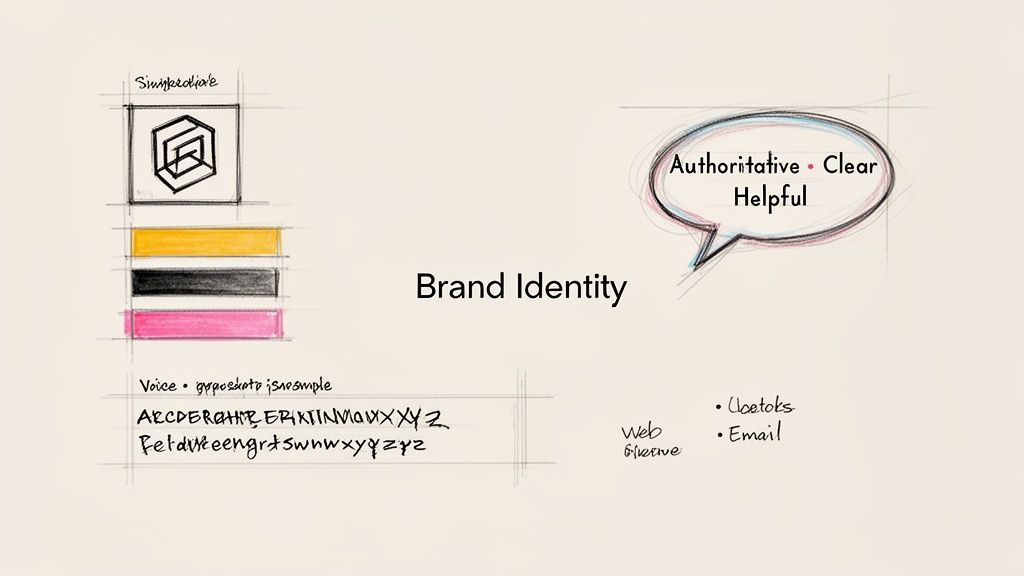
This is the point where abstract ideas become tangible. Your visual and verbal identity are the sensory expressions of your brand—the distinct personality, look, and feel that your audience will interact with at every single touchpoint. It’s about building a consistent and memorable experience, long before they ever read a feature list.

Your verbal identity is simply how your brand speaks. Is it an authoritative expert? A witty, relatable partner? An insightful guide who clears the fog? Your brand voice should be a direct reflection of your company’s personality and resonate deeply with your ideal customers.
Start by defining a handful of core personality traits. For a B2B AI startup, you might land on something like this:
These traits become the North Star for every piece of communication, from your website copy and sales emails to social media posts and even your technical documentation. If you're looking for a structured way to build this out, exploring different messaging framework examples can provide a solid foundation.
A brand's voice is its fixed personality; its tone is the mood it adapts for different situations. You have one voice, but you might use a more formal tone in a whitepaper and a more casual one on social media—while still sounding like you.
Your visual identity is the collection of design elements that people see. For an early-stage B2B startup, you don’t need a massive budget, but you absolutely need consistency across these core components.
This consistency is what builds recognition and trust over time. It’s non-negotiable in today’s market, where your brand has to show up effectively on every platform imaginable. Recent data shows that by 2025, mobile will account for nearly half of all B2B ad spending, and 83% of B2B marketers rely on content marketing to build brand awareness. Your visual and verbal identity must be strong and adaptable enough for this reality.
Even on a lean budget, you can get professional results by hiring a freelance designer. The absolute key to success here is providing an exceptional creative brief. A great brief saves countless hours, reduces frustrating revisions, and ensures the designer truly understands your vision.
Your brief needs to clearly outline:
Providing this level of detail empowers a designer to translate your hard-earned strategy into a compelling visual identity that truly represents your brand. Don't skip this step.
Let’s be honest. A beautiful brand strategy that sits in a Google Drive folder is worthless. Its real power is only unlocked when your sales team—the people on the front lines every single day—can bring it to life in conversations with actual buyers.
This is where the rubber meets the road. Activating your brand through sales enablement is all about equipping your sellers with the right tools, talking points, and intelligence to become your most compelling brand ambassadors. We're moving from high-level strategy to the practical assets that win deals.
Your pitch deck isn't just a slide presentation; it's the primary story you tell the market. A deck that just lists features is a surefire way to be forgotten the second the Zoom call ends. You need a narrative that hooks them.
A truly effective B2B sales deck doesn't lead with the product. It leads with the problem and follows a proven story arc:
Structuring your pitch this way transforms you from another vendor into an insightful partner who genuinely understands their world.
If the pitch deck is the story's structure, the messaging playbook is the script your actors use. It's an internal-only guide that gets everyone speaking the same language—absolutely critical for complex SaaS and AI products.
Think of the playbook as your company's single source of truth for communication. It eliminates guesswork and empowers everyone, from a new SDR to a seasoned account executive, to talk about your company with precision and confidence.
Your messaging playbook is what stands between brand consistency and brand chaos. It ensures that no matter who a prospect talks to, they hear the same core story, value, and differentiators.
A great playbook is relentlessly practical and easy to scan. It should include:
Building out this toolkit is a core part of what high-performing teams do. For a deeper dive, exploring a range of sales enablement best practices can provide more frameworks to get this right.
Your team is going to run into rivals. It's inevitable. Battlecards are your secret weapon for those moments, giving sellers the intel they need to strategically position your solution as the obvious choice—without resorting to mud-slinging.
Each battlecard should focus on one specific rival and be designed for a quick glance during a live call.
A Winning Battlecard Format
By creating these three assets—the pitch deck, messaging playbook, and battlecards—you do more than just help your sales team. You turn your brand strategy from a document into a living, breathing force that actively drives your sales motion. You empower your people to not just hit their number, but to build your brand, one powerful conversation at a time.
The brand strategy you've built isn't just a slide deck; its real value comes to life the moment it hits the market. A successful launch is a coordinated, multi-channel push designed to introduce your new identity with momentum and a clear message. It’s less like flipping a switch and more like conducting an orchestra.
Think beyond just updating your homepage. A powerful launch sequences every activity to make a massive first impression. This means orchestrating updates across your website, blog, and email campaigns while simultaneously firing up your PR and paid media engines to build that crucial initial buzz.
Once you're live, the real work starts: measuring what actually matters. It's so easy to get caught up in vanity metrics like social media likes or a temporary spike in website traffic. While those numbers aren't useless, a true B2B brand strategy is measured by its direct connection to revenue.
Your focus has to be on the Key Performance Indicators (KPIs) that tell a story about business growth. These are the numbers that justify the investment and help you make smarter decisions down the road.
A great brand doesn't just attract attention; it shortens sales cycles, improves win rates, and attracts higher-quality leads. These are the outcomes that secure future investment and prove your strategy is working.
To really see how your brand is performing, you need to track the metrics that bridge the gap between marketing efforts and sales results. These are the KPIs that should be on every brand leader's dashboard:
By zeroing in on these business-centric KPIs, you stop treating your brand as just a creative project and start managing it as a measurable growth engine. You build a clear, data-backed narrative showing exactly how a strong brand creates a healthier bottom line, ensuring it stays a top priority for the whole company.
Even with the best framework laid out, theory only gets you so far. When you start putting a B2B brand strategy into practice, the real-world challenges pop up. Founders and marketers I work with often run into the same roadblocks, from getting the whole team on board to figuring out how to stay relevant in a market that changes every six months.
Let's dive into some of the most common questions I hear and get straight to the practical answers.
One of the biggest hurdles is getting buy-in from leadership, especially from product or sales-focused execs who live and die by the daily metrics. They want to see an immediate, tangible return on any investment, and "brand" can feel a bit fuzzy to them.
The key is to reframe the conversation. Stop calling it a marketing expense and start calling it a sales accelerator. Show them exactly how a compelling brand story and clear positioning lead to higher win rates, shorter sales cycles, and better-fit customers who don't churn. Use the KPIs we talked about earlier—like your win rate against a specific rival—to draw a straight line from brand activity to revenue.
When it feels like your market is overflowing with similar solutions, the instinct is to shout louder. That's a mistake. The real answer is to speak more clearly to a very specific group of people.
This is where niche-driven strategies are a B2B startup's best friend. Forget trying to be everything to everyone. Instead, get laser-focused on your Ideal Customer Profile and solve one of their problems better than anyone else on the planet. Your differentiation might not even be a groundbreaking feature. It could be your deep industry expertise, a unique service model, or a brand voice that connects with a specific professional community.
True differentiation isn't about having a better product; it's about owning a specific problem.
Your brand isn't what you say it is. It's what your customers experience at every touchpoint. Consistency in that experience is what builds the trust that leads to long-term loyalty and advocacy.
Your brand strategy should be a living, breathing guide, not a dusty document you create once and forget about. While you definitely don't need a massive, expensive rebrand every year, you should be conducting a brand audit annually.
Take a hard look at your messaging, your market positioning, and your visual identity. Do they still line up with your business goals and the current market? More often than not, what you need is an evolution, not a revolution. A simple refinement of your core message or a subtle modernization of your visual style can be far more effective.
The goal is to stay relevant without sacrificing the recognition and trust you've worked so hard to build.
Ready to build a brand that opens doors and closes deals? At Big Moves Marketing, I specialize in creating the positioning, messaging, and sales tools that help B2B SaaS and AI startups win. Let's create your unfair advantage. https://www.bigmoves.marketing
Explore Big Moves Marketing services and resources:


%20-%20white.svg)