%20png%20copy.avif)
The 'Marketing Mix 4Ps'—Product, Price, Place, Promotion—is a framework most founders recognize from business school. They treat it as a checklist, populating it with generic tactics. This creates fragmented motion, not strategic momentum.
The problem isn't the framework; it's the superficial application. It's used as a classification exercise, not a tool for strategic design. To see how these components connect in practice, teams often look at powerful examples of marketing mix strategies without deconstructing the underlying logic.
This is not another theoretical overview. We will dissect the execution models of B2B SaaS companies that weaponized the interplay between the 4Ps. Each marketing mix 4ps example reveals hard strategic choices, trade-offs, and the first principles behind their growth.
The goal is to internalize their strategic logic, not to copy their tactics. We will analyze what they did, why it worked, and—more importantly—what most teams miss when they try to replicate it. Let's analyze the models.
Slack did not invent team chat. It perfected the go-to-market motion for it. Its success is a masterclass in using Product and Price to create a viral loop that bypasses traditional, top-down enterprise sales. This is a critical marketing mix 4ps example for any founder executing product-led growth (PLG).
Slack’s strategy was built on a simple premise: make the product so good that teams adopt it themselves, forcing the organization to purchase it. The free tier was not a stripped-down demo; it was a fully functional tool that solved a real pain point, onboarding over 750,000 new teams annually during its peak growth.
Key Insight: Slack treated its free product not as a lead magnet but as its primary acquisition channel. The objective was deep user adoption first, monetization second.
This model is potent when your product’s value increases with the number of users inside an organization. If your product fosters collaboration, study how Slack aligned its entire marketing mix to turn individual users into internal champions. Understanding the core concepts of what a marketing mix is provides essential context for these interconnected decisions.
Salesforce didn't just pioneer SaaS; it defined the playbook for enterprise-scale B2B distribution. Its dominance is a result of a disciplined approach to Place and Promotion, creating a go-to-market machine few have replicated. This is a critical marketing mix 4ps example for founders looking to move upmarket.
The company's core strategy rejected a one-size-fits-all model. Instead of selling a generic CRM, Salesforce systematically segmented the market by industry, building targeted solutions and sales motions for each. This verticalization allowed them to speak the customer's language, solve specific pain points, and command premium prices.
Key Insight: Salesforce treats industries as separate markets. By verticalizing its entire go-to-market motion—from product to sales—it built deep moats that horizontal competitors cannot cross.
This model is a blueprint for B2B companies aiming for enterprise leadership. If your product can serve multiple industries, resist the urge to average out your messaging. Instead, learn from Salesforce's machine for B2B market segmentation and tailored execution.
HubSpot didn't just create a marketing automation tool; it built an entire inbound marketing movement around it. The company's genius was inverting the traditional sales model by making Promotion (educational content) and Product (free tools) its primary acquisition channels. This is a foundational marketing mix 4ps example for any B2B SaaS founder aiming to build a brand moat.
HubSpot’s strategy was to educate its market on a problem (outbound marketing is broken) and a solution (inbound marketing) long before selling a product. By becoming the definitive source of marketing education, it built a massive audience that naturally funneled into its software suite, which was designed to execute the methodology they taught.

Key Insight: HubSpot treated content not as marketing material, but as a product in itself. The goal was to build an audience of believers first and customers second.
This model is effective when your product solves a complex, process-oriented problem. If your software requires a shift in user behavior, study how HubSpot aligned its entire marketing mix to educate the market first. The execution requires a deep commitment, detailed further in how to create a content marketing strategy that builds authority.
Stripe did not invent online payments. It reoriented the industry by treating developers as the customer, not the finance department. The core of its strategy is a powerful application of Product and Place to win the hearts and minds of builders. This is a definitive marketing mix 4ps example for any B2B company whose product is integrated at a technical level.
Stripe’s go-to-market was built on one key insight: developers hold immense influence over technology adoption. By building for them first, you can embed your product into a company from the ground up. Stripe made its product so easy for a developer to use that it became the default choice, forcing the business to follow.
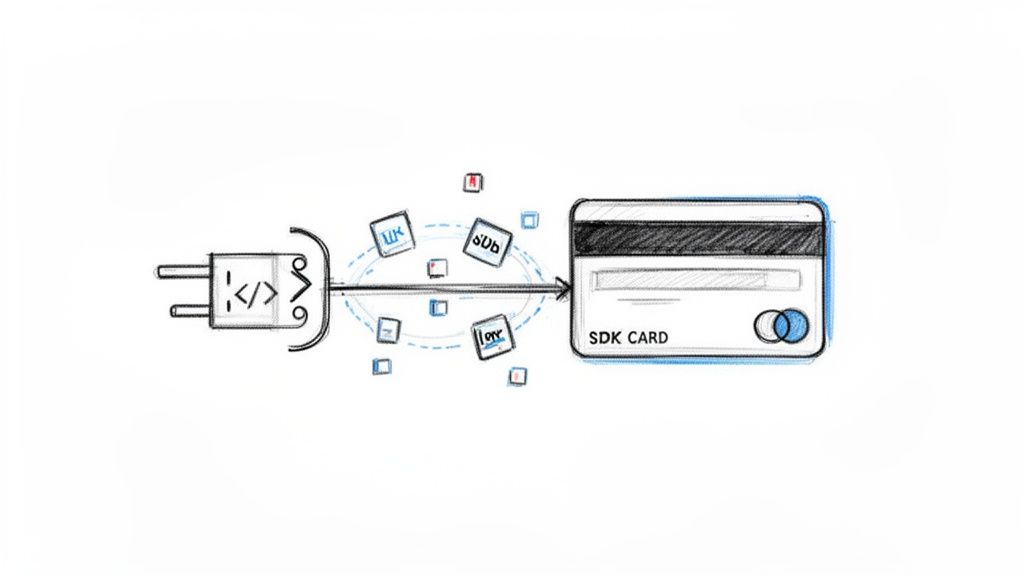
Key Insight: Stripe treated its API and documentation as its primary sales and marketing assets. By creating a superior developer experience, they turned technical users into their most powerful sales force.
This model is effective when your product requires technical implementation. If you are selling to a technical audience, your entire GTM motion must be re-engineered. Study how Stripe made its product the path of least resistance for developers, thereby becoming the inevitable choice for the business.
Intercom didn’t just build a chat tool; they built a revenue machine by mastering a coordinated approach to Promotion and Place. They recognized that selling higher-value contracts required moving beyond volume-based marketing into surgical, account-based engagement. This focus on Account-Based Marketing (ABM) is a powerful marketing mix 4ps example for any B2B SaaS company aiming to land and expand within high-value accounts.
The core premise of Intercom's GTM was simple: stop marketing to everyone and start orchestrating campaigns for the specific companies you want to win. This meant treating target accounts not as a list of leads but as individual markets, each requiring a coordinated mix of content, advertising, and sales outreach. The move from lead-centric to account-centric thinking is what separates high-growth SaaS from the rest.
Key Insight: Intercom proved that enterprise deals are won through coordinated, multi-threaded engagement. Marketing's job isn't just to generate a lead but to warm up an entire account before sales makes the first call.
This model is critical when your ideal customer profile is concentrated in a specific set of identifiable companies. If you're selling a solution with a high average contract value, study how Intercom aligned its marketing mix to make its brand inescapable to its most-wanted customers.
Notion's growth is a standout marketing mix 4ps example of how to weaponize community as a primary go-to-market engine. Instead of funding a traditional sales force, Notion focused its strategy on Place and Promotion, turning its most passionate users into a distributed marketing team. The core tactic was empowering creators to build upon, and profit from, the product itself.
This approach bypassed the traditional software adoption cycle by creating a powerful pull from the ground up. By building a platform that was a canvas for creativity, Notion gave knowledge workers and productivity experts a tool to build their own audiences and businesses. This creator-led flywheel became their core acquisition channel.
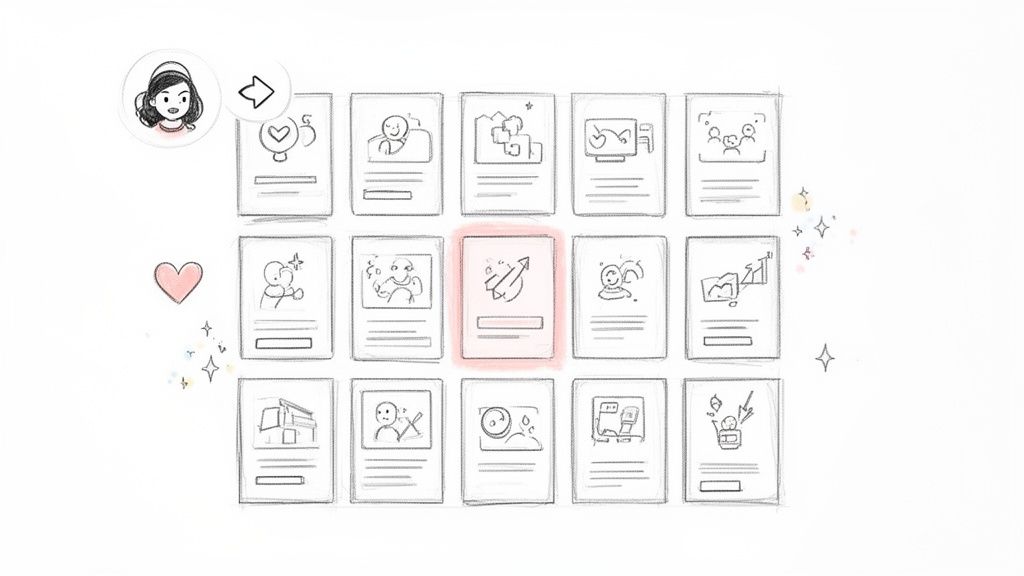
Key Insight: Notion recognized its most valuable marketing asset wasn't a campaign; it was the ecosystem of creators building on its platform. They didn't sell a product; they nurtured a community that sold it for them.
This strategy is potent for products with a high degree of flexibility and a user base that values customization. If your product can be a platform for others' expertise, investing in a creator ecosystem can deliver compounding returns that paid advertising cannot match.
Calendly solved the universal, high-frequency pain of scheduling meetings by embedding its solution directly into the user’s workflow. Its success is a definitive marketing mix 4ps example of how a product's core function can become its primary marketing engine. The strategy relies on making the Product itself viral and using Price to remove all adoption friction.
Calendly’s insight was recognizing that scheduling is a two-sided action. Every time a user successfully schedules a meeting, the recipient is exposed to the tool’s value. This created a powerful, self-perpetuating growth loop that ran on autopilot, sidestepping the need for a massive paid marketing budget.
Key Insight: Calendly engineered virality into its product by making the core user action (sharing a link) a marketing event. The goal wasn't just to get users, but to turn them into active distributors.
This approach is potent for tools that solve a common, recurring problem. If your product simplifies a workflow that involves interaction with non-users, study how Calendly built its distribution directly into its product experience. Mastering the freemium model is critical, and further detail on how to price a SaaS product can provide the strategic framework for getting it right.
Figma didn't just build a better design tool; it built an ecosystem that made its product the default choice for a generation of designers. Its go-to-market strategy is a masterclass in using Product and Promotion to create a moat built on community and education, making this a powerful marketing mix 4ps example for any B2B SaaS founder aiming to win a market from the ground up.
Figma’s strategy was rooted in a core belief: if you empower the next wave of talent, they will carry your tool into every company they join. Instead of fighting for enterprise contracts with established competitors, Figma focused on students, educators, and the design community. Its browser-first, collaborative product was not just a feature—it was the foundation for building a network.
Key Insight: Figma understood that the long-term win wasn't in selling a single license but in becoming the standard. By investing in education and community, they created generational lock-in.
This approach is extremely effective if your product has the potential to become a core skill set in a profession. Founders should analyze how Figma’s strategy demonstrates a deep understanding of what is product positioning, aligning every part of its marketing mix to own a specific identity in the market: the collaborative future of design.
| Example | Implementation Complexity 🔄 | Resource Requirements ⚡ | Expected Outcomes ⭐📊 | Ideal Use Cases 💡 | Key Advantages ⭐ |
|---|---|---|---|---|---|
| Slack: Premium Positioning with Free Freemium Model (Product & Price) | 🔄🔄 Medium — deep product work & integrations to enable PLG | ⚡⚡ High — engineering, integrations, analytics teams | ⭐📊 Rapid viral adoption and strong PMF; slower revenue realization from freemium | 💡 Bottom-up B2B teams, collaborative workplaces needing integrations | ⭐ Product-led virality, rich integrations, low early CAC |
| Salesforce: Enterprise Sales Motion with Vertical Segmentation (Place & Promotion) | 🔄🔄🔄 High — complex product + vertical customizations and long processes | ⚡⚡⚡ Very high — large salesforce, partners, events, implementation partners | ⭐📊 Enterprise market dominance and high ARR; long sales cycles | 💡 Enterprise CRM across regulated/vertical industries (finance, healthcare, retail) | ⭐ Premium pricing, vertical expertise, partner-driven distribution |
| HubSpot: Content Marketing as Product Positioning (Promotion & Product) | 🔄🔄 Medium — product alignment with sustained content operations | ⚡⚡ High — content teams, SEO investment, academy/certification resources | ⭐📊 Scalable organic lead generation and brand authority over time | 💡 SaaS targeting SMBs where education/inbound converts buyers | ⭐ Thought leadership, low-cost organic acquisition, certification stickiness |
| Stripe: Developer-First Positioning with Premium Pricing (Product & Place) | 🔄🔄 High — excellent API, docs, SDKs; engineering-heavy but sales-light | ⚡⚡ High — R&D, developer support, integrations and libraries | ⭐📊 Strong developer adoption, fast integration velocity, premium transaction revenue | 💡 Developer-led infra, payments, and technical buyers needing easy integration | ⭐ Best-in-class developer experience, bottom-up enterprise penetration, switching costs |
| Intercom: Account-Based Marketing with Vertical Segmentation (Promotion & Place) | 🔄🔄🔄 High — coordinated ABM, vertical product tweaks, multi-stakeholder workflows | ⚡⚡⚡ High — marketing+sales alignment, automation, account research | ⭐📊 Higher conversion rates, larger ACV, measurable account-level impact | 💡 Enterprise accounts with high ACV and complex buying groups | ⭐ Targeted account impact, higher deal sizes, aligned GTM execution |
| Notion: Community-Driven Growth with Creator Ecosystem (Place & Promotion) | 🔄🔄 Medium — flexible product and community tooling; UX complexity for features | ⚡⚡ Moderate — community programs, creator fund, marketplace ops | ⭐📊 Large organic user base and strong engagement; slow monetization uplift | 💡 Creator-heavy productivity tools, template-driven adoption markets | ⭐ Creator ecosystem and template marketplace driving viral distribution |
| Calendly: Viral Product Design with Freemium Monetization (Product & Price) | 🔄 Low–Medium — simple core product with necessary integrations | ⚡ Moderate — integrations and polish; minimal sales overhead | ⭐📊 Fast viral growth and broad adoption; TAM tied to scheduling use-case | 💡 Universal workflow tools solving a single high-frequency pain point | ⭐ Extremely simple UX with built-in viral distribution via shares/links |
| Figma: Design Community Positioning with Free Education (Product & Promotion) | 🔄🔄 High — real-time collaboration infra and plugin/community systems | ⚡⚡ High — engineering, education programs, community management | ⭐📊 Rapid adoption in design communities and generational lock-in via education | 💡 Collaborative design tooling for education, agencies, and product teams | ⭐ Real-time collaboration, community files/plugins, education-driven moat |
The examples analyzed reveal a critical truth: the 4Ps are not a checklist. They are a system of interconnected, high-stakes decisions. Your marketing mix is the architectural blueprint for your go-to-market motion, not a collection of siloed tactics. A decision about your Product’s core functionality dictates your viable Price point. That Price, in turn, determines the Place you can afford to sell (e.g., self-serve vs. enterprise sales). Your Place dictates the Promotion required to activate those channels.
Viewing each "P" in isolation is a recipe for wasted motion. You cannot bolt a PLG motion onto an enterprise product with a six-figure price tag. You cannot sustain a HubSpot-level content engine without a product that can capture and convert that demand at scale. Each marketing mix 4Ps example we've examined demonstrates this cohesion. Stripe’s developer-first Product is inseparable from its documentation-heavy Promotion. Calendly’s viral Product is the engine for its freemium Price model.
Your job as a founder or GTM leader is to design a cohesive, defensible system where each element amplifies the others. This is the difference between having marketing activities and having a GTM model. The strongest B2B SaaS companies build their mix with intentional, often painful, trade-offs.
Here are your next steps:
Stop thinking about your marketing mix as four separate workstreams. Start seeing it as one integrated machine. A well-designed machine creates its own momentum. A poorly designed one burns capital fighting its own internal friction. Architecting this system is your single greatest point of leverage.
Getting this model right requires brutal clarity on positioning and your ideal customer. If you are struggling to connect the dots between your product, customer, and market, Big Moves Marketing helps B2B SaaS leadership teams install the strategic clarity needed to build a cohesive GTM engine. We work with founders and revenue leaders to align their marketing mix before they waste millions on execution.
Explore Big Moves Marketing services and resources:



%20-%20white.svg)