%20png%20copy.avif)
At its core, a B2B content marketing strategy is simply a documented plan that connects the content you create to your actual business goals. It's the roadmap that defines who you're talking to, what you need to say, the topics you're going to own, and how you'll know if any of it is working. This is what turns random acts of content into a predictable growth engine.
Jumping into writing blog posts or recording webinars without a documented strategy is one of the fastest ways I've seen companies waste time and money. It's a recipe for inconsistent messaging, content that completely misses the mark with your audience, and—worst of all—no real way to prove the value of your work to the rest of the team.
A deliberate, thoughtful plan is the difference between just making noise and making a genuine impact on your pipeline.
This isn't about creating a rigid, 50-page document that will gather dust in a shared drive. It’s about establishing the core pillars that guide every single decision you make. This strategic foundation ensures every blog post, webinar, and case study you produce serves a clear purpose and moves your ideal customer one step closer to solving their problem.
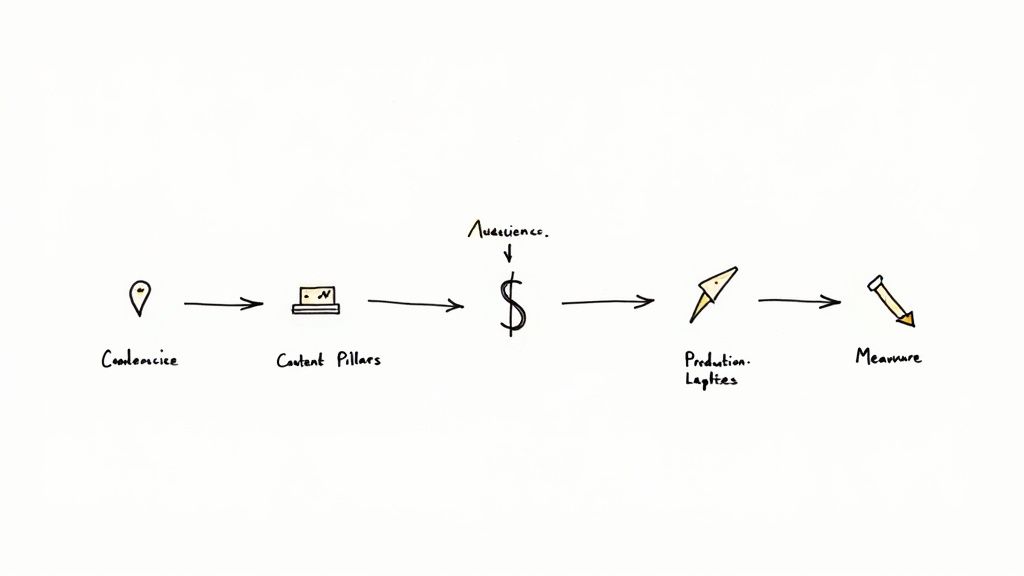
To build a plan that truly connects with your audience and drives results, you need to focus on four fundamental areas. Each one builds on the last, creating a clear line of sight from your day-to-day efforts to real business outcomes. These pillars keep you from getting lost in the tactical weeds and ensure you stay focused on what actually matters.
This simple framework shows how these four essential pillars come together.
Defining your audience, messaging, core topics, and goals upfront creates a powerful filter. It helps you vet every content idea, ensuring it's aligned with the bigger picture and has a real purpose.
To help visualize this, here's a quick summary of what each pillar represents.
Each component is critical. Without a clear audience, your messaging falls flat. Without solid messaging, your content pillars lack direction. And without goals, you're just guessing.
The reality is, most of your business rivals are already doing this. Almost 84% of companies worldwide have a content marketing strategy, which means it's no longer a nice-to-have; it's the standard for doing business. Lacking a clear plan means you're not just guessing—you're actively falling behind organizations that are systematically engaging their audience. For smaller teams just getting started, a solid guide to building a winning small business content marketing strategy can be a great place to begin.
A documented strategy isn't just about planning; it's about creating alignment. When your entire team—from marketing to sales to product—understands the "why" behind your content, their efforts become exponentially more effective.
Ultimately, all this foundational work is about building trust with your audience long before they ever talk to a salesperson. For a deeper look at this, check out our guide on how to https://www.bigmoves.marketing/blog/build-trust-with-b2b-content-marketing.
By the end of this guide, you won't just have a strategy; you'll have a clear, actionable playbook that connects your content directly to revenue.
If your content tries to speak to everyone, it will end up resonating with no one. This is a hard-learned lesson in B2B, where buying decisions are complex, committees are the norm, and "good enough" content gets ignored.
The absolute first step in building a content engine that generates real pipeline is to get radically specific about who you're talking to.
Forget those surface-level buyer personas filled with fluffy demographics. You know the ones. Your real goal is to build a data-backed Ideal Customer Profile (ICP). This profile doesn't represent a person; it represents the companies that are practically built to get massive value from your solution. This is how you move from guesswork to a strategy grounded in reality.
A traditional persona might say, "Marketing Mary, 35-45, Director of Marketing." An ICP-driven profile is worlds more powerful. It zeroes in on firmographics—things like company size, industry, and revenue—and the specific, painful operational challenges that make a company a perfect fit for what you sell.
Instead of guessing, you need to become a detective inside your own organization. The best insights are almost always hiding in plain sight.
Here’s where to start digging for gold:
This process uncovers the raw, unfiltered voice of your customer. You’ll learn their real pain points, not just the ones you've been assuming they have. For a practical way to structure all this, check out this guide on creating an ideal customer profile template.
Once you've gathered all this qualitative data, start looking for patterns. What are the common threads connecting your most successful customers? It’s never just one thing.
Let's take an AI-powered sales enablement tool. A surface-level persona might just target "Sales VPs." But deep research might reveal that the real ICP is a Series B SaaS company with 50-200 employees, a sales team of at least 15 reps, and a recent investment in a specific CRM like Salesforce.
The goal is to build a profile so sharp that your team can instantly spot poor-fit leads and focus all their energy on attracting perfect-fit accounts. This isn't about exclusion; it's about precision.
This level of detail becomes the foundation for every single piece of content you create. You'll know exactly which challenges to write about, what terminology to use, and which benefits will hit home the hardest.
With a crystal-clear picture of your ideal customer, you can now build a messaging framework that positions your solution as the only logical choice. This isn't just a tagline. It's the DNA of your content, ensuring every single asset you produce is consistent and on-point.
A strong messaging framework needs to articulate three things with absolute clarity:
Let's stick with our AI sales enablement tool example. Here’s what that framework looks like in action.
This simple framework becomes your north star. Every blog post, every webinar, and every case study should reinforce this core narrative. It keeps your message sharp, consistent, and aimed directly at the pains of the specific audience you've worked so hard to define.
This is how you stop just "creating content" and start building real authority.
Now that you have a firm grip on your ideal customer and your core message is locked in, you can finally stop chasing random keywords. It’s time to start building a content ecosystem—one that cements your company as the undisputed expert in your corner of the B2B universe. The way we do this is by establishing content pillars.
Content pillars are the handful of big, foundational topics that your audience is obsessed with and that tie directly back to the problems your product solves. Think of them as the strategic themes you want to completely own in the market. Instead of creating a series of disconnected, one-off pieces, you'll be building a deep well of authority around a few core subjects.
This isn't a guessing game. Your pillars should flow directly from all the hard work you just did on audience and messaging. The sweet spot is the intersection of what your ideal customer desperately needs to know and what your company is uniquely qualified to teach them.
Start by mapping your customer's biggest headaches to your solution's core value.
Let's imagine a B2B project management SaaS built specifically for creative agencies. Their pillars might look something like this:
See how these pillars are broad enough to spawn tons of subtopics, yet specific enough to magnetize their ICP—agency owners and ops managers? They hit on the high-stakes problems that keep their ideal customers staring at the ceiling at 3 a.m.
Your content pillars are your promise to the market. They signal what you stand for and the specific areas where you deliver undeniable value, long before anyone even thinks about buying your product.
Once you've landed on three to five core pillars, the real fun begins. You're going to break them down into smaller, more focused subtopics. This is how you build a content machine that never, ever runs out of fuel. For each pillar, start brainstorming dozens of specific content ideas that tackle granular questions, challenges, and “how-to” scenarios.
This approach, often called creating "topic clusters," does two things brilliantly: it ensures you cover a subject from every angle, and it signals to search engines that you have deep, authoritative expertise.
Let’s stick with our "Agency Profitability" pillar as an example.
By mapping out these subtopics, you're not just creating content; you're building a strategic backlog. Every single piece you publish reinforces your authority on a core theme, rather than being a random shot in the dark. This process is also a fantastic way to inform your broader content strategy and the messaging framework examples you’ll use across every marketing channel.
Okay, so you have a rich list of topics. Now for the final question: what’s the best way to actually deliver this information? The format you choose is just as critical as the content itself. A brilliant idea wrapped in the wrong format will fall completely flat.
There's no magic bullet here. The right format really depends on what your audience prefers, how complex the topic is, and what resources you have on hand.
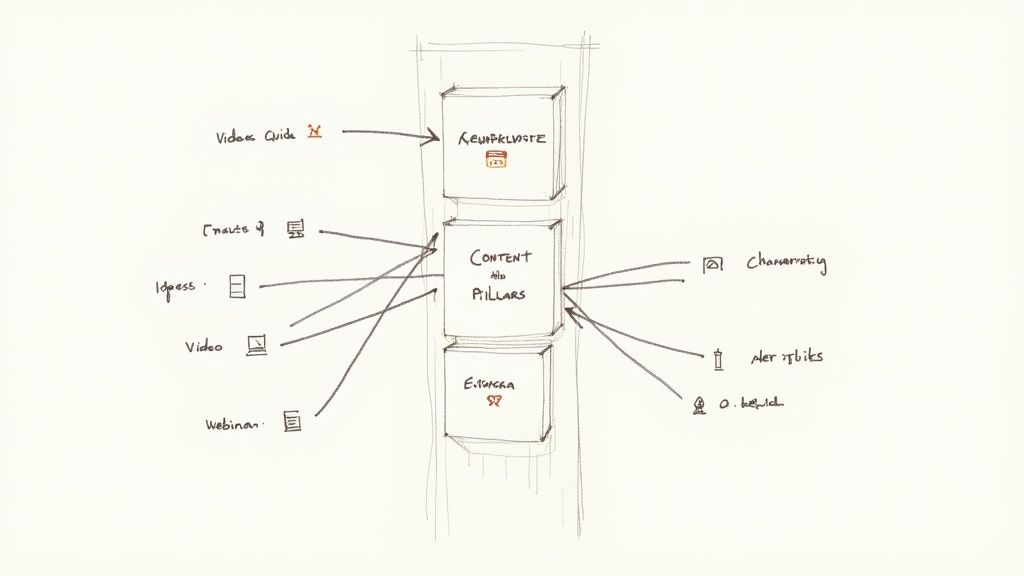
Here are some of the most effective formats for B2B and when to pull them out of your toolkit:
Don't feel like you have to do everything at once. Pick one or two formats that feel like a natural fit for your audience and your strongest pillar, and get really good at them. A single, high-quality webinar that you can slice and dice into video clips, quote graphics, and a follow-up blog post is infinitely more valuable than five mediocre pieces of content scattered across five different formats.
A brilliant strategy is useless without consistent, high-quality execution. This is where so many B2B content plans fall apart—not from a lack of great ideas, but from the friction of a clunky, undefined production process. It's time to build a system that removes bottlenecks and turns your strategy into a reliable content engine.
This isn’t about just hustling harder. It’s about creating a smarter, repeatable workflow that protects your team’s time and ensures every piece of content ships on schedule and meets your quality bar.
Think of your editorial calendar as the single source of truth for what’s being published, when, and by whom. It’s what turns your ambitious goals into a tangible, week-by-week plan. But for it to actually work, it has to be grounded in reality.
Start by mapping out your core content formats—maybe it’s one deep-dive guide, two case studies, and one webinar per month. Then, work backward. Be brutally honest about how long each piece actually takes. A comprehensive guide might need three weeks from brief to publication, while a quick case study could be done in one week.
Overloading the calendar is the fastest path to burnout and missed deadlines. I’ve seen it happen too many times. It's far better to consistently publish four high-impact pieces a month than to aim for eight and only deliver three mediocre ones.
Ambiguity is the enemy of an efficient workflow. When roles are fuzzy, tasks fall through the cracks and you're stuck in the dreaded "who's handling this?" loop. Whether your team is fully in-house, a mix of freelancers, or a hybrid model, everyone needs to know exactly what they own.
A simple RACI (Responsible, Accountable, Consulted, Informed) chart works wonders here.
Defining these roles upfront streamlines communication and empowers your team to move forward with confidence.
The goal here isn’t to create rigid bureaucracy. It’s to build a clear system of ownership that makes collaboration seamless and keeps the production train moving without constant check-ins.
The content brief is, without a doubt, the single most important document in your entire production process. It's the blueprint that aligns your writer, designer, subject matter expert, and strategist on a shared vision before a single word gets written. A great brief is the ultimate antidote to endless revision cycles and content that completely misses the strategic mark.
A well-structured brief doesn't just list a topic; it provides all the necessary context for success. If you're looking for a solid foundation, these marketing brief templates offer excellent starting points you can adapt for your specific content needs.
At a minimum, your brief should always include:
Trust me on this: investing 30 minutes to create a detailed brief will save you hours of frustrating rewrites later. It's the highest-return activity in the entire content creation workflow and the best way to ensure the final product is exactly what you envisioned.
Creating great content is a huge win, but it’s only half the battle. A brilliant white paper or a game-changing webinar that nobody ever sees has zero impact on your pipeline. It’s time to ditch the old "publish and pray" approach and build a deliberate, multi-channel distribution plan to get your work in front of the right B2B decision-makers.
This is how you turn a single content asset into a real business driver.
A well-documented distribution plan is what separates high-growth companies from those just adding to the noise. In fact, brands with a clear distribution strategy are three times more likely to see strong results. This is reflected in spending, too; a recent survey found that 46% of B2B organizations are planning to increase their content marketing budgets, with 13% expecting to boost it by over 9%. This growing investment makes a strategic approach that goes beyond just creation absolutely critical.

Look, you don't need to be everywhere at once. For most B2B SaaS and AI startups, focusing on a few high-impact channels will deliver far better results than spreading yourself too thin.
I always recommend starting with these three foundational channels:
Focus on mastering one or two of these to start. A perfectly executed email campaign is always better than three half-baked attempts across different platforms.
The most effective distribution isn't just about broadcasting links. It's about tailoring the message for each channel and sparking a conversation that adds value, not just noise.
The real secret to maximizing your impact without burning out your team? Smart repurposing. This isn't about just reposting the same blog link everywhere. It’s about deconstructing a single, high-effort "pillar" piece into a dozen micro-assets, each one tailored for a specific channel and purpose.
This is how you multiply the value of every single thing you create.
Here’s a real-world example of how we turn one 60-minute webinar into an entire content campaign:
When you think this way, you're not just creating one piece of content. You're building an entire campaign from a single core asset. This isn't about doing more work—it's about making the work you already do go infinitely further.
You've built your content engine, your distribution is humming along, but none of it means a thing if you can't prove it's working. This is where the rubber meets the road—the final, make-or-break step in building a content strategy that actually earns respect and, more importantly, budget.
It’s time to draw a straight line from every blog post, webinar, and whitepaper directly to business results. And it's time to build an unbreakable partnership with your sales team.
Forget the vanity metrics. Page views and social media likes don't keep the lights on. B2B execs, especially in the SaaS and AI space, care about one thing: results. Your job is to translate your team's hard work into the only language they truly speak—pipeline and revenue.
If you want to prove your content's worth, you have to track the metrics that matter. This means shifting your focus away from fuzzy, top-of-funnel activity and zeroing in on KPIs that show real business impact.
Your core content dashboard should be ruthlessly simple, tracking:
When you track these numbers, you can walk into any meeting and shift the conversation from "we got a lot of traffic" to "our content generated $150,000 in new pipeline last quarter." That’s a conversation everyone wants to have.
Your sales team isn't just a downstream recipient of your leads. They are your single greatest source of on-the-ground intelligence and your most critical distribution channel.
A solid feedback loop between marketing and sales isn't just a nice-to-have; it's the secret weapon for creating content that actually helps close deals.
This partnership really comes down to two things: creating sales enablement assets that genuinely help them sell, and building a consistent process for them to tell you what's working—and what's not—on the front lines. This is how you make sure the insights from real customer conversations are constantly making your strategy sharper.
When sales stops seeing marketing as the "arts and crafts department" and starts seeing you as a partner dedicated to helping them crush their quota, your content strategy becomes a powerful growth engine for the whole company.
By 2025, the link between planning and success has become undeniable. Data shows that 80% of very successful companies have a documented content marketing strategy, while only 52% of unsuccessful ones do. This highlights how strategic alignment, especially with sales, is crucial for tackling top challenges like attracting quality leads. You can explore more about these content marketing statistics and trends to see the full picture.
Building a B2B content strategy can feel like a massive undertaking, especially when you're just starting out. It's not. Here are some straight answers to the questions I get asked most often.
You absolutely don't need a huge team to make a real impact. The secret is ruthless focus.
Start by picking one core content pillar and one primary distribution channel. That's it. Instead of trying to be everywhere at once, your goal is to become the absolute best, most indispensable resource on that single topic, on that single platform.
A small team executing flawlessly on one front will always outperform a large, scattered team spread too thin. Go for depth over breadth every single time.
This is a long game, so patience is non-negotiable. While you might see some early signals like social media engagement, meaningful B2B results—qualified leads, pipeline influence, actual sales conversations—typically take six to nine months to show up consistently.
Why so long? You're building trust and authority from the ground up, not just chasing a few quick clicks. B2B buying cycles are notoriously long, and your content needs time to work its way through different stakeholders in an organization. Consistency is your single greatest asset here.
Your initial focus should be on creating high-value, problem-solving content. The leads and revenue will follow as you establish your expertise and build a library of helpful resources that prove your value.
Your content strategy should never be a "set it and forget it" document. Think of it as a living framework.
Plan to do a full, deep-dive review and refresh every six to twelve months. This is your chance to analyze what's really working, ruthlessly cut what isn't, and adapt to any shifts in the market or your customer's needs.
That said, you should be keeping a close eye on your key performance indicators every single month. This regular check-in helps you make smaller, tactical adjustments on the fly—like doubling down on a topic that's resonating or experimenting with a new format—without having to tear down and rebuild the entire plan.
At Big Moves Marketing, I specialize in building the strategic frameworks that turn your content into a predictable source of B2B growth. Find out how I can help you build a content engine that drives real revenue at https://www.bigmoves.marketing.
Explore Big Moves Marketing services and resources:





%20-%20white.svg)