The most popular LinkedIn advice is still "post more and buy cheaper leads." That advice is why so many B2B SaaS programs stall. A calendar plus an ad budget produces followers and form fills. It does not produce a buying committee that will take a meeting, or a deal that shows up in the CRM six months later.
A real LinkedIn lead generation strategy treats the channel as an assisted-pipeline system. You measure stage velocity and account progression, not cost per lead. Expert voices carry the distribution. Paid media and outreach only amplify a message that already earns trust.
If revenue attribution takes half a year and LinkedIn mostly assists rather than closes, a cheap download is a vanity win. Rebuild the program around four layers, named accounts, and stage targets you agree with sales before the first dollar goes out.
Most LinkedIn programs are a posting calendar with an ad budget attached. Teams judge them by follower growth and cost per lead. That is the wrong layer. Adoption is not the issue. A Wpromote State of B2B Marketing Report cited by LinkedIn found that 89% of B2B marketers used LinkedIn for lead generation, and 62% said the platform generated leads, more than twice the next social channel. The same source reports that 75% of would-be buyers say thought leadership helps decide which vendors make the shortlist.
Those figures justify LinkedIn as a demand channel, not an awareness hobby. They don't justify scoring the program on likes.
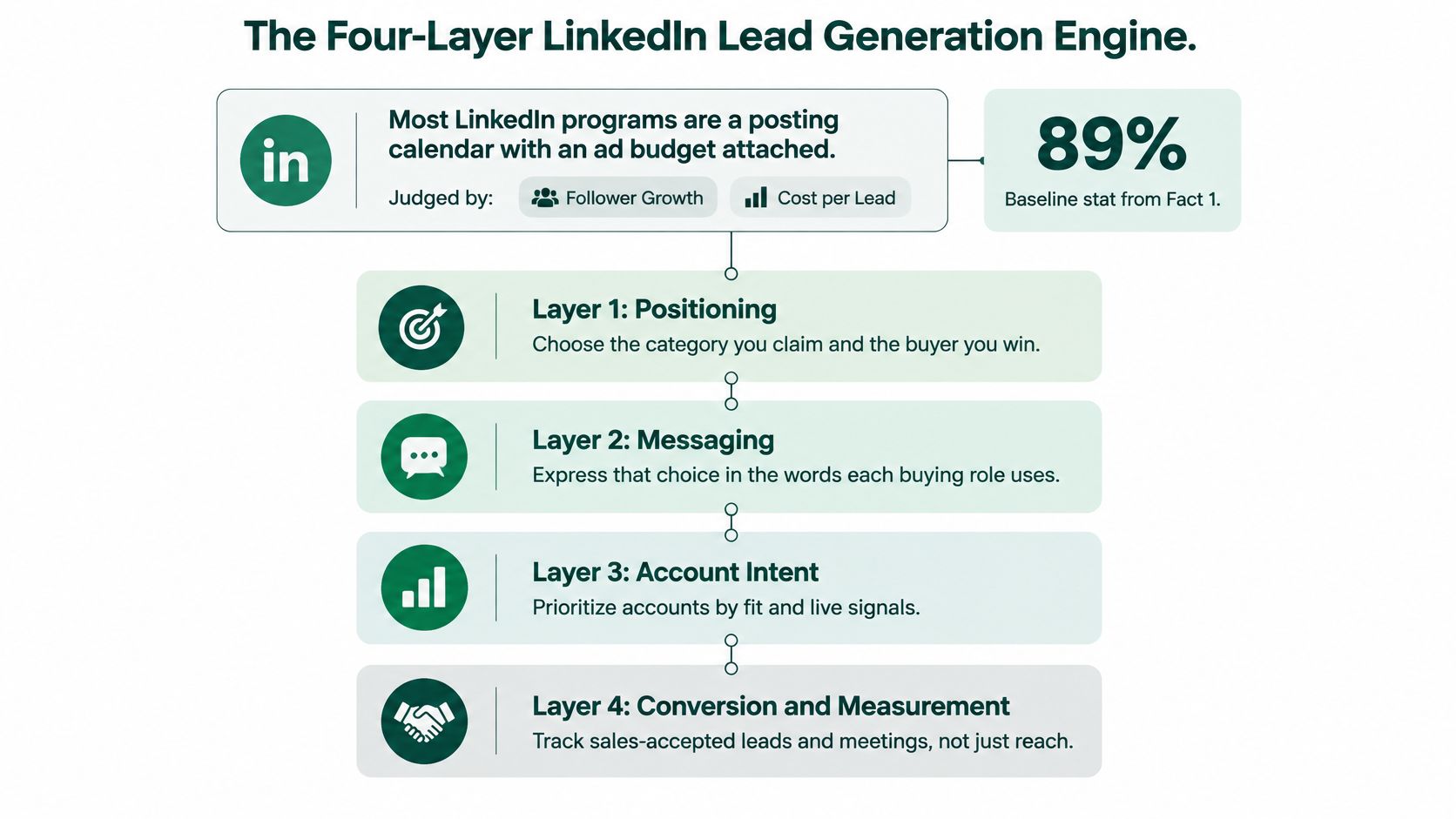
The engine has four layers. Each one has one job, one primary asset, and one stage metric. If a layer has no owner, the metric below it lies.
| Layer | Job | Primary asset | Stage metric it owns |
|---|---|---|---|
| Targeting | Reach the right buying committee | Account list and ICP filters | Target accounts reached |
| Content | Earn credibility before any ask | Expert posts and one original benchmark | Engaged target accounts |
| Outreach | Turn attention into a conversation | Message Ads, connection sequences, Conversation Ads | Replies and sales-accepted leads |
| Pipeline | Prove revenue contribution | CRM campaign IDs and Insight Tag events | Opportunities and pipeline per dollar |
The chain is causal. Weak targeting makes content invisible to buyers. Invisible content makes outreach expensive, because every message starts cold. Expensive outreach then makes the pipeline look worse than the channel deserves, and finance cuts the budget that was never aimed at the right accounts.
Practical rule: With limited capacity, build targeting and content first. Outreach and ads amplify whatever already exists, including a vague category claim.
Run this audit this week. Assign one owner to each layer. Flag any layer with no owner or no metric. That gap, not the algorithm, is usually why the program stalls.
Start with the account, not the job title. A title filter is a shortcut that feels precise and still misses the deal. The economic buyer, the champion, the technical evaluator, and the daily user rarely share a title, and a campaign that only reaches the champion produces leads nobody can close.
Define the account from four inputs, then map people onto it.
Then name the committee on each target account: economic buyer, champion, technical evaluator, and end user. If you can't name those roles, you don't have an ICP. You have a persona slide. A tighter treatment of role research sits in this guide on using buyer personas to accelerate B2B marketing and sales.
Search LinkedIn's Ad Library for competitors' sponsored content. Record which roles they target, which offers they use, and which buyer stage they skip. Pick the segment they under-serve. Fighting them for the same champion with the same demo ad is how you buy expensive noise.
Reach is a design constraint, not a vanity number. LinkedIn's audience guidance sets a minimum of 300 member accounts for an ad set and recommends 50,000 to drive results. Below 300, the campaign won't launch. Between 300 and 50,000, the set can launch and still fail to learn. Widen one filter at a time. Don't stack title, seniority, industry, and company size until the audience collapses. Above 50,000, scale spend only after conversions are verified.
A 300-person audience is an eligibility floor, not proof you can build pipeline.
In the European Economic Area and Switzerland, availability can be limited, especially for Matched Audiences. Check those markets on their own before you assume a US list will deliver in London or Zurich.
Positioning comes first. It decides the category you claim and the buyer you win. Messaging only expresses that choice in the words a specific role already uses. One message for every role produces generic copy that fails all four seats at the table.
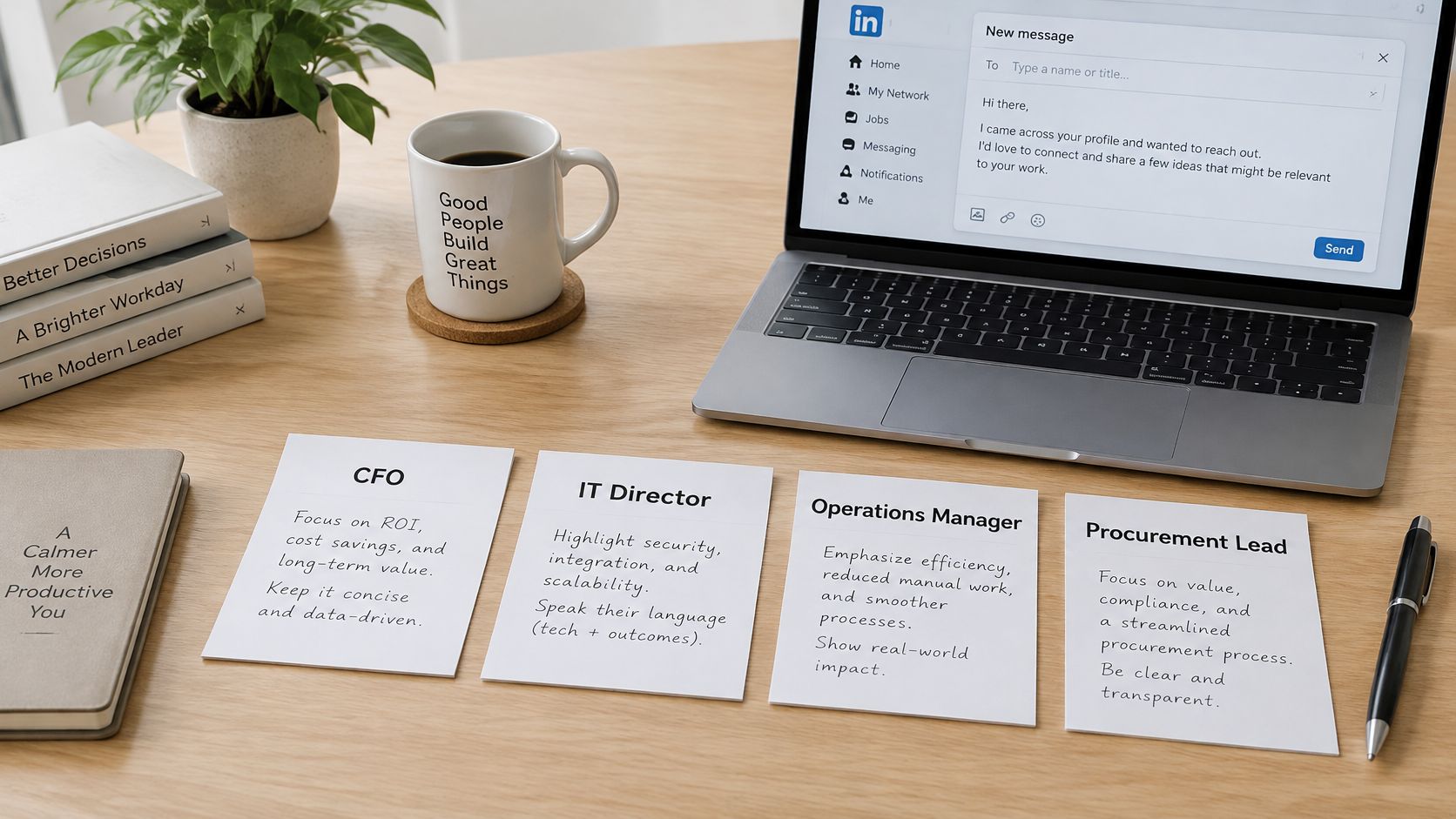
Each LinkedIn message needs four parts: the problem in that role's language, the cost of leaving it unsolved in that role's metric, one proof point you can defend, and a single ask. Drop any part and the note reads like a pitch deck squeezed into an inbox.
The economic buyer, usually a CEO or CFO, responds to payback and risk. Lead with the cost of delay, not a feature list.
The champion, often a Head of Growth or a RevOps lead, needs pipeline predictability and an argument they can win internally. Give them proof they can forward without rewriting it.
The technical evaluator, usually a CTO or VP Engineering, cares about integration effort, data access, and the security review. Name the integration and the review path. Vague "we integrate with your stack" language gets you parked.
The end user cares about hours removed from daily work. Describe the workflow change in concrete steps. Aspirational outcomes don't survive a skeptical operator.
A fuller structure for this split lives in a practical B2B messaging framework. Use this skeleton, then cut it until it fits a short message:
For a [role] at a [company type], facing [trigger], the current approach shows up in [one metric]. [One proof point]. [One small ask].
Example, stripped of decoration: a VP Engineering at a Series B SaaS company just hired a security lead. The current workaround shows up in review cycle time. One named implementation cut that cycle. The ask is a 20-minute architecture look, not a demo of the whole product.
The trade-off is real. Four versions take longer than one brand line, and sales will want a single script. Give them the skeleton, not four novels. Keep the final version short enough for a Message Ad, which the ads section below constrains hard.
This short walkthrough is worth watching before you lock the ask. It shows how a tight point of view beats a feature dump when the reader has thirty seconds.
A company page mostly reaches people who already follow it. That is a distribution problem, not a creative one. The posts that move buyers usually come from people those buyers already trust. Publishing more branded content is not the same as building credible distribution.
LinkedIn reported in 2025 that 77% of B2B marketing leaders said audiences rely on professional networks to vet brands, rather than company-owned channels alone. Related 2025 research found that 82% of B2B buyers said creator content influenced purchasing decisions, and 59% consumed that content on LinkedIn specifically.
Build the program around a founder, a product leader, and, where you have permission, one customer advocate. Map each person to a buyer question they can answer from direct experience. Why a migration failed. What a pricing change did to churn. What the security review asked for. If the expert can't answer from lived work, don't assign the topic. Polished corporate lines are how employee advocacy turns into disguised ads.
Set governance before cadence.
How someone earns that voice over time is covered in how to become a thought leader without turning every post into a product announcement.
Each expert posts a point of view twice a week. One customer or implementation story runs weekly. One original data piece, a benchmark from your own product data or a short survey, runs each quarter. Every day, spend 15 to 20 minutes commenting on posts by leaders at target accounts. A specific comment puts the expert in front of buyers without a paid impression.
Measure engaged target accounts and assisted pipeline. Impressions and follower counts say almost nothing about whether the motion is working. The trade-off is speed. Expert-led distribution is slower to start than a company-page blast, and it creates confidentiality risk if governance is verbal. Write the rules down, or don't start.
Configure the measurement before you spend. Install the LinkedIn Insight Tag and confirm conversion events fire on the landing page and the thank-you page. Define one conversion per campaign: a resource download, a demo request, or a form submission. Put UTM parameters and a CRM campaign ID on every ad so offline opportunities import back to the campaign. Without that loop, you will optimize for clicks you can't defend in a pipeline review.
| Format | Funnel stage | Hard constraint | Conversion path |
|---|---|---|---|
| Sponsored Content | Awareness and retargeting | Built around an expert point of view or benchmark asset | Landing page or Lead Gen Form |
| Lead Gen Form attached to Sponsored Content | Demand capture | Pre-filled from profile data; keep fields to what sales needs to qualify | Form submission to CRM |
| Message Ads | Direct outreach to ICP accounts | Copy under 500 characters, one CTA button | Landing page or Lead Gen Form |
| Conversation Ads | Qualification and routing | At least one CTA tied to a Lead Gen Form | Demo request, resource request, or information text |
LinkedIn's Message Ad guidance is blunt: keep copy under 500 characters, use one call-to-action button, and make the destination obvious. Conversation Ads guidance requires at least one CTA button connected to a Lead Gen Form on lead-generation campaigns. Branch the paths. A demo request and a resource request are different intents. Don't mash them into one pitch.
Format choice and offer fit are covered in more detail in this breakdown of LinkedIn ads for B2B.
LinkedIn reports that Lead Gen Forms convert at an average of 13%, against an average landing-page rate of 4.02% from an Unbounce study. The gap is friction. Forms are pre-filled from the profile. Treat the comparison as direction, not a promise. A weak offer converts poorly on any form.
Split budget by stage instead of dumping it into conversion. A starting test, not a benchmark, is roughly a quarter on awareness, about a third on retargeting engaged accounts, and the rest on conversion. Choose the native form when three or four fields are enough to qualify. Choose the landing page when qualification depends on questions a short form can't hold. Volume and speed trade against lead quality. Pick the path on purpose.
Sequence by account intent, not list order. A flat list treats a silent ICP fit the same as an account that just engaged a competitor's post. That is how reps burn the best names first and then wonder why reply rates fall.
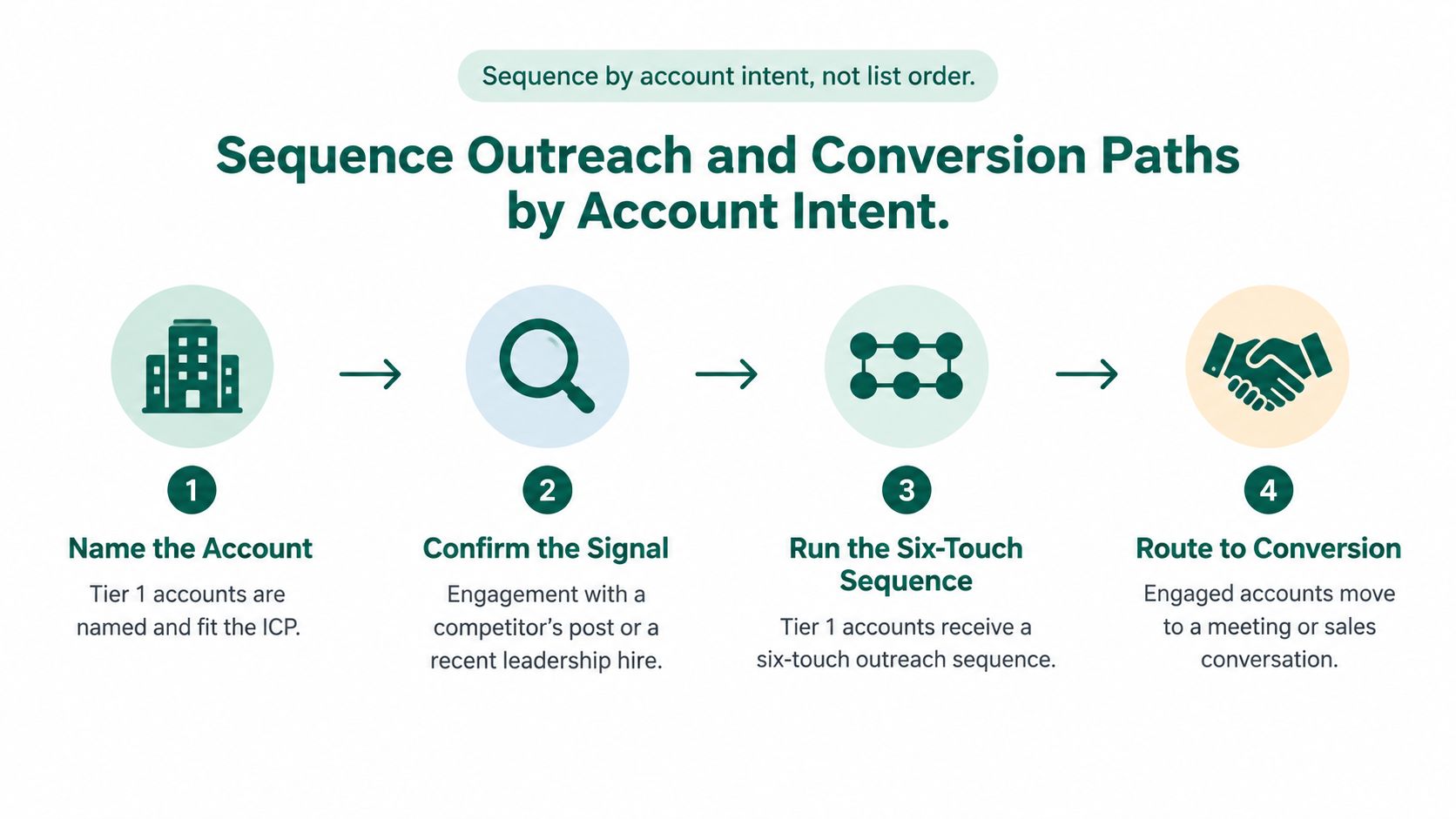
Tier 1 accounts are named, fit the ICP, and show a signal, such as engagement with a competitor's post or a recent leadership hire. They get six touches over about three weeks: profile visit, relevant comment, connection note, value message with one resource, Conversation Ad, and a direct meeting request.
Tier 2 accounts fit the ICP with no live signal. Four touches over two weeks: connection note, value message with a resource, follow-up, and a short close. Don't invent urgency they haven't shown.
Tier 3 is the broad ICP. Ads plus one message. Deeper manual outreach doesn't pay back at that width.
The logic behind naming accounts before channels is the core of a clear account-based marketing definition. Use it so sales and marketing share the same tier labels.
The connection note is the first failure point. Keep it under 300 characters and skip the pitch.
Hi [first name], saw your team is hiring for [role]. We wrote up how RevOps teams handle the first 90 days. Happy to send it.
The value message names one resource and one question. Route a demo request to sales within the hour. Route a resource request to nurture. Information requests get a short automated reply, not a meeting link. Conversation Ad buttons should already be tied to those paths from the ads setup. Don't redesign routing inside the sequence.
Sopro's 2025 State of Prospecting research found that 53% of B2B marketers use LinkedIn to identify prospects and source contact details. List-building is crowded. Your edge is the sequence and the exit rules, not a larger export.
| Account tier | Touches and days | Sequence | Exit rule |
|---|---|---|---|
| Tier 1: named, ICP fit, with signal | 6 touches over about 21 days | Profile visit, relevant comment, connection note, value message, Conversation Ad, meeting request | Stop on any reply; pause a silent account for 60 days |
| Tier 2: ICP fit, no signal | 4 touches over 14 days | Connection note, value message with resource, follow-up, closing message | Any reply or a completed sequence ends it |
| Tier 3: broad ICP | 2 ad exposures and 1 message over 7 days | Ad retargeting plus one message | Any reply or click routes to the matching path |
Stopping on a reply protects the relationship. Pausing a silent Tier 1 account for 60 days keeps the name available when a new signal appears. Deleting it throws away the only asset you had.
Don't spend until this gate is true. A campaign that launches without it will generate activity you can't attribute, and you will argue about lead quality with no shared definition.
Reuse these templates instead of redrafting in the campaign builder.
Check engaged target accounts, reply rate by tier, sequences stopped or paused, and expert posts shipped against cadence. Every layer still needs a named owner. If a layer has none, the checklist didn't fail later. It failed at assignment. Fix the owner before you add spend.
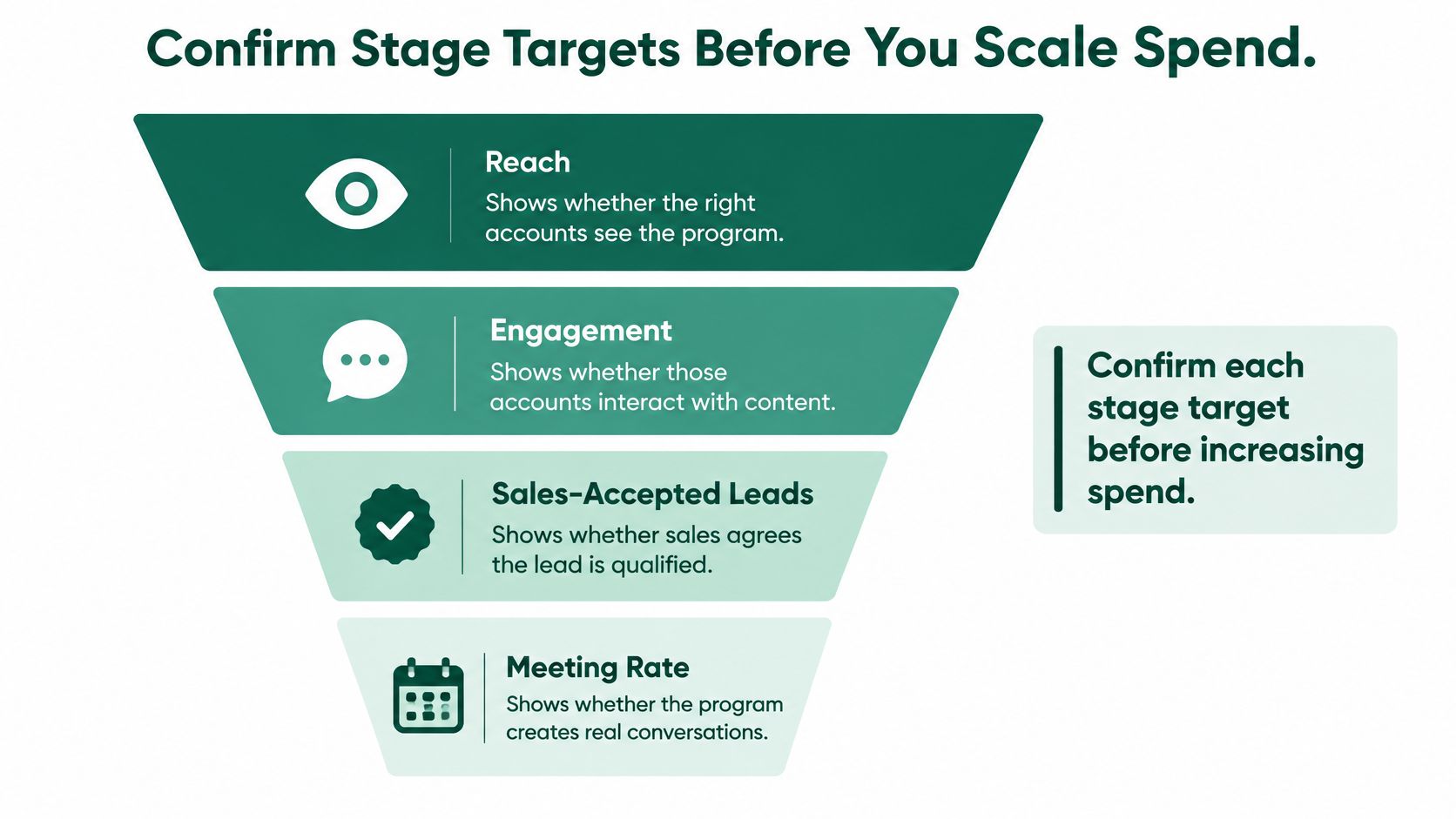
Read the metrics in the order the buyer moves. Reach and engagement show whether the right accounts see the program. Sales-accepted leads and meeting rate show whether it creates real conversations. Opportunities and pipeline per dollar show whether it pays. Cost per lead sits outside that order on purpose. It rewards contacts sales will reject.
Aggregated 2025 data from hundreds of B2B customers found an average customer journey of 211 days, 320 days from the first LinkedIn ad impression to revenue, and 219 days from first conversion to revenue. The same dataset found LinkedIn influenced 29% of MQLs, 36% of SQLs, and 35% of new-business deals. The channel mostly assists. A last-click dashboard will call that failure.
| Stage | Metric | Leading or lagging | Review cadence |
|---|---|---|---|
| Reach | Target accounts reached and engaged | Leading | Weekly |
| Qualification | Sales-accepted leads and qualified account rate | Leading | Biweekly |
| Conversation | Meeting rate from qualified responses | Leading | Biweekly |
| Opportunity | Opportunities created and cost per opportunity | Lagging | Monthly |
| Revenue | Pipeline per dollar and influenced revenue by cohort | Lagging | Quarterly |
Pick one attribution model before launch and write it on the dashboard. Switching models mid-quarter is how teams manufacture a win. Agree the thresholds with sales first: the minimum sales-accepted rate, the meeting rate that justifies more spend, and the point at which a campaign pauses. A cheap lead that misses those bars is a reason to stop, not a reason to "give the algorithm more time."
The 90-day decision is simple. Confirm targets with sales, run one pilot per layer, and review against those thresholds. If nobody owns all four layers, close that gap before you scale spend. Scaling a program with a missing owner just buys a more expensive stall.
Big Moves Marketing works with B2B SaaS founders and revenue leaders who need a LinkedIn motion tied to sales-accepted pipeline, not follower growth. If your program is producing cheap leads and thin meetings, start with the four-layer audit and the stage targets above, then get senior help putting them into a working system. Visit Big Moves Marketing when you want that rebuild owned, not just described.