%20png%20copy.avif)

Most advice on how to become a thought leader starts with posting more often. That's the wrong starting point for B2B SaaS.
A founder who publishes generic commentary every day isn't building authority. They're increasing the supply of content buyers already ignore. Thought leadership becomes commercially useful only when it helps a specific buyer understand a difficult problem, evaluate a category, or choose a provider with greater confidence.
That makes thought leadership a go-to-market operating system, not a personal branding exercise. It connects positioning, customer insight, research, distribution, sales enablement, and revenue measurement. The visible article or LinkedIn post is only the output. The company's ability to produce credible insight that changes buyer behavior is the core asset.
Thought leadership fails commercially when visibility replaces authority.
A post can attract reactions without changing a buying committee's view. A recognizable founder can still lack credibility. An article can rank in search while giving a skeptical buyer no reason to believe the company understands their operating constraints.
B2B SaaS buyers need help with decisions involving security, implementation, integrations, internal change, budget ownership, and commercial risk. Broad commentary avoids those pressures. It may sound polished, but it does not demonstrate useful judgment.
The term has a relatively recent business history. Joel Kurtzman used it formally in 1994 for executives whose distinctive ideas earned industry-wide attention, as documented in this brief history of thought leadership. The lasting distinction matters: thought leadership is recognition that someone has developed original insight buyers can apply, not just gained an audience.
The buyer impact is measurable. In the 2024 Edelman-LinkedIn B2B Thought Leadership Impact Report, 73% of decision-makers said thought leadership provides a more trustworthy basis for judging a company's capabilities than marketing materials and product sheets, compared with 59% in 2019. The report also found that 75% of global B2B buyers and C-suite leaders had researched a product or service they were not previously considering after consuming thought leadership, while 86% said they would be moderately or very likely to invite such an organization into an RFP process.
These findings do not justify publishing more content. They increase the standard for what a B2B SaaS company should publish.
Practical rule: If a buyer cannot use your insight to make a better decision, it probably is not thought leadership.
The evolution of B2B buyer trust reinforces the same point. Credibility requires a defensible position, evidence connected to real operating conditions, and distribution through channels buyers use while evaluating providers.
A revenue-oriented program connects four layers:
Weak positioning produces broad content. Weak evidence produces unsupported opinion. Weak interpretation produces a data dump. Weak commercial integration leaves marketing unable to determine whether the work influenced a deal.
The true test is operational. Can the company repeatedly turn customer reality into insight, distribute it across the buying journey, and give sales a sharper reason for buyers to trust the business? If not, increased visibility will create attention without preference, pipeline, or revenue.
Thought leadership begins with intellectual territory, not an editorial calendar.
Most B2B SaaS teams choose a topic that sounds relevant to their product, then publish around it until the connection becomes obvious to nobody. A workflow platform writes about productivity. A security product writes about cyber risk. A revenue tool writes about growth. These categories are too large to own and too vague to create preference.
Choose one consequential problem, one defined audience, and one position you can defend better than generalist competitors.
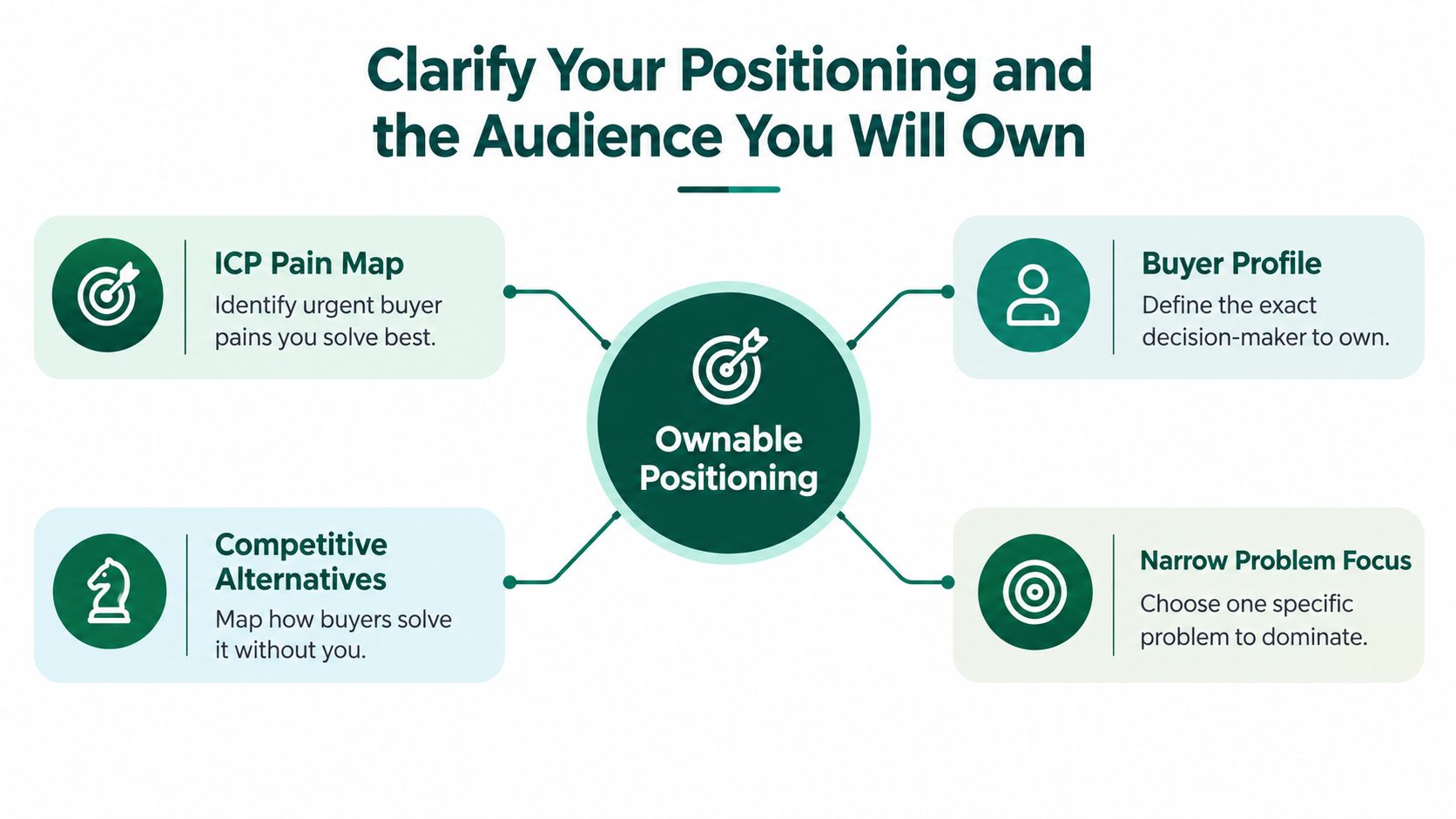
Interview sales, customer success, product, and recent buyers. Don't ask what content they want. Ask what decisions feel risky, what alternatives they considered, what internal objections delayed action, and what evidence finally created confidence.
Map four things:
The answer should be narrower than your product category. “Improving revenue operations” is a theme. “Helping Series A SaaS teams replace founder-dependent forecasting before adding enterprise sales complexity” is ownable territory.
A narrow audience reduces reach. That's the point.
When you try to speak to founders, sales leaders, product teams, and investors in the same stream, every argument gets softened. Buyers recognize their language less clearly, and your company becomes another vendor offering broad expertise.
The definition of a positioning statement provides a useful discipline here. State who you serve, what problem you solve, what alternative you displace, and why your approach is meaningfully different. Your thought leadership should then make that positioning more credible through insight, not repeat it as advertising.
The narrower your claim, the higher the standard of proof. That trade-off is productive.
A strong audience definition also determines the voice of the program. A technical evaluator may need implementation constraints and architecture decisions. A CEO may care about organizational risk and payback logic. Both can discuss the same category, but they don't need the same interpretation.
Use this internal template:
We believe [specific buyer] should rethink [specific problem] because [evidence or observed pattern]. The better approach is [distinct principle], which changes [business outcome or decision].
Don't publish the sentence as a slogan. Use it as an editorial filter. If an idea doesn't sharpen the claim, challenge a common assumption, or provide evidence for it, leave it out.
For teams developing a flagship report or book-length asset, editorial quality matters as much as strategic clarity. Understanding the different types of manuscript editing can help distinguish structural argument review from line-level polishing. Thought leadership needs both, but structural weakness can't be fixed by better prose.
Thought leadership becomes commercially useful when a clear point of view produces evidence, content, and sales conversations that reinforce the same market position. Opinions alone create attention. A tested argument can shape pipeline.
Start with a hypothesis that is specific enough to investigate. For example: “Growth-stage SaaS teams aren't struggling with insufficient demand. They're struggling to explain why their product matters to a buying committee with competing priorities.” That claim creates a research agenda. It directs customer interviews, sales-call reviews, win-loss analysis, and examination of internal product or usage data.
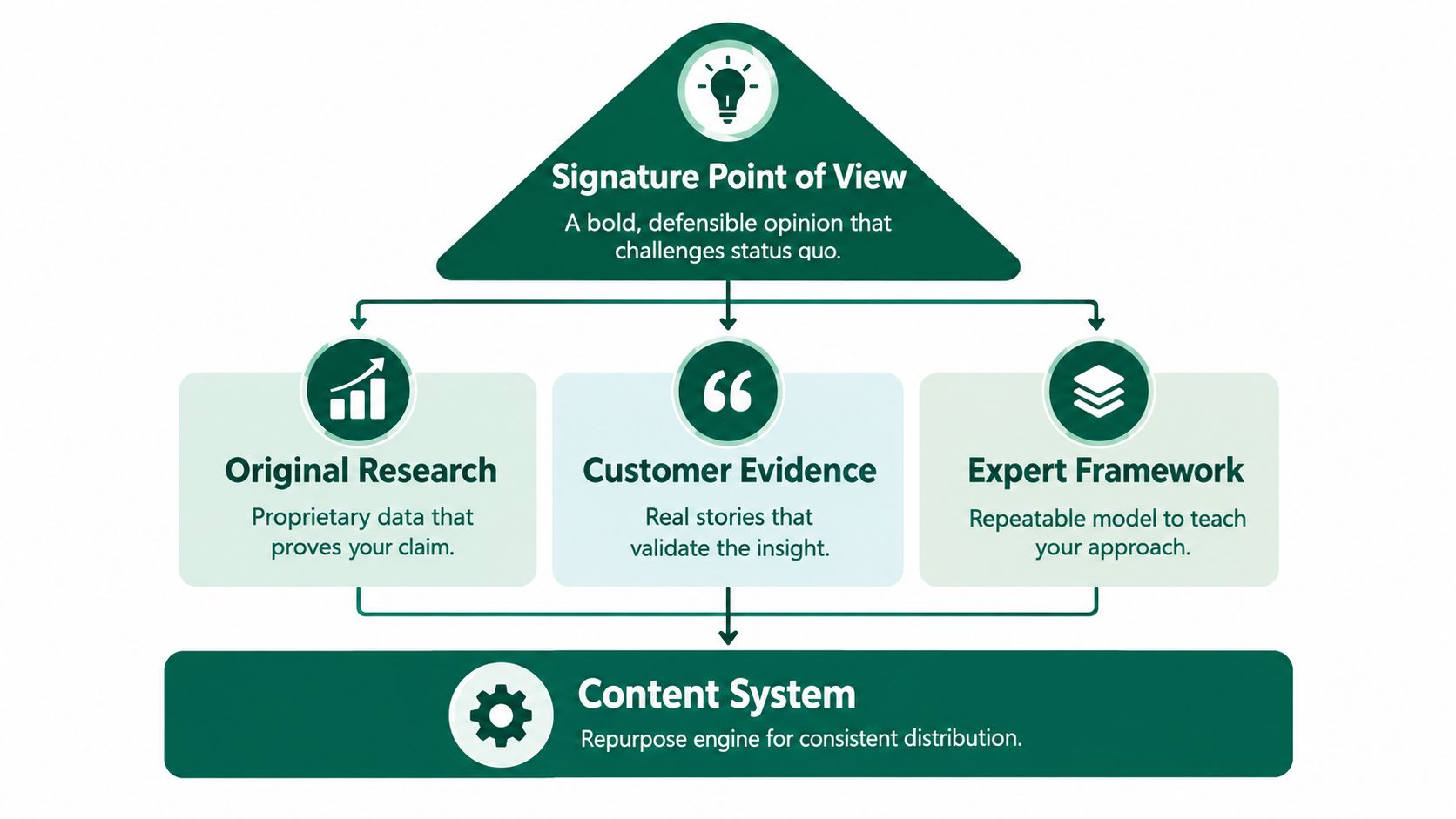
The 2026 B2B Thought Leadership research summary reports that 93% of marketers using original-research content considered it effective at driving engagement and leads, with 48% rating it very effective. The operating lesson is direct: original research gives a point of view a reason to be believed, rather than asking buyers to trust polished commentary.
Build the evidence engine from four inputs:
Keep customer evidence analytical. A customer story should explain the decision, the constraint, the change in approach, and the lesson another buyer can apply. Use this guide to writing a case study to turn raw experience into evidence that teaches, rather than a testimonial that only praises the vendor.
A flagship report should become the source material for a full-funnel system. Build each format around the central finding:
Each format has a distinct job. The report earns consideration, articles support discovery, social content creates recognition, live sessions handle doubt, and enablement connects the argument to revenue conversations.
Editorial governance keeps the system from becoming content volume without direction. Assign one owner to the thesis, one expert to validate the evidence, one editor to improve clarity, and one commercial reviewer to test buyer relevance. Require every major asset to answer three questions: What claim are we making? What supports it? What should the reader do or reconsider?
AI discovery changes how clearly ideas must be published. Organize every asset so a busy executive and a retrieval system can identify the claim, reasoning, proof, and practical implication.
Use explicit headings, defined terms, labeled evidence, and accessible source references. Do not write for a machine. Write with enough precision that the argument can be quoted accurately, evaluated quickly, and carried into a buying conversation.
A founder does not need to become a full-time creator to build authority. Growth-stage SaaS companies gain more from a small group of credible internal voices connected to one editorial and commercial system.
Consider a company with a founder who holds the strongest market conviction, a product leader who understands implementation friction, a sales leader who hears objections every week, and a customer success leader who sees where promised value breaks down. That company has an evidence network, not a single content source. Use it to reinforce positioning, answer buyer objections, and create sales conversations.

The founder may own the category argument. The head of product may explain technical trade-offs more clearly. A customer success leader may offer the strongest perspective on adoption and retention.
Use a straightforward workflow:
This removes the biggest production bottleneck, executive time. Experts contribute judgment and evidence, while the editorial team handles structure and execution. The result is a repeatable operating system for turning internal knowledge into market-facing assets.
LinkedIn tests language and surfaces objections quickly. Podcasts create room for nuance, disagreement, and context. Webinars let prospects challenge the argument in public. PR extends a research finding into conversations beyond your owned audience.
Adapt the core idea instead of copying one paragraph across every channel:
Distribution still needs operating discipline. Teams can use a resource on how to schedule LinkedIn content, but scheduling only improves consistency. It cannot repair weak positioning or unsupported claims.
Repurpose from the research asset outward. Keep the evidence and central argument consistent, then change the framing for each buyer context. A LinkedIn post can create recognition, a podcast can develop conviction, and a webinar can address objections that block evaluation.
A webinar becomes a demand and sales asset when it answers a live buying question rather than presenting a company tour. Guidance on marketing with webinars shows how educational content can support actual buyer dialogue.
The objective is repeated exposure among the decision-makers evaluating a problem your company understands. Connect each channel to the next commercial action, from recognition to conversation to pipeline.
Thought leadership earns its budget only when it changes a commercial outcome. The useful question is specific: Did the buyer trust your interpretation enough to change how they evaluated the problem, the category, or your company?
Traffic measures distribution. Likes measure lightweight attention. Neither proves that a buying committee sees your team as a credible option. Track the behaviors that connect authority to pipeline, then use those findings to decide which content deserves more investment.
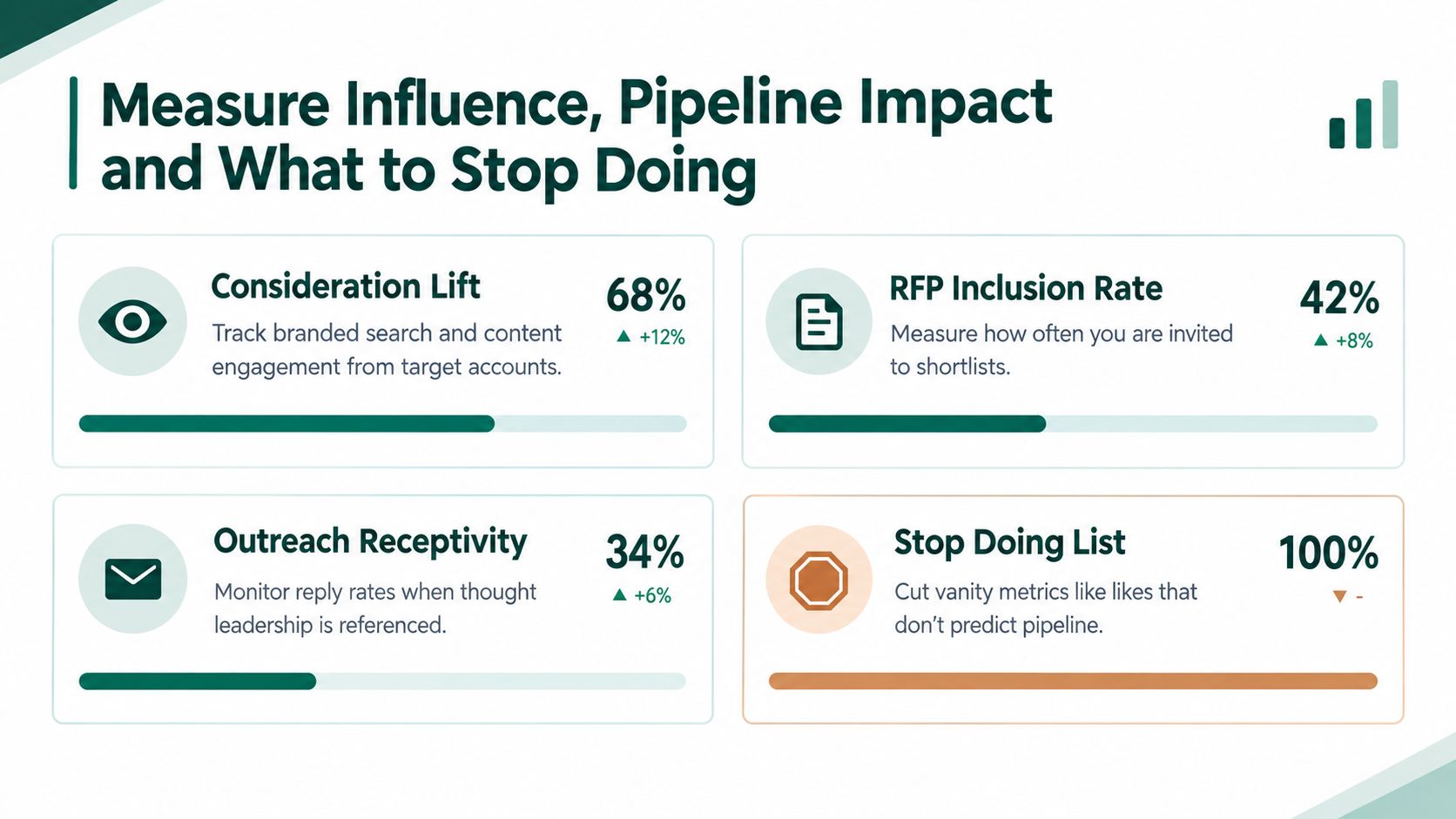
Use four measurement groups:
These signals require account-level tracking. Connect content engagement to CRM records, opportunity stages, meeting notes, and source-of-influence fields. Ask sales to record whether a prospect cited a report, repeated its language, or used its framework to describe the buying problem. A manually maintained field is acceptable at first. A vague attribution model is not.
Use influence reporting to separate reach from persuasion. A post can reach thousands of people and influence no active opportunity. A small research briefing can reach ten target accounts and help move three of them into evaluation. The second asset has greater commercial value, even if its audience looks smaller in the channel report.
Thought leadership should support the customer lifecycle, not end when a prospect books a first meeting. In a SaaS business, the same point of view can shape category education, sales discovery, implementation expectations, product adoption, expansion conversations, and renewal confidence.
Create a simple influence map for each flagship asset:
Do not claim that content caused revenue because it appeared in a contact record. Review the sequence and the buyer's behavior. Compare influenced opportunities with similar opportunities that had no meaningful exposure, where your data volume allows it. Combine CRM evidence with seller feedback and customer interviews.
Use this guide to measuring marketing ROI to structure reporting around investment decisions, attribution limits, and outcomes. Your dashboard should help answer three questions: What should we produce again? Where should sales use it? What should we stop funding?
Stop commissioning articles without a defensible thesis. Stop asking executives for generic industry commentary. Stop treating impressions as buyer intent. Stop publishing a flagship report without assigning it a sales use, an audience, and a follow-up path.
Cut content that sales cannot apply in a conversation, buyers cannot understand without internal translation, or evidence cannot support under scrutiny. Retire assets that attract broad attention but fail to influence target accounts. Keep the material that helps a buyer define the problem, challenge an existing assumption, or justify a decision to other stakeholders.
Set a quarterly stop-doing review. Remove low-value formats, weak distribution channels, and themes that produce engagement without account movement. Reallocate that time to evidence gathering, customer-led analysis, and content that helps opportunities progress. A thought leadership program becomes a revenue asset when the team measures changed buyer behavior, not the volume of posts it publishes.
A thought leadership program needs a small operating rhythm, not a large content department. Use the first phase to establish the argument, the second to produce evidence, and the third to put the system into market.
Define the audience, problem, and point of view. Interview sales, product, customer success, and a sample of recent buyers. Review lost-deal notes and recurring objections. Select one flagship research question and assign a single accountable owner.
Create an editorial brief with these fields:
Collect the evidence and build the flagship asset. Establish review gates for factual accuracy, customer confidentiality, legal risk, brand clarity, and sales usefulness. Draft the report, then extract article ideas, webinar questions, LinkedIn arguments, and enablement material from the same source.
Use responsible AI assistance for transcription, clustering interview themes, and identifying repeated questions. Keep human ownership over research design, interpretation, claims, and final approval. AI can accelerate production. It can't supply earned judgment.
Publish the flagship asset, run a webinar, brief sales, and release a sequence of channel-specific interpretations. Ask sellers which accounts engaged, what objections surfaced, and where the insight helped a conversation progress.
Review the program using a simple monthly dashboard:
Treat the program as a compounding system. Keep the thesis stable long enough to become recognizable, but update the evidence as the market changes. That balance creates authority without forcing founders to publish constantly or perform expertise online.
Big Moves Marketing helps B2B SaaS leaders turn positioning, proprietary insight, and channel distribution into a thought leadership system connected to pipeline and revenue. If your team needs sharper market territory and an operating cadence that sales can use, visit Big Moves Marketing to discuss the next move.





%20-%20white.svg)