%20png%20copy.avif)
LinkedIn Ads for B2B don't fail because LinkedIn lacks the right buyers. They fail because teams measure a long, political buying process with short-term advertising metrics. A click is easy to report. A qualified opportunity influenced by multiple stakeholders over months is harder, but that's the outcome leadership needs.
LinkedIn has become a major B2B paid-media channel. Dreamdata's 2026 benchmarks report that LinkedIn represented 41% of total B2B ad budgets, up from 39% in 2025, and was the only major platform in that study with positive return on ad spend, at 121% in 2025 (Dreamdata benchmark coverage). That scale changes the question. The issue isn't whether you should advertise there. It's whether your campaigns are built to create revenue signals rather than cheap activity.
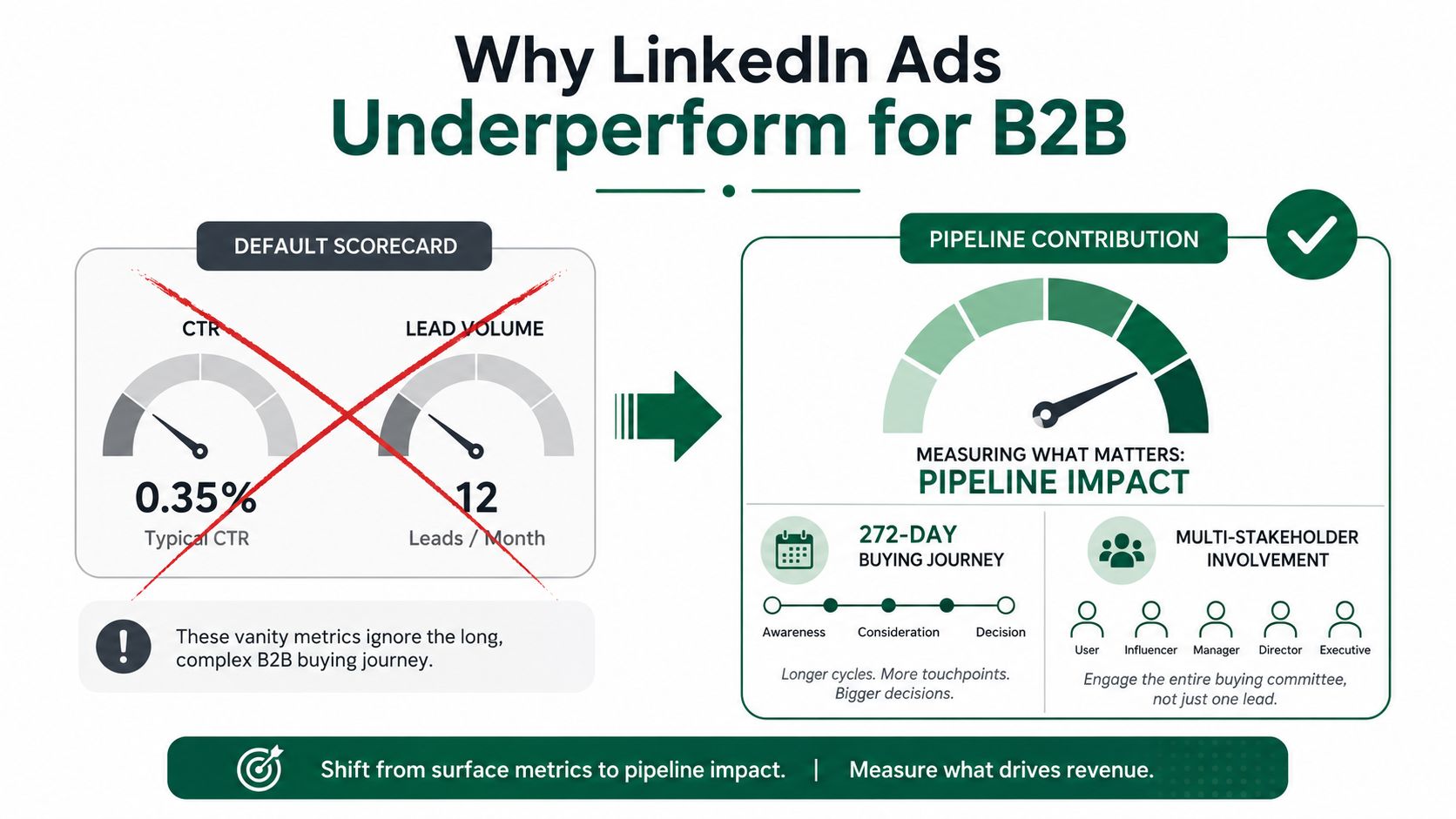
Most B2B SaaS teams judge LinkedIn Ads by CTR, CPC, and lead volume. That scorecard rewards the wrong behavior. It encourages broad offers, loose qualification, and creative designed to earn inexpensive clicks from people who were never likely to enter a serious buying process.
The buying journey doesn't work that way. Dreamdata reports an average B2B customer journey of 272 days, with 81% of the journey taking place before sales enters the picture, an average of 10 stakeholders, and 88 touchpoints per deal (Dreamdata's LinkedIn B2B benchmarks). LinkedIn may influence the account long before anyone submits a form, returns a sales call, or becomes the last-click source.
Three failure patterns appear repeatedly:
The mismatch is especially damaging because LinkedIn gives you access to a professionally relevant audience, but many advertisers promote low-intent offers to that audience. A generic ebook may generate volume while telling you little about buying intent. A focused diagnostic, comparison asset, or relevant conversation gives sales a better signal.
The operating rule: Score LinkedIn Ads on qualified conversations, SQL rate, opportunity creation, and influenced ARR. Treat CTR as a diagnostic, not a destination.
Dreamdata's data supports that revenue-oriented view. LinkedIn accounted for 41% of B2B paid social budgets in the same benchmark coverage, so the strategic challenge is no longer channel validation. It's measurement discipline inside a long, cross-channel process.
For a broader perspective on channel planning, Netco Design LLC's guide to LinkedIn for B2B growth is a useful companion. Your own operating model should go further by connecting ad exposure to account progression and sales feedback. Big Moves Marketing's perspective on B2B LinkedIn marketing follows that same principle, prioritizing positioning and buyer relevance over platform activity.
Audience construction starts before Campaign Manager. If your ICP is vague, LinkedIn's targeting options only give you more ways to spend against the wrong people.
Define the account first. Identify the company profile, operating environment, trigger, problem severity, and commercial fit. Then map the buying group. A RevOps platform might target directors and VPs of RevOps at SaaS companies with 50 to 500 employees, then separate the economic buyer, champion, evaluator, and daily user into distinct audience groups.
The layering sequence matters:
LinkedIn requires a minimum campaign audience of 300 member accounts, and location is a required targeting facet (LinkedIn audience-size guidance). That minimum makes hyper-specific combinations dangerous. A founder who layers an exact title, narrow seniority, one industry, a tight company-size band, and a small region may create an audience too small to deliver consistently.
Going straight after C-suite buyers sounds advanced. It often removes the people who discover the problem, compare solutions, and persuade the executive sponsor. For many B2B SaaS products, directors and senior managers are closer to the operational pain than the executive who signs the contract.
Use separate ad sets for:
The creative should change with the persona. A VP needs a business consequence. An operator needs a mechanism and proof that the workflow can change. A technical evaluator needs evidence about implementation, security, or integration.
| Layer | Targeting | Min Size | Purpose |
|---|---|---|---|
| Account fit | Industry, company size, geography, named accounts | 300 member accounts | Keep spend inside the commercial ICP |
| Function | RevOps, finance, security, engineering, marketing | 300 member accounts | Align ads with the problem owner |
| Role | Director, VP, manager, specialist titles | 300 member accounts | Separate buying-group responsibilities |
| Context | Salesforce, Snowflake, relevant groups and interests | 300 member accounts | Add problem or stack relevance |
| Expansion | Lookalike or broader matched audiences | 300 member accounts | Extend reach after qualified demand appears |
Use the B2B ideal customer profile template to make the account and buying-group definition explicit before you build audiences. If the team can't explain why a person belongs in the audience, that person shouldn't be funded by default.
Generic funnel labels like TOF, MOF, and BOF hide the decision you need to make: what does this person already understand, and what evidence should move them forward?
Structure LinkedIn Ads for B2B around three intent buckets:
Each bucket needs a different offer. Problem-aware audiences should see an ungated diagnostic, sharp point of view, or problem-framing asset. Solution-aware audiences can receive a comparison guide, implementation checklist, or category explanation. Vendor-aware audiences can handle a demo, technical walkthrough, or commercial conversation.
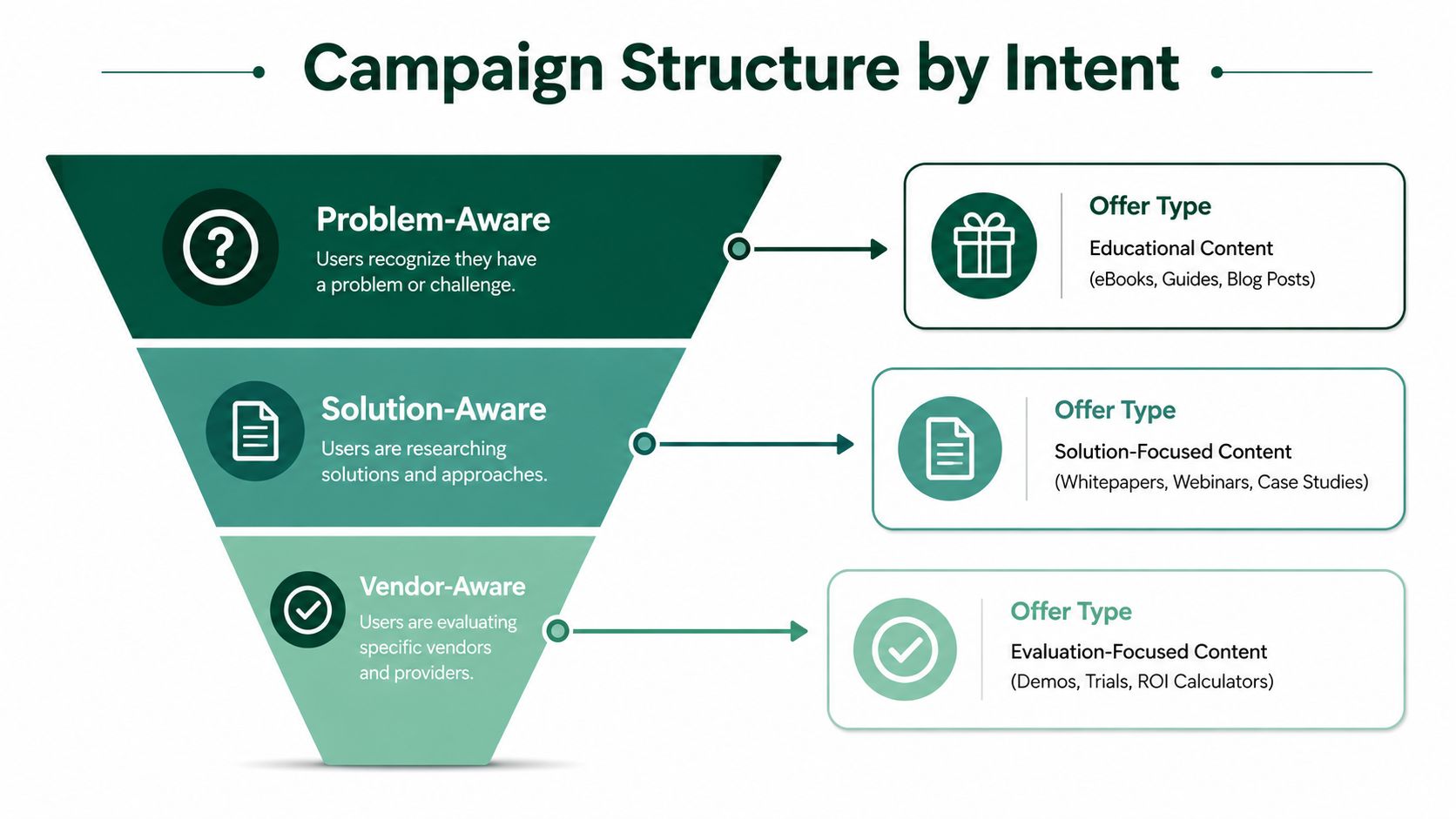
A practical starting allocation is 60% problem-aware, 25% solution-aware, and 15% vendor-aware, particularly when cold accounts make up most of the addressable audience. That split is a planning recommendation, not a universal law. Warm retargeting may justify more solution-aware spend, while a concentrated named-account motion may put more weight on vendor-aware offers.
The logic is simple. Cold buyers need a reason to care before they need a reason to book time. Warm buyers need evidence that your category and approach fit their situation. Vendor-aware buyers need friction removed from the next commercial step.
For a mid-market ABM motion, run three concurrent campaigns with separate audiences, exclusions, and bid controls:
| Intent | Audience | Offer | Primary decision signal |
|---|---|---|---|
| Problem-aware | Cold ICP accounts and relevant functions | Ungated diagnostic | Qualified account engagement |
| Solution-aware | Site visitors, content engagers, and warm accounts | Comparison guide | MQL-to-SQL progression |
| Vendor-aware | High-intent visitors and sales-targeted accounts | Demo or technical review | SQL creation and opportunity rate |
Keep exclusions strict. Remove converted leads from acquisition campaigns, exclude vendor-aware audiences from broad education campaigns, and prevent one account from receiving contradictory messages.
The benchmark ranges make offer intent impossible to ignore. For Sponsored Content, practical CTR benchmarks sit around 0.44% to 0.65%, while demo or meeting offers typically convert at 2% to 5%, low-friction content offers at 10% to 15%, and native Lead Gen Forms around 10% on average, with strong campaigns reaching 15% or more (2026 LinkedIn Ads benchmarks). Evaluate each campaign against the buyer action it was designed to create, not against another campaign with a different offer.
The SaaS marketing funnel framework can help align campaign intent with broader lifecycle stages. The important decision is not the label. It's whether the offer matches the buyer's current understanding.
LinkedIn Ads should function as a precision revenue channel, not a contest for cheap clicks. Choose the format according to the buyer's question, the stakeholder viewing it, and the next action that can improve SQL quality across a long B2B buying journey.
| Intent Bucket | Best Format | Lead Gen Form vs Landing Page | Copy Angle |
|---|---|---|---|
| Cold awareness | Single Image, Video, Thought Leader Ad | Use a landing page when education and context matter | Name the costly problem and its business consequence |
| Category education | Carousel, Document, Video | Use a Lead Gen Form for a focused asset, not a complex explanation | Show the mechanism, trade-off, or evaluation criteria |
| Demo readiness | Single Image, Conversation Ad, Lead Gen Form | Lead Gen Forms usually reduce friction when qualification is simple | State who the product is for and what the conversation will answer |
A Lead Gen Form is the better choice when the offer has clear intent, the audience is mobile-heavy, or the buyer can respond without additional explanation. Send traffic to a landing page when the decision requires context, such as pricing logic, implementation requirements, or category education. Independent 2026 benchmark reporting cites 6% to 13% conversion for Lead Gen Forms versus 2% to 5% for Sponsored Content sending traffic to a landing page (LinkedIn B2B lead-generation benchmarks). Treat those figures as format benchmarks, not proof of pipeline quality.
VP-level buyers do not click because an ad lists more features. They click when it names a familiar business problem, explains why the current approach fails, and offers a credible next step for their role.
Use this copy structure:
For a RevOps audience, “Your forecast is late because pipeline definitions change after handoff” is stronger than “Improve revenue visibility.” The first line gives the buyer a problem to recognize. The second gives them a slogan.
Thought Leader Ads serve a different job. One benchmark dataset reported 2.68% CTR at $2.29 CPC for Thought Leader Ads, compared with materially higher costs for standard formats (2026 LinkedIn industry benchmarks). Use that format to build familiarity and credibility before sales follow-up. Judge it by assisted engagement and progression toward qualified conversations, not by forcing every impression to produce a direct conversion.
Copy standard: If the ad could run unchanged for three different personas, it's probably too vague.
Review these B2B ad copy examples, then rewrite the patterns around your own ICP, buying trigger, stakeholder concern, and proof. A polished format cannot rescue weak positioning.
Treat bidding as a portfolio decision. A setting change cannot repair an offer aimed at the wrong buyers or a landing page that breaks the ad's argument.
LinkedIn traffic costs more when the audience is narrow and senior. That is the price of precision. Accept it only when the resulting SQLs show stronger fit and create pipeline through the 272-day, multi-stakeholder buying journey. Review LinkedIn Ads benchmarks by industry for directional context, then judge your account by qualified opportunities rather than cheap clicks.
The bid strategy is only as good as the event it optimizes. A low CPL from an unqualified content download can make automation look efficient while sales receives no usable opportunities. Set conversion events closer to the revenue decision, then inspect lead acceptance, SQL creation, and pipeline progression.
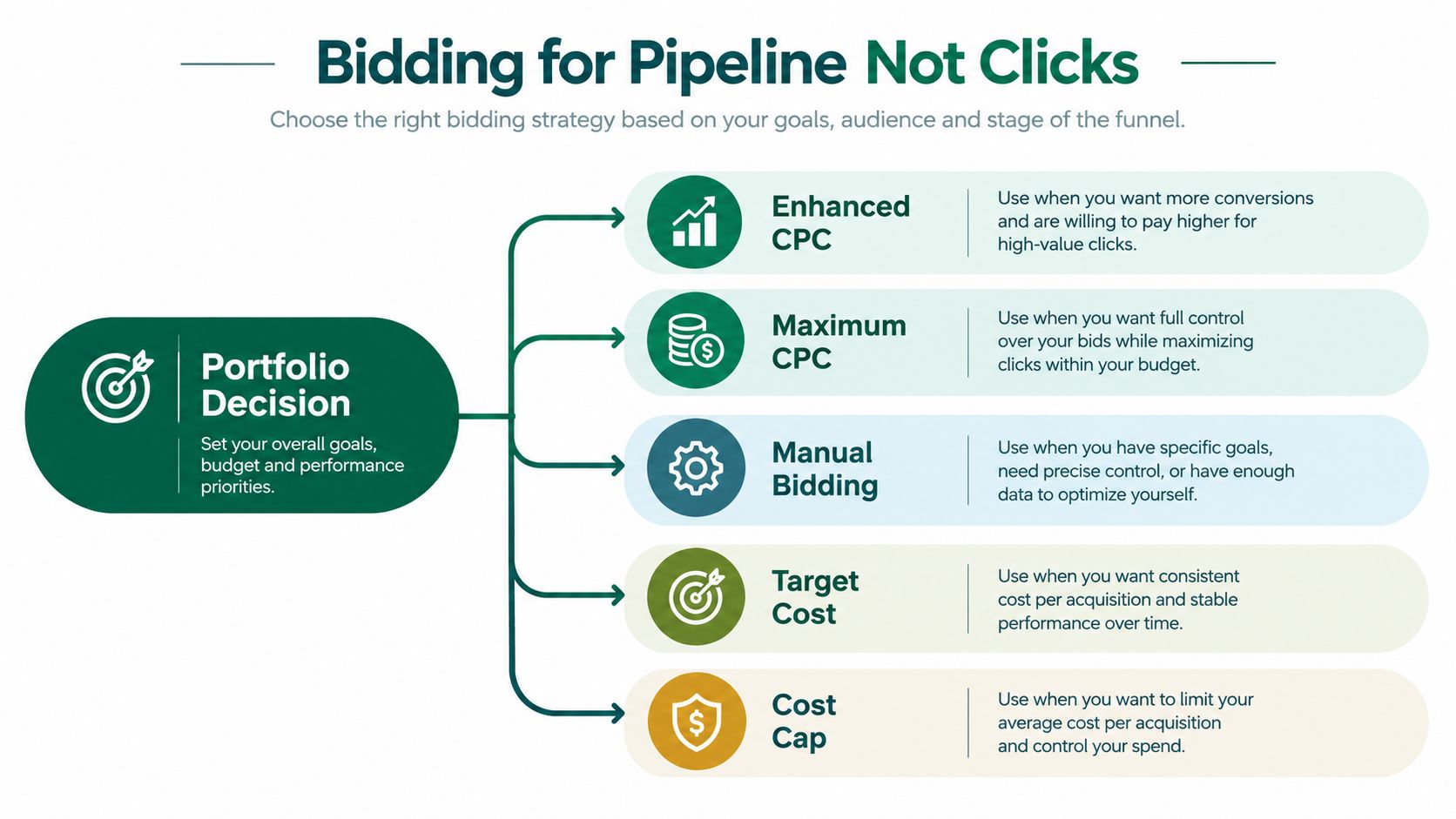
Use this operating sequence:
These thresholds are operating guardrails, not universal platform rules. For smaller B2B SaaS deals, review CPL alongside MQL-to-SQL rate, lead acceptance, and pipeline per dollar. A campaign with higher CPL can be the better investment when sales accepts its leads and opportunities advance.
Manage pacing by weekly economics. Set a ceiling so one audience cannot consume the portfolio, review delivery and lead quality across the week, and avoid reacting to one anomalous day. Off-hours suppression usually matters less than audience fit, offer relevance, and timely sales follow-up.
Most LinkedIn Ads for B2B lose efficiency after the click. The ad promises one thing, and the page asks the visitor to understand something else. That break forces the buyer to restart the decision instead of continuing it.
Message match has three parts:
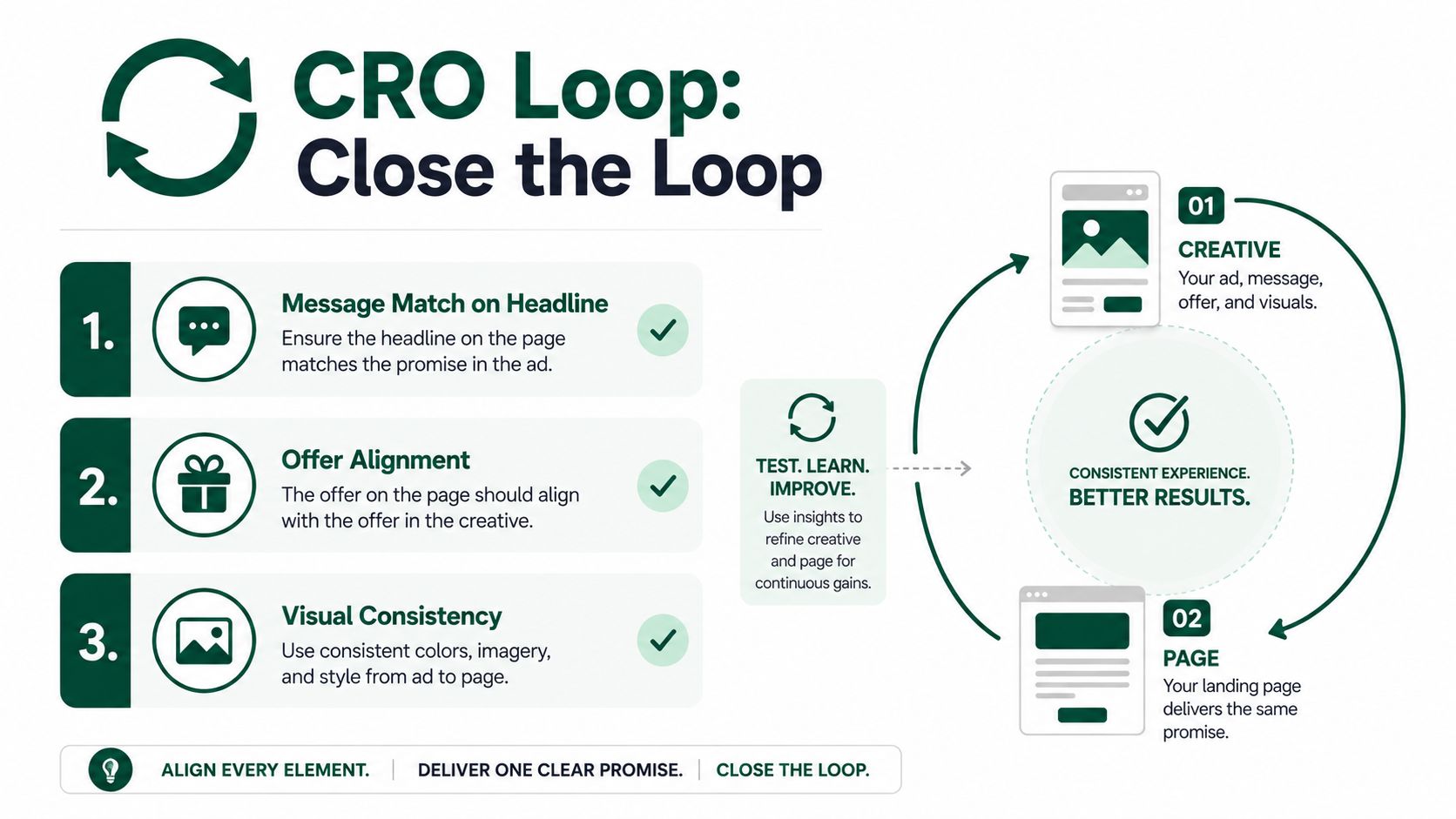
Three friction points damage B2B conversion:
LinkedIn recommends 3 to 4 fields for Lead Gen Forms, allows a maximum of 12 fields, and supports up to 3 custom questions, each with up to 100 characters (LinkedIn Lead Gen Form specifications). Use the shorter form for low-friction actions. Add qualification only when sales can explain why each question changes routing or prioritization.
Cold Sponsored Content needs a clear problem, a credible explanation, and a low-commitment next step. A mid-funnel case-study click needs evidence tied to the buyer's industry, operating model, or objection. Demo-ready traffic needs a direct promise about what the meeting will resolve, plus enough proof to make the meeting feel commercially sensible.
Don't run the same page for all three. A broad education page can make a qualified buyer work too hard. A demo page can pressure a problem-aware visitor before trust exists.
For additional CRO thinking, the 925 studios 2026 techniques guide offers useful context on testing and conversion design. Your own testing cadence should remain disciplined. Change one meaningful variable at a time, preserve holdouts when the offer allows it, and review performance with marketing and sales together on the next scheduled checkpoint.
The B2B conversion optimization resource can support that process, but the core principle is simpler: every landing page should continue the argument made by the ad.
Last-click reporting makes LinkedIn look weaker than it is, while form-fill reporting can make it look better than it is. Both approaches flatten a buying process involving multiple people, channels, and decisions.
Push meaningful lifecycle events into the CRM. In HubSpot, that means preserving lifecycle-stage progression and source context. In Salesforce, maintain campaign membership and campaign influence so account engagement can be reviewed alongside opportunity movement. Track the events that sales can validate, not only the events the ad platform can count.
A practical attribution view combines three lenses:
A position-based model can assign 40% to the first interaction, 40% to the last interaction, and the remaining 20% across middle interactions, as described in the methodology of the benchmark research summarized by HockeyStack (multi-touch LinkedIn Ads benchmark methodology). Use the model as a decision aid, not a claim that marketing can divide human decisions into perfect mathematical ownership.
The useful KPI stack includes:
Review the system at three levels. Use weekly checkpoints for creative, delivery, audience, and lead-quality decisions. Use a monthly pipeline review for opportunity creation, sales feedback, and budget movement. Use a 30-60-90 view to account for the longer journey and distinguish early signals from durable revenue contribution.
| Funnel Stage | LinkedIn Metric to Track | Pipeline or Revenue Tie-In | Review Cadence |
|---|---|---|---|
| Awareness | Qualified account engagement and audience response | Accounts entering an active buying motion | Weekly |
| Consideration | Offer engagement and accepted lead quality | MQL-to-SQL progression | Weekly and monthly |
| Evaluation | Cost per SQL and SQL-to-opportunity rate | Opportunity creation and pipeline velocity | Monthly |
| Revenue | Influenced ACV and closed-won association | Revenue contribution across the buying group | 30-60-90 review |
For teams refining their measurement model, this resource on attribution for growth teams provides a useful framework for multi-touch thinking. The final mental model should remain clear: LinkedIn Ads are a precision signal channel inside a 272-day, multi-stakeholder journey. Judge them on pipeline quality, account progression, and sales feedback. CTR and CPL can diagnose the system, but they shouldn't decide its budget alone.
Big Moves Marketing helps B2B SaaS teams clarify positioning, structure LinkedIn campaigns, and connect paid activity to qualified pipeline instead of vanity metrics. If your LinkedIn spend is producing leads but not enough sales confidence, visit Big Moves Marketing to discuss a sharper growth system.


%20-%20white.svg)