%20png%20copy.avif)
Most advice about the account based marketing definition starts with personalization. That's the wrong starting point for a growth-stage SaaS company.
ABM isn't primarily a way to write more relevant emails or build custom landing pages. It's a revenue operating model that decides which accounts deserve coordinated attention, how sales and marketing work those accounts together, and whether those accounts are moving toward pipeline and revenue. Personalization matters, but it's downstream of account selection, buying-group intelligence, orchestration, and measurement.
The practical question isn't “How can we personalize this campaign?” It's “Which accounts could materially change our year, what's happening inside them, and what should every revenue function do next?”
Most published definitions describe ABM as a targeted, personalized approach to high-value accounts. That description is directionally correct, and operationally incomplete. CapyScout ABM strategy insights offers useful context on how account-centric programs connect marketing activity with sales execution, but founders need a definition that can run inside a revenue team, not just explain a category.
The common definition puts content at the center. That leads teams to build one-to-one emails, account-specific ads, or bespoke landing pages before they've answered more important questions:
Without those answers, ABM becomes expensive decoration around ordinary demand generation. Marketing creates a static target list, sales works a different list, and both teams report activity that doesn't translate into account progression.
In conventional lead generation, the lead is the visible unit. A person downloads something, enters a workflow, and may eventually become an opportunity. ABM reverses that logic. The account becomes the planning unit, while individual contacts are understood as members of a buying group inside that account.
That distinction changes the operating model. A finance leader may care about risk, an operations leader may care about implementation, and a technical evaluator may care about security or integration. One contact rarely represents the entire opportunity.
The Big Moves Marketing perspective on one-to-one marketing is useful here, provided you treat one-to-one execution as a layer of the motion, not the definition of ABM itself. Personalization should express a clear account strategy. It shouldn't substitute for one.
ABM also requires sales and marketing to share an account list and a commercial outcome. If marketing celebrates engagement while sales has no account owner, no follow-up expectation, and no agreed progression criteria, the program isn't aligned. It's two disconnected workflows using the same label.
A strong operating definition therefore has three parts:
That's the standard founders should use. If the program can't change how the revenue team selects, engages, and measures accounts, it isn't ABM yet.
ABM is not a prettier target-account list. For a growth-stage SaaS company, it is a go-to-market operating model that coordinates buying-committee intelligence, commercial action, and pipeline outcomes around the accounts the company can realistically win.
The term ABM was coined in 2003 by Bev Burgess at ITSMA, helping establish account based marketing as a discipline built around named-account targeting and personalized programs. That history provides context. It does not tell founders how to run the motion now.
A useful account based marketing definition must guide decisions:
ABM is a go-to-market motion in which a defined account, including its buying committee, is the unit of planning, coordinated sales and marketing activity, and pipeline measurement.
The definition creates three operating requirements.
Select the companies you want to win, then map the functions and people involved in the decision. This reverses the generic demand-generation funnel. Demand generation maximizes lead capture and qualifies interest later. ABM starts with priority accounts and concentrates effort around their buying process, as described in this account based marketing definition from G2.
An account record needs more than a company name. Include fit, relationship status, relevant business context, known stakeholders, active opportunities, customer health where applicable, and meaningful buying signals. AI-driven account intelligence can help the team update that picture as research activity, product engagement, and stakeholder behavior change.
Sales and marketing can run different plays, but they must work from the same account view and progression criteria. Marketing creates demand within the buying group. An SDR maps stakeholders. An AE develops the commercial path. Customer success contributes expansion intelligence for existing accounts.
The handoff is not a marketing-qualified lead passed over a wall. It is an account reaching a condition that calls for a coordinated play, with ownership and a defined pipeline objective.
Personalization should match expected account value and buying complexity. High-priority accounts can justify one-to-one work. Clusters of similar accounts may receive one-to-few messaging. Broader target segments can use scaled programs shaped by shared industry, technology, or business-model characteristics.
For foundational context, learn about ABM with MarTech Do. For execution, use an account based marketing strategy that assigns tiers, plays, owners, and metrics. Track the outcomes founders care about: account progression, opportunity creation, pipeline quality, and revenue.
ABM fails before the first campaign launches. The failure usually sits in the account model, the scoring logic, the operating agreement, or the measurement system. Content personalization can't repair those weaknesses.
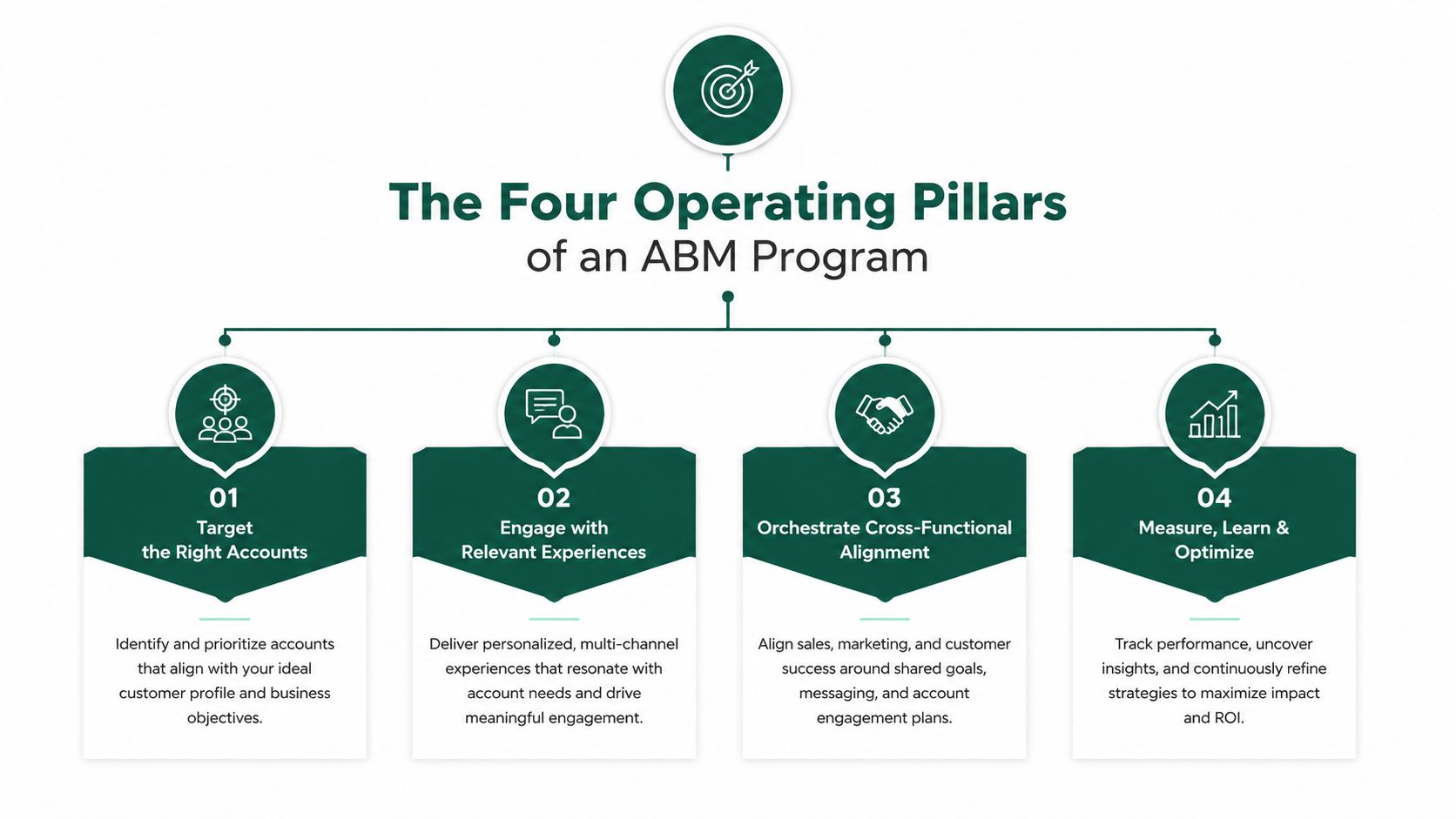
Your target list shouldn't be a quarterly spreadsheet that nobody trusts. Treat it as a living revenue artifact informed by ICP fit, CRM history, product usage, customer patterns, and intent signals.
The failure mode is predictable. A static list keeps dead accounts in active campaigns, misses accounts showing new buying behavior, and gives sales no reason to prioritize one company over another. The minimum bar is a documented list with explicit inclusion criteria, account tiers, ownership, and a process for adding or removing accounts.
A useful ABM campaign framework can help teams turn account selection into a repeatable operating process rather than a creative exercise.
Company size is a weak proxy for opportunity. An enterprise account may have the wrong technology environment, a poor implementation fit, low urgency, or a revenue model your product can't support.
Your scoring model should combine firmographics, technographics, and business-model signals. Validate it against closed-won and closed-lost history. The ideal customer profile template from Big Moves Marketing gives teams a starting structure, but the ultimate test is whether the model helps sales make better prioritization decisions.
A target account isn't a single inbox. Marketing, SDRs, AEs, and customer success should see the same account context and understand their role in the next play.
The skipped-pillar failure is single-threading. One enthusiastic contact engages, the team assumes the account is active, and the opportunity stalls when procurement, security, finance, or an executive sponsor enters the process.
Track account engagement, buying-group coverage, opportunities created, pipeline generated, stage progression, velocity, and wins. Don't let MQL volume remain the headline metric.
Inflexion Group's 2026 study reviewed 40 large enterprises and identified 20 success factors across objectives, metrics and governance, account coverage, activation, infrastructure, talent, and funding. Its findings reinforce a practical point: high-performing ABM programs depend on operating discipline and coordinated capability, not personalization alone. Read the Inflexion Group ABM research for the broader transformation context.
ABM and demand generation solve different problems. Demand generation creates interest across a market and lets conversion data reveal which prospects deserve attention. ABM starts with a defined account set and concentrates resources where the commercial upside justifies the focus.
The mistake is adopting both motions by default. Growth-stage teams often split a small marketing and sales group across broad content, paid acquisition, outbound, account plays, events, and product-led nurture. Each motion gets partial funding, partial ownership, and insufficient repetition. The result is not strategic diversification. It's starvation.
Demand generation usually suits a wider market, shorter buying path, and product experience that can carry much of the conversion burden. ABM makes more sense when each opportunity requires coordinated access to several stakeholders and the potential contract supports the work.
For practical planning, use the following thresholds as decision points, not universal laws. Demand generation tends to win when ACV sits under roughly $15K, sales cycles run under 90 days, and product-led growth can carry conversion. ABM becomes more attractive when ACV clears $50K, buying committees exceed three stakeholders, and broad-funnel pipeline velocity is flat or unpredictable.
| Dimension | Demand Generation | Account Based Marketing |
|---|---|---|
| Funnel direction | Attract broadly, qualify later | Select accounts first, orchestrate engagement |
| Lead volume | High volume is expected | Fewer accounts, deeper coverage |
| Commercial fit | Lower ACV, shorter cycles, self-serve or PLG | Higher ACV, complex evaluation, multiple stakeholders |
| Team structure | Marketing can generate and route demand at scale | Sales and marketing share account ownership and plays |
| Core measurement | Qualified demand, conversion, CAC, pipeline | Account progression, buying-group coverage, pipeline, velocity |
The Big Moves Marketing view on demand generation strategies is relevant when your primary constraint is insufficient market demand rather than poor account focus. Don't deploy ABM to disguise weak positioning or an unclear ICP.
Decision rule: If your ACV is below roughly $15K and your sales cycle is under 90 days, start with demand generation. If ACV is above $50K and several stakeholders must agree, evaluate ABM first.
The hybrid model can work later. Early on, choose the motion your team can execute consistently.
Static target lists make ABM easy to describe and difficult to run. A company chooses accounts, launches campaigns, and updates the list on a fixed schedule. That approach fails when buying behavior changes before the next campaign review.
For growth-stage B2B SaaS, the working definition of account based marketing is a continuous coordination layer. It combines account fit with product usage, CRM activity, hiring changes, technology changes, website behavior, and third-party intent. AI helps identify patterns and rank accounts. Human judgment still decides whether the positioning is credible, the account deserves attention, and the sales team can execute the play.
According to HG Insights' 2026 ABM platform guide, 78.7% of companies incorporate AI into ABM, while 86.2% expect AI to boost ABM ROI over the next year. These figures show adoption and expectations, not guaranteed performance. AI can surface a signal. It cannot validate your message, assess strategic account value, or create capacity for sales follow-up.
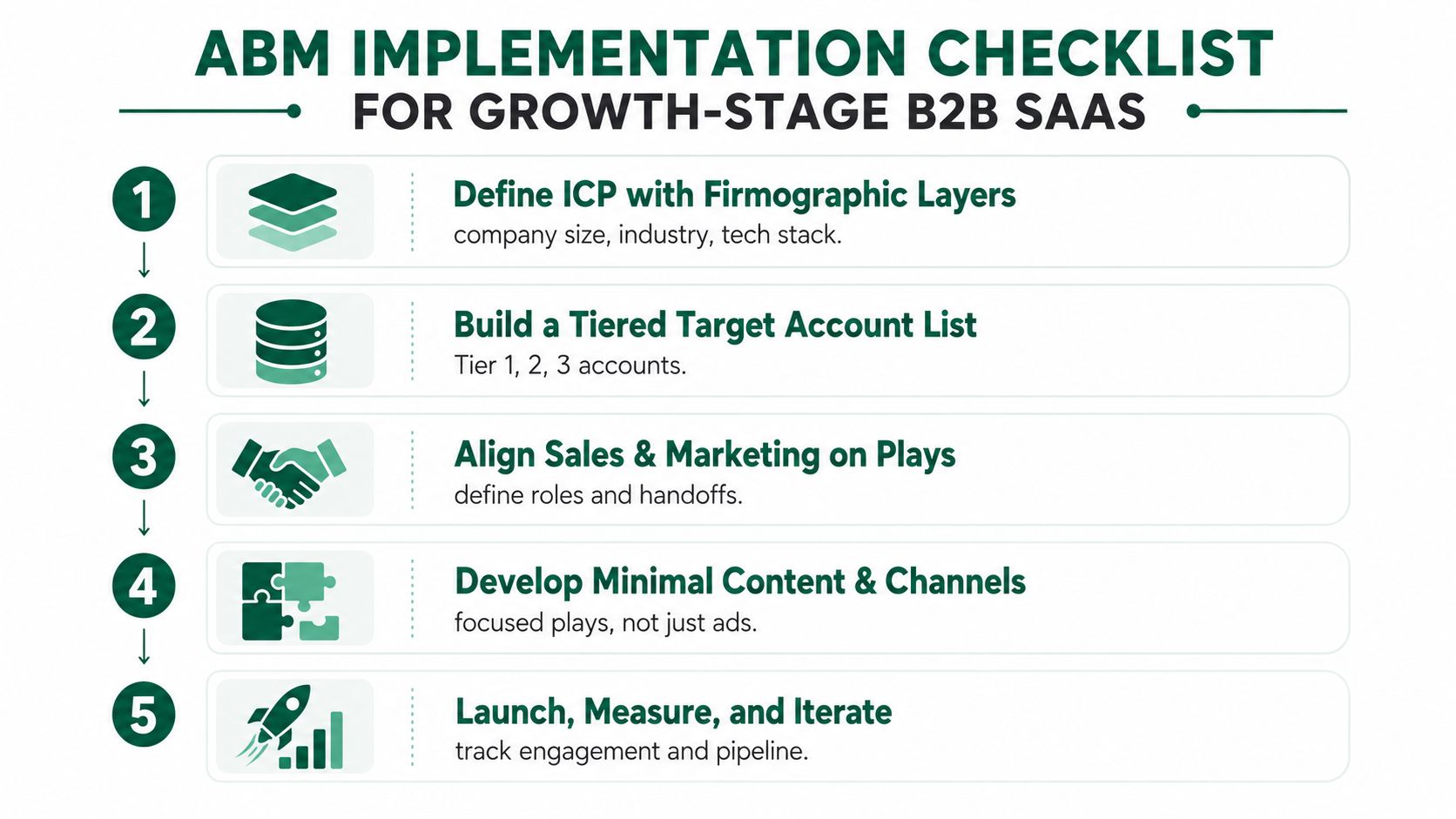
The operating shift has three parts:
Start with first-party data. Product usage can indicate expansion readiness. CRM history can expose stalled opportunities and influential contacts. Support and customer success notes can reveal recurring pain. Add third-party intent only after this internal signal spine works reliably.
The Big Moves Marketing overview of ABM platforms can support a tooling review. Do not buy software to compensate for unclear account criteria or broken routing. The system should help the team make a sound decision faster, not produce more dashboards.
ABM now works as the coordination system that turns account intelligence into plays across outbound, paid media, events, content, and product experiences. The campaign is one output. The operating layer is what improves account progression, buying-group coverage, pipeline, and velocity.
A 30-to-150-person SaaS company shouldn't copy an enterprise ABM department. It needs a narrow motion with clear ownership, limited channels, and enough account density for the team to learn.
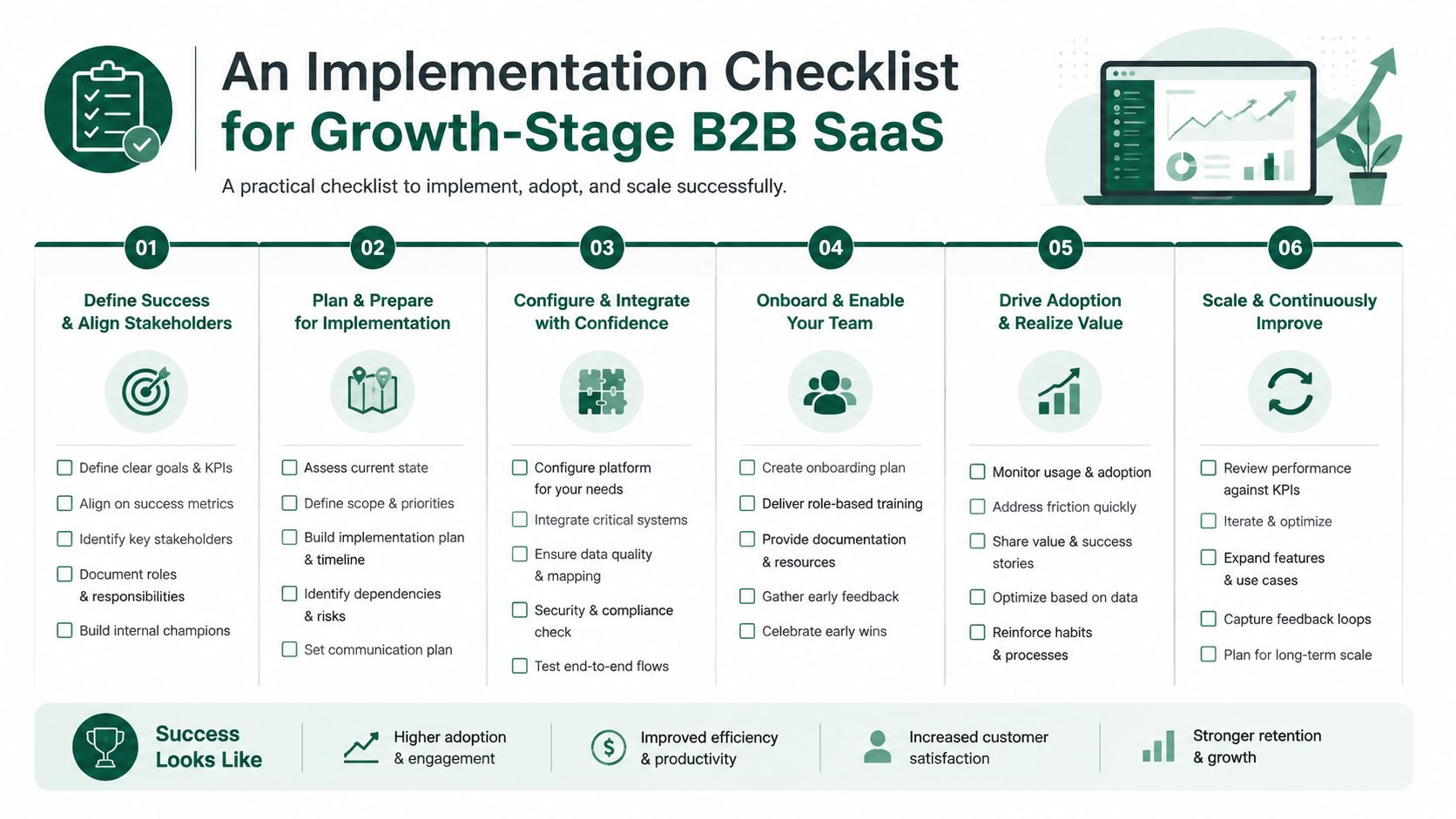
Define the ICP using three firmographic layers, then validate the model against closed-won deals. Add industry and company characteristics, technology environment, and business-model fit. If your best customers don't share a coherent pattern, pause ABM and fix positioning and segmentation first.
Build a target list of 50 to 300 accounts, using fit plus intent signals. The exact list size depends on your capacity and account value. A smaller list with real coverage beats a larger list that receives generic outreach.
Create a sales-marketing SLA that names:
The most common execution error is running ABM without rewriting the SDR or AE workflow. If the CRM still prioritizes the newest lead, the program's strategic account list won't survive contact with the sales floor.
Use a tiered structure:
Measure over a 90-day cadence using account engagement, pipeline created from target accounts, and win rate compared with control accounts. Don't judge the motion by clicks alone. Review account movement with sales and remove plays that create attention without commercial progress.
ABM is a decision filter, not a tactic stack.
Run it when deal size, ACV, and buying-group complexity justify named-account orchestration. Skip it when a self-serve, PLG, or SMB volume motion already converts at an acceptable CAC and doesn't require coordinated human intervention. Adding ABM to that model can create cost and process without improving the customer path.
Three failure modes appear repeatedly in growth-stage SaaS.
If your team can't explain why an account fits beyond industry and company size, the list isn't strategic. Weak fit criteria cause marketing to personalize the wrong message for the wrong company, while sales spends time defending accounts that were never likely to buy.
A shared account list has no value if marketing sees engagement that sales ignores, or sales pursues accounts marketing has excluded. Owners, timing, handoffs, and progression rules must live in the workflow, not in a planning document nobody opens after launch.
Teams often celebrate custom copy, landing pages, or ads because those outputs are visible. Pipeline accountability is harder. It requires the team to ask whether the buying group is expanding, whether the opportunity is progressing, and whether the account is becoming more likely to close.
The category has clearly moved beyond niche adoption. One 2024 benchmark found that 70% of B2B organizations reported an active ABM program, compared with 49% in 2020 and 31% in 2018, a 39-point rise over six years. The same benchmark reported ABM budget share reaching 28.4% in 2026 from 18.7% in 2022, according to The Starr Conspiracy's ABM benchmark reporting. Adoption creates no advantage by itself. Better account decisions do.
The sharper mental model is simple:
ABM means shared revenue accountability between marketing and sales against a curated, changing account set, with AI accelerating signal detection and humans owning account selection, messaging, and deal strategy.
If you can't name the 50 to 200 accounts that would change your year, you aren't running ABM. You're running decorated demand generation.
Big Moves Marketing helps growth-stage B2B SaaS teams clarify their ICP, design account-tier plays, align CRM routing, and connect positioning with account-level pipeline work. Visit Big Moves Marketing to discuss whether ABM fits your commercial motion and what needs to change before you launch it.


%20-%20white.svg)