%20png%20copy.avif)
In the world of B2B SaaS, converting a prospect isn't just about button colors or clever headlines. It’s about earning trust, clearly demonstrating immense value, and empowering your teams to close complex deals. While many companies get stuck endlessly optimizing small website tweaks, real growth stems from a unified approach that aligns your messaging, sales tools, and product experience into a seamless journey. This article delivers 10 powerful conversion optimization tips designed specifically for B2B innovators ready to scale.
These aren't minor adjustments; they are strategic moves that create a cohesive buyer experience, from the first click on a social post to the final signature on a contract. As you move beyond traditional A/B testing, gaining insights into a comprehensive B2B social media profit playbook can significantly enhance your growth strategies. We'll explore everything from refining your value proposition and optimizing sales demos to implementing product-led growth and reducing user friction. Prepare to move beyond surface-level tactics and implement strategies that build momentum and drive meaningful, sustainable revenue. Let's build your new playbook.
Your conversion rate hinges on one critical question: can a B2B buyer understand what you do, who you’re for, and why you’re the best choice within five seconds? A vague or feature-heavy message creates friction and kills momentum. This is where a crystal-clear Value Proposition and Messaging Framework becomes one of the most powerful conversion optimization tips you can implement. It’s a structured approach to translating what your product does into the business outcomes your ideal customers require.
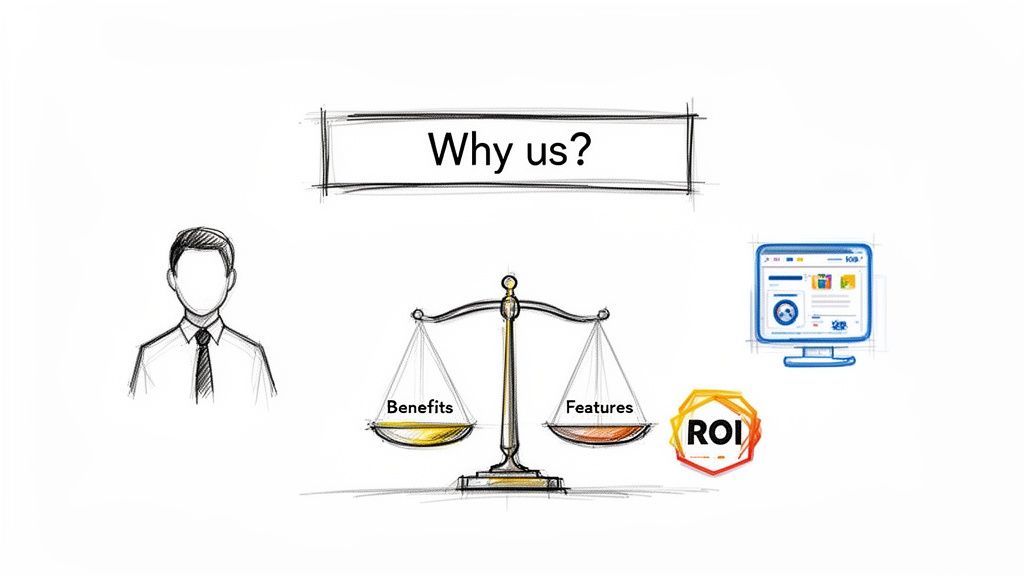
Think of Slack’s iconic “Where work happens” or Notion's “The all-in-one workspace.” These statements are not just taglines; they are promises of value, perfectly aligned with a specific business need. For B2B SaaS, this means articulating how your solution accelerates revenue, cuts operational costs, or mitigates risk, not just listing its technical specifications. When your messaging resonates with a prospect's core business challenges, the decision to click "Get a Demo" becomes an easy, logical next step.
Start by deeply understanding your position in the B2B market and building a messaging architecture around it. To dig deeper into this foundational step, explore this comprehensive guide on how to build a B2B messaging framework that works.
Your website might generate a lead, but the sales conversation is where the B2B deal is won or lost. In business-to-business sales, optimizing this human-to-human interaction is a critical conversion point. Sales enablement focuses on equipping your reps with the tools, content, and training they need to close deals faster. This means moving beyond generic presentations to create purpose-built pitch decks, one-pagers, and battlecards that speak directly to a prospect’s business pain.
Think of Stripe’s legendary pitch deck, which became a benchmark for its clarity and focus on the customer’s problem, not just the technology. The goal is to structure every sales interaction, from the initial demo to the final proposal, as a guided journey. When your sales team can expertly navigate discovery, tailor a demo to a prospect's exact needs, and handle objections with confidence, they don’t just sell a product; they build a business case that makes saying “yes” feel inevitable.
Start by auditing your current sales process and building a library of resources that directly addresses common bottlenecks. For a deeper dive into this, check out these sales enablement best practices to get started.
Your landing page is the digital handshake with a potential business customer; it can either build instant trust or create immediate friction. Conversion Rate Optimization (CRO) is the systematic process of improving that page to increase the percentage of visitors who take a desired action. For B2B SaaS, this isn't about guesswork; it's about methodically removing barriers between a prospect’s problem and your solution, turning clicks into qualified leads.
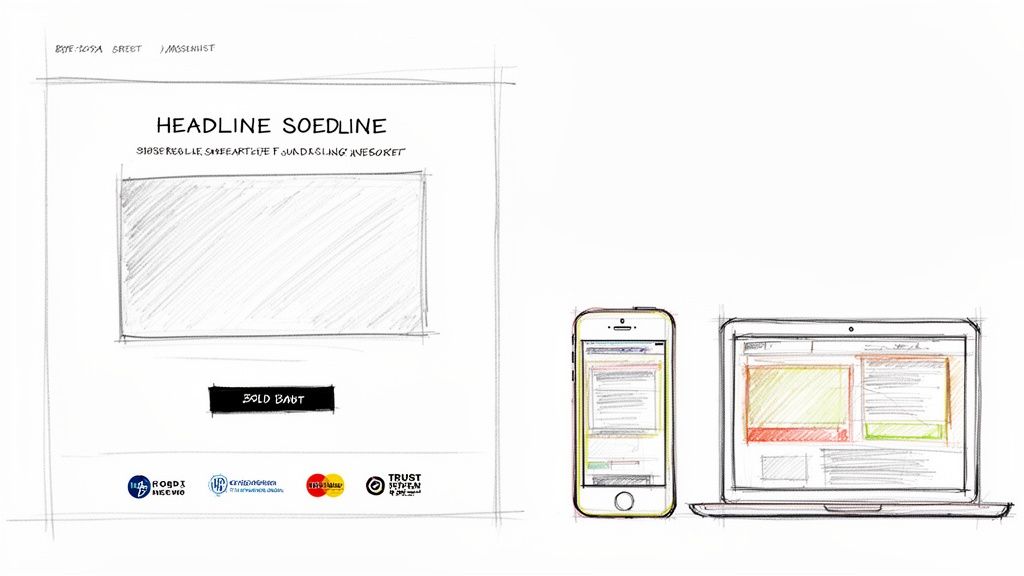
Consider Calendly’s legendary landing page: a one-sentence value proposition paired with a simple signup form. This masterclass in CRO demonstrates that clarity and ease-of-use are paramount. The goal is to make the decision to convert feel like an effortless, logical step. By meticulously testing headlines, adding compelling social proof, and simplifying forms, you can achieve compound gains that translate directly into significant revenue growth. A crucial aspect of this is implementing effective strategies for capturing first-time website visitors before they have a chance to leave.
Begin with the highest-impact, lowest-effort tests and build from there. To dive deeper into crafting a high-performing foundation, explore this detailed guide on how to build a B2B SaaS website that converts.
In a crowded B2B market, prospects are inherently skeptical. Why should they trust your solution over an established provider? The most effective way to dismantle this skepticism and build immediate credibility is by strategically deploying social proof. This isn't just about adding a few logos; it’s a systematic approach to showing, not just telling, that your product delivers real-world results for companies just like them.
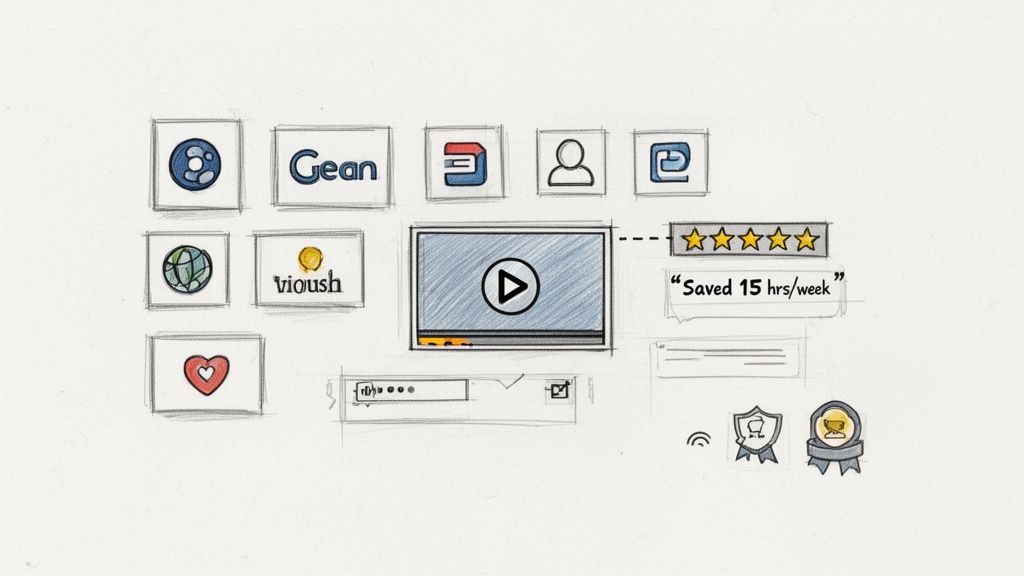
Think of how Stripe showcased brand-name customers early on to overcome payment processing distrust, or how Slack's wall of logos from Airbnb and Uber made adoption feel like a safe, smart business decision. By showcasing the success of others, you create a powerful psychological pull, making the choice to convert feel less like a risk and more like joining a winning team. This is one of the most vital conversion optimization tips for turning visitor doubt into decisive action.
Start by building a repeatable process for capturing and showcasing customer success. To understand how to transform customer wins into a powerful asset, get more details on the impact of case studies for B2B companies.
A generic message aimed at everyone resonates with no one. The CTO, CFO, and Head of Sales all have distinct pain points, priorities, and success metrics. Trying to convert them with the same landing page is a recipe for high bounce rates. This is why persona-based segmentation isn't just a marketing tactic; it's one of the most effective conversion optimization tips for creating a frictionless buying journey. It’s about speaking directly to the individual, not just the company.
Think of how Salesforce tailors its Einstein AI messaging: it highlights powerful analytics for data scientists, robust security for IT leaders, and tangible ROI for executives. Similarly, Calendly frames its product as a "productivity tool" for individual users but a "team efficiency driver" for managers. When your messaging reflects a deep understanding of each stakeholder's unique challenges and goals, you don't just capture their attention; you earn their trust and make the decision to engage feel personal and relevant.
Start by building detailed profiles for each key decision-maker involved in the purchase. To create truly effective profiles, you can discover more about developing a B2B buyer persona that drives your strategy.
What if your product itself was your most effective salesperson? This is the core principle behind a Product-Led Growth (PLG) strategy, a powerful approach where user acquisition, conversion, and expansion are driven primarily by the product. By offering a freemium tier or a free trial, you eliminate the initial purchase friction, allowing B2B users to experience your solution's core value firsthand. This model doesn't just lower customer acquisition costs; it generates highly qualified leads who already understand and appreciate what you do.
Think of how Calendly simplified scheduling for millions through its intuitive free tier, or how Figma became a design staple by letting teams collaborate for free. For B2B SaaS, a PLG motion allows your solution to prove its worth directly to the end-user, creating internal champions who drive the purchase decision. When a user experiences that "aha moment" where your product solves a real business problem, the upgrade to a paid plan becomes a natural, value-driven choice rather than a hard sell.
The key to a successful PLG model is designing an experience that rapidly demonstrates value and has clear, logical paths to paid features.
Every unnecessary step, confusing button, or extra form field in your user journey is a crack where potential revenue leaks out. Friction is the silent killer of conversions, creating just enough hesitation to make a user abandon a demo request or signup. Implementing friction reduction as a core part of your conversion optimization tips means systematically identifying and eliminating these obstacles, creating a smooth, intuitive path from interest to action. It’s about making the desired outcome feel effortless for your B2B prospect.
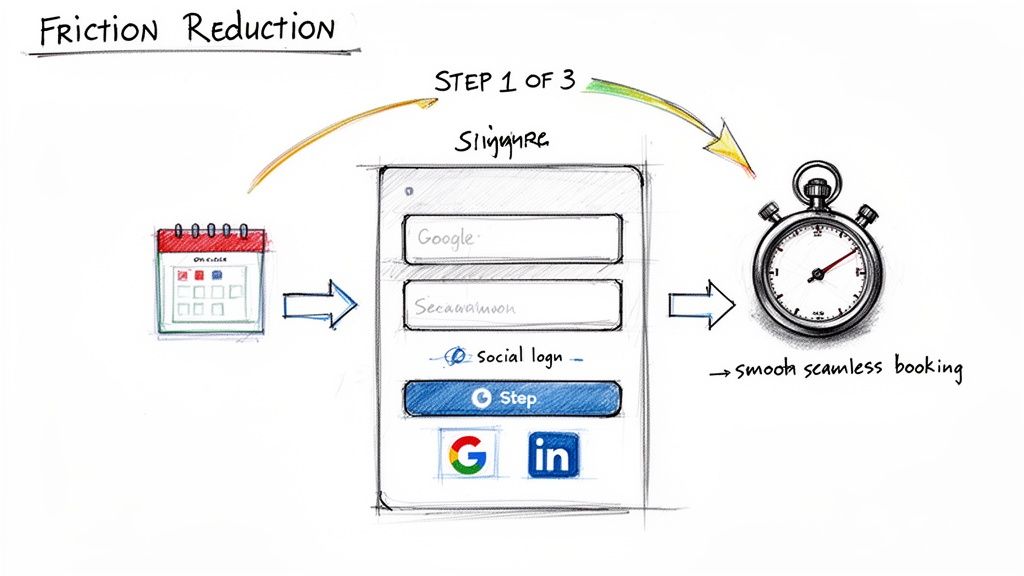
Think of Calendly's one-click scheduling or Slack’s simple email and password start; they masterfully defer complexity. Instead of demanding extensive information upfront, they deliver immediate value and handle profile building later within the product. This approach respects the user's time and momentum. For B2B, this could mean reducing a demo request form from eight fields to three, a small change that can yield a massive lift in qualified leads by making the first "yes" incredibly easy to give.
Begin by auditing every critical conversion path on your site, from the demo request flow to the final checkout or signup process.
If your B2B prospect sees your product as just another option in a crowded market, you’ve already lost. True conversion power comes not from being better on every feature, but from being fundamentally different in a way that matters to your ideal customer. A sharp positioning and differentiation strategy ensures you own a specific, valuable space in the buyer’s mind, making the choice to go with you feel inevitable. This is a crucial conversion optimization tip that shifts the conversation from a feature comparison to a value alignment.
Think of Figma versus Sketch. Figma didn't just build a design tool; it created "collaborative design, in the browser." This wasn’t a minor feature, it was a category-defining stance. For B2B SaaS, this means identifying what makes you the only logical choice for a specific business problem. When you clearly articulate your unique value against the alternatives (including the status quo), you remove doubt and dramatically shorten the sales cycle.
Start by mapping your market and defining the one or two axes where you can dominate. April Dunford's book, Obviously Awesome, is an essential read for mastering this process.
Not every visitor is ready to buy the moment they land on your site. The real opportunity lies in what happens after they download a resource or sign up for a newsletter. This is where strategic email nurturing becomes a powerhouse for B2B conversion optimization. It’s the art of guiding prospects through their buying journey with automated, value-driven communication that keeps your solution top-of-mind and builds trust over time.
Instead of a generic email blast, effective nurture sequences deliver the right content to the right person at the right time. Think of HubSpot’s persona-aligned sequences that address specific pain points for marketers, sales leaders, and service managers. Or Calendly’s onboarding sequence, which guides new users toward the "aha" moment of scheduling their first meeting. This methodical approach ensures that when a prospect is ready to talk, your sales team is their first call.
Start by mapping the key decision-making stages for your ideal customers and create specific email flows for each. The goal is to educate and empower, not just to sell, building a relationship that makes the final conversion feel like a natural conclusion.
Without data, optimization is just guesswork. A structured Conversion Rate Analytics & Testing Framework moves you from making changes based on opinion to making decisions based on evidence. It’s the engine that powers sustainable growth, providing a repeatable process to identify drop-off points in your funnel, form hypotheses about why they exist, and systematically test solutions. This data-driven approach ensures your efforts are focused on changes that actually move the needle on revenue-impacting metrics.
Think of it as applying the scientific method to your marketing. Instead of throwing spaghetti at the wall to see what sticks, you build a system for continuous improvement. Platforms like Optimizely or Convert allow you to run controlled A/B tests on landing pages, while tools like Mixpanel reveal the user behaviors that lead to conversion or churn. This framework transforms your website from a static brochure into a dynamic laboratory for discovering exactly what motivates your ideal B2B customer to act.
Start by establishing a single source of truth for your key metrics and a clear process for experimentation. This foundational work is crucial for any successful conversion optimization tips you implement later.
You've just navigated a comprehensive blueprint of high-impact conversion optimization tips, moving far beyond simple A/B testing of button colors. We've explored the foundational pillars of B2B growth, from articulating your value proposition with surgical precision to architecting a frictionless user journey. Each strategy, whether it's refining your pitch deck, implementing persona-based messaging, or building a robust analytics framework, represents a critical lever in your B2B SaaS growth engine.
The most profound takeaway is this: true conversion optimization is not a series of isolated tactics. It is an integrated system, a mindset of continuous improvement that unites your marketing, sales, and product teams. It's about building a cohesive experience where every touchpoint, from the first ad a B2B prospect sees to their first login, reinforces your value and builds undeniable trust. This holistic approach is what separates companies that merely survive from those that dominate their market.
Reading these tips is the first step, but action is what creates transformation. Don’t fall into the trap of analysis paralysis. Instead, choose one or two areas that represent your biggest opportunity for immediate impact.
Commit to mastering one domain before moving to the next. Build a testing framework, track your results, and let the data guide your decisions. This disciplined approach turns theoretical knowledge into tangible revenue growth. You are not just tweaking a website; you are building a scalable, predictable customer acquisition machine. The journey from a list of tips to a full-fledged conversion strategy begins with that first, decisive move. Make it count.
As a fractional CMO specializing in B2B SaaS and AI, I've seen how powerful this integrated approach can be. At Big Moves Marketing, we help founders and marketing leaders implement these exact frameworks to build unstoppable go-to-market motions. If you're ready to turn these insights into a concrete action plan for scalable growth, visit Big Moves Marketing and let's start the conversation.
Explore Big Moves Marketing services and resources:
Related reading:

%20-%20white.svg)