%20png%20copy.avif)

A revenue-focused content strategy for websites is not about publishing more articles. It’s a shift in thinking: you stop creating "content" and start building strategic assets that enable sales, build authority with your Ideal Customer Profile (ICP), and systematically de-risk their decision to buy from you.
Most B2B SaaS founders get the same tired advice: "You need to start a blog."
This usually kicks off a flurry of random acts of content. A checklist article here, a trend piece there. The result is a collection of posts that might generate vanity traffic but does nothing to produce a meaningful, qualified pipeline. The content calendar gets filled, but the sales team sees zero impact.
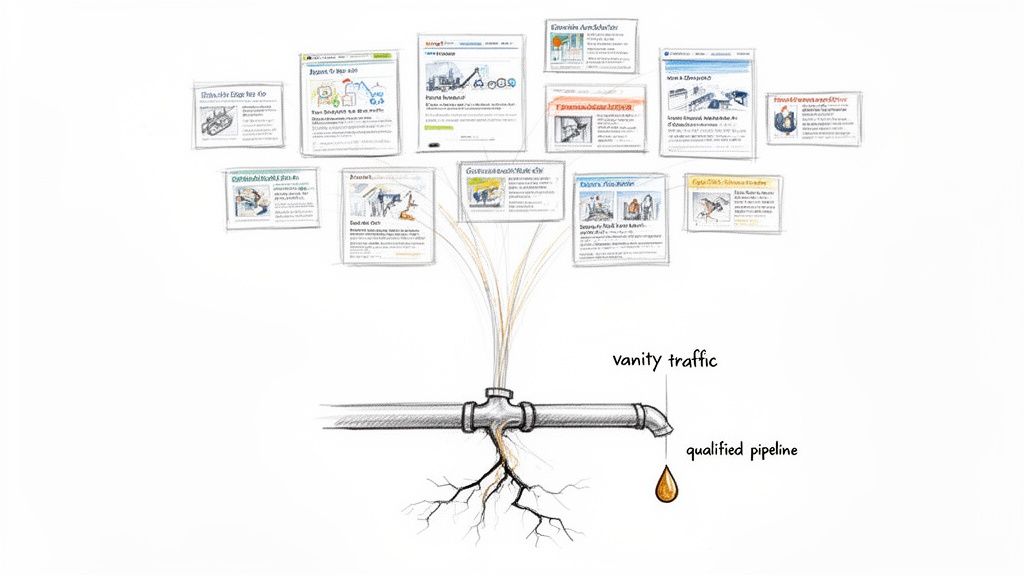
The core problem is not a lack of effort. It’s a fundamental misunderstanding of what sophisticated B2B buyers need from your website. They are not looking for another "ultimate guide" or a rehashed summary of commonplace ideas.
They are navigating a high-stakes purchase and searching for proof that you deeply understand their operational reality.
This disconnect between activity and pipeline is everywhere. I've seen countless teams burn through marketing budgets producing content that no one reads, least of all their target buyers.
The common playbook is broken because it prioritizes volume over value and fails to connect content directly to revenue.
Your website is the heart of your growth engine, not a digital brochure. As we’ve analyzed before, your website is at the heart of B2B marketing growth. It must function as a library of strategic assets, each designed for a specific purpose within your GTM motion.
The goal must shift from publishing content to building a collection of assets that actively enables your sales team, builds true authority with your ICP, and systematically de-risks their buying decision.
This demands a reframing of how you view your website's content. It’s not about attracting the most traffic; it’s about attracting the right traffic and arming them with the insights they need to choose you. Every piece of content must have a job.
Most companies are stuck in a flawed, resource-draining cycle. The shift to a strategic model is what separates high-growth B2B companies from the rest.
| Common (Flawed) Approach | Strategic (Revenue-Focused) Approach |
|---|---|
| Focus on generating "vanity traffic" and high page views. | Focus on attracting and converting the right traffic. |
| Chase high-volume, generic keywords. | Target specific, high-intent keywords tied to buyer pain. |
| Publish broad, "ultimate guide" style articles. | Create opinionated, expert content that answers critical questions. |
| Measure success with social shares, likes, and traffic. | Measure success with content-sourced pipeline and revenue. |
| Content operates in a silo, separate from sales. | Content is built as a sales enablement and GTM asset. |
When content is intentionally built to support specific business objectives, it stops being a marketing expense and becomes a revenue-generating asset. This is the foundation of a website content strategy that works.
Before you brief a single article or think about a headline, stop. The entire success of your website content hinges on one thing: radical clarity on your positioning.
This is not a marketing exercise. It’s the concrete foundation for every piece of content that will ever generate revenue for your business.
Most B2B SaaS companies get this wrong. They either skip it, rushing into keyword research, or create a positioning deck that gets filed away. The result is always the same: generic, unfocused content that tries to speak to everyone and resonates with no one. It talks about the product, but it never offers a clear point of view about the market.
Strong content does more than list what your software can do. It must be a direct extension of your company’s core beliefs—about your market, your customer's real problems, and the flawed ways others are trying to solve them. This is your Point of View (POV).
Your POV lives at the intersection of your unique market insights and your ideal customer's urgent pains. It’s the hard truth you’ve discovered that others have missed. Without it, your content is just another commodity, lost in a sea of look-alike blog posts.
A strong POV acts as a filter. It attracts right-fit customers who share your view of the world and actively repels prospects who are a poor fit. This is a feature, not a bug.
This goes beyond a clever tagline. It's about building a messaging hierarchy that maps directly to your website's content architecture. To get there, answer these questions with brutal honesty:
The answers become the pillars of your messaging. Every piece of content you create—from a top-of-funnel thought leadership article to a bottom-of-funnel comparison page—must reinforce these core ideas.
Founders are often too close to their product. They're convinced their messaging is clear because they understand the nuances. The only way to know is to test your positioning against the people whose opinions matter: your best customers.
Set up interviews with your highest-value customers. Don't ask if they like your product. Ask them about their world.
The language they use is gold. It's almost always simpler, more direct, and more powerful than the jargon on your current website. This customer language needs to become the bedrock of your content. To learn more about this process, you can explore our detailed guide on how to write a positioning statement.
By anchoring your content in well-defined positioning and a validated POV, you stop competing on features and start competing on perspective. This is how you shift from content that informs to assets that persuade. It's how you ensure every word on your site works to convince your ideal buyer that you are the only logical choice.
Your website content has one job: guide a prospect from "who are you?" to a signed contract. But most B2B SaaS teams use a broken model. They build sites around a simplistic top, middle, and bottom of the funnel (TOFU/MOFU/BOFU), ignoring the messy reality of how businesses buy software today.
This outdated thinking creates jarring experiences. A prospect reads a brilliant thought leadership article, clicks through, and is immediately ambushed with a hard "Book a Demo" CTA. The gap between their awareness and your request is a canyon. You’ve asked for a marriage proposal on the first date. They're gone.
A strategic website doesn't just attract visitors; it's architected to meet them where they are. It answers the right question at the right time, creating a seamless path from curiosity to conviction. Every page has a purpose.
This all starts by anchoring your content in your core positioning, ensuring every asset flows from who you are as a company to what your ideal customer needs to hear.
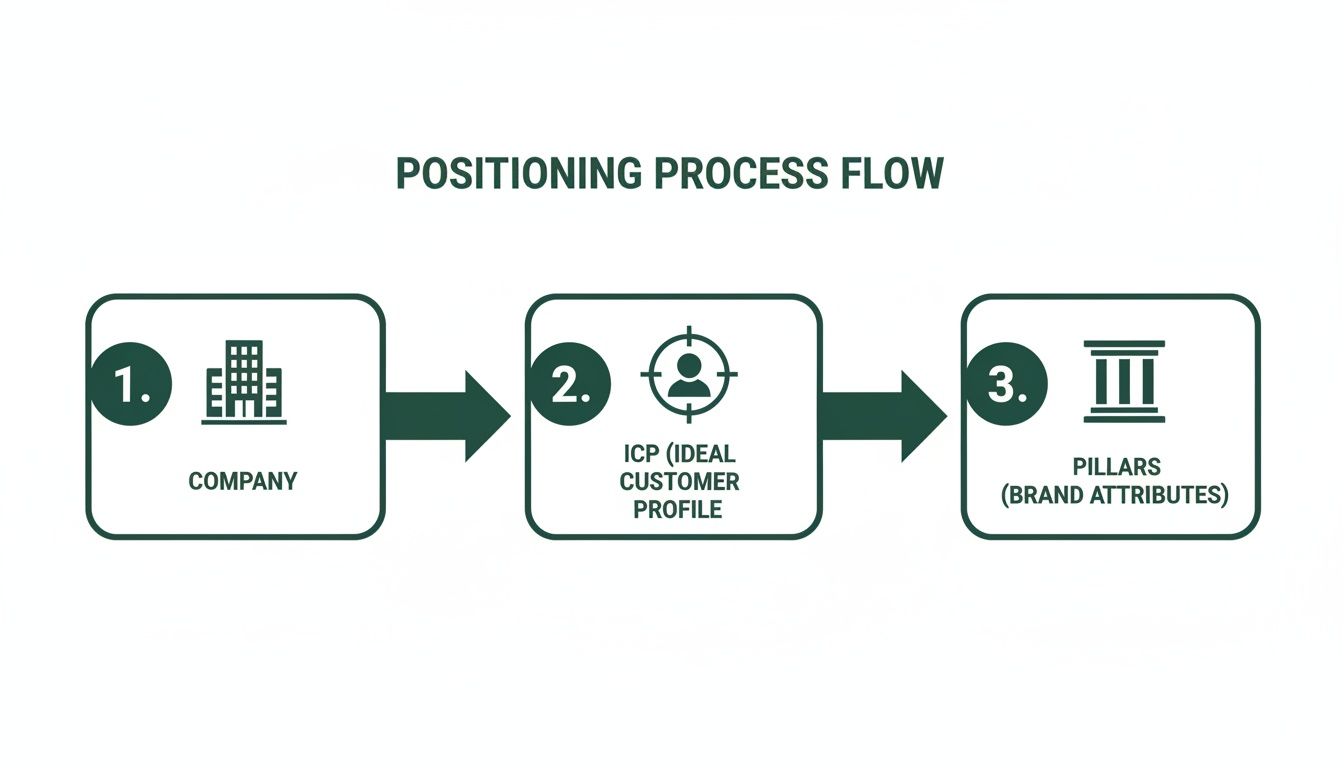
This process ensures every blog post, landing page, and case study is a direct reflection of your strategy, speaking to your Ideal Customer Profile through a consistent set of messaging pillars.
Instead of the tired TOFU/MOFU/BOFU framework, think in terms of the buyer's state of mind. We map client content strategies across four distinct stages of awareness and intent. Each stage demands a different content approach.
Your ideal customer doesn't yet realize they have the problem your product solves. They operate under the status quo. Your job isn't to sell; it’s to make them question everything.
Now you have their attention. The prospect recognizes the pain point you highlighted but has no idea a solution like yours exists. They're researching the problem, not potential solutions.
Your content must earn the right to make a recommendation. First, provide value by helping the prospect understand their problem with more clarity than anyone else. Only then can you introduce your product as the logical next step.
Things are serious. Your prospect is actively evaluating options. This includes your direct competitors, but also indirect alternatives like "do it in-house" or "do nothing." They need to de-risk the decision and build a business case to justify the purchase internally.
You closed the deal. The journey isn't over; it has entered a new phase. Content’s job now shifts from acquisition to activation and advocacy. Your goal is to ensure customers succeed, see overwhelming value, and become fans.
By mapping your website content to these buying stages, you transform it from a static brochure into a dynamic, 24/7 sales and success engine. Every page has a job, and every job contributes directly to revenue.
If your blog is a random collection of posts—one on AI this week, another on sales leadership the next—you're not building authority. You're creating noise. This approach signals to both sophisticated buyers and search engines that your expertise is a mile wide and an inch deep.
To own a market category, you need a systematic way to demonstrate structured expertise. This is where the Pillar and Cluster framework comes in. It’s not just an SEO tactic; it’s a strategic model for becoming the definitive resource in your niche.
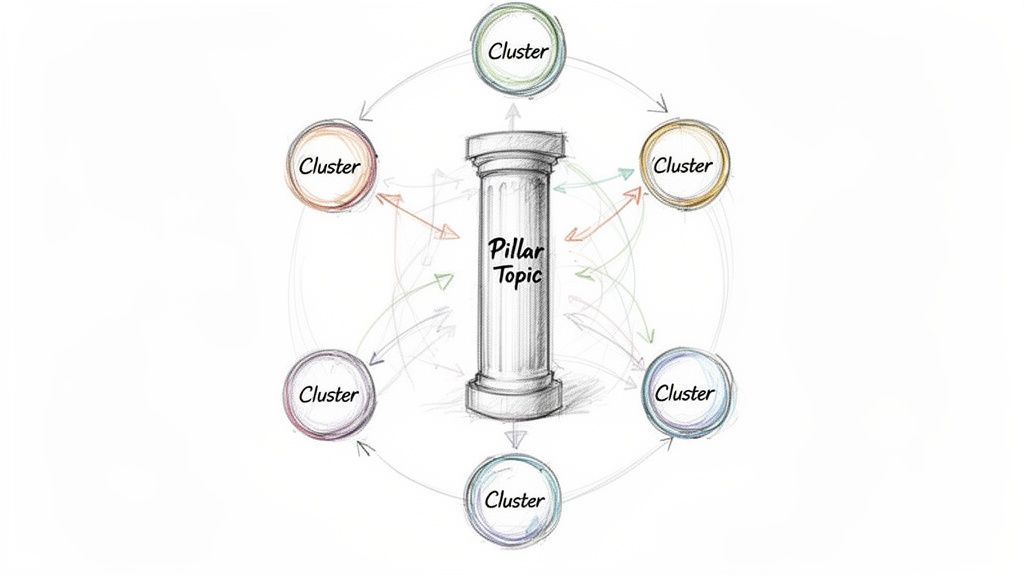
This model forces discipline. Instead of chasing dozens of disparate keywords, you focus your resources on dominating a few core topics central to your business and your ICP's critical challenges.
A Pillar is not a broad keyword; it's a major strategic theme you want to own.
For a Series B SaaS selling to finance teams, a pillar isn't "accounting software." That's too generic. A real pillar is a problem space, like "Automating the Financial Close Process." This is a topic with real business pain and revenue potential behind it.
Your pillars must live at the intersection of three critical areas:
Most early-stage companies should select no more than 2-3 pillars to start. Focus is your greatest weapon. Trying to build five pillars at once is a surefire way to ensure none achieve the depth required to establish authority.
Once you’ve locked in a pillar, map out every conceivable sub-topic and question related to it. These become your Clusters.
Sticking with our pillar "Automating the Financial Close Process," your cluster topics would look something like this:
Each cluster topic becomes a comprehensive article that thoroughly answers a specific question. You are not just skimming the surface; you are creating a network of content that addresses every facet of your customer's world.
The goal is to create an inescapable web of expertise. When a prospect searches for any question related to your pillar topic, they find you. Repeatedly. This is how you build trust at scale.
The power of this model ignites with internal linking. Each cluster article must link up to the central pillar page. This sends a powerful signal to search engines.
It tells them the pillar page is the most authoritative resource on the topic, with the cluster articles acting as supporting evidence. This structure concentrates authority, funneling it from specific cluster pages up to the broader pillar page. Over time, this causes the pillar's ranking potential to compound, a core tenet of any effective SaaS SEO strategy.
The pillar and cluster model creates a dense, internally-linked asset that naturally attracts high-quality backlinks to both the pillar and its cluster pages, amplifying your entire investment.
This methodical approach moves you from a random content creator to a strategic category owner. You stop publishing one-off articles and start building an asset that dominates search and convinces your ideal customer that you are the only logical choice.
You have built a library of expert content. But if it just sits on your website, you've built an expensive library no one visits. The most common point of failure I see in B2B SaaS is the chasm between marketing’s content production and sales’ daily reality.
Your sales team lives and dies by its ability to persuade. Yet, they are often sent into complex conversations armed with little more than a standard pitch deck. This is a massive, unforced error.
The content you’ve created—your pillar pages, cluster articles, and data-backed insights—is the single greatest source of fuel for your sales engine. If it’s not systematically integrated into the sales process, your investment is being squandered.
The objective is to make every piece of content work harder. It must move beyond a passive website asset and become an active tool in the hands of your revenue team.
This isn't about sending reps a link to the company blog. It’s about methodically deconstructing your strategic content into specific, high-impact sales enablement tools. Your 5,000-word pillar page on "Automating the Financial Close Process" is a goldmine of reusable components. To build authority with this model, a detailed understanding of topics like What Is a Pillar Page and How to Build One for SEO is critical.
Here’s how to operationalize it:
This process turns your marketing team into a direct-support function for sales. You’re not just creating content; you’re manufacturing the intellectual ammunition that helps reps win deals. For more on this, check out these B2B content examples for successful sales enablement.
That same precision must be applied to distribution. The "post and pray" approach—publishing to your blog and sharing on the company LinkedIn page—is a recipe for invisibility.
Your ICP is not waiting for your updates. They are busy, skeptical, and spending their time in niche, high-signal communities.
Your job is to find those walled gardens. They might be private Slack groups, industry-specific forums, or exclusive founder networks. This requires deep empathy for your ICP's daily life and where they go to solve problems.
Once you identify these channels, the goal is not to spam links. The strategy is to equip your team—especially founders and senior leaders—to add value to the conversation.
This approach positions your company as a generous expert, not a self-interested vendor. It's slow, methodical work that doesn't scale in the traditional sense, but it's how you build real influence with the people who can actually buy your product.
Whenever I work with B2B SaaS founders and their revenue teams, the same tough questions surface. There's a constant tension between the perfect, on-paper strategy and the messy reality of getting it done.
Below are my direct answers to the most common points of friction I see, from pre-PMF startups to Series C companies trying to scale. These are not theoretical responses. They come from years in the trenches, seeing what works, what fails, and what moves the needle on pipeline.
That’s the first question I always hear, and it’s the wrong one. The right question is, "How much are we willing to invest in building a strategic asset that generates pipeline?" The budget follows the commitment, not the other way around.
Shift your mindset from treating content as a marketing "expense" to a capital "investment." You’re not buying blog posts; you’re funding the construction of a revenue machine.
For an early-stage SaaS company, this means funding fewer, much higher-quality pillar assets that your team can repurpose endlessly. Do not spread a small budget thinly across dozens of low-impact articles.
A realistic starting point for a serious program—one that includes strategy, high-caliber creation, and intelligent distribution—is typically in the $5k-$15k per month range. Anything less is likely just funding random acts of content, not building a competitive moat.
This level of investment covers the deep thinking, subject matter expertise, and activation needed to produce content your sales team will actually use and your ideal customers will respect.
Stop obsessing over page views and social shares. Those are vanity metrics that tell you nothing about business impact. Your board doesn't care about traffic spikes; they care about revenue.
The only KPIs that matter are tied directly to pipeline. It is on you to ensure your CRM and analytics are set up to track these metrics.
Measuring ROI is not a passive activity. It demands a deliberate operational setup to connect content consumption to sales outcomes.
Yes, but think of it as a scalpel, not a sledgehammer. AI is a powerful tool for accelerating grunt work, but it is not a replacement for hard-won expertise.
Here’s how to use it effectively:
Here’s what you should NEVER use it for:
The winning formula is human-led, AI-assisted. A sophisticated B2B buyer can spot generic, soulless AI content from a mile away. Your unique perspective is your only durable competitive advantage. AI cannot replicate the earned authority that builds trust and wins deals. For a deeper dive into how this fits into the bigger picture, you can explore broader strategies in content marketing.
At Big Moves Marketing, we partner with B2B SaaS founders to translate deep product expertise into a GTM and content strategy that builds authority and drives revenue. If you're ready to stop creating random acts of content and start building a strategic pipeline-generating asset, visit https://www.bigmoves.marketing.
Explore Big Moves Marketing services and resources:




%20-%20white.svg)