%20png%20copy.avif)

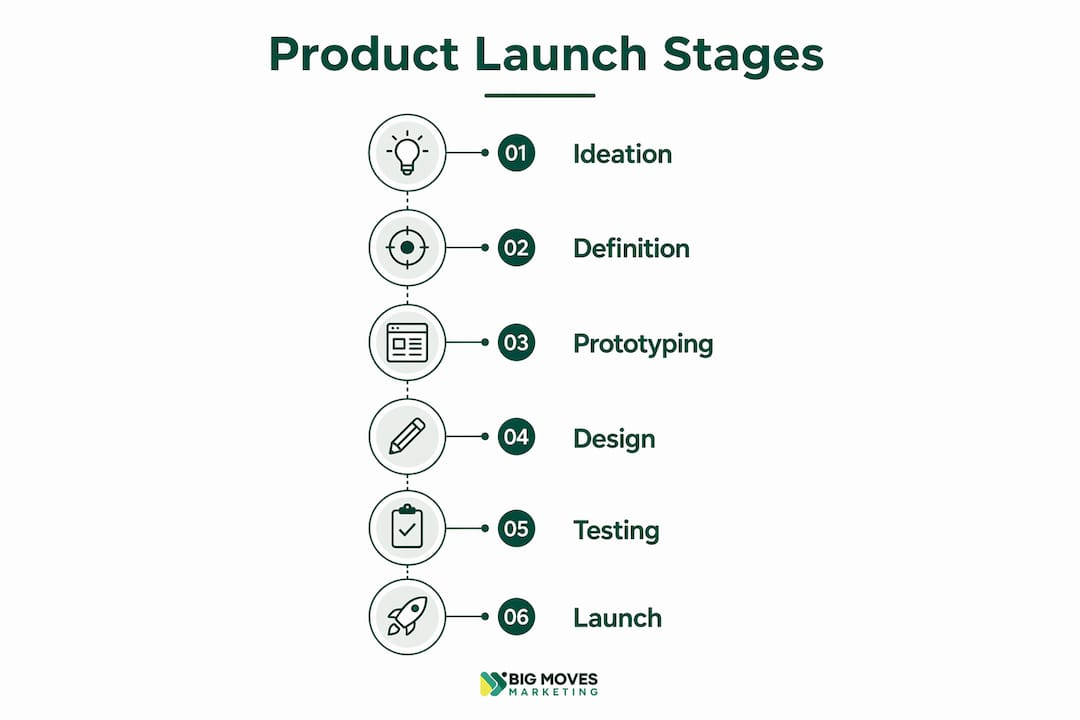
Bringing a product to market is the process of turning a validated idea into a revenue-generating product through structured development, testing, and launch execution. The formal term for this process is product commercialization, and it covers every phase from ideation through post-launch scaling. Most founders underestimate how many distinct stages exist between “I have an idea” and “customers are buying.” A six-stage development cycle covering ideation, product definition, prototyping, design, testing, and commercialization gives you the clearest map of what lies ahead. Skipping stages does not save time. It creates expensive rework.
Product commercialization follows a structured sequence. Each stage has a specific goal, and completing it properly protects the stages that follow.
The Minimum Viable Product (MVP) concept belongs inside stage three. An MVP is the simplest version of your product that still delivers its core value. Over-engineering at this stage wastes resources and delays market feedback. Launch small, learn fast, and build from real data.
| Stage | Primary objective |
|---|---|
| Ideation | Define the problem and opportunity |
| Product definition | Align buyer, use case, and metrics |
| Prototyping / MVP | Test core value with minimal investment |
| Design and testing | Refine based on real user feedback |
| Commercialization | Execute launch and go-to-market plan |
Pro Tip: Set one measurable goal per stage. “Validate that 20 target buyers will pay $X” is a goal. “Explore the market” is not.
Validation is the act of confirming that real buyers will pay for your product before you invest heavily in building it. Early validation reduces development risk and keeps your roadmap focused on what buyers actually need. Founders who skip this step often build products the market does not want.
Proven validation methods include:
Intellectual property (IP) protection runs parallel to validation, not after it. File a provisional patent before sharing your concept publicly. Register design rights for any distinctive visual elements. Use NDAs when discussing your product with manufacturers, suppliers, or potential partners.
Pro Tip: File your provisional patent application before your first public demo or crowdfunding campaign. Public disclosure can void patent rights in many jurisdictions.
The commercialization path is iterative. You will return between ideation, prototyping, and validation multiple times. That is not failure. That is the process working correctly.
Prototyping is iterative by design. Your first prototype will be wrong. Build it anyway, test it with real users, document what breaks, and improve. Each iteration narrows the gap between your concept and a product buyers will actually use.

Design for Manufacture (DFM) is the discipline of designing your product so it can be produced cost-effectively at scale. DFM analysis happens before you finalize specifications. It identifies components that are expensive to source, difficult to assemble, or likely to fail under production conditions. Applying DFM early prevents costly redesigns after tooling has been ordered.
| Prototyping approach | Best for | Key consideration |
|---|---|---|
| 3D-printed mockup | Early concept testing | Low cost, not production-grade |
| Functional prototype | User testing and feedback | Closer to final spec |
| Pre-production sample | Supplier and quality validation | Built using production tooling |
| Pilot production run | Final quality control check | Small batch before full order |
Supplier sourcing requires the same rigor as product design. Evaluate suppliers on minimum order quantities (MOQs), lead times, quality certifications, and communication responsiveness. Request samples before committing to any volume order. Build relationships with at least two suppliers for critical components to reduce single-source risk.
Cost modeling belongs in this stage, not at launch. Calculate your landed cost per unit, including materials, labor, freight, duties, and quality control. Set a target gross margin before you finalize your retail or SaaS pricing.
Pro Tip: Ask your manufacturer for a DFM report before finalizing your design. A good manufacturer will flag cost and assembly issues before tooling begins. A manufacturer who skips this step is a risk.
For B2B SaaS founders, prototyping means building a minimum viable product that real buyers can use in their workflow, not a demo that only works in a controlled environment.
A product launch is a planned event, not a moment. Launch planning includes brand messaging, timing selection, channel identification, and asset preparation. Founders who treat launch as a single day consistently underperform those who treat it as a 90-day campaign.
Your brand messaging must connect your product’s core function to a specific buyer outcome. “We help mid-market SaaS teams reduce onboarding time by 40%” is a message. “We build great software” is not. Every piece of launch content, from your website to your LinkedIn posts, should reinforce that single outcome.
Key launch marketing tactics for bringing new products to market include:
Timing matters. Avoid launching during major industry events where your announcement will be buried. Align your launch with a buyer calendar event, a fiscal quarter start, or a regulatory change that makes your product newly relevant.
A marketing strategy for new product launches in B2B tech requires channel selection based on where your buyers actually spend time, not where you are most comfortable.
Post-launch is where most products either build momentum or stall. The difference is how quickly you act on feedback. Customer feedback and market trends drive continual product improvement and competitive advantage. Collect it systematically, not occasionally.
Set up a feedback loop from day one. Use in-app surveys, sales call recordings, support tickets, and review platforms to capture what buyers say and what they do. Separate feature requests from core complaints. Core complaints signal product-market fit gaps. Feature requests signal growth opportunities.
Track three metrics weekly in the first 90 days after launch: activation rate (do new users reach the core value moment?), retention rate (do they come back?), and Net Promoter Score (would they recommend you?). These three numbers tell you more than any vanity metric.
Scaling requires operational readiness, not just marketing spend. Before you increase acquisition spend, confirm your onboarding, support, and delivery processes can handle 3x your current volume. Scaling a broken process creates churn, not growth.
Pro Tip: Schedule a formal product review at 30, 60, and 90 days post-launch. Review feedback data, update your roadmap, and communicate changes to your early buyers. Buyers who see their feedback acted on become advocates.
Optimizing your product pages for SEO and conversion is a post-launch priority that most founders delay too long. Your website is a sales asset. Treat it as one.
Bringing a product to market requires completing six structured stages, validating demand before heavy investment, and treating launch as a 90-day campaign rather than a single event.
| Point | Details |
|---|---|
| Follow the six-stage cycle | Move through ideation, definition, prototyping, design, testing, and commercialization in sequence. |
| Validate before you build | Use surveys, focus groups, and pre-launch pages to confirm buyers will pay before investing in production. |
| Apply DFM principles early | Design for Manufacture analysis prevents costly redesigns after tooling is ordered. |
| Launch with a 90-day plan | Align messaging, channels, content, and timing before launch day arrives. |
| Iterate post-launch fast | Track activation, retention, and NPS weekly and update your roadmap at 30, 60, and 90 days. |
Most founders treat product commercialization as a linear checklist. It is not. The commercialization process loops back on itself constantly. You will validate, prototype, discover a flaw, return to ideation, and validate again. That cycle is not a sign of failure. It is the process working.
The mistake I see most often is founders who fall in love with their product before buyers validate it. They over-invest in design, branding, and features before a single real buyer has confirmed they will pay. The MVP discipline exists precisely to prevent this. A small but purposeful MVP validates demand early and preserves the capital you will need for scaling.
The second mistake is treating go-to-market as a late-stage task. Failing to plan go-to-market logistics until late in development consistently delays product release. Your messaging, channel strategy, and website need to be ready before your product is. Not after.
My honest advice: build your go-to-market plan in parallel with your product. Know your buyer, your message, and your launch channels before you finalize your specifications. The founders who do this ship faster, spend less, and convert more.
— Veb
Bigmoves works with B2B SaaS and technology founders at exactly the stage where most launches stall: translating a built product into a market-ready go-to-market system. That means clear positioning, a website that converts, and channel execution that generates pipeline from day one.
Veb and the Bigmoves team have worked with over 75 startups and enterprises to build go-to-market websites that support rapid product launches. From Webflow-based conversion sites to LinkedIn and Google Ads execution, Bigmoves builds the marketing infrastructure that turns a product launch into sustained revenue. If you are preparing to launch and need a go-to-market system that works, explore the launch guide to see how the process works in practice.
Product commercialization is the process of taking a validated product from development to market, covering manufacturing preparation, pricing, go-to-market planning, and launch execution.
The standard product development cycle follows six stages: ideation, product definition, prototyping, design, testing, and commercialization.
An MVP (Minimum Viable Product) is the simplest version of your product that delivers its core value. It validates market demand quickly and preserves resources for later development.
File a provisional patent before any public disclosure, including demos, crowdfunding campaigns, or supplier conversations. Public disclosure can void patent rights in many jurisdictions.
Track activation rate, retention rate, and Net Promoter Score weekly in the first 90 days. These three metrics reveal whether buyers are reaching value and returning for more.



%20-%20white.svg)