Most GTM plans fail because nobody asked hard questions first. Teams plan go-to-market as a launch checklist: messaging, a website, ads, sequences. The failure is upstream. The strategic questions that decide who signs, what alternatives buyers already weigh, which motion the economics can support, and what evidence justifies spend were never answered. A checklist then spends money on a story the market did not ask for.
Popular advice says start with an ICP slide and a channel mix. That advice is backwards. An industry, a headcount band, and a title do not tell you who can kill the deal, or whether a modest contract can pay for a human seller. I would rather see ten sharp answers than a forty-page plan full of tactics.
This list is the ten go to market strategy questions worth answering before the first dollar moves. Each one states why it matters, the probes that expose a weak answer, and the decision it should change across positioning, channels, pricing, sales enablement, metrics, or kill criteria. If you are about to scale sequences, work through a readiness checklist for B2B outbound first. Outbound without a buying map is noise with a calendar link.
Most B2B SaaS teams define an ideal customer by industry, company size, and job title, then stop. That skips the question that decides whether a deal closes: who signs, who blocks, and who has to live with the tool.
The user who loves the product often has no budget. The budget holder cares about risk, integration cost, and a business outcome the user never sees. Teams that merge the two write for the wrong person, then wonder why pipeline dies at the second meeting.
Demandbase research reports that 72% of B2B purchases involve complex, multi-stakeholder buying groups, with most purchases involving seven to ten stakeholders across IT, finance, operations, and end users. One persona deck cannot cover that room.
Practical rule: Treat a champion without budget authority as a risk to manage, not a closed deal.
Probes that expose a weak answer
What you decide. Split messaging by role before you pick a channel. Pricing has to survive a finance conversation, not only a user demo. Sales enablement needs a different proof point for each seat at the table.
Say you sell a developer tool that spreads among engineers. Usage looks healthy. Nothing becomes an enterprise contract until a VP of Engineering or procurement approves it. Review the last 15 won and lost deals and list every person who moved the outcome. Write messaging around each role's metric.

Positioning fails when it describes features. The useful question is comparative. What does the prospect do today, and why would they stop?
Many teams skip alternatives and jump to a category name. The copy could describe three competitors. Strong positioning starts with what buyers consider, which is often a spreadsheet, an internal build, an agency, or doing nothing. Name those, and you can define the context where you win and the value that makes switching worth the pain.
Purpose. Turn a feature list into a wedge you can defend in a sales call and on a homepage.
Probes
For this context, unlike these alternatives, we deliver this outcome. If a seller cannot say that in one breath, the website will not save you.
Test the line in live calls before you rewrite pages. The call shows whether the wedge holds. A workflow product that beats manual finance spreadsheets on time-to-value will lose if it pretends to be a general automation suite. A security tool that replaces in-house alerting scripts should not pose as a full security platform. The outcome you own also sets pricing. You charge for the result they stop doing by hand, not for a feature count.
The go-to-market motion is a cost structure with a hiring plan attached. Product-led, sales-led, and hybrid each demand a different asset before they produce a dollar. Teams borrow a motion they admire in another company, then find their price and buyer cannot support it.
| Motion | What it demands | Breaks first when |
|---|---|---|
| Product-led | Self-serve value without a human, and a price that tolerates a small first contract | A stranger needs a demo to reach a result |
| Sales-led | Pipeline capacity, a deal size that covers the seller, and a process someone else can repeat | Contract value cannot pay back a sales touch |
| Hybrid | Two systems and a written handoff between them | Product-qualified and sales-qualified stay undefined |
Gartner's B2B buying report names the tension: buyers prefer to research without a rep, while self-service digital-commerce purchases are more likely to produce regret. They want autonomy during research and a human check before commitment. A pure sales motion adds friction. A pure self-serve motion admits bad-fit deals nobody screened.
Purpose. Match acquisition cost to what a customer can pay back before you hire reps or build a funnel that cannot cover its own cost.
Probes
What you decide. Price and packaging follow the motion, and so does sales enablement. Define product-qualified and sales-qualified in writing before launch, with the trigger that moves a deal between paths. Revisit the choice when average contract value or cycle length moves in a material way. Collaboration tools often grow through individual use, then add enterprise sales once admin controls and security reviews appear. Enterprise software with long procurement should not run a self-serve trial that fills the funnel with buyers it cannot serve.
Early teams assume marketing will create demand once the site is live. The first customers almost always come from founder networks, direct outreach, existing relationships, or a thin set of partnerships. Paid search and content need time, data, and budget before they produce signal. Waiting for a scalable channel is how you starve.
Purpose. Pick an initial sales motion that produces learning fast enough to justify the next investment.
Probes
A vertical SaaS company can land its first twenty accounts through one industry association, then turn those logos into proof for paid acquisition. A developer tool can grow through open source and conference talks before anyone funds outbound. Both paths are valid. Neither is a "channel strategy" yet. They are evidence machines.
Document every objection in a shared log. The pattern predicts which channel will work later, and which message will waste spend. Convert early customers into references as soon as they hit a measurable outcome, not after a renewal. For the manual path that gets you there without a marketing team, see finding your first 10 B2B customers.
Do not fund a scalable channel to avoid the discomfort of the first ten conversations. Those conversations are the strategy.
Demand generation amplifies whatever already exists. If the message is fuzzy, the site is weak, and proof is thin, paid and outbound produce traffic that does not convert. Teams then blame the channel.
The question is not whether to invest. It is which foundations must exist so the spend produces usable signal. You need a message sales can repeat, a page that converts, a clear offer, and enough proof that a stranger will take the next step. Sequencing matters because every result sits behind the click.
In a McKinsey survey of more than 1,000 B2B buyers, 76% said speaking with a salesperson was helpful when researching a new product, only 10% were buying online, and 46% said they would buy on a supplier site if the process were available and efficient. The gap is friction and missing information, not a lack of ads.
Probes
What you decide. Hold budget until those thresholds are met. Launch one channel so attribution stays clean. Write the conversion goal for each page before the copy. A team that rebuilds the site around one buyer problem often sees conversion move before ad spend does, which is the only way cost per lead means anything. Another team pauses paid for several weeks, tests the headline in calls, and finds the promise does not match the buyer's priority. That pause is cheaper than another month of mis-targeted clicks. The build sequence is covered in building a B2B demand generation engine from zero.
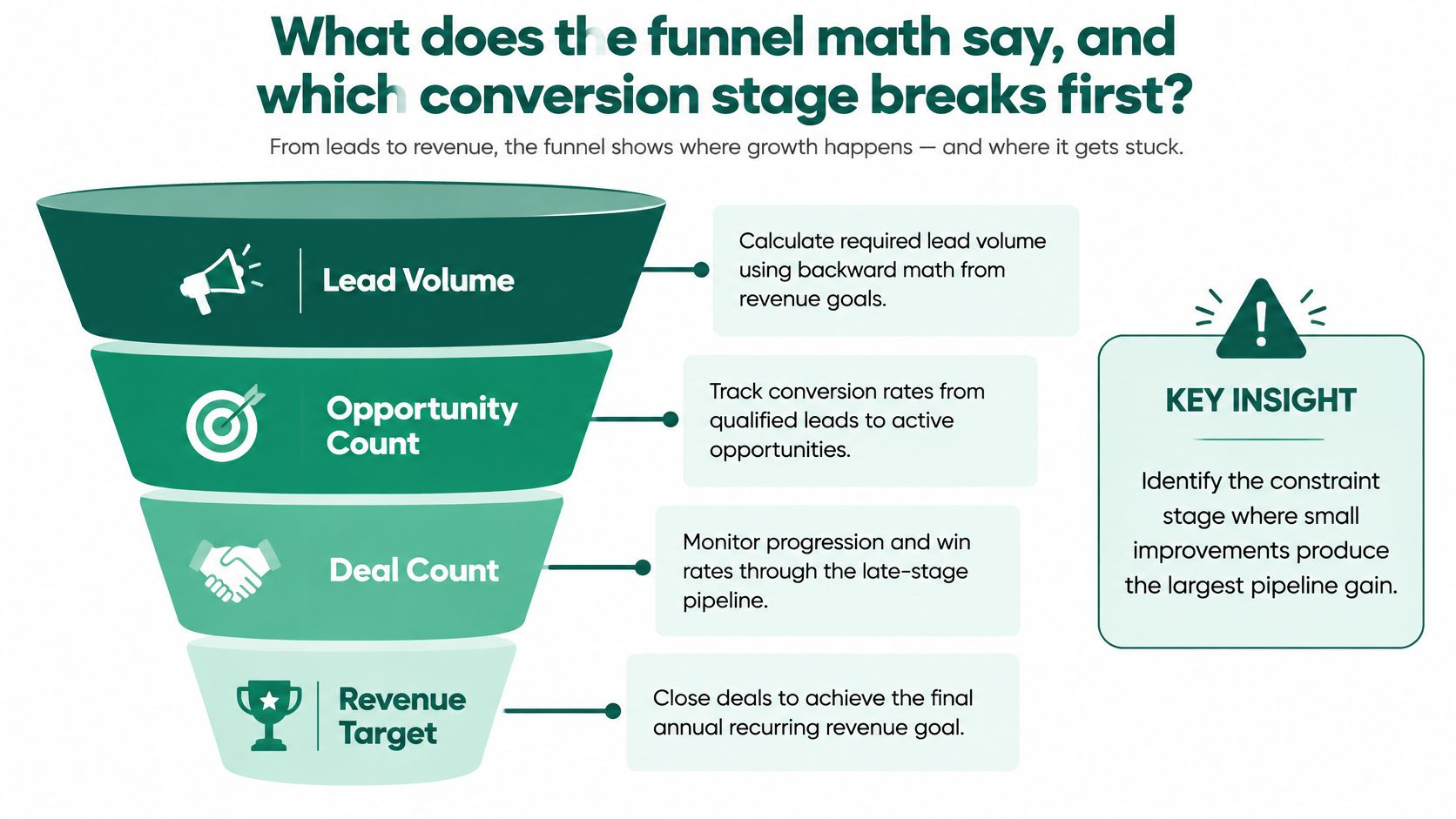
Pipeline targets without funnel math are guesses in a slide. You cannot reason about a revenue number until you know opportunities required, a realistic win rate, cycle length, and how much pipeline each source must carry. Build the model from the bottom up, then find the stage most likely to constrain you.
In many B2B SaaS companies the constraint is not lead volume. It is opportunity creation from qualified leads, or win rate late in the cycle where price and procurement show up. Adding leads into a broken stage makes the dashboard look busy and the forecast worse.
A 2026 industry synthesis citing Benchmarkit reports that median B2B SaaS CAC payback was 16 months in 2025, with the 25th percentile at 10 months and the 75th percentile at 24 months. The same synthesis reports median sales and marketing spend of $1.63 for each dollar of new ARR. Cheap leads that pay back slowly are a bad trade against a costlier source that closes faster and expands.
The shape of that problem is easier to see when you draw it.
Probes
What you decide. Fund the constraint stage, not the loudest request for more leads. If qualification differs by rep, fix the definition before you buy more traffic. Review that stage monthly. A business whose cost per lead looked efficient, then found payback beyond a year and a half once it counted closed deals, does not have an ads problem. It has a conversion problem.
If you want a short walkthrough of reading a revenue funnel before you set targets, this is a clean one.
Paid acquisition produces leads while the budget lasts. Search presence, an email list, a community, comparison pages, and a product referral loop compound. Teams often put almost all money into rented channels because the report arrives this week. Cost rises as competitors bid the same terms, and you own nothing underneath.
In McKinsey's global B2B Pulse research, e-commerce was rated the most effective B2B sales channel by 35% of respondents in 2023, ahead of in-person sales at 26%, video conferencing at 12%, email at 10%, and telephone at 8%. Buyers are not picking one route. A plan that rents one paid surface and ignores the self-serve path will not match how they buy.
Probes
What you decide. Allocation, timeline, and the metrics leadership reviews. An integration directory and a set of comparison pages can keep producing inbound long after the build cost is recovered. Paid search on high-intent terms can sit beside that library, not replace it. Social distribution is the same split. You can rent attention, or you can build an audience you can reach again. LinkedIn engagement software explained is useful only if you know whether the activity feeds an owned list or dies when the tool stops.
Set a directional target for owned pipeline each quarter. If that share never moves, you do not have a channel strategy. You have a media budget.
B2B buyers have more options than time, and they distrust vendors by default. Claims about speed or ease carry little weight unless a buyer can check them. Proof is named customers, quantified outcomes, third-party references, security documentation, and a peer who will take a call.
Many teams treat proof as a late-stage sales asset and write case studies only after deals close. That is backwards. Proof decides whether a stranger answers at all. It is a demand input.
A 2026 compilation of buyer research identifies IT security review as the largest post-selection delay for software buyers, affecting 39% of buyers, ahead of budget approval and implementation planning. If your first proof pack is a logo slide, procurement will stall you after the champion already said yes.
Probes
What you decide. Enablement and the website share one proof library, organized by use case and buyer role. Ask every customer for a measurable result around day 90, while the outcome is visible. Keep a risk document ready on data handling, uptime, support, and implementation effort. A vendor that walks into outbound with a security packet and an implementation timeline spends less time stuck after selection. For the asset itself, use how to write a case study so the story is a number a stranger can trust, not a testimonial.
Friction between marketing and sales gets blamed on personalities. The cause is usually structural. No shared definition of qualified, no service level for follow-up, and no shared view of which sources deserve more money. Marketing scores volume. Sales scores deals it can close. Leadership sees a revenue number and a debate.
Gartner's 2024 survey of 632 B2B buyers found that 61% prefer an overall rep-free buying experience, while 69% perceive inconsistencies between supplier websites and seller-provided information. Buyers will research alone, then punish you when the call contradicts the page. Shared definitions are how you stop that.

Probes
What you decide. Move the score from lead volume to opportunity creation. A company that made that shift often finds a large share of "marketing leads" never reached a conversation. That is not a channel failure. It is a handoff failure. A weekly half-hour on lost deals, where sales names two objections that become new site sections, does more than another attribution tool. Review the definitions quarterly. Without them, every channel review becomes a fight about data quality.
Teams often start channels easily and stop them badly. They run forever because nobody wants to admit a miss, or they die after two weeks because a dashboard looks ugly. Both waste money.
The question is what evidence changes the investment, what time horizon is fair, and who can make the call. Write kill criteria before launch. Judge pipeline, not vanity counts. Move budget to the next best option on purpose.
Probes
What you decide. Marketing becomes a portfolio with rules. A team can set a ninety-day window on a paid channel, cut it when opportunity cost beats the agreed line, and move the money into referrals. Another team can keep a content program with weak early traffic because sellers hear prospects cite the articles on calls. Leading indicators diagnose. They do not acquit or convict.
Keep a small experimental budget so the portfolio can change without blowing up what already works. The allocation logic belongs in B2B marketing budget allocation, read as decision rules, not a menu of tactics. If you cannot say what would make you stop, you have not chosen a channel. You have started a habit.
| Question | GTM Decision It Informs | Key Output | Best Timing |
|---|---|---|---|
| Who is the economic buyer, and who is the user? | Which buyer roles to target and how to support the buying committee | Buying-role map with needs, objections, and proof points | Before choosing channels or creating campaigns |
| What is the one outcome we own, and what do buyers use instead of us? | How to position the product against real alternatives | Differentiated positioning tied to a buyer outcome | Before finalizing messaging and market focus |
| Which go-to-market motion are we building, and what does it demand? | Whether to use a product-led, sales-led, or hybrid motion | Operating model with investment needs and success metrics | When aligning product, pricing, and sales plans |
| Where do the first ten customers come from before any channel is proven? | Which early acquisition path to pursue | Initial customer plan with learning goals and scale-up criteria | At the earliest stage, before investing in scalable channels |
| What must be true before we spend money on demand generation? | Whether the company is ready to invest in demand generation | Readiness checklist covering message, website, proof, and tracking | Before launching paid or content campaigns |
| What does the funnel math say, and which conversion stage breaks first? | Which funnel constraint and growth investment to prioritize | Revenue-to-lead model with conversion rates and bottleneck | When setting targets and reviewing pipeline performance |
| Which channels can we own, and which are we only renting? | How to balance immediate reach with durable channel assets | Channel portfolio classified by rented, owned, and earned | During budget planning and channel strategy |
| What proof will make a stranger trust us enough to take a meeting? | Which evidence to use at each buyer stage | Proof library with outcomes, references, and risk documentation | Before scaling demand generation or outbound |
| How do marketing and sales share ownership of pipeline, and what counts as qualified? | How to define qualification, handoffs, and shared accountability | Written stage definitions, service levels, and review process | Before scaling lead generation or adding sales capacity |
| What would make us stop a channel, and what decision rule governs the next dollar? | When to continue, change, or stop channel investment | Predefined channel criteria, review cadence, and decision owner | Before launching a channel and at scheduled reviews |
The value of these go to market strategy questions is not in the asking. It is in what each answer forces you to commit to. A mapped buying committee. A named competitive wedge. One motion whose economics match the price. Channels in a sequence. Written kill criteria before spend.
If you cannot separate the economic buyer from the user, you do not have positioning. You have a homepage. If you cannot name the spreadsheet, the agency, or the internal script you replace, your category label will sound like three competitors. If you cannot show the contract value at which a seller pays for themselves, a sales-led motion is a costume.
Founders usually hit the gaps in this order. Positioning that sales cannot repeat. A site that educates nobody. Demand spend that produces traffic and no pipeline. Then a fight about lead quality, because nobody wrote down what qualified means. Fix them in that order. More budget earlier only makes the argument more expensive.
Stop a few habits while you do it. Stop treating an ICP slide as a buyer map. Stop scoring channels on last click alone. Stop keeping every program because sunk cost feels like strategy. Rethink proof as a late-stage leave-behind. Rethink self-serve and sales as rival religions. Rethink MQL volume as a marketing score. The metric that matters is whether a qualified buying group moves, and whether the dollars come back on a timeline you can defend.
Outside senior help can shorten the time to close those gaps when the team is stuck debating slides. Big Moves Marketing is an independent B2B marketing consultancy led by a fractional CMO with 17+ years across B2B product marketing, demand generation, and sales operations. We work directly with founders, product owners, and sales-marketing teams to plan and execute growth programs. The strategy work starts from two choices, where to play and how to win, then builds positioning, messaging, and conversion-ready foundations before channel pilots begin. Pilots on a fuzzy offer teach you almost nothing.
I would not hire anyone, including us, to run activity while the buying committee, the wedge, and the kill rules are still blank. Those are decisions. Execution comes after. If your GTM plan cannot survive these ten questions, start with a Get Consultation request and bring the answers you have, including the thin ones.
Big Moves Marketing helps B2B SaaS founders and revenue leaders turn these go to market strategy questions into a plan you can fund, with positioning, messaging, and a growth program that matches the motion your economics can support. If the buying map, the wedge, or the kill criteria are still fuzzy, bring the gaps to a working session instead of another channel test. Visit Big Moves Marketing and start with a Get Consultation request.