%20png%20copy.avif)
Let me tell you something I've learned over two decades in B2B marketing: most startups don't fail because they build bad products. They fail because nobody knows their product exists.
I've sat in countless rooms with brilliant founders who've built genuinely innovative solutions. They can articulate their technology beautifully. They've nailed product-market fit with their first ten customers. But when I ask them about their demand generation strategy, I usually get a variation of the same answer: "We're posting on LinkedIn and going to conferences."
That's not a strategy. That's hope.
The harsh reality is that 76% of B2B marketers successfully generated demand through content marketing in 2023, yet most early-stage founders struggle to move beyond founder-led sales. The gap between successful demand generation and wishful thinking is wider than ever, especially in today's AI-saturated market.
This guide cuts through the noise. Based on proven frameworks from Bessemer Venture Partners and reinforced by contemporary data, I'll show you exactly how to build a demand generation engine that scales—whether you're raising your seed round or pushing toward Series B.
Before we dive into tactics, let's address the elephant in the room: demand generation is not lead generation.
I see this confusion constantly. Founders think they need more leads, so they chase vanity metrics—website visits, form fills, demo requests. But here's what the data tells us: buyers are 69% through their purchasing process before engaging with sellers. That means if you're only focused on capturing leads, you've already lost most of the battle.
Demand generation is about creating awareness and desire for your solution throughout the entire buyer journey. It's about being present and valuable during that invisible 69% of the decision-making process—not just showing up at the finish line with a sales pitch.
The consequences of getting this wrong are severe. Customer acquisition costs have nearly doubled in just three years, while average revenue growth has slowed to around 22%. Companies stuck in outdated demand generation models are burning cash faster than they're building pipeline.
I cannot overstate this: knowing your ideal customer profile is the cornerstone of everything that follows. Every dollar you waste, every failed campaign, every misaligned message traces back to a fuzzy understanding of who you're actually serving.
Yet when I ask founders about their ICP, I typically hear something vague like "mid-market SaaS companies" or "enterprise CTOs." That's not an ICP. That's a market segment.
Here's the framework I use, adapted from Allyson Letteri's work with hundreds of AI startups at Bessemer Venture Partners:
1. Pains: What specific, pressing problems does your solution solve? Not general inconveniences—urgent, expensive problems that keep your buyers up at night.
2. Gains: What measurable outcomes are they trying to achieve? Revenue growth? Cost reduction? Faster time-to-market? Be specific.
3. Shifts: What's changing at their company that makes them open to new solutions? New leadership? Compliance mandates? Technical debt finally catching up to them?
4. Blockers: What objections will prevent them from buying? Do they think the problem isn't urgent? Are they married to a competitor? Do they have budget constraints?
5. Motivators: What will actually push them over the line to purchase? Hard ROI data? Peer testimonials? Risk mitigation guarantees?
This isn't a one-time exercise. Your ICP definition should evolve through continuous conversations with customers and prospects. But you need a working model to build anything else.
Why this matters: 95% of marketers agree that demand generation is significantly improved when a data-driven strategy is used. You can't be data-driven without knowing exactly who you're measuring and why.

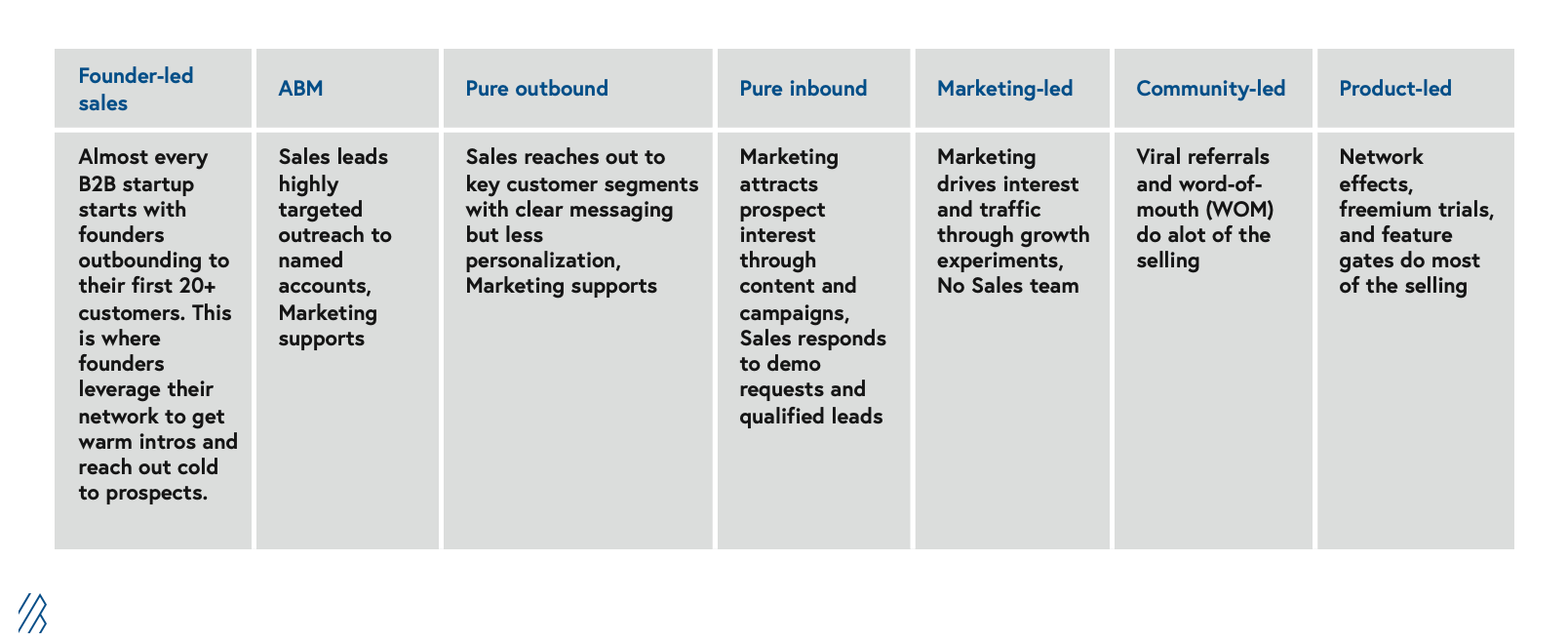
Once you understand your ICP, you need to determine how you'll reach them. Your GTM motion exists on a spectrum from highly personalized account-based marketing to product-led growth.
Here's the reality: you'll likely use a hybrid approach, and it will evolve as you scale.
Founder-Led/ABM: For complex, high-value deals ($100K+ ACV) with long sales cycles. You're selling to the C-suite, deals require customization, and relationships matter deeply.
Inside Sales + Inbound: For mid-market deals ($10K-$100K ACV). You're reaching directors and VPs who need education and trust-building before they'll take a sales call.
Product-Led Growth: For solutions with clear, immediate value that users can experience without talking to sales. Typically lower ACV initially, but massive scale potential.
The mistake I see constantly is founders picking a motion based on what they think they "should" do rather than what actually serves their ICP. If you're selling enterprise infrastructure software, forcing a PLG motion because it worked for Slack is strategic malpractice.
That said, if your product can support it, PLG offers extraordinary leverage. PLG companies are more than twice as likely to be growing quickly (100%+ year-over-year) than sales-led companies, especially those offering freemium products.
Real-world proof: Fal.ai reached 500,000 developers and a nearly $10 million revenue run rate in less than a year through a freemium, API-first approach. Vapi grew to millions in revenue within six months by making voice AI accessible to developers through self-serve tools.
The key insight: PLG lets prospects experience your product's value before you ask them to trust your claims. In an AI-saturated market where skepticism is high, this experiential approach cuts through the noise.
But here's the nuance: even PLG companies eventually layer on enterprise sales. Twilio, Dropbox, and Box all started product-led and added sales teams as they matured. The question isn't "PLG or sales?" It's "PLG first, or sales first?"
Now we get to where most founders completely drop the ball: the middle of the funnel.
After working with hundreds of startups, I can predict what I'll find with 90% accuracy: they have a basic website, maybe a sales deck, and virtually nothing in between. They're obsessed with top-of-funnel lead generation but have nothing to nurture prospects who aren't ready to buy yet.
This is the gap that kills momentum.
Think about it from your prospect's perspective. They see your LinkedIn post or hear about you from a peer. They check out your website. And then... nothing. No educational content, no proof points, no way to go deeper without talking to sales. So they ghost you.
Here's what the data shows: Content marketing generates approximately 3x more leads than traditional channels while being 62% cheaper. But only if you actually create content that serves the middle of the funnel.
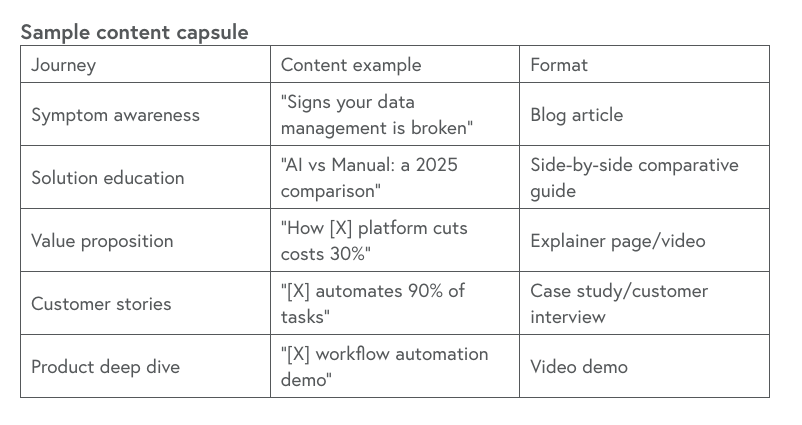
I recommend building what Letteri calls a "content capsule"—the essential set of content pieces that can be repurposed across channels to accelerate pipeline. Think of it like a capsule wardrobe: fewer pieces, maximum versatility.
Build 2-3 pieces in each category:
1. Symptom Awareness ContentHelp prospects understand they have a problem. What are the warning signs? What are the hidden costs of the status quo?
2. Solution Education ContentHelp problem-aware folks understand current solutions, how to evaluate them, and where existing products fall short. This is thought leadership that builds trust.
3. Value Proposition ContentExplain your product and why it's better than alternatives. What benefits do you deliver? What features differentiate you?
4. Customer Stories & DataShare quantifiable proof that customers are getting results. Metrics matter more than testimonials.
5. Product Deep-DivesHow does your product actually work? What specific use cases does it solve? How do customers use it?
This capsule becomes your foundation. You'll reference these pieces in sales conversations, share them in follow-up emails, promote them on LinkedIn, and use them to warm up cold outbound.
Why this works: Creating effective mid-funnel content unlocks both top-of-funnel lead generation (you have valuable things to share) and bottom-of-funnel conversion (your sales team has proof points and educational materials).
With your content capsule in hand, you can activate the channels that actually move prospects from awareness to consideration. Based on my experience and Bessemer's research, here are the six that matter most:
Your homepage is usually too broad and generic, or too technical and feature-focused. It needs to speak directly to your ICP's most pressing concerns.
I've seen countless founders bury their value proposition under jargon and feature lists. Your website should answer three questions in the first five seconds: Who is this for? What problem does it solve? Why is it better than alternatives?
This is your content capsule in action. Blog posts, guides, whitepapers, comparison charts—content that educates and builds authority.
According to recent research, marketers who blog are 13x more likely to drive positive ROI than those who don't. But the content must be strategic, not just frequent.
Whether you're sponsoring conferences, hosting intimate dinners, or running webinars, events create low-pressure environments for prospects who are interested but not ready for sales conversations.
Webinars are considered the most effective top-of-funnel demand generation tactic by 45% of B2B marketing practitioners, and 53% say webinar content generates the most high-quality leads.
Stop the random posting. Instead, share content that addresses what your ICP needs to know to move forward in the buying process: their symptoms, why current solutions fail, and how you solve problems differently.
The data backs this up: LinkedIn drives 80% of B2B leads, making it the dominant platform for B2B lead generation. But only if you're strategic about what you share and why.
Figure out where your ICP already gathers and show up there. Guest on podcasts they listen to. Write for publications they read. Speak at communities they participate in.
Earned media provides built-in social proof and validation. It's rarely a reliable top-of-funnel channel, but it creates evergreen assets that build immense credibility in the middle of the funnel.
Once you've captured prospects into your database, keep them engaged with monthly newsletters sharing your latest content. This keeps you top-of-mind during the long consideration period.
The numbers are clear: 79% of businesses agree that email marketing is the most effective demand generation tool available. It's multipurpose, affordable, and offers excellent ROI.
Here's where founders waste the most money: they adopt channels because someone told them they "should" rather than because those channels actually reach their ICP.
Every component of your demand generation strategy must connect back to your ICP and where they actually spend time. Don't run paid search ads just because your competitor does. Don't invest in a podcast because it sounds cool.
Ask yourself:
A case study in what not to do: One AI SaaS company I consulted with was sending cold outbound emails that essentially said "We built this cool thing, want a demo?" Predictably, this failed.
We overhauled their website messaging, created a capsule of content including strong case studies, and developed an outreach strategy that led with understanding the prospect's problems. The content built enough trust that prospects wanted to talk to a small, unproven startup. Their conversion rates tripled.
This is a critical challenge for many technical founders: you've built something valuable, but you're not a recognized voice in the industry you're selling into.
First, get visible on LinkedIn or wherever your prospects congregate. Share thought leadership that demonstrates your expertise in the industry, problem, and solution. Don't try to come up with novel topics—focus on being consistent around the same themes that establish you as credible.
Second, partner with influencers who already have trust in your space. I've seen startups struggle with cold outbound until they partnered with a podcast influencer in their target vertical. The founder guested on podcasts, contributed to newsletters, and co-hosted webinars. This made a night-and-day difference because they suddenly had resources and social proof.
Third, bring in advisors who are well-known in the space. Having a trusted peer on your buying committee during sales conversations provides built-in credibility. These advisors can speak your ICP's language and validate your approach.
The data supports this: 75% of decision makers trust brands more when they're affiliated with industry experts or influencers. That's not a nice-to-have. That's table stakes.
Community-led growth deserves special attention because it's both powerful and widely misunderstood.
DataHub offers the perfect case study. They invested early in building a community around their open-source data catalog, launching a Slack community in 2020. By 2021, they launched a commercial SaaS version, converting organic community adoption into scalable revenue.
Engineers at Netflix, Visa, Etsy, and other major firms used DataHub via the open-source project and actively participated in discussions. The product didn't rely on traditional top-down GTM—it grew organically as passionate users championed it within their organizations.
Today, their Slack group has nearly 14,000 members serving as both a support channel and a funnel for new users who discover DataHub via word-of-mouth. The company recently raised a $35 million Series B.
Community-led growth works because it creates a flywheel: community members provide feedback that shapes features, which leads to higher retention, which creates more advocates, which grows the community.
While the fundamentals remain constant, the AI era demands specific adaptations:
AI products evolve mind-bogglingly fast. Your messaging will get outdated dizzyingly quickly. You must be nimble at translating new features into tangible value for end users.
Many AI startups excel at explaining new features but struggle to correlate them with actual benefits. Don't announce "We added GPT-4o integration." Say "You can now process customer support tickets 3x faster with higher accuracy."
You need messaging that appeals to both C-suite decision makers and end users—and these may be radically different messages.
Executives care about productivity and ROI. End users worry about job security and being asked to do more with less. If your messaging is off-putting to the people who actually use your product, they won't adopt it, regardless of what leadership mandates.
Frame AI benefits to end users around becoming more strategic, less mired in tedious work, and more valuable—not just "faster" or "automated."
The AI boom has created unique "invest in AI" budget line items at many companies. This has led some startups to build something and hope to find a buyer—a dangerous approach that wouldn't fly in traditional SaaS development.
Don't lose sight of fundamentals. You need a strong hypothesis about the unmet need of a specific buyer group. Build for that, then iterate quickly if needed. Product-market fit requirements haven't changed just because AI is hot.
AI is a means to an end, not a value proposition. Products that win solve urgent, unmet needs. The "invest in AI" budget line items will eventually disappear, and you'll need to compete for functional budgets again.
You can't improve what you don't measure. But in the rush to track everything, founders often focus on the wrong metrics.
Here's what actually matters for early-stage demand generation:
Top-of-Funnel: Traffic to key pages, email list growth, social engagement on strategic content (not vanity metrics)
Middle-of-Funnel: Content downloads, webinar attendance, repeat website visits, email engagement
Bottom-of-Funnel: Demo requests, trial signups, sales conversations booked, pipeline created
Revenue Metrics: Conversion rates at each stage, customer acquisition cost, sales cycle length, win rates
But here's the critical insight: 42% of B2B marketers now cite revenue generated as a top performance indicator, reflecting a shift toward marketing accountability. You can't just optimize for MQLs anymore. Everything must tie back to revenue impact.
This is especially true as marketing budgets have flatlined at just 7.7% of overall company revenue. You must prove ROI on every dollar spent.
After twenty years, I've seen founders make the same mistakes repeatedly:
Mistake 1: Spreading Too ThinTrying to do everything—paid ads, SEO, events, social, content, webinars—with a team of two. Focus on 2-3 channels that actually reach your ICP and execute them well.
Mistake 2: Optimizing for Volume Over QualityOnly 9% of free accounts convert to paid accounts on average in PLG models. Chasing vanity metrics instead of qualified engagement wastes resources.
Mistake 3: Neglecting the Middle of the FunnelBuilding awareness without nurturing infrastructure means prospects have nowhere to go when they're interested but not ready to buy.
Mistake 4: Misaligned Teams79% of organizations with tightly aligned revenue teams achieve faster revenue growth, yet most B2B SaaS companies operate in silos. Marketing, sales, and product must share unified goals and dashboards.
Mistake 5: Ignoring the 69% RuleRemember: buyers are 69% through their journey before contacting you. If you're only showing up at the end, you've already lost to someone who was present throughout.
Here's what I want you to understand: demand generation is not a campaign. It's not a quarter's worth of effort. It's an engine you build piece by piece, test relentlessly, and refine continuously.
The startups that win don't have secret tactics. They have discipline. They know their ICP cold. They create consistent, high-quality content that serves real needs. They measure everything and iterate based on data, not hunches.
The global demand generation software market is projected to grow from $4.5 billion to $8.4 billion by 2028, representing 10.91% annual growth. This isn't happening because the tactics are getting more complicated. It's happening because the fundamentals work, and more companies are executing them properly.
Start with a crisp ICP definition. Build your content capsule. Choose channels that actually reach your buyers. Create consistent value in the middle of the funnel. Measure everything. Iterate quickly.
And most importantly: start now. The companies winning tomorrow's AI-driven marketplace aren't the ones with the most advanced technology. They're the ones who master these fundamentals today and have the discipline to execute them month after month.
Your product might be extraordinary. But if nobody knows it exists, that doesn't matter. Build the engine. Feed it consistently. Let it scale your impact far beyond what founder-led sales could ever achieve.
That's how you win.
Explore Big Moves Marketing services and resources:



%20-%20white.svg)