%20png%20copy.avif)

Most B2B go-to-market plans are channel lists wearing a strategy label. They contain SEO, paid search, LinkedIn, events, outbound, and webinars, but no serious answer to the questions that determine whether those channels can work: Who is buying, what problem are they already prioritizing, who else must agree, and why should this company be shortlisted?
That failure usually happens before the first campaign launches. Founders mistake activity for progress, marketers inherit an unclear product story, and sales teams compensate with individual heroics. The result is expensive motion without a repeatable route to revenue.
A practical go-to-market strategy for B2B starts in the opposite place. It establishes the commercial foundations, turns those foundations into a coherent buying experience, then selects channels that can test the strongest assumptions. The sequence matters more than the channel mix.
Most plans fail because they answer where the company will show up before answering why a buyer should care. A deck can list content, ads, email, events, and outbound sequences without defining a market position, a buying committee, or a credible path from problem recognition to approved purchase.
I see the same pattern across early-stage and growth-stage SaaS companies. The product is strong, the founders know the problem intimately, and the team has already built a list of tactics. Yet every tactic carries a different interpretation of the company. The website describes features, sales describes outcomes, and paid campaigns target a broad persona that doesn't have authority to buy.
Four assumptions damage these plans:
The fix isn't another planning template. It's a clear change management method for changing how the company makes market decisions, assigns ownership, and learns from buyer behavior.
The practical rule: A channel deserves budget only after the company knows which buyer assumption it is testing.
A real GTM strategy defines the market to pursue, the problem to own, the people who must agree, the motion that fits the product, and the evidence required at each stage. The dated plan comes later. It assigns owners, timelines, budgets, and decision gates to that strategic logic.
This is why sequencing beats enthusiasm. If the ICP is vague, targeting wastes spend. If positioning is generic, traffic produces curiosity rather than intent. If the site can't support self-directed evaluation, sales inherits questions that marketing should have answered. If the buying group isn't mapped, a promising lead can still die inside the account.
The goal isn't to make every channel work. It's to build a revenue system where each channel reinforces a clear commercial argument.
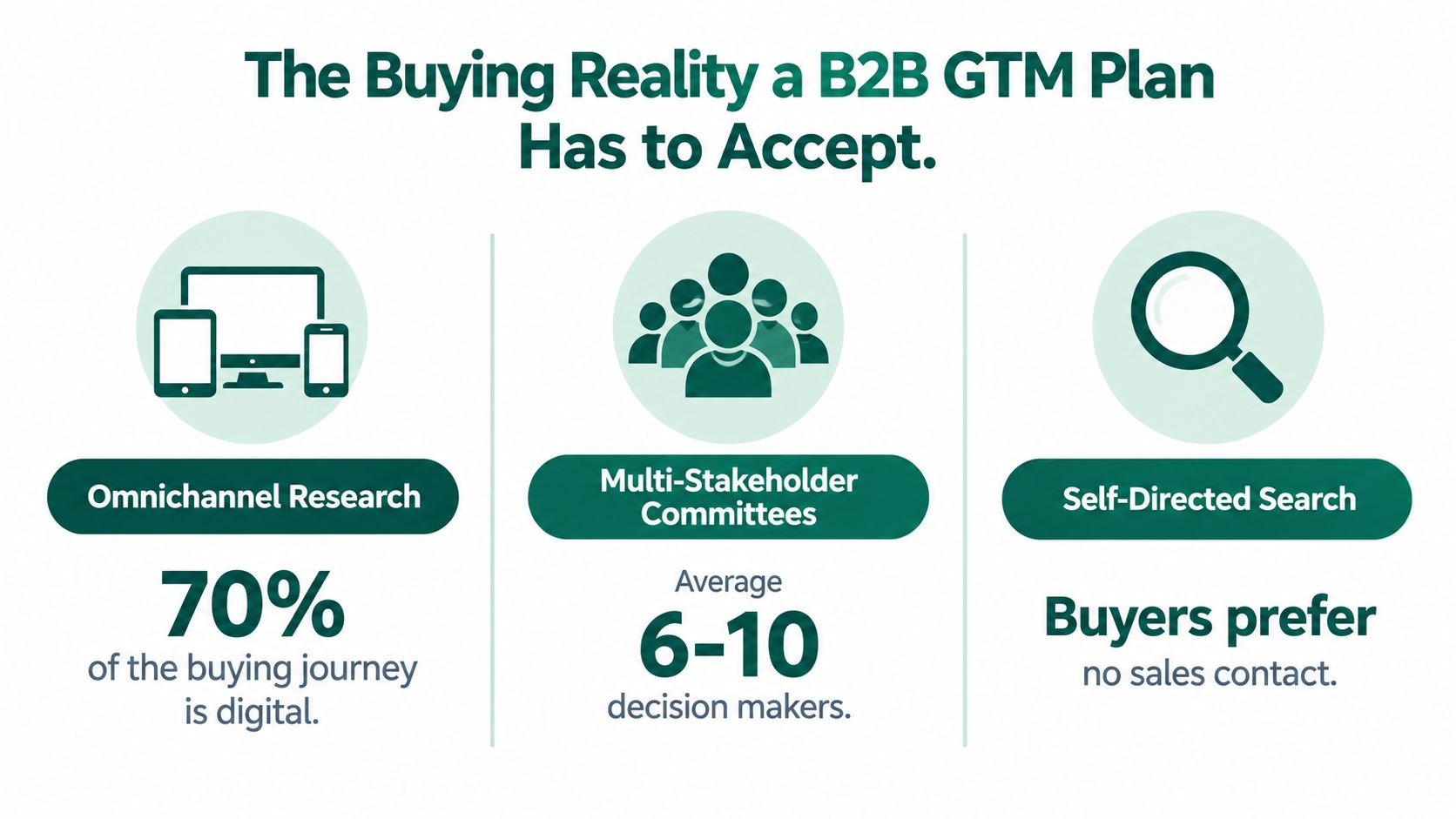
A serious B2B GTM plan has to accept two uncomfortable realities. Buyers research across many channels without following your funnel, and buying decisions are made by groups whose members want different proof.
McKinsey's 2024 B2B Pulse research found that buyers use an average of 10 interaction channels, compared with five in 2016. At each stage, roughly one-third prefer in-person interaction, one-third prefer remote communication, and one-third prefer digital self-service. The same research found that 36% require a consistent omnichannel experience and may switch suppliers when it's missing. These figures make a single-channel acquisition plan structurally inadequate. (McKinsey's B2B Pulse research)
The person who clicks an ad may be a practitioner. The person who signs may be an executive. A security reviewer may never visit the website but can stop procurement from proceeding. Treating the first identifiable contact as the buyer creates false confidence in the pipeline.
Gartner reported in May 2025 that 74% of B2B buyer teams experienced unhealthy conflict during the decision process, based on a survey of 632 B2B buyers conducted in August and September 2024. Buying groups that reached consensus were 2.5 times more likely to report a high-quality deal, while buyers who experienced strong buying-group relevance were three times more likely to report a high-quality outcome. (Gartner's buyer-team research)
That changes what marketing should measure. A form fill is an event, not evidence of account progress. Your GTM plan should track whether multiple relevant stakeholders engage, whether evaluation questions are answered, and whether the account is moving toward commercial readiness.
Build the plan around the committee, not the lead record:
Your website, sales calls, email nurture, webinars, events, and self-service resources should tell one coherent story while supplying different forms of evidence. That's the difference between omnichannel execution and just publishing the same message everywhere.
A useful companion perspective is why B2B buyers want simple choices. Simplicity doesn't mean removing detail. It means making the decision path easier to understand for every stakeholder.
The foundational layer has four parts: positioning, messaging, ICP definition, and competitive mapping. Everything else depends on them. If this layer is unresolved, channel testing mostly measures how well your team can generate noise around an unclear offer.

Don't begin with personas built from job titles. Begin with the decision the customer is trying to make and the alternatives already available to them.
Write down:
Your ICP should include firmographic fit, operating context, trigger events, existing tools, buying constraints, and disqualifiers. For a more detailed SaaS-specific treatment, this targeting ICP for SaaS resource is useful because it treats ICP definition as a commercial choice rather than a list-building exercise.
Competitive mapping should include more than direct rivals. Map the status quo, internal development, adjacent tools, services, spreadsheets, and delayed decisions. A prospect rarely asks, “Should we buy you or Competitor A?” They ask, “Should we change anything, and if so, which option creates the least risk?”
A positioning document is only useful when sales, marketing, product, and leadership can use it without interpretation. I typically build four layers:
The message should change emphasis by stakeholder, not contradict itself. Executives need business consequences. Technical evaluators need architecture, integrations, and implementation facts. Users need workflow improvement. Procurement needs confidence that the vendor won't create avoidable exposure.
Teams often rush at this stage. They launch a landing page before deciding whether the product is a category alternative, a replacement, an operating layer, or a new approach. That rush creates copy that sounds polished but gives buyers no reason to change.
The next step is to convert these decisions into a small set of artefacts before piloting channels:
Use these documents to create a B2B marketing foundations layer that the whole revenue team can reference.
The trade-off is straightforward. You can spend early weeks producing assets that improve every later channel, or you can spend the same time paying for traffic that exposes unresolved strategic decisions one campaign at a time.
Use this video as a practical prompt for turning the foundation into an operating plan:
A B2B SaaS website is the company's most available sales asset. It has to help an anonymous visitor understand the problem, compare alternatives, assess risk, find proof, and choose a next step without waiting for a representative.
McKinsey reported that suppliers delivering outstanding digital experiences were more than twice as likely to be selected as primary suppliers. (McKinsey's omnichannel research) The implication is clear. A website isn't decoration around sales. It is part of the selection process.
A conversion-ready site usually includes:
A content strategy for websites should assign each page a buyer question, a search or discovery purpose, a proof requirement, and a next action. That prevents the common problem of publishing pages that attract visits but don't move evaluation forward.
A practical website rollout can follow this sequence:
The site must answer five questions at every meaningful moment: Is this for me? Is the problem worth solving? Is this solution credible? Can my organization adopt it? What should I do next?
A founder may still choose a sales-led motion. That doesn't justify hiding information. Remote and self-service buying now support substantial B2B purchases. McKinsey's 2024 survey found that 73% of B2B buyers were willing to spend more than $50,000 through remote or self-service digital channels, while 39% were willing to spend more than $500,000 and 20% more than $1 million through those routes. (Digital Commerce 360's coverage of the McKinsey survey)
The site doesn't replace sales. It reserves sales time for ambiguity, business-case development, stakeholder alignment, and negotiation rather than basic product education.
Treat channels as experiments with a job to perform, not as a standard stack to assemble. SEO can build durable discovery, Google Ads can capture existing intent, LinkedIn can reach defined accounts and roles, email can nurture known contacts, and events can create trust around complex problems. None of them fixes weak positioning.
The right starting pair depends on your market and motion. For most early-stage B2B SaaS companies, I prefer one high-intent channel and one relationship or learning channel. That might mean Google Ads plus founder-led outbound, SEO plus targeted webinars, or LinkedIn account work plus a tightly scoped event.
Use this matrix as a decision tool, not a prediction machine. Time to first signal means the earliest useful evidence, not revenue.
| Channel | Time to first signal | Best ICP fit | Dependency on foundations | Kill criterion |
|---|---|---|---|---|
| SEO | Slow | Problem-aware buyers with recurring search behavior | High | Pause the topic cluster if it attracts the wrong roles or produces no qualified engagement after the planned test period |
| Google Ads | Fast | Buyers expressing explicit problem or solution intent | High | Stop terms that generate irrelevant inquiries, weak evaluation behavior, or no qualified progression |
| Medium | Narrow roles, account lists, and committee education | High | Stop audiences that consume content but don't produce relevant account engagement or conversations | |
| Fast for known contacts | Existing prospects, customers, and partner audiences | Medium | Stop sequences that create no meaningful replies or consistently trigger objections unrelated to the offer | |
| Events | Slow to medium | Complex categories where trust and group discussion matter | High | Stop formats that attract attendees outside the ICP or create no follow-up conversations with relevant accounts |
The matrix intentionally avoids invented benchmarks. Your first pilot should establish a baseline from your own sales cycle, deal economics, and buyer behavior.
An experiment card should state:
A 90-day plan might begin with positioning and audience validation, move into two controlled pilots, then add only the channel that shows a credible path to qualified account progression. Don't add a third channel because the team is bored. Add it because the current motion has a known limitation.
SEO is often overfunded before the company knows which problems it owns. Google Ads is often judged on cheap leads rather than qualified buying groups. LinkedIn is often treated as a volume engine when it works better as an account and category education layer. Events fail when teams measure attendance rather than post-event account movement.
Kill criteria protect strategy. A pilot without a stop rule becomes a permanent programme funded by habit.
Use cost per meaningful stage, time to signal, ICP fit, foundation dependency, and sales capacity to make the call. Activity metrics help diagnose an experiment. They shouldn't decide whether the company keeps paying for it.
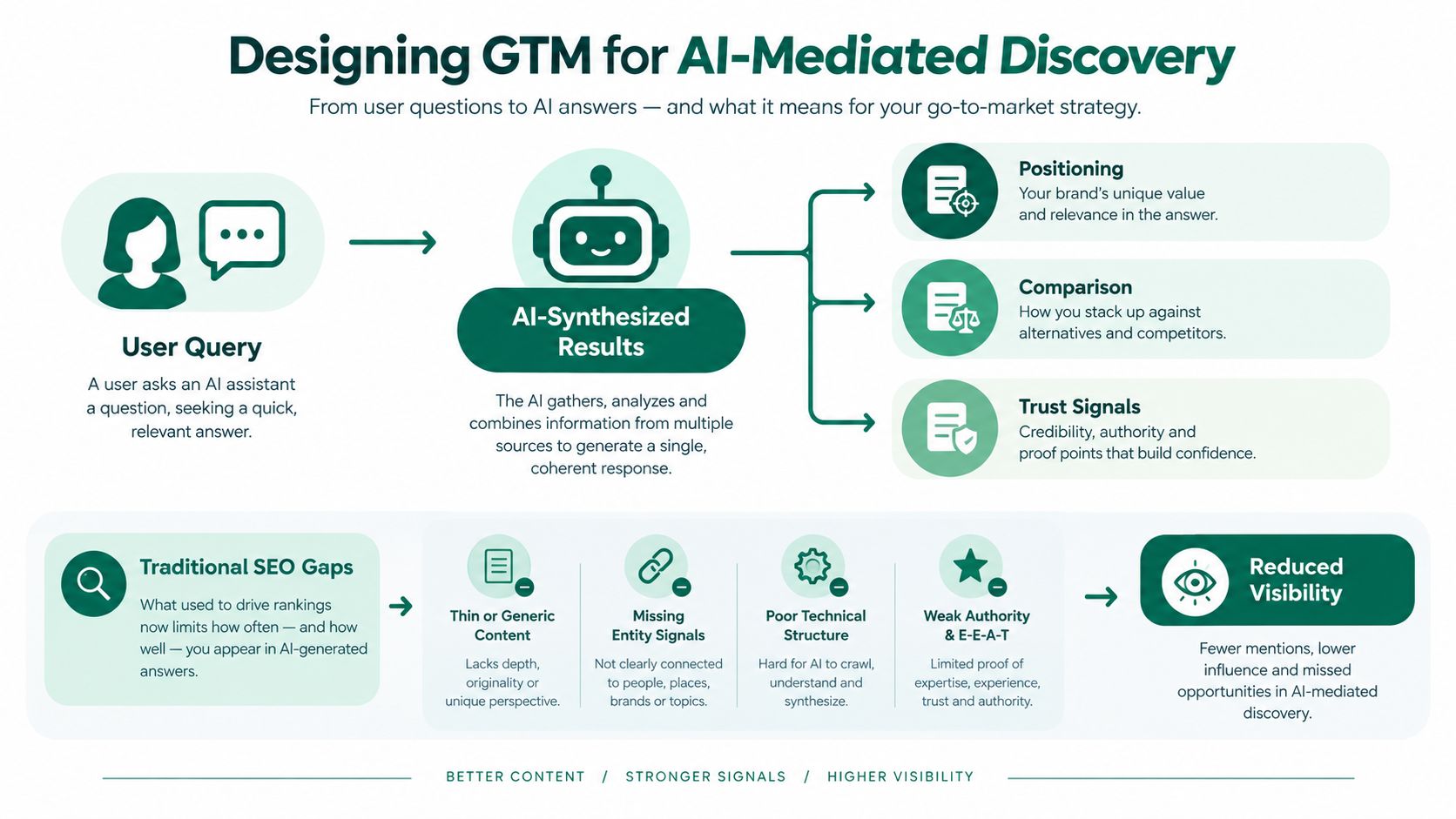
AI-mediated discovery creates a separate GTM planning layer. Buyers can ask an AI assistant to define a category, compare vendors, summarize weaknesses, or recommend a shortlist before visiting your website or identifying themselves.
Recent benchmark coverage reports that 51% of software buyers now start research with an AI chatbot more often than Google, up from 29% a year earlier, while 69% still want a sales representative to validate AI-generated insights. (The Starr Conspiracy's B2B buying benchmarks)
Discovery assets should be concise, structured, and easy to interpret:
Validation assets should reduce perceived risk:
This changes the role of sales. The representative isn't there to repeat the homepage. They validate the research, correct misunderstandings, help quantify the business case, and equip the champion to handle internal objections. The wider shift toward expert guidance as interfaces recede is explored in when the interface disappears.
Founders should monitor how AI systems describe the category and the company, publish claims that can be independently checked, improve third-party review coverage, and record anonymous evaluation behavior where privacy and consent allow. Structured data helps machines interpret content, but it can't rescue vague positioning or unsupported promises.
For a deeper view of the relationship between AI discovery and marketing systems, see AI in digital marketing. The core point is simple: don't add a chatbot and call the problem solved. Manage what machines can discover, what humans must validate, and how the two layers connect to pipeline.
A GTM strategy becomes real when someone owns the sequence and the company reviews evidence at a consistent cadence. Early-stage teams rarely need another department. They need clear decision rights, senior judgment, and a small operating system that prevents channel activity from outrunning strategic clarity.
Foundation phase: Confirm the ICP, buying committee, positioning, proof inventory, competitive alternatives, and commercial assumptions.
Site phase: Turn those decisions into the homepage, use-case pages, comparison content, proof, pricing context, implementation information, and measurable next steps.
Pilot phase: Run two channel experiments with explicit hypotheses, owners, signals, and kill criteria. Review account-level progression, not only leads.
Scale phase: Increase investment only where the company has evidence of ICP fit, message resonance, sales follow-through, and a credible route to revenue.
A fractional CMO can own this sequence when a full-time senior operator isn't yet justified. The role isn't to produce a larger marketing calendar. It's to keep founders, marketing, sales, product, RevOps, and customer success making coordinated decisions.
Track activity metrics for diagnosis, pipeline metrics for commercial movement, revenue metrics for economic value, and retention metrics for whether the customers acquired are viable. Keep the definitions stable across teams.
A weekly pipeline review should answer:
A monthly leadership review should decide what to continue, change, or stop. Board reporting should show the relationship between strategic assumptions, investment, pipeline, revenue, and retention rather than a list of campaign outputs.
Marketing and sales alignment also needs explicit working agreements. These proven alignment tactics for B2B are useful as a practical reference, but the principle is more important than the template: both teams must share account definitions, stage criteria, feedback, and commercial responsibility.
The system can run on five reusable artefacts:
Self-service readiness matters for enterprise deals as much as smaller ones. A buyer may still need a seller, but they shouldn't need one to understand whether the product fits, what adoption involves, or which internal questions require answers.
The operating model is the advantage. Channels change. Buyer behavior shifts. The companies that grow efficiently keep their foundations clear, their evidence current, and their decisions fast. Big Moves Marketing provides fractional CMO leadership, positioning and messaging, GTM planning, conversion-ready websites, channel pilots, and reporting systems for B2B SaaS and technology teams that need strategy connected to execution.
Big Moves Marketing helps B2B SaaS founders and revenue leaders sequence positioning, website, buying-group evidence, and channel experiments into a measurable GTM system. Visit Big Moves Marketing to discuss where your current motion is losing clarity, time, or pipeline.


%20-%20white.svg)