%20png%20copy.avif)

Most advice on fractional marketing services is backwards.
Founders get told to hire a marketing manager, bring in an agency, and “start testing channels.” That’s usually how B2B SaaS teams waste a year. The issue isn’t lack of activity. It’s lack of strategic clarity. If your ICP is fuzzy, your message is generic, and your sales motion still depends on founder interpretation, adding more marketing capacity just scales confusion.
That’s why the market has moved. The number of fractional professionals doubled from 60,000 in 2022 to 120,000 in 2024 as startups and B2B companies shifted toward flexible senior expertise instead of full-time hires that can cost 60-70% more, according to Fractionus market data. That trend matters because smart teams have realized a hard truth: before you build a marketing department, you need someone who can design a go-to-market system that deserves to be scaled.
The default first marketing hire in B2B SaaS is often the wrong one.
A founder hires a capable marketing manager. Or they sign with a generalist agency. Both can be competent. Both can still fail. Not because they’re bad, but because they’re being asked to solve a problem they were never built to solve.

Early-stage SaaS companies usually don’t need more hands first. They need judgment.
They need someone to answer uncomfortable questions. Who is the true ICP? What problem do buyers think they’re buying, versus the problem the product team thinks it solves? Is this a founder-led sales motion pretending to be a repeatable GTM engine? Which channel fits the sales cycle? Which message belongs on the homepage, in sales calls, and in outbound?
A junior or mid-level hire can’t invent strategic clarity out of thin air. An agency usually won’t either. Agencies need a brief. If the brief is wrong, they execute the wrong thing efficiently.
Founders often confuse output with progress. They launch paid search, rewrite the website, start LinkedIn content, sponsor a webinar, and then wonder why pipeline still feels random.
That’s not a resource problem. It’s a sequencing problem.
Most first marketing hires inherit ambiguity and then get judged for not turning ambiguity into revenue.
If you’re deciding between a full-time hire and hiring a specialized agency, the better first question is simpler: do you already know what must be executed, or are you still trying to determine the right GTM narrative and motion?
If the answer is unclear, don’t rush the org chart. A more useful starting point is a sharper view of how to build your B2B marketing team structure around stage, not around hope.
Fractional marketing services exist for this exact gap. Not as a cheaper substitute. As the right tool for a company that hasn’t yet earned the right to scale a marketing team.
Most B2B SaaS companies don’t have a marketing problem. They have a go-to-market clarity problem.
That distinction matters because headcount doesn’t fix confusion. More campaigns don’t fix weak positioning. Better design doesn’t fix a muddled value story. If your team can’t explain why buyers switch, who feels the pain most acutely, and what sales motion fits the product, your issue sits upstream of execution.
It usually shows up in familiar ways.
The ICP is broad because no one wants to exclude opportunity. Messaging tries to speak to users, managers, and executives in the same breath. Sales calls close when the founder runs them, but the rest of the team can’t reproduce the conversation. Marketing reports on leads while revenue leaders care about pipeline quality. Everyone is busy. No one is aligned.
Fractional marketing services earn their keep, not by producing more assets, but by forcing a company to choose.
A strong fractional leader narrows the ICP, sharpens the problem statement, defines the category context, and aligns sales and marketing around one coherent commercial story. That’s the work that makes later hiring productive.
Practical rule: If your team can’t say “why us, why now, and for whom” in a way that sales, product, and marketing all agree on, you don’t need more execution yet.
This isn’t abstract. According to a Harvard Business Review analysis cited by Lebowski CMO, companies that engage fractional CMOs achieve 29% average revenue growth, compared with 19% for those without one, outperforming them by 53%. The point isn’t that a title creates growth. It’s that senior strategic input changes where the company places bets.
That’s why I’d take an experienced fractional operator over a premature in-house team in most early-stage SaaS situations. The right person has seen the same failure modes across multiple companies. They recognize when PLG messaging is fighting a sales-assisted motion. They see when feature-heavy copy is masking weak market understanding. They know when a channel issue is really an offer issue.
Founders often ask whether they should build internally or buy externally. The better framing is whether they should buy labor or buy judgment. In the stages where GTM assumptions are still shaky, judgment is the scarce asset.
That’s also why the answer often sits inside a build vs buy decision in B2B marketing, not a hiring decision in isolation.
A fractional leader’s real value is this. They reduce the number of expensive wrong turns your company takes before it finds repeatability.
You shouldn’t compare these options as substitutes. They solve different problems.
A full-time hire is for running and scaling a known system. An agency is for specialized execution when the strategy is already reasonably clear. A fractional leader is for designing, correcting, or pressure-testing the system itself.
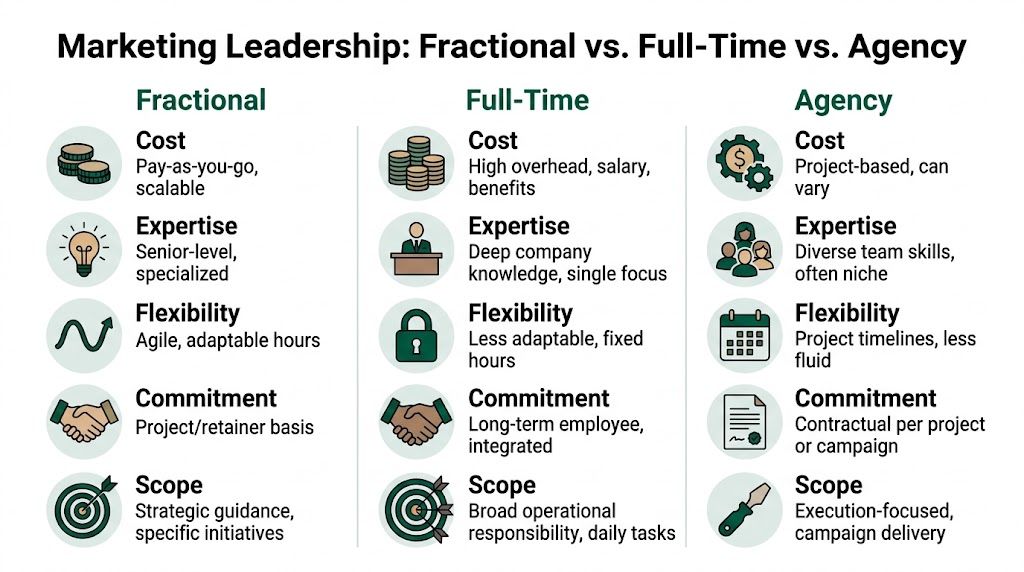
If you miss this, you’ll hire the wrong shape of help and then blame the person or partner instead of the decision.
| Criterion | Fractional Leader (e.g., CMO) | Full-Time Hire (e.g., VP/Director) | Marketing Agency |
|---|---|---|---|
| Core job | Define GTM direction, make strategic choices, align functions | Own ongoing internal marketing function | Execute channel work or campaign delivery |
| Best timing | Before repeatability, during repositioning, after stalled growth | After a playbook shows signs of working | After priorities, messaging, and targets are clear |
| Cost logic | Flexible engagement, focused on senior decision-making time | Highest fixed commitment, salary plus overhead | Variable retainer or project spend |
| Speed to useful impact | Fast if the mandate is strategic and access is real | Slower ramp because context must be built internally | Fast on deliverables, slower on diagnosis |
| Risk | Under-scoped mandate or lack of internal buy-in | Expensive mismatch if strategy is still unsettled | Efficient execution of the wrong plan |
| Accountability | Decisions, prioritization, operating cadence | Team output and organizational build-out | Deliverables, channel metrics, campaign operations |
A full-time marketing leader sounds like commitment. Sometimes it’s just premature structure.
If your product positioning is still moving, your sales narrative isn’t stable, and your funnel instrumentation is weak, a full-time hire becomes a very expensive experiment. They’ll spend months diagnosing, inheriting political friction, and trying to recruit around unresolved fundamentals.
An agency has the opposite problem. It can move quickly, but it often needs strategic inputs from the client. If you can’t clearly state ICP, message hierarchy, offer architecture, and handoff rules with sales, the agency will fill in the blanks. That rarely ends well.
A fractional leader sits in the middle. Enough altitude to shape direction. Enough involvement to make decisions operational. Not trapped in the org chart. Not detached from reality.
If strategy is unsettled, an agency becomes a guess multiplier and a full-time hire becomes an expensive interpreter.
For teams evaluating outside support, it helps to understand the difference between strategic advisory and execution-first models. A useful frame is this breakdown of a B2B marketing agency decision, especially if your internal team is strong tactically but weak on GTM direction.
Ask yourself three questions.
If the answer to those is shaky, fractional leadership is usually the smarter move.
Fractional marketing services earn their keep when they change how the company makes GTM decisions.
Founders should expect operating assets they can use, reuse, and hand to a team. If the engagement ends with a few smart observations and no working system, it was a waste.

The standard setup is a monthly retainer with direct founder access, weekly working sessions, and ownership over a short list of high-impact decisions. You are buying judgment, prioritization, and GTM architecture. You are not buying a part-time content manager.
For B2B SaaS, the work usually falls into three engagement types:
A strong B2B marketing consultant for SaaS growth strategy usually starts by narrowing scope, not expanding it. That matters because early-stage companies rarely have a marketing execution problem in isolation. They have a focus problem.
The right deliverables create clarity across the revenue engine.
This is the work that prevents bad hiring. Once these pieces exist, a demand gen manager, content lead, or agency has something solid to execute against.
Analysts at Cocan Media’s guide to fractional marketing point to better attribution, cleaner funnel design, and stronger budget allocation as common outcomes of fractional leadership. In B2B SaaS, that usually means fixing CRM discipline, campaign naming, source hygiene, and the messy gap between a marketing handoff and a real sales opportunity.
A serious engagement often touches a wider surface area than founders expect, because GTM problems rarely stay in one department.
If your team needs sharper outbound messaging, this LinkedIn sales prospecting playbook is a useful example of how message discipline should carry into pipeline creation.
Big Moves Marketing works as a fractional CMO and GTM partner for B2B SaaS and tech companies across positioning, messaging, website strategy, and multi-channel demand generation.
A short walkthrough helps make the operating model more tangible:
Most founders hire the wrong fractional leader for the same reason they hire the wrong first marketer. They evaluate credentials instead of thinking.
A polished LinkedIn profile doesn’t tell you whether someone can diagnose a broken GTM system. Plenty of candidates are just agency owners using “fractional CMO” as better packaging. Others are senior marketers who know channels well but can’t make hard strategic trade-offs.

You’re looking for judgment under uncertainty.
That means you want someone who can walk into a messy B2B SaaS context, identify what’s broken, and sequence the work correctly. They should be able to challenge your assumptions without turning every answer into a framework slide.
Use this checklist before you discuss deliverables.
Ask questions that force a candidate to think in public.
We have decent activity but inconsistent pipeline. What would you audit first, and why?
A serious operator should talk about ICP fit, message-market fit, funnel leakage, sales alignment, and instrumentation before they talk about posting frequency or ad tactics.
How would you establish ROI attribution across a multi-channel B2B motion?
This matters more than most founders realize. As noted in the source material above, experienced leaders should be able to discuss analytics infrastructure, CRM integration, and attribution models such as first-click, last-click, and linear to identify what’s influencing revenue.
What would make you recommend against hiring a full-time marketing leader right now?
Good answers show restraint. Bad answers always somehow end with “you need more marketing.”
How do you document your work so a future internal leader can take over cleanly?
This question is paramount. A critical gap in evaluating fractional marketers is whether they have a plan for knowledge transfer, as noted in Brendan McConnell’s piece on fractional content marketing.
A strong fractional leader should be willing to build the company in a way that eventually makes their own role smaller.
Some warning signs are obvious. Others are subtle.
| Red flag | What it usually means |
|---|---|
| They lead with tactics before diagnosis | They’re solving the wrong layer of the problem |
| They promise to “do everything” | They don’t know how to prioritize |
| They avoid discussing sales | They view marketing in isolation |
| They can’t describe a reporting cadence | They won’t create real accountability |
| They have no handoff philosophy | They create dependency, not capability |
The right candidate should leave you feeling slightly challenged, not merely reassured.
They should make your current GTM picture look sharper within the first conversation. They should identify trade-offs. They should tell you what they wouldn’t do. They should have a clear answer for how they’ll work with the team you already have, whether that includes product marketers, growth managers, SDRs, founders, or agencies.
If you need another lens for evaluating senior external help, this view on what a B2B marketing consultant should do is a useful benchmark.
You don’t need polished case studies to know when fractional marketing services fit. The patterns are obvious if you’ve seen enough B2B SaaS companies.
The product gets adoption. Users like it. Expansion doesn’t follow.
What’s missing isn’t traffic. It’s commercial translation. The company built a user story, not a buyer story. A fractional leader comes in, separates user value from executive value, rewrites the core narrative, and aligns marketing with a sales-assisted motion. Suddenly the website, demos, outbound, and lifecycle messaging stop fighting each other.
The win isn’t “better branding.” The win is that the team can finally sell the same story repeatedly.
Pipeline exists, but it’s inconsistent and founder-dependent.
In this pattern, the founder still carries too much of the deal. Marketing creates activity, sales follows up unevenly, and no one can say which inputs influence revenue. The quality of the fractional leader is therefore critical. Founders should ask how that person would establish ROI attribution for a multi-channel B2B motion, including analytics setup and models such as first-click, last-click, or linear, as discussed in CMOvate’s perspective on revenue alignment.
Once that gets fixed, the company usually gains something more valuable than a campaign. It gains a shared operating model.
The first sign of progress is often not more demand. It’s less internal disagreement about what’s working.
The product can serve multiple markets, so the company keeps trying to message all of them.
This is common in horizontal SaaS and especially common after early traction comes from customers the team didn’t originally expect. A fractional leader forces the painful choice. Which segment gets the sharpest story? Which use case becomes primary? Which proof points belong on the site, and which are confusing noise?
That work often feels restrictive in the moment. It’s usually liberating in practice. Sales gets a cleaner pitch. Product hears clearer market feedback. Marketing stops producing broad, forgettable language.
It usually doesn’t look dramatic at first.
It looks like fewer random acts of marketing. Cleaner handoffs. Better sales conversations. A website that sounds like the buyer, not the founder. A narrower channel focus. Reporting that informs decisions instead of decorating slides.
Those are the signals that the company is becoming scalable.
Fractional marketing services are not a budget workaround. They’re a sequencing decision.
If your GTM foundation is unstable, hiring full-time too early usually hardens the wrong assumptions. You don’t need more people executing disconnected tasks. You need someone senior enough to decide what deserves to exist, what should be cut, and what the company should repeat.
That’s the right mental model. Build the blueprint first. Then build the team.
For B2B SaaS founders, that means treating marketing leadership as an architecture problem before it becomes a staffing problem. Get the ICP clear. Tighten the positioning. Align sales and marketing around one commercial story. Set up measurement that can survive scrutiny. Then, and only then, scale execution.
If you’re trying to make that shift, a simple planning tool like this strategic marketing plan template can help turn fuzzy ambition into an actual decision framework.
The mistake isn’t using agencies, or hiring full-time, or bringing in fractional help. The mistake is using the right option at the wrong stage.
Get the order right, and the rest of the org design gets much easier.
Hire fractional marketing services when the company has ambition but not enough GTM clarity to justify permanent marketing leadership. That usually means your ICP is still being refined, founder-led sales carries too much weight, positioning isn’t translating across site and sales, or your current marketing activity feels noisy rather than cumulative.
Don’t hire one if you already have a proven motion and what you need is execution volume. In that case, a strong in-house leader or specialist agency may be the better fit. Also don’t hire one if the founder won’t stay engaged. Fractional leadership works best when the company is willing to make hard decisions quickly.
More involved than an advisor, less embedded than a full-time executive. They should have enough access to sit inside core GTM decisions, join leadership conversations, pressure-test sales and marketing assumptions, and create operating clarity. If they’re too distant, they become a commentator. If they’re doing everything themselves, the model is being used incorrectly.
Expect diagnosis first. A good fractional leader will spend early time understanding buyer segments, current messaging, sales process, funnel data, team capability, and where decision-making is breaking down. If the first conversation jumps straight into channel plans, be careful.
Sometimes, but that shouldn’t be the reason you hire them. The core value is strategic direction, prioritization, and accountability. Execution can sit with internal team members, freelancers, or agencies. What matters is that someone senior is deciding what gets done and why.
Look for sharper decisions before you look for broader activity. You should see clearer positioning, tighter prioritization, better alignment between sales and marketing, cleaner reporting, and a more coherent pipeline story. If you’re just getting more assets and more meetings, that’s not enough.
Yes, if the person is doing the job properly. One of the best outcomes of a strong engagement is that it creates the structure for a future internal leader to succeed. That includes documented strategy, clear operating cadence, channel priorities, measurement logic, and a cleaner definition of the role you need to hire for.
If you’re a B2B SaaS founder trying to decide whether you need a full-time marketing leader, an agency, or sharper GTM guidance first, Big Moves Marketing is one option to consider. The focus is on positioning, messaging, demand generation strategy, and building a marketing function that fits your stage instead of copying someone else’s org chart.
Explore Big Moves Marketing services and resources:





%20-%20white.svg)