%20png%20copy.avif)
Most brand messaging frameworks are strategic dead ends. They're documents born in a marketing silo, filled with theoretical claims, and destined to die in a shared drive, completely ignored by the GTM teams they were meant to serve. A functional brand messaging framework template is not a copywriting exercise; it's a core go-to-market asset that translates your strategic position into language that wins deals.
It is the source code for how your entire company talks about what you do, why it matters, and for whom. Anything less is a waste of time and capital.
I’ve seen this pattern repeat across dozens of B2B SaaS companies, from seed stage to Series C. A team invests weeks building a comprehensive slide deck filled with personas, value props, and taglines. It looks sharp. It sounds smart.
Then, nothing happens. The sales team never adopts the language because it doesn't survive first contact with a real prospect.
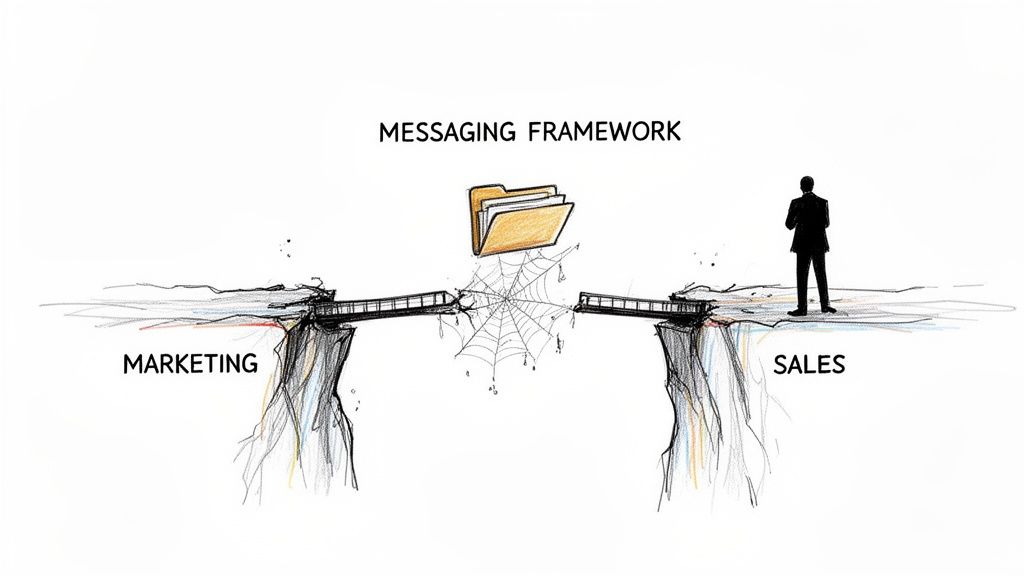
The failure isn't a lack of clever words. The failure is a fundamental disconnect from the realities of the GTM motion. These academic exercises fail because they are built on flawed assumptions about how buyers make decisions and how sales conversations actually unfold.
Founders and marketers often treat messaging as a creative task, not a strategic GTM function. This leads to critical, revenue-damaging failure points.
These are the most common ones I observe:
The real cost of a bad messaging framework isn't a poorly written website. It's a higher CAC, longer sales cycles, lower win rates, and a GTM team pulling in different directions.
A proper brand messaging framework isn't about filling in blanks. It's about building the strategic foundation for your entire revenue engine.
A messaging framework that doesn’t help your GTM team close deals is an expensive distraction. It’s an academic exercise—full of plausible words that fall apart under the pressure of a real sales cycle.
To avoid that fate, your messaging architecture must be built on three pillars laser-focused on one objective: revenue.
This isn't about sounding good. It's about building a defensible market position that your sales team can use with confidence and your marketing team can amplify with precision. Anything less is wasted motion.
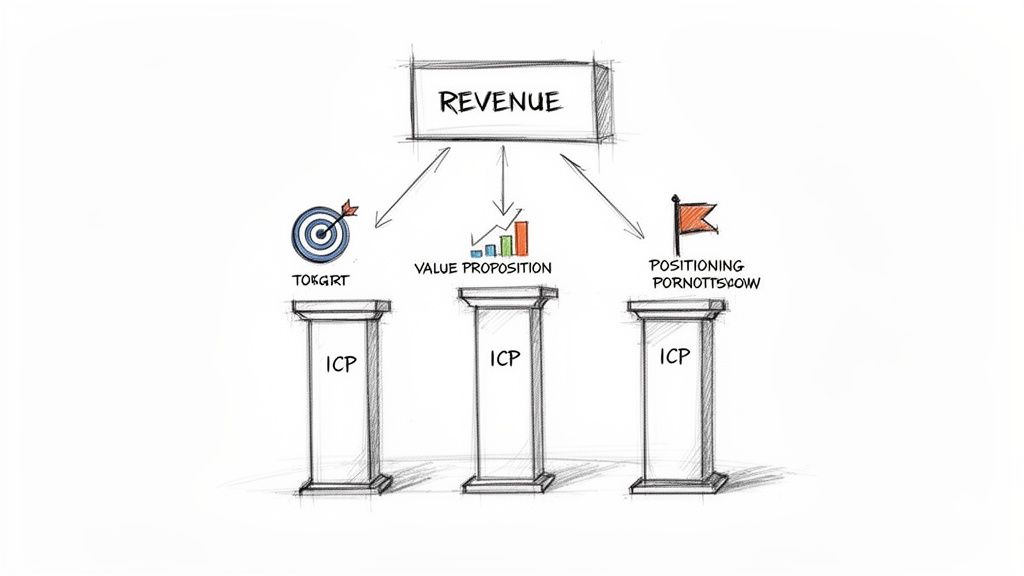
This is not a list; it's an integrated system. Each component supports the others to create a unified message that aligns your entire GTM motion.
Getting these three components right ensures your messaging is tied directly to the financial outcomes your prospects—and your own board—care about.
Your Ideal Customer Profile (ICP) is the bedrock of your entire GTM motion. Most companies get this wrong. They use flimsy personas with cute names and generic demographics.
A revenue-focused ICP goes deeper. It defines the firmographic and technographic signals of a high-value account, but more importantly, it codifies the strategic context of the buyer.
You must answer:
Without this clarity, your messaging will be generic and your sales team will operate blind.
Your value proposition must be a clear, logical argument, not a marketing slogan. A weak value prop forces reps to sell features, a losing battle in any competitive SaaS market. A strong one connects a specific pain to a unique capability and a measurable business outcome.
It should follow a simple, powerful structure: For [ICP], who struggles with [Specific Problem], our solution provides [Unique Capability] that delivers [Quantifiable Outcome]. This forces specificity on the tangible, economic value you create.
A value proposition that can’t be translated into a business case is not a value proposition. It’s a talking point that will crumble under scrutiny from a CFO.
Positioning clarifies where you fit in the market and why you win. It's the direct answer to the question every prospect is thinking: "How are you different from [Competitor X]?"
If your team can’t answer that in two sentences, you don’t have a messaging problem—you have a positioning crisis.
This requires an unflinching assessment of your strengths mapped against your competitors’ weaknesses and market gaps. Define your unique differentiators—the capabilities you have that rivals lack—and tie them directly to the pains of your ICP. For a detailed breakdown, our guide on how to write a positioning statement walks through this process.
These three pillars—ICP, Value Proposition, and Positioning—are a tightly integrated system. A change in one demands re-evaluation of the others. Get them right, and you have the foundation for a messaging framework that drives growth.
Strategy without execution is meaningless. With the strategic inputs defined—ICP, value proposition, and positioning—it's time to build the asset your GTM teams will use: the brand messaging framework template.
This is where strategy is translated into the exact language for a sales call, an email, or a landing page.
Most templates are either so simplistic they’re useless or so academic they’re never adopted. A functional framework is not a static PDF; it's a living GTM document built for utility. It allows sales, marketing, and product teams to pull the precise language they need for any scenario.
A framework that drives revenue goes beyond mission statements. It provides the granular building blocks for every customer-facing interaction. This is not about writing scripts to be parroted; it's about providing a consistent source of truth.
Essential components include:
Your goal is a modular system. A sales rep should be able to grab a specific pillar, the corresponding pain point for their target persona, a relevant proof point, and a pre-built email opener in under 60 seconds. That’s utility.
This document must be built from insights buried across your organization. This is not a top-down exercise. The most potent messaging comes from those closest to the customer and the product.
Run targeted workshops.
Ask your sales reps: "What's the one sentence that gets a prospect to lean in?" Ask your customer success managers: "What's the 'aha' moment when a customer truly gets our value?" Ask your product team: "What assumption about the old way of doing things does our solution break?"
The answers are the raw material for your framework. They provide the authentic, field-tested language that will always outperform marketing-speak.
This process hinges on a crystal-clear customer definition. If that foundation is weak, our guide on creating an ideal customer profile template provides the necessary prompts.
Structure this raw material clearly in your template. Use tables and bullet points for scannability. This document is the connective tissue between high-level strategy and daily GTM execution. Build it for speed, clarity, and impact.
A brand messaging framework that isn't activated is a failed project. Its sole purpose is to arm your go-to-market teams with the exact language they need to create demand and win deals.
The entire point of this exercise is to turn strategy into deployable assets. This is where real leverage is created. A well-defined value proposition shouldn't just be a leadership talking point. It becomes the narrative spine for your sales deck, the hook for a LinkedIn ad campaign, and the core idea behind an outbound sequence.
This translation from strategy to execution is where most B2B SaaS companies fail. They build the "what" but never operationalize the "how."
Your sales team is on the front line. If they can’t internalize and use the messaging, it doesn’t exist. Activation means turning the framework’s components into tangible assets that help reps close deals. Don't just give them the framework; give them the tools built from it.
Every asset must be perfectly aligned. There is no room for deviation.
Your demand generation efforts are often a prospect's first encounter with your brand. Inconsistency is a deal-killer. Your messaging framework must be the single source of truth for all external content.
This simple three-step process shows how we extract core ideas, structure them for clarity, and then adapt them for GTM activation.
Activation is not an afterthought. It is the most critical stage of building a system that drives revenue.
A unified messaging system acts as a force multiplier for your marketing spend. When ads, landing pages, and content all echo the same core value propositions, you build recognition and trust with every impression.
Brands maintaining tight messaging consistency see significant financial upside. One analysis I reviewed found that 32% of consistent brands experienced revenue increases exceeding 20%, while their inconsistent peers struggled.
To deploy your messaging effectively, you need a coherent Go-To-Market plan. It’s worth looking into a comprehensive digital marketing strategy playbook for startups to ensure every channel is aligned.
The end goal is a seamless buyer experience. The promise made in an ad must be the exact value proposition a sales rep discusses on a demo. That is how you build a GTM motion that wins.
Even a perfectly structured framework can fail during implementation. I’ve seen promising messaging projects—backed by solid research—end up as another document collecting dust. The problem is rarely the template; it’s almost always the process.
These failures follow predictable patterns. Getting ahead of them means anticipating the friction and building alignment before it derails your work.
This is the most common mistake. The marketing team disappears and returns with a "finished" framework, only to meet a lukewarm reception. Sales says it's unusable. Product disagrees with the positioning.
It happens when messaging is treated as a marketing-only task, not a cross-functional strategy. The document is missing vital context from those closest to the customer and the product.
How to Avoid It:
The second classic failure: creating messaging that sounds incredible in a deck but falls flat on the front lines. The framework makes bold claims about being the "leading" or "most innovative" solution, but with nothing concrete to back it up.
This is aspirational marketing—a description of what you wish you were, not what you can prove today. Prospects see through it, and your sales team will never use language they can't confidently defend.
Messaging that isn’t grounded in provable reality is just marketing jargon. It erodes trust and forces your sales team to sell features because they can't defend the value claims.
How to Avoid It:
This is a living asset, not a static document. The market shifts, customers evolve, and your product roadmap changes. Your messaging must keep pace.
A light refresh every quarter and a significant overhaul every 12–18 months is a good cadence. However, certain events trigger an immediate update:
If your reps consistently go off-script because the official messaging feels stale, you're already behind.
While a Head of Marketing or product marketer often drives the creation, ownership must be shared. The moment it's labeled a "marketing document," it’s destined to fail.
True ownership is a shared responsibility across GTM leadership:
When Revenue, Product, and Marketing all have skin in the game, the framework becomes a core GTM asset that aligns the company.
They solve two different problems. They are partners, not substitutes.
Your brand messaging framework dictates what you say—the substance of your value prop, your strategic story, and your positioning. Your style guide dictates how you say it—the tone, voice, grammar, and visual identity.
The framework provides the core message; the style guide ensures it's delivered with a consistent personality. Build the framework first. A consistent tone delivering a weak message is just well-packaged noise.
For inspiration on how top-tier companies articulate their value, it can be useful to analyze how leading B2B SaaS companies nail their messaging.
At Big Moves Marketing, we partner with B2B SaaS founders to build GTM strategies that drive revenue. If you need to sharpen your positioning and create a messaging framework your sales team will actually use, let's talk. Find out more at https://www.bigmoves.marketing.
Explore Big Moves Marketing services and resources:



%20-%20white.svg)