The most popular featured snippet optimization advice starts with a writing trick: put a short answer under a question heading. That's useful formatting, not a growth strategy. If the page doesn't rank, the query doesn't attract your buyers, or Google answers the question without sending a visit, a cleaner paragraph won't fix the business problem.
For a B2B SaaS founder, the right question isn't whether your team can win an answer box. It's whether improving an already competitive page produces qualified clicks, useful buyer engagement, and pipeline. Treat snippet ownership as a testable distribution decision, not a content trophy.
Snippets are mostly a ranking problem before they're a writing problem. In a 2017 Ahrefs analysis reported by Search Engine Land, 99.58% of featured snippets came from pages already ranking within Google's top 10 organic results, while only 30.9% occupied the top organic position.
That's historical evidence, not a current eligibility rule. But it establishes the sensible starting point: improve a page Google already considers competitive instead of creating another article and hoping formatting compensates for weak rankings.
For a SaaS team with limited editorial capacity, this distinction matters. Rewriting a relevant implementation guide is a different investment from building authority for a broad category term.
Use this sequence to build your opportunity list:
The query-length distinction is substantial: a large-scale analysis summarized by Search Engine Journal found featured snippets on 55.5% of searches containing 10 words, compared with 4.3% of single-keyword searches; it also reported the format averages below.
Snippet format to match by query type
| Query type | Format to match | Typical size | Evidence |
|---|---|---|---|
| What is or definition query | Paragraph | About 42 words or 249 characters | 70% of snippets are paragraphs |
| How to or step query | Ordered list | About six items, 44 words | 19.1% of snippets are lists |
| Comparison query | Table | About five rows, two columns | 6.3% of snippets are tables |
These are observed patterns, not specifications to copy mechanically. Match the live result first, then choose the structure that answers the buyer's question directly.
A founder selling enterprise integration software shouldn't prioritize an elementary software definition just because it attracts impressions. A question about implementation prerequisites may attract fewer people but expose a problem the product solves.
Keep this work inside your broader SEO content strategy, rather than maintaining an isolated snippet backlog. For a practical measurement companion, use MD TECH TEAM's resource on how to measure featured snippet performance when defining the reporting fields.
Finish with a shortlist of 10 to 20 queries, each mapped to exactly one authoritative URL. That's a manageable editorial queue, not a forecast of wins.
In a U.S. analysis of more than 10 million keywords reported by MarTech, AI Overviews appeared on 13.14% of desktop searches in March 2025, up from 6.49% in January, a 102% increase in two months. Treat that dated snapshot as evidence that search presentation changes quickly, not as a description of every result today.
The strategic implication is straightforward: inspect the search surface before deciding what to optimize. If the result shows an AI Overview without a featured snippet, winning a traditional snippet isn't a useful immediate objective.
A page can supply a complete answer and receive no visit. A citation in a broader generated response may help a buyer discover a vendor, but that influence isn't automatically measurable pipeline. Neither outcome deserves a revenue claim without supporting evidence.
Use intent to establish a starting hypothesis, then let the live results override it.
Target and measure by query intent
| Query intent | Primary target | Supporting proof | Primary measure |
|---|---|---|---|
| Definition (what is) | Snippet paragraph | Original example or internal data below the answer | Snippet CTR in Search Console |
| Procedure (how to) | Snippet list | Implementation detail and tool requirements | Clicks and assisted demo requests |
| Comparison (X vs Y) | Snippet table | Decision criteria and a clear verdict | Clicks and trial starts |
| Evaluation or buying query | AI Overview citation | Pricing logic and case data | Assisted pipeline |
For definition queries, CTR is a useful traffic measure, but Search Console alone won't isolate every snippet appearance. Pair query-level reporting with a separate ownership log.
For buying queries, write material that deserves citation: explain pricing assumptions, implementation constraints, customer fit, and the circumstances under which your product isn't appropriate. A vague vendor comparison adds little that a generated summary can't reproduce.
Commercial rule: Give away the answer. Preserve a reason to visit through evidence, implementation detail, and judgment.
Suppose your product manages identity provisioning. A definition of provisioning can satisfy a basic informational need. A worked migration plan, exception-handling checklist, and ownership model serve the buyer who must implement it.
Don't deliberately make the definition incomplete to force a visit. Add something useful beyond the definition instead.
A PLG business might connect that detail to a sandbox or setup workflow. A sales-led business might offer an architecture review tied to the implementation question. Sending both audiences to a generic demo form ignores why they searched.
Use an AI Overviews strategy for B2B SEO to coordinate these decisions. The goal is a coherent buyer journey, not separate teams competing to report snippet wins and AI citations.
Edit the URL that should own the question. Don't create a separate snippet page while leaving the authoritative guide untouched.
Google's featured snippet documentation explains that its systems select featured snippets algorithmically, and that clicks can take searchers directly to the extracted section. Your answer therefore needs to work both as an excerpt and as an entry point into the page.
Use this process to organize the rewrite.
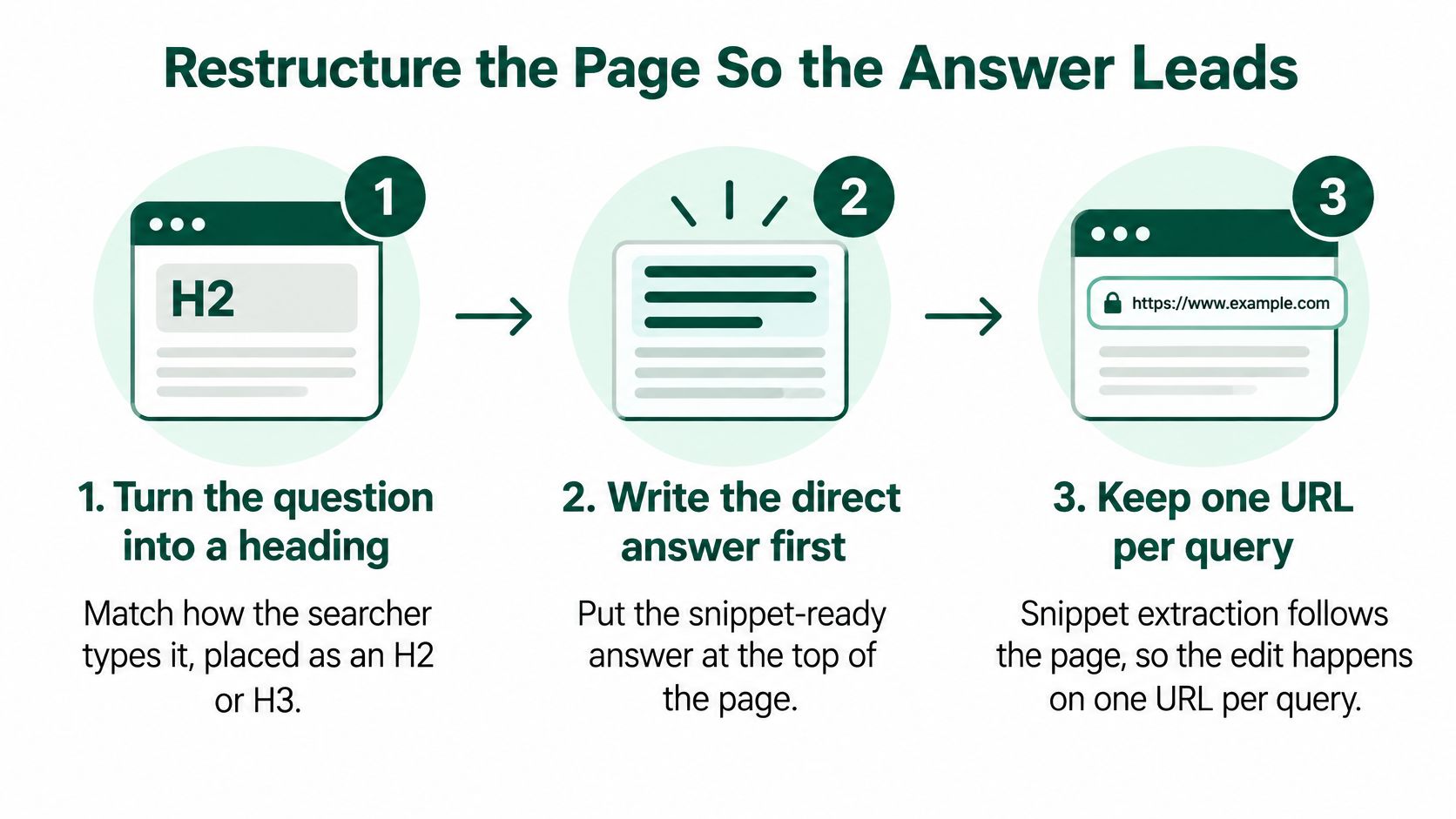
Turn the question into a descriptive heading. Use an H2 or H3 that matches the searcher's language without awkward keyword repetition. A buyer asking about provisioning prerequisites shouldn't have to interpret a heading about operational excellence.
Put the direct answer immediately beneath it. Aim for one or two sentences when the question permits, including the assumption that makes the answer true. Don't open with company positioning or a paragraph explaining why the topic matters.
Use ordered steps for a genuine procedure. Include the reason behind each action, especially where order affects implementation. Exporting existing mappings before changing provisioning settings isn't just another checklist item; it supports diagnosis and rollback.
Use tables for comparable attributes. Put consistent decision criteria in the columns and comparable options in the rows. Don't turn unrelated product claims into a table just because a competitor has one.
Follow the answer with proof and a relevant next step. Add a worked example, documented product behavior, decision criteria, or clearly scoped customer evidence. Then offer the next action that fits the task.
Consolidate competing pages deliberately. Merge overlapping answers and redirect retired URLs where appropriate. Preserve pages that serve distinct buyer needs rather than collapsing everything that shares a keyword.
Consider a security SaaS page answering whether SSO automatically removes access.
Weak answer
Our platform provides integrated identity management that helps modern enterprises simplify access across their technology stack.
Answer-first rewrite
SSO alone doesn't guarantee that a departing employee loses access to every application. Access removal depends on the application's provisioning integration, session behavior, and deactivation settings; verify those controls for each connected system.
The rewrite answers the question and preserves the condition. The supporting page should then explain how to test deactivation, identify exceptions, and assign responsibility.
Sensitive answers need more care, not tighter compression. A systematic audit of 1,508 baby-care and pregnancy queries found AI Overviews in 84% of results and featured snippets in 32.5%, with both appearing together in 22%. That finding concerns health queries, not SaaS, but it illustrates why you shouldn't assume a stable answer-box format.
For pricing, security, compliance, or regulated-product claims, keep the condition and limitation inside the extractable answer. Make headings descriptive, use real list and table elements, and ensure a screen-reader user can understand the passage without visual cues.
For a video companion to the page-restructuring work, use the following walkthrough.
A sound website content strategy connects these answer blocks to deeper evaluation material.
If a skeptical CFO could quote the answer accurately and still find the page useful, the structure is doing its job.
The markup myth wastes engineering time: teams treat featured snippet optimization as though installing the right schema will trigger an answer box. There's no author-controlled featured-snippet tag, and structured data isn't a guaranteed selection mechanism.
The word-count myth is just as distracting. Google's explanation of featured snippets doesn't prescribe an exact minimum word count; the page needs enough text to generate a useful snippet.
Don't pad a complete answer to meet an SEO template. Don't remove a necessary qualification because a writing tool prefers a shorter paragraph.
Run the checks in a practical order: rendering, indexability, heading structure, mobile presentation, then structured data. This separates inaccessible content from content Google can access but hasn't selected.
Technical checks before a snippet test
| Check | Why it matters | How to verify |
|---|---|---|
| Answer text present in rendered HTML | Google builds snippets from page content | Inspect the rendered DOM, not only the source |
| Answer sits under a descriptive heading | Clear section boundaries help extraction | Read the heading outline in the browser |
| Page is indexable and canonical | Only indexed pages can be extracted | URL Inspection in Search Console |
| Mobile layout shows the answer high on the page | Snippet clicks can land on the extracted section | Review on a phone-width viewport |
| Structured data matches visible content | Supports clarity, doesn't trigger the snippet | Validate with a structured data testing tool |
| Author-controlled snippet tag | Doesn't exist | Ignore vendors who claim one |
Check the rendered page through Search Console's URL Inspection, not just your own browser. An answer that appears after a user interaction deserves investigation, especially when the initial rendered content doesn't contain it.
Review declared and selected canonicals as well. If Google treats a different URL as canonical, the experiment isn't operating on the page you think it is.
A technically clean page can still lose because a competing answer is more relevant, better supported, or attached to a stronger page. Passing an audit removes obstacles. It doesn't create an entitlement to selection.
For Webflow teams, the useful question isn't whether Webflow is good for SEO. It's whether the published template exposes the answer, uses sensible HTML, and preserves the intended canonical and indexing settings.
Stop buying tools that promise a snippet badge or proprietary extraction tag. Spend that attention on the actual result page and the content Google chose instead.
If every check passes, investigate ranking strength, intent alignment, evidence, and answer quality before opening another engineering ticket.
Ownership is an observation. Incremental traffic and buyer action are outcomes. Report them separately or your dashboard will reward visibility that contributes nothing to the business.
According to Google Search Console's performance documentation, a featured snippet is a linked search result typically assigned position 1; impressions count when it's shown, clicks count when users follow its link, and CTR is clicks divided by impressions. That means a top reported position isn't proof of improved acquisition.
Use the following as an operating cadence, not a claim about how long Google requires to select a snippet:
Snippet test log template
| Query | Baseline impressions | Baseline CTR | Snippet owned after | Clicks after | Decision |
|---|---|---|---|---|---|
| what is account-based marketing | Enter the pre-edit Search Console total | Enter pre-edit clicks divided by impressions | No | Enter the post-edit Search Console total | Revise or keep at the scheduled review |
| Replace with your target query | Impressions for four to six weeks before the change | Clicks divided by impressions | Yes or No | Clicks in the 60-day window | Keep, revise, or revert |
The first row illustrates the recording format, not an observed campaign result. Keep baseline clicks and average position in the underlying worksheet, even though the compact view doesn't display them.
Use equal-length comparison windows or normalize daily totals when the periods differ. Annotate demand changes, ranking movement, and changes to the search-result layout before attributing every click difference to the rewrite.
Query-level Search Console data won't establish individual lead attribution. Connect landing-page engagement and conversion events to your CRM, and label assisted influence as assisted rather than pretending it proves causation.
A snippet with impressions but no visits is a visibility event, not a traffic gain.
A disciplined approach to measuring marketing effectiveness keeps the team from changing the success metric after publication.
Choose one URL for the quarter's initial test. It should already be competitive for a specific buyer question, with an agreed search target, a completed baseline, and a named owner for the decision.
This constraint isn't about moving slowly. It's about avoiding a batch of rewrites that produces plenty of activity and no usable explanation of what worked.
Write the hypothesis in business terms. For an enterprise SaaS implementation guide, that might be: a clearer procedural answer will attract more relevant visits, and the supporting implementation material will help those visitors evaluate fit. Don't promise demos from a question that buyers ask long before they're ready to speak with sales.
Ownership improves and CTR rises. Keep the answer if the visits remain relevant, then inspect what those visitors do. More clicks from students or job seekers won't justify expanding the program for an enterprise product.
Ownership improves but clicks stay flat or fall. Don't immediately conclude that the snippet caused the decline. Check demand, device mix, competing result features, and ranking changes; then decide whether better supporting evidence gives buyers a reason to visit.
Ownership doesn't improve and performance doesn't move. Review whether the page is competitive and whether it answers the intended question. Repeating technical checks without a suspected defect is busywork.
A useful test produces a decision even when it doesn't produce a win. You may discover that a query is worth serving for buyer education but not worth further acquisition investment.
At the scheduled 60-day review, make the keep, revise, or revert call. Record what changed your judgment, not just whether the answer box appeared.
Expand only when the result supports touching another page. If the experiment fails, preserve useful content improvements but revert changes that weakened clarity, buyer relevance, or conversion. Featured snippet optimization earns its place in a SaaS growth program when it improves how qualified buyers find and evaluate the business, not when it creates another metric to celebrate.
Big Moves Marketing offers fractional CMO leadership and strategic growth guidance that connects positioning, content priorities, and measurement to pipeline decisions. If your team needs to distinguish worthwhile search opportunities from wasted optimization work, visit Big Moves Marketing to discuss a focused growth plan with clear tests and decision criteria.