%20png%20copy.avif)

In 2026, B2B marketing stands at an inflection point. The traditional playbooks—linear funnels, MQL-driven campaigns, and sales-controlled buyer journeys—are being rewritten by forces that demand a different approach altogether. As 92% of B2B buyers now enter the buying process with at least one vendor already in mind, and 41% start with a single preferred vendor before any formal evaluation begins, the reality is clear: the battle for business is won or lost long before a buyer fills out a form or takes a sales call.
This isn't just a shift in buyer behavior—it's a fundamental transformation in how trust is built, validated, and sustained throughout the B2B buying journey. With 70% of the buying journey now happening before buyers contact sales, and 80% of decision-making occurring before a seller even enters the room, B2B marketers must reimagine their role from lead generators to trust architects.
Drawing from recent research across Forrester, Gartner, the Content Marketing Institute, and dozens of B2B-focused studies, this article explores the fundamental shifts reshaping B2B marketing in 2026—and what they mean for marketers, founders, and product leaders who need to adapt quickly.
Trust has always mattered in B2B, but in 2026, it has become the ultimate competitive advantage. According to Forrester's 2026 predictions, we're entering a year where "trust is no longer a soft metric—it's a strategic imperative."
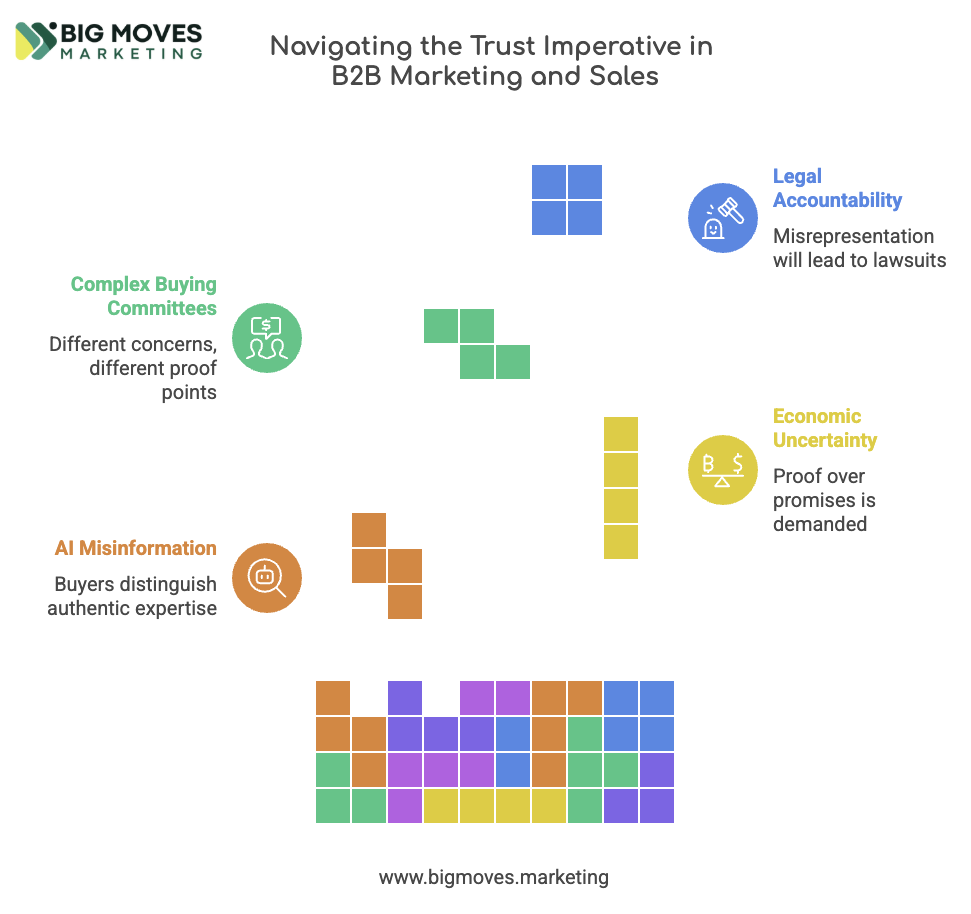
The data reveals why this shift is happening now:
This environment creates what researchers are calling a "trust gap"—the space between what vendors claim and what buyers can independently verify. As 88% of B2B buyers trust a brand more when they receive valuable content from that vendor, the question becomes: what constitutes "valuable" in an age of AI-generated abundance?
For years, B2B marketers operated under a simple assumption: more content equals more leads. This "content is king" mentality drove teams to produce endless streams of blog posts, whitepapers, and case studies. But 2026 marks the death of this approach.
The data tells a striking story about the content landscape:
The paradox is clear: we can create more content than ever, but it's becoming less effective at driving engagement and building trust. As audiences become overwhelmed by an endless barrage of information, trust erodes because more content becomes harder to verify.
Leading B2B marketers in 2026 are making a counterintuitive shift—creating less content, but making what they create count more:
1. Original Research as Trust Currency
The most compelling shift is toward proprietary research. 86% of marketers plan to increase research budgets in 2026, with those publishing original data reporting 64% higher conversion rates and 61% stronger SEO performance.
Why? Because original research is inherently difficult to replicate with AI, carries the weight of real data, and positions brands as sources of genuine insight rather than content creators. When TopRank Marketing surveyed B2B marketers, they found that 74% who frequently collaborate with influencers on research-based content report it as "very effective" versus just 29% of everyone else.
2. Experience, Expertise, Authority, Trust (E-E-A-T)
Google's E-E-A-T principles are reshaping not just SEO, but content strategy writ large. In 2026, successful content must demonstrate:
This means moving away from generalized "how-to" content that AI can easily replicate toward content that only your organization—with your specific experience and data—can create.
3. Owned Channels Over Rented Space
With 32% of B2B marketers increasing investment in owned media (websites, blogs, email), there's a strategic shift toward channels where brands control the experience and own the relationship.
Email newsletters and branded content hubs are experiencing a renaissance because they build high trust with audiences while providing richer, first-party data that insulates brands from platform algorithm changes. These owned channels reposition content as a long-term asset rather than disposable noise.
If 2025 was about promising value, 2026 is about proving it. The shift from persuasion to proof represents a fundamental change in how B2B marketing operates.
The most sobering statistic for B2B marketers: 95% of the time, the winning vendor was already on the buyer's day-one shortlist. Even more striking, buyers place about four out of five vendors on their shortlist before day one, and 81% choose their vendor before any sales contact.
This means that by the time most marketing and sales activities begin, the decision has largely been made.
So how do buyers form these early preferences? Research reveals a complex web of validation sources:
1. Third-Party Validators Dominate
75% of enterprise B2B companies will increase budgets for influencer relations in 2026. This isn't about Instagram influencers—it's about analysts, subject-matter experts, and industry voices who buyers increasingly rely on for fact-based insights.
The data on this is compelling:
As Forrester notes, "Millennials and Gen Z now make up over two-thirds of buyers involved in large and complex transactions," and these buyers are expected to "include 10 or more external influencers in their purchasing network."
2. Customer Evidence Over Claims
With 73% of buyers actively avoiding suppliers that send irrelevant outreach, and 61% preferring an overall rep-free buying experience, the burden of proof has shifted dramatically.
Smart B2B marketers are responding by making customer evidence central to their strategy:
3. Try-Before-You-Buy Becomes Standard
Gartner research shows that buyers increasingly use trial-based evaluations to reduce risk and validate AI-generated claims. This shift toward experiential validation means:
The message is clear: In 2026, B2B marketers must shift from persuasion to proof, showcasing real outcomes and elevating trusted voices rather than relying on marketing claims alone.
Perhaps the most disruptive shift in B2B marketing is the collapse of the linear funnel model. The traditional awareness → consideration → decision journey has been replaced by something far more complex and, paradoxically, more natural.
According to Gartner's research, "Today's B2B buying journey follows a nonlinear purchasing path that more closely resembles a set of distinct buying jobs or sets of tasks that buyers must complete." These tasks happen concurrently, individually, and without a consistent order.
The statistics bear this out:
If buyers discover and evaluate through networks rather than funnels, marketing strategy must adapt accordingly:
1. Community-Led Growth
49% of organizations are increasing in-person event budgets, and 37% plan to expand virtual events. But it's not just about events—it's about building spaces where buyers can engage, exchange insights, and validate decisions.
As one researcher notes: "Communities like Slack groups, Discord channels, or moderated forums allow greater engagement, feedback, and peer-led value." These owned communities provide:
2. The Multi-Channel Reality
B2B buyers don't live in a single channel, and increasingly, they don't want to. Research shows:
The implication: Your content and brand presence must be discoverable wherever buyers are looking—from traditional search to AI-powered answer engines, from LinkedIn to industry-specific communities, from podcasts to peer review platforms.
3. Algorithm Influence vs. Human Influence
Here's where it gets interesting: As one analysis puts it, "Everyone is competing to stay relevant in a buyer's networks and feeds—the places where their trust is actually formed."
This means optimizing for two types of algorithms simultaneously:
The brands that win in 2026 are those that understand that over 90% of cited pages in AI Overviews contain AI-generated content, making AI-assisted content creation essential for visibility—while simultaneously investing in the human relationships and original research that can't be automated.
If marketers don't control the buyer journey anymore, what do they control? The answer is profoundly strategic: they control the environment, the insights, and the systems that enable buyers to choose them.
As EndeavorB2B's research frames it: "When we strip away the old illusion of control, what's left is actually more powerful: we control the strategy, the environment, and the insight."
This breaks down into three distinct areas:
1. Strategy: Defining What Success Means
Rather than being measured solely on volume metrics (MQLs, email opens, content downloads), leading marketing teams in 2026 are:
This strategic clarity requires partnership with sales and revenue operations. High-performing B2B companies are 2.5× more likely to align sales and marketing around the buyer journey.
2. Environment: Designing Spaces for Trust
Since trade shows, small-group meetings, and hybrid roundtables have quietly become the places where deals move from "interesting" to "serious", marketers must design environments that facilitate authentic connection:
As one researcher notes, "Personalization for younger audiences now hinges on creating intimate experiences such as small group activities, networking with like-minded peers, and objective-focused discussions based on their individual needs."
3. Insight: Intelligence as the New Control
When you can't control the journey, you can still control the intelligence that shapes it. This means developing deep understanding of:
56% of marketers expect budgets to grow in 2026, yet 25% say measuring ROI remains a top barrier. This disconnect suggests that many teams still lack the insight infrastructure needed to connect their activities to outcomes.
Any discussion of B2B marketing in 2026 must address AI—but not in the way most think.
The statistics on AI adoption are staggering:
But here's the critical insight from the Content Marketing Institute's research: "AI is like giving every marketer a turbo-charged typewriter. Hooray! We can all crank out words faster. But the bigger prize is what we do with the time saved: the slower, deeper work of thinking."

The data reveals a clear pattern:
AI Excels At:
AI Struggles With:
As one analysis notes, "Content performance shows the highest combined uncertainty—22% scratch their heads or say 'ask me later'—suggesting they need more time to see how AI impacts content effectiveness."
The winning approach in 2026 isn't AI or humans—it's AI and humans working in partnership:
This is why, despite massive AI investment, only 9% of B2B marketers plan to increase investment in human resources (salaries, training, development)—a concerning trend that may limit the strategic value organizations can extract from AI tools.
These four shifts—from volume to scarcity, persuasion to proof, funnels to networks, and execution to environment design—create a radically different operating model for B2B marketing.
1. Audit Your Trust Architecture
Ask yourself:
2. Shift Budget Allocation
Based on the research, high-performing teams in 2026 are investing in:
While maintaining strategic investment in:
3. Reorganize for Buyer Jobs, Not Funnel Stages
Gartner's research recommends focusing on cataloging "buying jobs and the underlying tasks and activities to support job completion" rather than mapping linear buyer journeys.
This means structuring your marketing team and content around:
4. Build for Both Discovery and Validation
Since buyers research between 2-7 websites before purchasing and 32% now discover content through GenAI tools, your discoverability strategy must include:
5. Invest in the Human Elements AI Can't Replace
Despite AI's capabilities, certain elements remain uniquely human:
This is why human expertise will rival GenAI in appeal as buyers seek deeper validation.
If you're leading a B2B startup or managing a product team, these shifts have specific implications:
1. Your Product Is Your Marketing
With 75% of buyers preferring a rep-free sales experience, your product experience—including trials, demos, onboarding, and in-product education—is often the primary way buyers evaluate you.
Invest accordingly:
2. Customer Evidence Becomes Your Differentiator
Since 84% of buyers use peer recommendations early in the decision process, your early customers aren't just revenue—they're your most valuable marketing asset.
Build a systematic approach to:
3. Thought Leadership as Competitive Moat
With only 11% of B2B marketers rating their thought leadership as advanced or leading, there's a massive opportunity to differentiate through original thinking.
This means:
While tactics will continue to evolve, several principles emerge from this research that are likely to endure:
1. Trust Compounds Over Time
Building trust is not a campaign—it's a long-term investment. The brands winning in 2026 are those that started building trust years ago through consistent value delivery, transparent communication, and proven results.
2. Owned Relationships Beat Rented Attention
As platform algorithms change and AI reshapes discovery, owning your audience relationships through email lists, communities, and direct channels provides resilience that paid attention cannot.
3. Quality Scales Differently Than Quantity
One piece of truly valuable content—original research, unique perspective, customer evidence—can generate returns for years. A hundred mediocre AI-generated blog posts generate little lasting value.
4. Human Connection Remains Irreplaceable
In an age of AI abundance, the scarcest resource is genuine human connection, understanding, and trust. The organizations that prioritize this while using AI to enhance efficiency will outperform those that try to automate everything.
The shifts reshaping B2B marketing in 2026 are not incremental—they represent a fundamental rethinking of how business buyers discover, evaluate, and choose solutions. The collapse of the linear funnel, the rise of AI-powered research, the early formation of buyer preferences, and the demand for proof over promises create both challenges and opportunities.
For B2B marketers, the path forward is clear: design every aspect of your marketing with trust as the primary objective. This means:
The winners in 2026 won't be the organizations with the most content or the biggest marketing budgets. They'll be the ones that earn their place on day-one shortlists by consistently delivering value, building trust, and proving their worth long before a buyer is ready to make contact.
As we navigate this transformation, the question isn't whether to adapt—it's how quickly you can shift from the old playbook to the new reality. The buyers have already made the shift. The only question is whether your marketing will keep pace.
Explore Big Moves Marketing services and resources:




%20-%20white.svg)