%20png%20copy.avif)

Most SaaS founders approach lead generation as a volume problem. They hire marketers to fill the top of the funnel, assuming more MQLs will inevitably lead to more revenue.
This is a profound misunderstanding of how B2B SaaS growth works.
Effective lead generation for SaaS is not about cranking a tactical lever. It’s about architecting a go-to-market system that consistently attracts high-intent buyers who already understand the problem you solve. Chasing volume is a surefire way to burn capital, demoralize your sales team, and build a pipeline full of noise.
The obsession with top-of-funnel volume is the original sin of B2B marketing. It’s a relic from an era when buyers were information-poor and relied on vendors for education.
That world is gone. Today, your ideal customer is well-informed, deeply skeptical, and halfway through their buying process before they ever consider filling out a form.
When you pursue MQLs from every corner of the internet, you create a bloated pipeline of low-intent prospects. Your sales team then wastes expensive cycles on leads who downloaded an ebook out of mild curiosity, not because they have a budget and a burning problem.
This friction between sales and marketing isn't a personality conflict; it's a systemic failure. The model is designed to produce activity, not revenue.
The most expensive mistake in growth is spending time and capital to acquire customers who will never be successful. Your lead generation model is where this mistake begins.
This misalignment manifests in predictable ways. Your customer acquisition cost (CAC) climbs while revenue growth stagnates. Sales cycles lengthen as reps struggle to educate and persuade leads who were never truly qualified.
Marketing complains sales isn’t working their leads. Sales argues the leads are junk. This isn't just frustrating; it's a direct threat to your growth trajectory.
A broken lead generation model isn't subtle. It announces itself through clear operational and financial stress points. Founders often misdiagnose these as isolated execution problems—a bad ad campaign or an underperforming SDR—when the issue is strategic.
The system is failing if you recognize these patterns:
To fix lead generation, you must first understand what makes SaaS marketing different from other industries. The subscription model and complex buying cycles demand a more rigorous approach.
The core problem is a disconnect from your Ideal Customer Profile (ICP) and go-to-market strategy. Instead of designing a machine to attract best-fit customers, most companies build a dragnet to catch anyone with a pulse.
This approach doesn't scale. It burns cash and demoralizes your team. We've seen numerous companies reverse this by ensuring their website attracts the right visitors.
The first step to fixing the model is admitting it’s broken.
Sustainable SaaS lead generation isn't about chasing a dozen tactics. It’s about building an engine. From our work with dozens of B2B SaaS companies, a clear pattern emerges: the winners build their pipeline on four interdependent pillars.
If one pillar is weak, the entire structure is compromised. You cannot fix a foundational problem by throwing more money at ads or hiring more SDRs. That's a direct path to wasted spend, a frustrated sales team, and a pipeline full of low-intent leads that go nowhere.
This broken model isn't just inefficient; it creates deep-seated friction between marketing and sales, slowing the entire revenue engine.
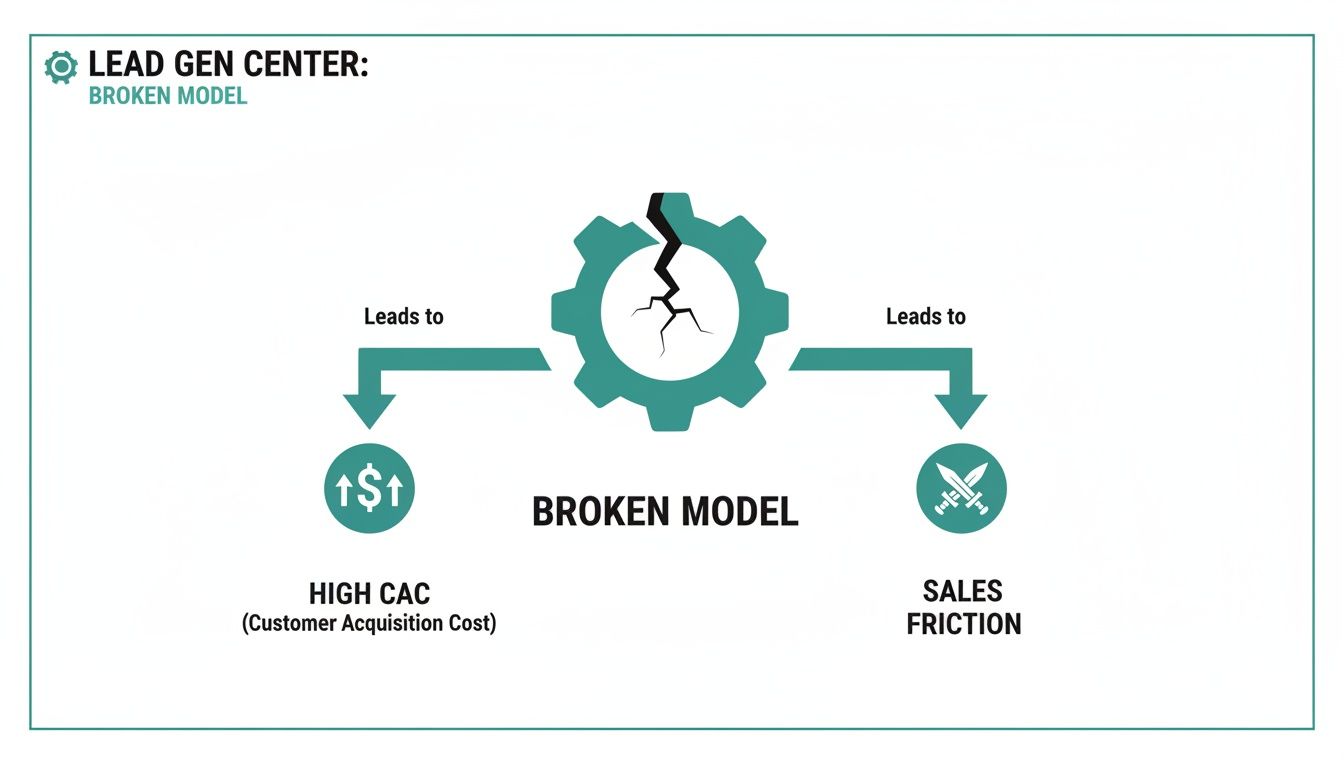
High acquisition costs and internal conflict are symptoms. The disease is a flawed system. Let's fix it by rebuilding the four pillars.
Most companies define their Ideal Customer Profile (ICP) with basic firmographics—employee count, industry, revenue. This is table stakes, not a strategy.
Real clarity comes from understanding the triggering event. What specific change inside a company compels them to search for a new solution now? Did they just hire a new VP? Fail a compliance audit? Did an internal project just implode?
A great ICP definition doesn’t just tell you who to target. It tells you when and why they are ready to listen. Without this, your messaging is just noise.
This is the bedrock of your positioning. It allows you to move from discussing product features to articulating a sharp value proposition that solves a critical, time-sensitive business problem. If your ICP and positioning are fuzzy, every marketing dollar is less effective.
Once you know exactly who you're talking to and why they should care, you must show up where they actively look for solutions. Stop spreading your budget thin across every platform. Focus your firepower exclusively on high-signal channels.
These are the environments where your ideal buyers demonstrate intent. It’s about quality over quantity.
To distinguish between channels that deliver ready-to-buy leads and those that just generate noise, here's a simple breakdown.
Focusing on high-signal channels is about capital efficiency. You deploy time and money where they have the highest probability of turning into pipeline, not just clicks or impressions.
As you grow, other channels can become high-signal. A well-run partner program can deliver incredibly warm, pre-qualified leads. This lead generation affiliate marketing guide shows how to build a network that functions as a powerful high-signal channel.
Your offer is the currency you use to earn a prospect's attention. In a world drowning in content, generic ebooks and "Top 10" listicles are worthless. They attract researchers and tire-kickers, not serious buyers.
A high-value offer must provide genuine, immediate utility. It should help your prospect solve a small piece of their problem now, which builds trust and proves your expertise.
Stop thinking about content. Start thinking about tools.
The goal is to make the value exchange a no-brainer for a qualified prospect. This acts as a natural quality filter. People who are serious enough to use the tool you provide are the ones you want to talk to. For more on this approach, see our deep dive on B2B demand generation.
This is the final, and often most overlooked, pillar. You can have the perfect message, channel, and offer, but if your conversion process is a clunky, frustrating experience, you will lose high-intent prospects at the finish line.
Every extra form field, every unnecessary click, and every moment of confusion is a reason for a qualified lead to abandon the process.
A frictionless path isn't about a pretty landing page. It's about designing a seamless journey from the first click to a booked meeting.
Audit your entire flow from the prospect's perspective:
Too many SaaS companies burn millions driving traffic only to let their best leads leak out through a conversion path full of holes. Fixing this pillar often delivers the fastest and cheapest lift in qualified leads you will ever see.
When you need pipeline now, paid channels offer speed. But organic search is how you build the capital-efficient foundation for durable, long-term growth.
Many early-stage founders dismiss SEO as a slow-burn strategy they can't afford. This is a profound strategic miscalculation. It’s a classic case of chasing short-term results at the expense of building a lasting competitive asset.
B2B buyers, particularly for complex SaaS solutions, conduct extensive research before they ever speak to a sales team. Capturing this high-intent traffic isn’t optional; it's a core function of a modern go-to-market strategy. Winning at organic search isn't about ranking for keywords—it's about building a content moat around your category.
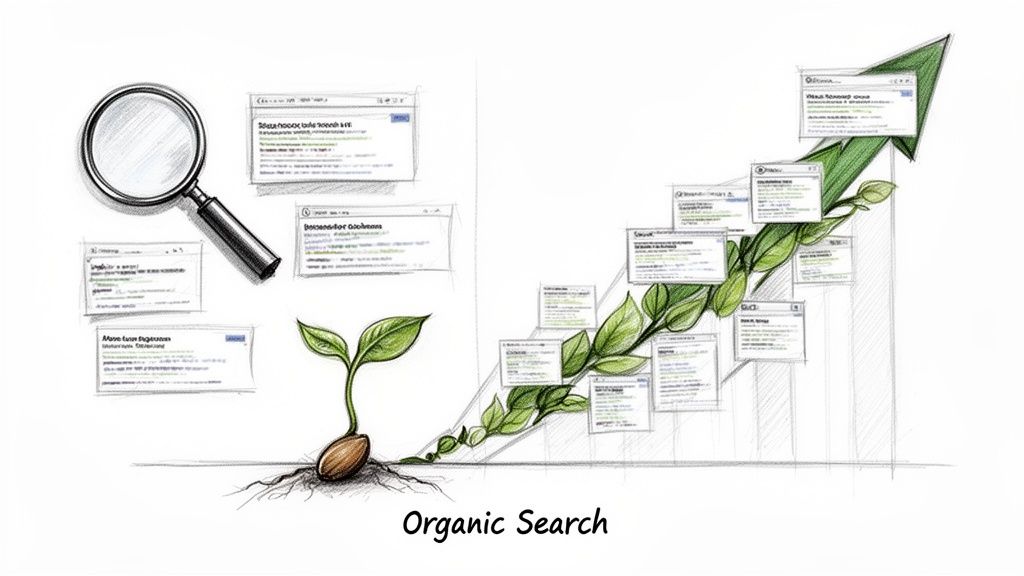
A common mistake is treating all content equally. An effective SEO strategy must operate on two fronts simultaneously: capturing existing demand and creating new demand. Focusing on only one leaves a massive hole in your pipeline.
Demand Capture targets buyers who are already problem-aware and solution-aware. They are actively searching for answers, comparing products, and evaluating alternatives. This is your bottom-of-funnel, high-intent content.
This includes:
This content intercepts buyers with high purchase intent. The goal is direct conversion—a demo request or trial signup. It's the lowest-hanging fruit and should be your first priority.
Demand Creation targets buyers who are problem-aware but not yet solution-aware. They feel the pain but don't know how to frame their problem or that your software category exists.
Most SaaS marketing teams burn cash on top-of-funnel blog posts that generate traffic but zero pipeline. The real work is creating content that doesn't just answer a question, but reframes the reader's problem and positions your category as the only logical solution.
This is where you establish your company's point of view and build authority. You're not just answering a question; you're teaching your ICP a smarter way to think about their business. This content won't always lead to an immediate demo, but it seeds future demand.
Creating content is not enough. Every article, guide, and landing page must be engineered to guide the right visitor to the right next step. One of the most common failures I see is slapping a generic "Request a Demo" CTA on every piece of content.
Your calls-to-action must match the reader's intent and their stage in the buying journey.
This segmented approach ensures you meet buyers where they are, providing a logical next step that builds trust instead of creating friction.
Building a powerful organic search presence is a long-term play. It requires patience and a commitment to creating genuinely insightful, opinionated content. For a deeper analysis, see our guide on building a SaaS SEO strategy that drives real pipeline.
The payoff is a durable, compounding asset that generates high-quality leads for years, insulating your growth from the rising costs and volatility of paid channels. It is not just another marketing tactic; it's how you build an enduring brand.
LinkedIn is the single most concentrated ecosystem of B2B buyers on the planet. Yet most SaaS companies treat it like a digital billboard, broadcasting company updates and running ads that disappear into the void.
If that sounds familiar, you don't have a channel problem. You have a strategy problem.
The value of LinkedIn is not about posting frequency or connection requests. It's a strategic environment for building relationships and positioning your company as an authority. When done right, LinkedIn becomes a powerful tool for building trust at scale—the foundation of effective lead generation for SaaS.
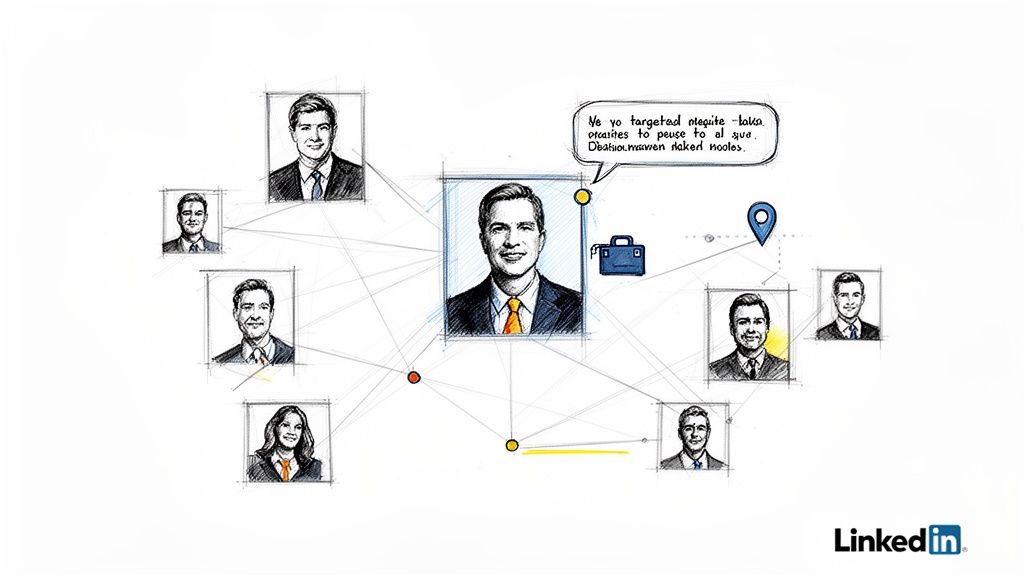
The failure starts with a misunderstanding of user intent. No one logs into LinkedIn hoping to get sold to. They are there to learn, observe credible people in their industry, and stay ahead of trends.
Most SaaS marketing on LinkedIn ignores this reality. It's either self-promotional noise ("Check out our new feature!") or a thinly veiled sales pitch. This approach doesn't build a pipeline; it just adds to the noise and misses the one thing that drives B2B buying decisions: authority.
People buy from companies they trust, and they trust companies led by credible people. On LinkedIn, your founder's and executives' personal profiles are your most valuable marketing assets—not your company page.
The strategy must shift from broadcasting from a faceless brand account to building the personal authority of your key leaders. That is how you earn the right to a conversation.
A winning LinkedIn strategy runs on two parallel tracks. One track builds long-term influence and trust; the other captures immediate buyer intent. You need both.
Track 1: Organic Authority (The Founder's Voice)
Your founder, CEO, or another key executive must be the face of your company’s point of view on LinkedIn. Their personal profiles are where the real conversations happen.
This isn't about posting ghostwritten fluff. It's about sharing sharp, specific, and often contrarian insights from real-world experience. They should be talking about:
This content acts as a filter for your ICP. The people who resonate with your strong opinions are the exact people you want in your pipeline. You're building an audience of believers before they ever see a demo. For a deeper dive, see how we approach LinkedIn B2B marketing.
Track 2: Paid Precision (Targeted Ad Campaigns)
While organic content builds the foundation, paid campaigns allow you to surgically target your ideal customers with messages that address their most pressing pain points. LinkedIn’s targeting is unmatched for B2B, letting you reach buyers by their exact job title, company size, industry, and seniority.
The classic mistake is running generic brand ads. The best ads feel like a natural extension of your thought leadership. Instead of a bland "Request a Demo" CTA, your ad should promote a high-value, problem-solving asset—a tactical guide, a proprietary data report, or a diagnostic tool that offers immediate value.
The data supports this approach. LinkedIn is significantly more effective for lead generation than other major social networks. A high percentage of B2B marketers rank it as their number one channel for high-quality leads, simply because users are there with professional intent. You can dig into the research behind LinkedIn's exceptional lead generation performance for more detail.
Mastering LinkedIn isn't about running more campaigns; it's about having a clearer point of view. When your founder’s authentic voice builds trust organically and your paid ads deliver tangible value to a precisely defined audience, the platform transforms from a chore into a powerful engine for generating high-quality, sales-ready leads.
Strategy without execution is a thought exercise. Many founders learn this after burning through runway on campaigns that generate noise but zero pipeline. The problem isn’t a lack of effort—it’s a failure to measure what predicts revenue.
Too many SaaS teams are addicted to vanity metrics. They celebrate MQL volume and website traffic, mistaking activity for progress. This leads to a bloated pipeline, a frustrated sales team, and a broken feedback loop. It’s time to stop counting what’s easy and start measuring what matters.
The only metrics that should command a founder's attention are those with a direct line to revenue and capital efficiency. Stop asking how many leads marketing generated.
Instead, your new obsessions should be these questions:
These three KPIs form the bedrock of a revenue-focused dashboard. They force an honest, productive conversation between marketing and sales, shifting the goal from hitting a superficial MQL number to building a predictable revenue machine.
Great execution is about a disciplined system for learning and adapting. It's not about running random A/B tests on button colors. It's about building a closed-loop system connecting marketing, sales, and product.
Treat your entire go-to-market motion as a series of controlled experiments. When you launch a new channel or campaign, you are not just fishing for leads. You are testing a hypothesis about your ICP's behaviors, pain points, and motivations.
A growth experiment is a success if it generates a clear answer, not just if it generates leads. Learning that 'this channel doesn't work for our ICP' is an incredibly valuable, capital-efficient lesson.
This mindset requires a non-negotiable process for lead qualification and handoff. Every lead passed to sales must meet a strict, mutually agreed-upon definition. When sales rejects a lead, the reason must be documented and fed back to marketing immediately.
This isn’t about blame; it’s about fine-tuning the machine. Is the messaging off? Is the targeting wrong? Is the offer attracting the wrong persona?
This continuous, real-time feedback is the lifeblood of efficient growth. It provides the confidence to double down on a winning channel or kill a losing one before it drains your budget. Truly understanding how to measure marketing effectiveness isn't just a reporting task; it's the core of your growth strategy.
By focusing on revenue-centric KPIs and building a rigorous feedback loop, you graduate from guessing to knowing. You stop wasting motion and start building a lead generation system that creates measurable business value.
I get asked these questions constantly by SaaS founders and revenue leaders. Here are direct, experience-backed answers.
This is the wrong question. It implies a budget-first mindset, which is how early-stage companies burn capital with nothing to show for it. There's no magic percentage of revenue.
The right question is: What is our cost to acquire a qualified meeting in a scalable channel?
Instead of spreading a small budget across five channels and winning on none, be surgical. Pick one or two high-signal channels—typically founder-led outbound and high-intent SEO—and invest only what’s necessary to validate them.
Your goal is not to spend a budget; it is to prove you can acquire customers profitably. Once you have a positive signal and clear unit economics on one channel, you have earned the right to scale your spend.
The single most costly mistake is prioritizing lead quantity over lead quality. It is an addiction to vanity metrics.
Obsessing over a top-of-funnel MQL target without scrutinizing lead intent creates massive downstream chaos. Your sales team wastes finite time and energy on prospects with no authority, budget, or real pain. This lengthens sales cycles, tanks morale, and destroys trust between sales and marketing.
A successful lead generation strategy is defined by the predictable revenue it generates, not the superficial activity it creates.
Focus on generating fewer, better leads that align perfectly with your Ideal Customer Profile. A smaller pipeline of high-intent prospects that close is infinitely more valuable than a bloated pipeline of unqualified leads that go nowhere.
The answer depends entirely on the asset and its purpose. The guiding principle is the value exchange. Are you offering enough genuine utility to justify asking for someone's contact information?
Top-of-funnel thought leadership (blog posts, articles): Absolutely not. Leave it ungated. The goal here is to maximize reach, build authority, and earn trust. Gating this content suffocates its impact.
High-value, bottom-of-funnel resources (ROI calculators, diagnostic tools, exclusive data reports): Use a simple, low-friction gate. These assets provide tangible, immediate value that justifies a prospect identifying themselves.
Never gate something a user could find with a simple search. If the "value" behind your form is a generic ebook, you are not generating a lead; you are building a list of people to annoy. The quality of your offer dictates the quality of your lead.
At Big Moves Marketing, we help B2B SaaS founders build the strategic clarity needed to drive predictable growth. We partner with you to refine your positioning, sharpen your messaging, and construct a GTM engine that generates pipeline, not just noise. Learn more at https://www.bigmoves.marketing.
Explore Big Moves Marketing services and resources:



%20-%20white.svg)