%20png%20copy.avif)

Most advice on branding a product name is wrong because it starts in the wrong place. Founders get a room together, open a doc, throw around words, then vote on what sounds smart. That process feels productive. It usually produces names your team has to explain, defend, and apologize for in every sales call.
A product name in B2B SaaS isn't a creative trophy. It's part of your go-to-market system. It affects recall, searchability, demo flow, sales enablement, category fit, and how quickly a buyer understands what they’re looking at. If the name creates friction, your website works harder, your reps talk longer, and your positioning gets weaker.
That matters because 77% of consumers purchase items based on the brand name rather than the name of the object itself, according to branding statistics compiled by Tenet. Different market, same principle. Names shape recognition. Recognition shapes trust. Trust shapes pipeline.
Founders should treat naming like they treat pricing, packaging, or category strategy. It’s a business decision with creative inputs, not a creative exercise with business consequences.
Most product naming processes fail for one reason. They optimize for internal excitement instead of market clarity.
The usual pattern is predictable. A founder wants something “bold.” Product wants something descriptive. Marketing wants something memorable. Sales wants something easy to explain. Then the loudest person in the room wins. Nobody has defined the job of the name, so everyone argues from taste.
That’s how teams end up with names that sound polished in a board deck and fall apart in the field. Reps shorten them. Prospects mishear them. Search results get muddy. The website needs an extra paragraph to explain what should have been obvious in the first five seconds.
A product name has one primary responsibility. It should reduce cognitive load for the buyer.
If you sell into a crowded B2B category, buyers already have too much to process. They’re comparing vendors, assessing risk, involving multiple stakeholders, and trying to understand whether your product fits an existing budget line. A weak name adds another layer of friction. A strong one makes the rest of the message easier to absorb.
Practical rule: If your sales team has to routinely translate the name before they can explain the product, the name is doing negative work.
This is why the common advice to “just pick something memorable” is incomplete. Memorability without strategic fit creates curiosity but not comprehension. In B2B SaaS, comprehension usually matters first.
Brainstorming isn’t the problem. Unstructured brainstorming is.
Voting makes it worse because people vote for names based on private associations. One person likes the sound. Another likes the metaphor. A founder likes that it feels ambitious. None of those reactions tell you whether your ideal customer will understand it, remember it, say it out loud, or trust it.
Here’s the better mental model:
| Bad process | Better process |
|---|---|
| Start with words | Start with positioning |
| Debate taste | Define evaluation criteria |
| Pick a favorite | Eliminate weak candidates |
| Hope the market agrees | Test with actual buyers |
The name isn’t the brand by itself. But it is often the first piece of language your market encounters. If that first encounter creates drag, everything downstream gets harder.
You can’t name well from a blurry strategy. When founders try, they usually create one of two problems. Either the name becomes so literal it traps the product, or so abstract it floats free from the market reality.
If you can’t state who the product is for, what problem it solves, and why that solution matters now, you’re not ready to name anything.
A lot of teams resist this because naming feels concrete. Positioning feels slower and harder. So they jump ahead. Then they spend weeks arguing over vocabulary that’s really standing in for unresolved strategic decisions.
That sequencing is backwards. A good name is downstream of positioning. It’s not a substitute for it.
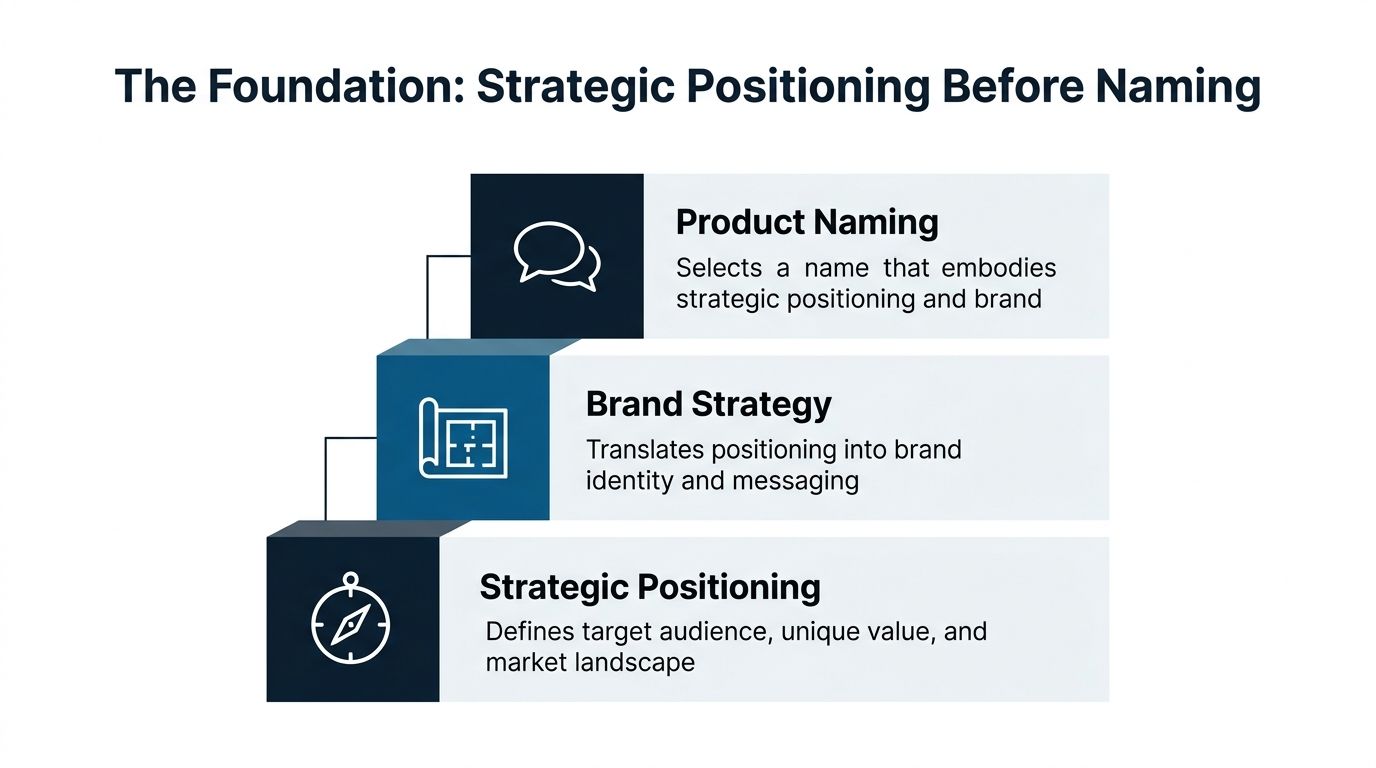
A useful framing comes from Carlos Alba Media's brand strategy, which treats positioning as the foundation for everything customers later see and hear. That’s the right order. Identity follows strategy. Naming follows identity.
Visual memory matters here too. Consistent use of color in branding improves brand recognition by up to 80%, according to Indeed’s branding statistics roundup. Founders often isolate the name from the rest of the brand system, but buyers don’t experience it that way. They experience the name, visual identity, page structure, and message together. If you want the name to stick, it has to live inside a coherent brand.
If you need a sharper framework for that strategic layer before naming, review this B2B brand strategy breakdown.
You don’t need a massive brand workshop. You do need clear answers to a few essential questions.
A founder who can’t answer those questions shouldn’t be evaluating names. They’re still evaluating strategy.
Use this as a pressure test before naming.
| Question | If the answer is weak | What happens to the name |
|---|---|---|
| Who is the buyer? | Audience is broad or generic | The name tries to appeal to everyone |
| What pain gets budget? | Team lists features instead of stakes | The name becomes vague or overloaded |
| What category are you in? | Team avoids category language entirely | Buyers can’t place the product |
| What outcome matters most? | Too many claims at once | The name carries mixed signals |
| How should the brand feel? | Tone is undefined | Naming debates collapse into preference |
Positioning ambiguity always leaks into naming. The only question is whether you catch it early or after launch.
That’s the hard truth. Founders don’t usually have a naming problem first. They have a clarity problem first.
Once the strategy is set, creativity becomes useful. Before that, it’s just noise.
Most B2B teams default to descriptive names because they’re scared of confusion. That instinct is understandable. It’s also limiting. Descriptive names can help early comprehension, but they often age badly, blend into the category, and create legal headaches. At the other extreme, invented names can build stronger distinctiveness but require tighter messaging discipline at launch.
A naming framework is a choice about what you want the name to do immediately versus over time.
| Framework | Strength | Weakness | Best use |
|---|---|---|---|
| Descriptive | Fast category clarity | Generic, hard to own | Narrow products in familiar categories |
| Evocative | More brand character | Can drift into ambiguity | Companies with a clear message and differentiated angle |
| Invented | High distinctiveness | Needs explanation at launch | Businesses betting on long-term brand equity |
| Acronym | Compact and internal-sounding | Low meaning for new buyers | Rarely ideal unless market convention supports it |
Descriptive names work when buyer education is the main challenge and category language carries strong demand intent. If your product solves a specific operational problem and the category is mature, a clearer name can shorten the path to understanding.
Evocative names are usually stronger when your product ambition exceeds its current feature set. They give you room to expand. They also force discipline. You can’t hide behind the name. You have to build the meaning through messaging.
Invented names can be excellent in crowded markets where every obvious descriptive route is taken or weak. There’s a reason many strong brands use non-dictionary language. But founders should be honest about the trade-off. If you pick an invented name, your homepage, pitch deck, and sales narrative have to work harder on day one.
McKinsey data cited by Siegel+Gale on naming pitfalls shows that 50% of product launches fail due to poor naming, and that figure drops to less than 20% when teams use a vetted, systematic process. That’s the important part. The framework matters, but the rigor matters more.
Bad naming sessions produce a handful of obvious ideas. Good ones produce range.
Start by generating from strategic territories, not random words. If your positioning is built around control, speed, confidence, orchestration, or signal clarity, those become creative territories. Then build out from each territory using metaphors, verbs, environmental cues, systems language, and phonetic variations.
A practical longlist method:
Map the strategic territories
Pull out the few concepts your product should imply. Not features. Meaning.
Create word banks for each territory
Include industry terms, adjacent vocabulary, metaphors, textures, motion words, and contrasts.
Use AI as an expansion tool, not a decision-maker
Prompt it with positioning constraints. Ask for metaphors, compound constructions, coined terms, and names that imply a specific buyer outcome. Don’t ask for “cool SaaS names.” You’ll get recycled sludge.
Force variety
Require your team to produce candidates across multiple structures. Single-word. Compound. Evocative. Coined. Unexpected but pronounceable.
Score for strategic fit before taste
Does it fit the buyer? Can a rep say it naturally? Does it feel too narrow? Too trendy? Too enterprise-theater?
Good naming work feels less like inspiration and more like filtering signal from noise.
Most longlists die from causes that should have been obvious in the first pass.
A useful way to keep the team honest is to write the homepage hero under each candidate. If the name makes the headline harder to write, that candidate is a liability.
For companies thinking through this in a broader category context, this branding approach for B2B tech companies is the right lens. The name has to fit the commercial reality of the category, not just the founder’s sense of taste.
This is the stage teams often underinvest in. They fall in love with a shortlist, do a quick search, and move on. That’s reckless.
A name can sound sharp in a workshop and still fail in the market, fail in other languages, fail in legal review, or fail in the first buyer conversation.
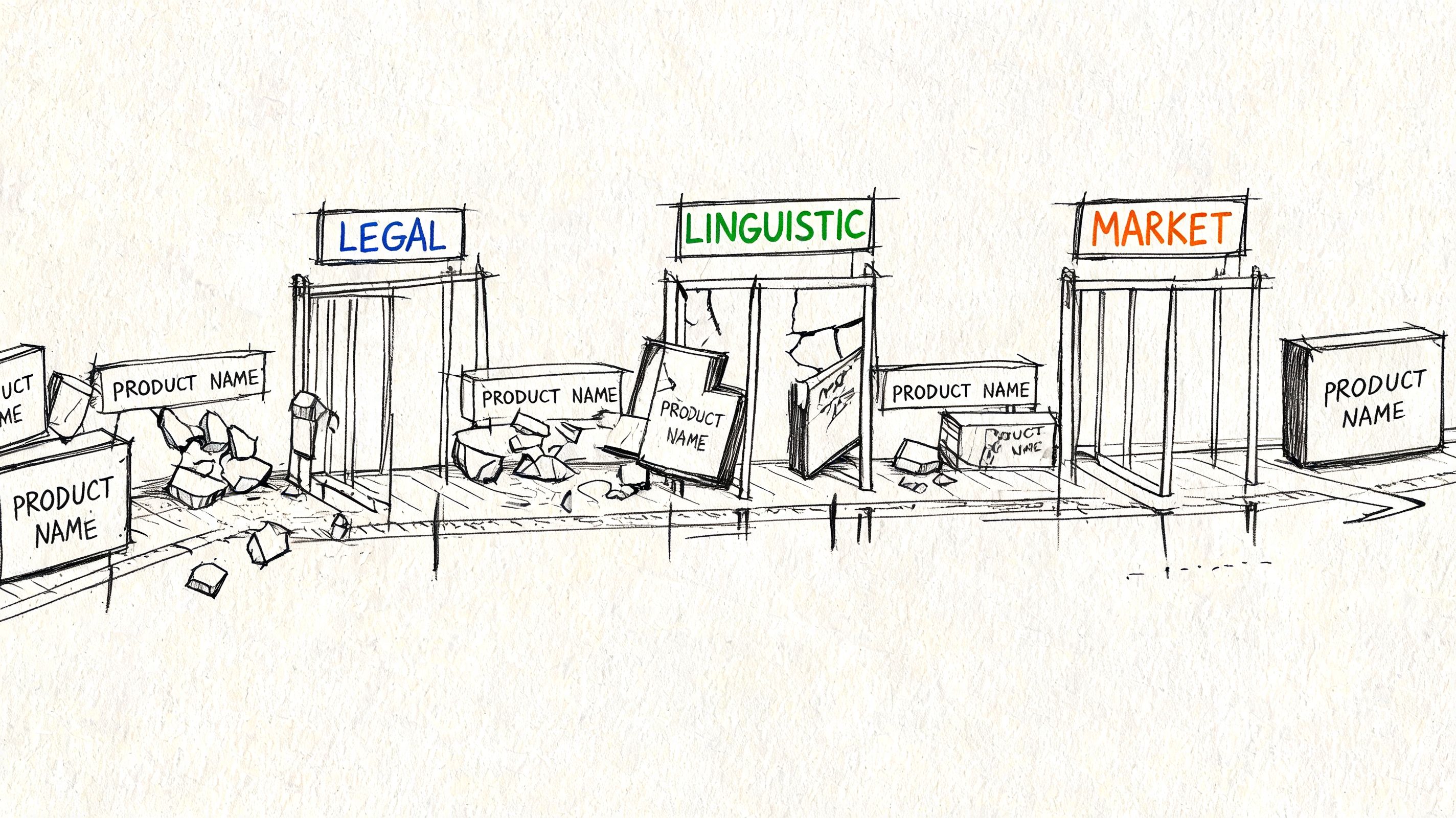
The right shortlist isn’t a list of names people like. It’s a list of names that have survived early elimination.
That’s why vetting should be staged. Don’t spend legal budget or executive time on names that fail basic pronunciation, obvious association checks, or buyer comprehension. Move from cheap filters to expensive filters.
Benchmark data cited by SmashBrand’s naming best practices shows that product names passing full vetting achieve 4x higher 12-month sales velocity than untested ones and face a 75% reduced risk of a costly rebrand. That shouldn’t be surprising. The process strips out weak options before they become expensive mistakes.
Founders building for global or semi-global markets often ignore language risk because the company starts in English. That’s shortsighted. The issue isn’t only embarrassment. It’s friction in search, demos, referral, and memory.
Use a practical first-pass screen:
If you’re validating a broader market bet at the same time, this startup idea validation guide is useful because naming quality and market clarity often break in the same places.
A name that works in a workshop but breaks in a sales demo isn't a strong name. It’s an untested one.
Later in the process, use a walkthrough like this to sharpen what you’re screening for:
You do not need a giant research program to pressure-test a shortlist. You do need actual buyer reactions.
A simple test structure works well:
| Test | What to ask | What to watch for |
|---|---|---|
| Cold exposure | “What do you think this product does?” | Immediate category confusion |
| Preference comparison | “Which feels most credible in this space?” | Trust and seriousness |
| Recall check | “Which names do you remember later?” | Sticky candidates |
| Fit question | “Which sounds like it belongs in your workflow?” | Practical relevance |
Use real prospects, friendly customers, advisors with market exposure, and sales calls where appropriate. Keep the questions open-ended. If you lead respondents, you’ll get fake confidence.
Avoid one trap. Don’t ask people which name is “best” in a vacuum. Ask what each name implies. Buyers are better at reacting than inventing.
This is where discipline matters.
Your lawyer should handle actual trademark review. Before that, your team should do a preliminary screen to avoid obvious collisions. Also check domain options, major social handles, and whether the branded search environment is clean enough to support launch.
The best candidate is rarely the one with the most internal energy. It’s the one that survives all four filters:
That’s the gauntlet. Names that survive it are usually less flashy and more durable.
A chosen name has zero market value until your team gives it meaning. That happens through repetition, context, and message discipline.
Too many SaaS companies stop at selection. They announce the name, swap the logo, and assume the market will absorb it. Buyers won’t. They need a narrative that tells them what the name stands for, why it matters, and how it connects to a business problem they already care about.
Start with a simple rule. The name should never appear alone in early market exposure.
It should travel with a category cue, a value statement, and proof language. On a homepage, in an ad, or in a sales deck, the buyer should get all three quickly. That’s how the name picks up commercial meaning.
Build the messaging stack in this order:
A good internal tool for turning the chosen name into usable GTM language is a structured brand messaging framework template. The point isn’t to produce polished copy first. The point is to make sure every team tells the same story.
Your market doesn't remember the meaning you intended. It remembers the meaning your team repeats consistently.
Once the messaging hierarchy exists, operationalize it fast.
Your homepage hero should answer the buyer’s first question without making them decode the name. Your product page should connect the name to category relevance. Your sales team needs a one-line explanation they can use in demos, intros, and follow-ups without improvising.
Useful launch assets include:
This is also where weak names get exposed. If every asset requires extra explanation, your messaging team is compensating for naming debt.
A name doesn’t stop being risky once it clears legal review. It can still create avoidable GTM drag in multilingual markets.
According to Red Slice on the naming gap in global B2B, overlooking linguistic and cultural risks can reduce organic search traffic by up to 30% in multilingual markets and raise customer acquisition costs by 15-20% due to confusion. For B2B SaaS companies, that doesn’t just affect search. It affects outbound response, partner communication, event visibility, and word-of-mouth inside buyer networks.
So treat activation as multilingual, even if launch is English-first. Pressure-test how the name appears in:
The best activation work makes the name feel inevitable. Not because it’s clever, but because every touchpoint reinforces what it means.
A weak rollout can damage a strong name. Teams underestimate this because launch tasks look administrative until they start breaking things.
You need one owner coordinating legal, product, sales, marketing, customer success, and web operations. If nobody owns the transition end to end, pieces get missed and the market sees a half-migrated brand.
Your team has to understand the name before the market does.
That means giving sales, CS, partnerships, and recruiting a tight explanation of what changed, what didn’t, and how to speak about it. If customer-facing teams are improvising on launch week, you’ve already lost consistency.
Use an internal checklist like this:
Messy launches usually occur there. Not in the strategy. In the incomplete execution.
Review every surface where the old or placeholder name appears:
| Area | What to check |
|---|---|
| Legal | contracts, terms, privacy policy, procurement docs |
| Product | UI labels, emails, notifications, in-app help |
| Web | navigation, metadata, page titles, forms, redirects |
| Revenue systems | CRM fields, automation workflows, proposal templates |
| Customer comms | onboarding docs, renewal materials, support macros |
For launch operations, I’d also borrow from Aakash Gupta’s battle-tested launch framework. It’s useful because it forces cross-functional accountability instead of treating launch as a marketing event.
If you want a practical reference focused on execution detail, this product launch checklist template is the kind of artifact teams should work from, not a vague launch plan doc.
External launch should feel coordinated, not noisy.
Announce the name where your buyers already pay attention. Website first. Customer email. Sales outreach. Founder channels. Partner channels. Then wider distribution. Don’t lead with aesthetics. Lead with clarity. Explain what the product is, who it’s for, and why the name now fits the strategy better.
A clean rollout usually includes:
Founders often want the launch to feel bigger. Most of the time it should feel clearer.
A product name is only useful if buyers can absorb it quickly, your team can use it consistently, and the market can attach the right meaning to it. That’s the standard. Not whether the room liked it when it was first presented.
If you’re rethinking branding a product name because your positioning is fuzzy, your sales team keeps translating the product, or your category story isn’t landing, Big Moves Marketing helps B2B SaaS teams tighten the strategy underneath the name so the brand supports pipeline, sales enablement, and launch execution.
Explore Big Moves Marketing services and resources:




%20-%20white.svg)