The most popular advice for building a B2B marketing plan is to choose your channels, fill a content calendar, and attach a budget. That's backward. A channel list doesn't explain how your company will create enough qualified opportunities to support its revenue target.
A useful B2B marketing plan sample PDF starts with the pipeline requirement, identifies who must agree to buy, and funds controlled tests against explicit commercial thresholds. The PDF is the record of those decisions, not a substitute for making them.
Order matters more than completeness. Put channels before positioning and you'll debate LinkedIn versus Google Ads without agreeing on what buyers should believe. Put budget before funnel economics and you'll allocate money without knowing what an acceptable opportunity costs.
Use the following skeleton as a decision document. Each row must produce something another leader can inspect, challenge, and approve.
| Section | Question It Answers | Output | Owner |
|---|---|---|---|
| Executive summary | What outcome, and how much? | One primary metric and target | CEO or CMO |
| Market context | Which shifts change our spend? | Three named shifts, no more | Marketing lead |
| ICP and buying group | Who decides, and who can block? | Account profile and stakeholder map | Marketing with sales |
| Positioning and messaging | Why us, in one line? | Message pillars and proof points | Founder and product marketing |
| Funnel model | Where do deals stall? | Stage definitions and conversion assumptions | Revenue operations |
| Channel plan | Which channel does which job? | One role and one pilot per channel | Channel owners |
| Measurement and tracking | How will we know what worked? | Tracking spec and attribution rules | Analytics owner |
| Budget and resourcing | What do we fund, and at what share? | Budget by channel and headcount | CFO and CMO |
| Timeline | When does each pilot start and end? | Quarterly plan with decision gates | Program manager |
| Governance | Who reviews, and what stops a channel? | Review cadence and stop criteria | Leadership team |
Read the rows as dependencies. The executive summary establishes the commercial obligation. Market context should include only changes that alter an investment decision, not a broad overview essay.
The account profile and positioning determine whom you pursue and why they should care. The funnel model then exposes the assumptions behind the target, while channel owners explain how they'll test those assumptions.
Measurement must specify actual CRM fields and campaign conventions. Budget must include the people needed to produce assets, follow up, and maintain reporting. A media allocation without execution capacity isn't a funded plan.
The timeline assigns decision dates, not just publishing dates. Governance names who can release additional spending and who can stop an activity when evidence contradicts the original assumption.
Document test: If a section produces nothing a sales leader can verify, cut it.
A sample PDF longer than the operating plan it describes has become a brochure. Use this skeleton as the downloadable working document, and keep the editable version alongside the exported PDF so owners can update assumptions without rebuilding a presentation.
Write down and date your pipeline target, average opportunity value, and current lead-to-opportunity rate. Use the next two quarters as a planning scenario, with assumptions clearly separated from observed performance.
Check the revenue obligation behind the target using a pipeline coverage ratio. If the implied opportunity volume exceeds your sales capacity, adding channels won't repair the model. Revisit the segment, offer, conversion assumptions, or target before committing spend.
Send the draft to sales before approval. Ask which objections prevent progression, which opportunities consume time without advancing, and whether the team can handle the proposed follow-up load.
If outbound capacity is the constraint, hireSDR.com's Hire BDR resource can support the staffing discussion. It shouldn't become permission to hire around an unclear account profile.
At Big Moves Marketing, we treat B2B growth as cumulative work that relies heavily on a strong brand framework. Consistent language gives successive activities a common foundation instead of forcing every campaign to introduce a different company.
A persona deck can tell you who uses the product while missing who prevents the purchase. Start with the account and the decision it must make, not a collection of job titles.
In its survey, Gartner found that 74% of B2B buying teams experienced unhealthy conflict, while groups reaching consensus were 2.5 times more likely to report a high-quality deal. That makes agreement a marketing responsibility, not merely a negotiation problem for sales.
Use this account-level map as the starting point, then expand it to include the people who assess risk.
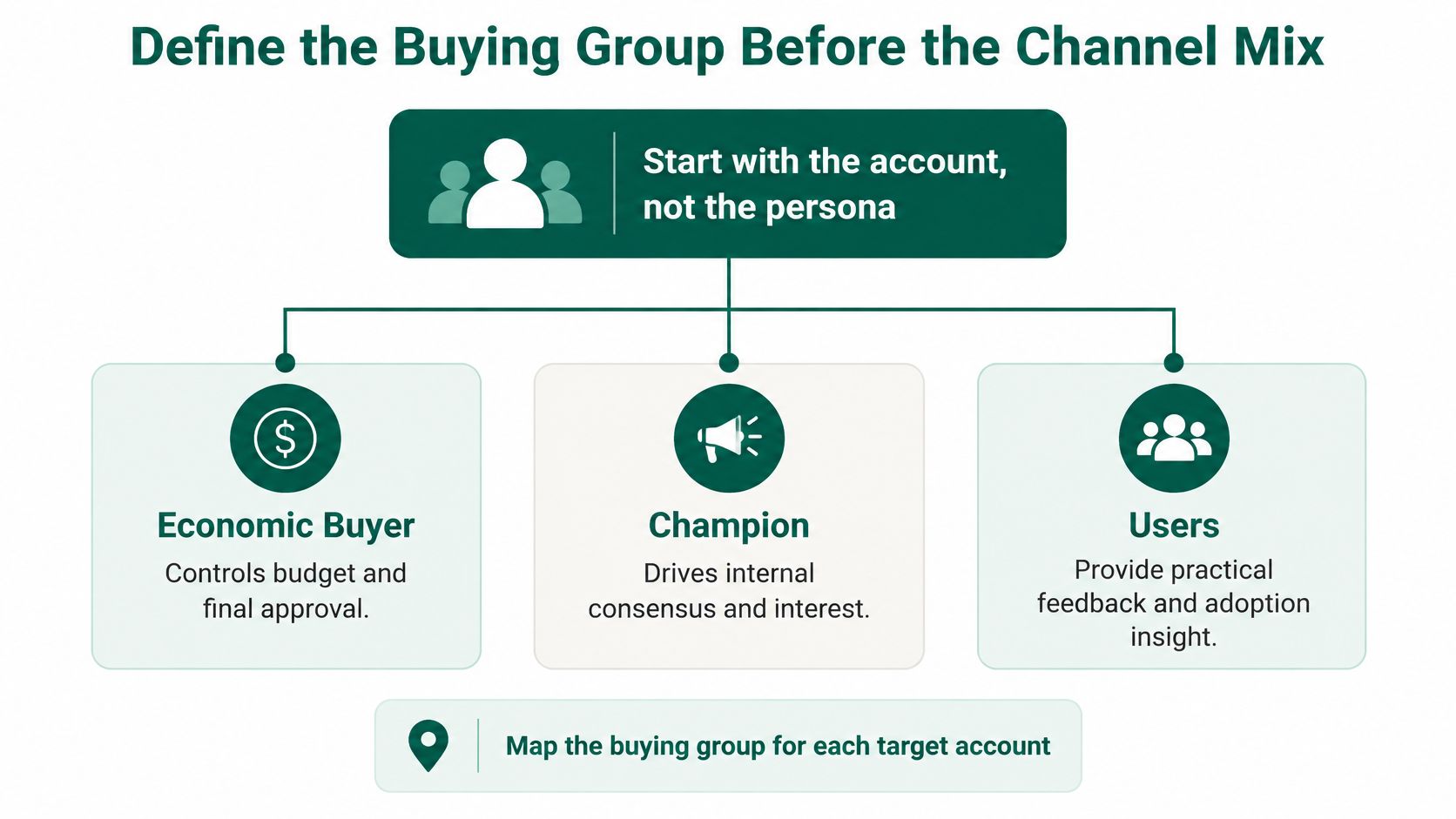
Build the account criteria with an ideal customer profile template, then document the decision responsibilities inside those accounts.
| Role | Question Before Approval | Evidence to Prepare |
|---|---|---|
| Economic buyer | Does the outcome justify the investment? | Business case, commercial assumptions, cost of inaction |
| Operational user | Will this improve the actual workflow? | Workflow demonstration, adoption requirements |
| Technical evaluator | Can we integrate and maintain it? | Architecture, integration documentation, technical validation |
| Security or procurement reviewer | Can we accept the risk and terms? | Security documentation, contract requirements, vendor assessment |
| Executive sponsor | Can I defend this initiative internally? | Strategic rationale, implementation ownership, outcome reporting |
| Champion | Can I help colleagues agree without creating extra work? | Forwardable decision brief and stakeholder-ready proof |
Don't assume the champion controls the budget. An enthusiastic user can introduce you to the buying group, but enthusiasm doesn't resolve implementation risk or spending authority.
Write one shared business case containing the problem in the company's language, required capabilities, named risks, implementation load, and expected business outcome. Personalize the emphasis by role, not the underlying case.
Gartner reports that 61% of B2B buyers prefer an overall rep-free buying experience, while buyers still prefer seller input for contextual questions about company fit. Don't force a meeting to answer a general product question. Reserve human involvement for decisions where context changes the answer.
Keep core capabilities, credible comparisons, implementation expectations, and customer proof accessible without a form. Offer specialist conversations for security, integration, procurement, and business-case validation.
Apply a forwarding test: can the economic buyer and technical evaluator circulate the same asset without correcting its claims? If not, your messaging may be creating disagreement.
Finally, record purchase triggers such as new funding, a failed integration, or a new executive mandate. In an illustrative launch plan, name one primary segment for the first 90 days so the team can distinguish a segment problem from a message problem.
Assign each channel one job before it gets budget. Search captures expressed demand. LinkedIn builds familiarity with relevant accounts. Content provides explanations and evidence. Email helps engaged contacts make progress without forcing a premature sales conversation.
The channel roles below are useful only when they serve a defined audience and buying decision.
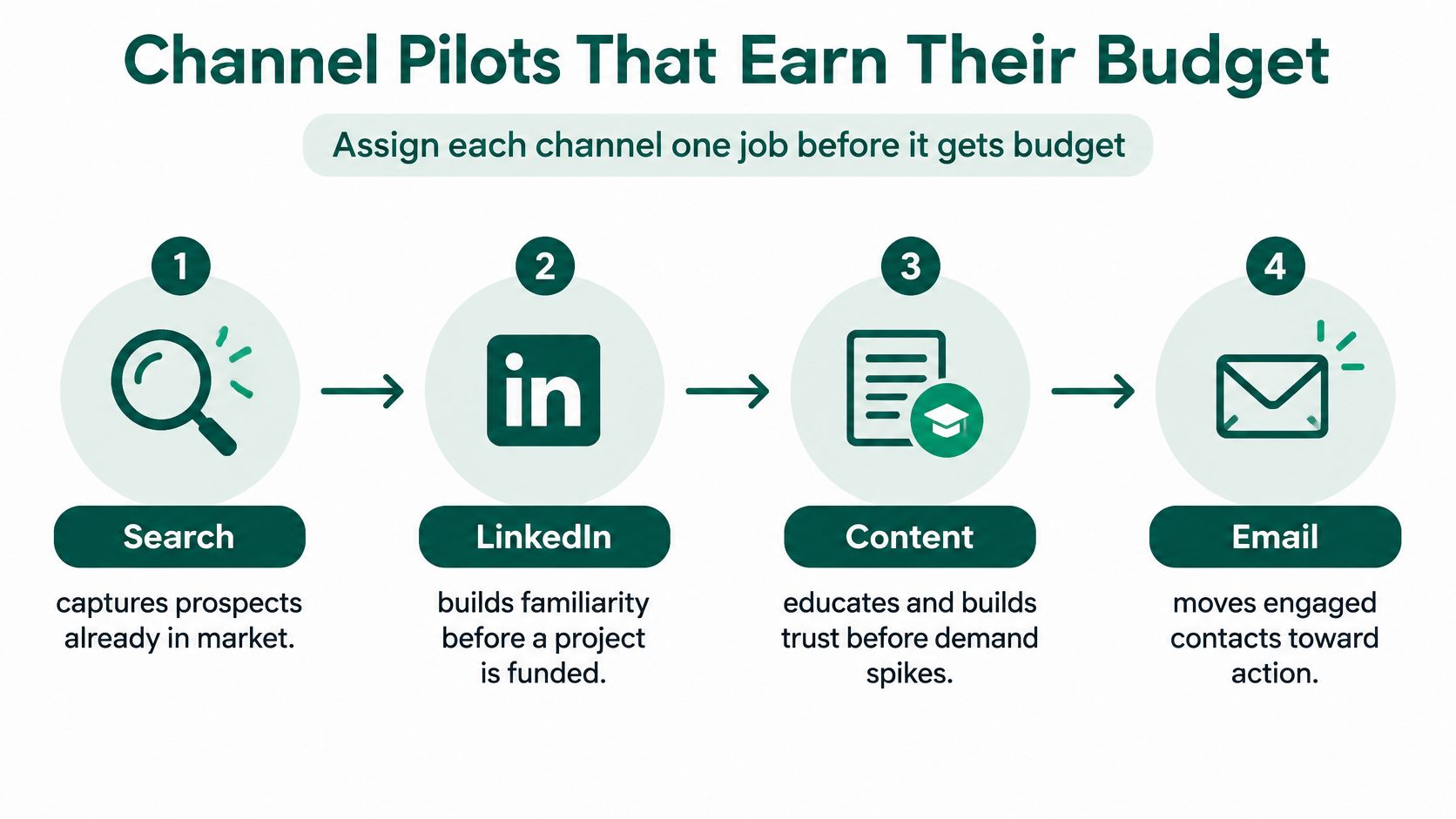
Don't confuse capture with creation. Gartner reports that only 2% of B2B buyers start the purchase process with no vendors already in mind. A search-only plan competes for existing demand without deliberately building familiarity before the project begins.
Start with an in-market pilot and an out-of-market pilot rather than launching every available channel. Use a B2B channel mix decision framework to make the trade-off explicit: which audience behavior makes this channel plausible?
A Statistics Fundamentals compilation reports that only 27% of marketing leads are sales-ready when first generated. Treat that as a warning against equating inquiries with opportunities, not as a forecast for your own funnel.
Define an MQL through account fit and meaningful engagement. Define an SQL through sales-validated need and an agreed next step. Give sales an acceptance window and require a rejection reason so marketing can distinguish poor targeting from incomplete follow-up.
Nurture should match the unresolved question:
For a small team, iHatePosting's social media scheduler is an execution resource to consider after the message and publishing responsibilities are settled. Scheduling doesn't replace a defensible point of view.
Use the accompanying video as an additional discussion resource for the team.
Record spend, reach, response, qualification, opportunities, and pipeline progression. Don't change audience and creative simultaneously, optimize around low-intent downloads, or count opportunities that sales never worked. Otherwise, you won't know whether the pilot failed or the operating process did.
Work backward from the commercial outcome. In a hypothetical quarterly model, a target of 40 opportunities at a 10% qualified-lead-to-opportunity rate requires 400 qualified leads. These are illustrative assumptions, not benchmarks.
For a pipeline-value target, divide required pipeline by average opportunity value to estimate opportunity volume. If you start from a closed-won revenue target instead, account for the opportunity-to-close rate before calculating lead requirements. Don't apply the win rate twice.
Your tracking specification needs campaign IDs, UTM conventions, CRM source fields, lifecycle-stage timestamps, opportunity amount, and closed-won revenue. Revenue operations should test the journey from campaign interaction to opportunity reporting before launch.
Attribution is directional, not proof of causation. Google Analytics distinguishes attributed conversions from incrementality and describes data-driven attribution using factors including time to conversion, device, ad interactions, exposure order, and creative type. A credited interaction isn't automatically an interaction that caused the sale.
Compare first-touch, last-touch, and data-driven views monthly. Investigate discrepancies before shifting budget, especially when campaign reporting looks healthy but sales reports weak opportunity quality.
| KPI | Definition | Review Cadence | Decision It Drives |
|---|---|---|---|
| Sourced pipeline | Opportunity value where marketing created the first touch | Monthly | Channel funding |
| Influenced pipeline | Opportunity value where marketing touched the account before creation | Monthly | Account targeting |
| Cost per qualified opportunity | Channel spend divided by opportunities that pass sales acceptance | Monthly | Continue or stop a pilot |
| Opportunity-to-close rate | Closed-won deals divided by opportunities created | Quarterly | Sales and messaging fixes |
| Sales-accepted lead rate | Share of MQLs accepted by sales within the agreed window | Biweekly | Scoring and handoff rules |
| Sales cycle length | Median days from opportunity creation to close | Quarterly | Nurture length and timeline |
| Branded search and direct traffic | Volume of brand-name queries and direct visits | Monthly | Demand creation health |
Sourced and influenced pipeline overlap. Never add them together as though they represent separate revenue pools. Document exclusions, lookback rules, and account matching so leaders can reproduce the report.
ViralBrain's comparison of LinkedIn analytics tools can help evaluate channel diagnostics. Keep those diagnostics subordinate to account and opportunity evidence, using a consistent approach to measuring marketing ROI.
A dashboard should change a decision. If nobody can name that decision, the metric doesn't belong in the leadership view.
Also monitor how AI answers describe your product, which evidence they cite, and whether they introduce misconceptions. Record the prompts and observation dates, but don't treat mention frequency as attributable pipeline.
The Fall 2024 CMO Survey put marketing budgets at 10.1% of total company budgets and 7.7% of company revenue, while digital marketing spending grew 11.1% during the prior year. Those figures describe surveyed U.S. companies, not the correct spending level for your SaaS business.
Your budget must reflect runway, sales capacity, contract economics, and confidence in the offer. A pre-PMF company shouldn't copy a mature company's allocation or fund a software stack before it can explain repeatable demand.
The following is an illustrative allocation, not a market benchmark. Its percentages are planning choices for a fixed monthly budget, and the search share is the remainder after the other allocations.
| Line Item | Share of Budget | What It Buys | Release Gate |
|---|---|---|---|
| Foundations (positioning, website, tracking) | 20% | Messaging framework, site and tracking spec | Tracking live and verified |
| In-market search | 25% | Solution and comparison terms | Cost per qualified opportunity under target |
| LinkedIn and email nurture | 20% | Account targeting and nurture sequences | Sales-accepted lead rate at agreed level |
| Content and SEO | 15% | Proof pages and buying-stage content | Assisted pipeline reported monthly |
| Events and webinars | 10% | Two buying-group sessions per quarter | Opportunities created per session |
| Reserve for passing pilots | 10% | Scaling winning channels | Released only by gate review |
| Total | 100% | Full fixed monthly budget | Gate reviews set in advance |
Don't mistake budget lines for independent channel launches. Content can supply the search pilot, email can support account engagement, and a webinar can reuse the same proof. If the team can't support these activities, remove rows rather than underfunding everything.
A 2025 B2B benchmark summarized by Marqeable identifies pipeline generated as the leading marketing metric, used by 62% of companies. Release spending against commercial evidence, not delivery volume.
For an illustrative annual schedule, use the opening quarter to establish foundations and launch initial pilots. Continue evaluation in the following quarter against thresholds set before launch, scale qualifying activity afterward, and rebuild the final-quarter plan from actual economics.
Review B2B marketing budget allocation with labor and production costs visible. Mark unsupported conversion assumptions as unknown, assign validation work, and avoid disguising uncertainty with spreadsheet precision.
A pre-PMF founder and a growth-stage revenue leader shouldn't use the same operating plan. They face different uncertainties, so they need different evidence before expanding investment.
Use the sample to remove inappropriate work, not to justify a complete marketing department before the business needs one.
| Company Profile | What the Plan Prioritizes | What It Removes or Defers |
|---|---|---|
| Pre-PMF with founder-led sales | Customer interviews, a named ICP, qualified conversations, offer validation | Paid acquisition, elaborate attribution, scaling decisions |
| Series A to B mid-market SaaS | Buying-group coverage, sales acceptance, deal progression, recurring funnel reviews | Broad audience expansion and lead-volume targets disconnected from capacity |
| Product-led business with an enterprise tier | Separate self-serve and enterprise paths, ownership, qualification, expansion signals | A blended funnel that hides different buying economics |
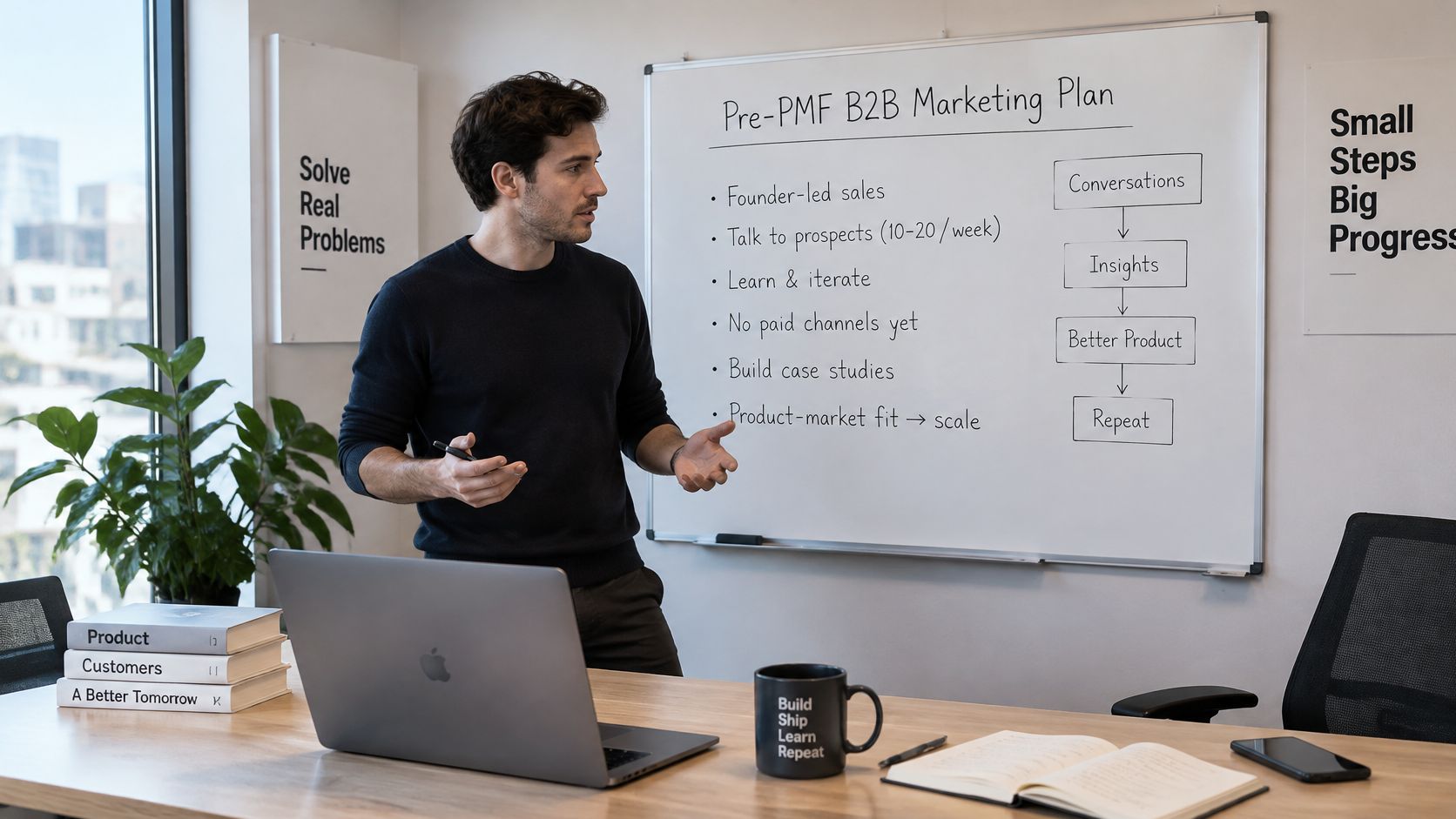
For a hypothetical pre-PMF work plan, replace paid pilots with 15 to 20 customer interviews and a weekly qualified-conversation target. The founder needs to establish whether buyers describe a repeatable problem and accept a credible offer, not whether an ad platform can generate registrations.
This is the kind of working discussion a founder should be able to lead without a polished presentation.
For mid-market SaaS, inspect stalled deals and rejected handoffs before increasing acquisition spending. If contacts enter the CRM but nobody confirms the business problem, more volume increases the follow-up burden.
For product-led companies, distinguish a user reaching activation from an enterprise account entering a procurement process. State exactly when a product signal creates a sales-owned account, who accepts it, and what evidence qualifies the transition.
Marketplace-led products such as Shopify apps need a different starting point. Treat the app listing as a conversion surface, with clear use cases, credible reviews, and accurate installation expectations before a paid pilot sends more visitors there.
Industry changes the proof requirement too. A security SaaS vendor selling to CISOs should fund technical and security validation before broad awareness. An HR-tech vendor needs a business case that both the budget owner and hiring manager can support, including the daily workflow implications.
Every adaptation must preserve the link between the business constraint, the evidence required, and the decision to fund the next action.
Big Moves Marketing helps B2B SaaS leaders connect positioning, go-to-market decisions, and measurement into a workable growth plan. Visit Big Moves Marketing to discuss your pipeline target, the assumptions behind it, and which activities deserve funding before you turn the plan into a PDF.