%20png%20copy.avif)
Most B2B ad programs fail before the creative starts. Teams pick a channel because it is available, then ask the ad to create demand that the buyer hasn't formed yet. A polished image can't fix unclear positioning, weak audience logic, or an offer that doesn't match the decision in front of the buyer.
The best B2B ads examples are not judged by visual polish. They're judged by the buyer decision they can move. Does the ad help someone recognize a problem, frame a business case, shortlist a vendor, or request a demo? The answer determines the format, message, call to action, and measurement model.
The eight examples below move from problem awareness to demo capture. Each one includes the targeting logic, the decision it can influence, and the metric that proves whether it's earning budget. That matters as digital acquisition becomes a larger part of B2B growth planning. Worldwide B2B digital advertising expenditure was projected to reach approximately $48.15 billion by 2026, with the United States representing a projected 47.4% of that total, according to Statista's B2B digital advertising outlook.
Use faster ad variant testing tools to test the message before you spend heavily behind it. The channel comes second. The buyer decision comes first.
Demand Gen campaigns replaced Discovery campaigns in 2023 and distribute video, image, and carousel creative across YouTube, Discover, and Gmail. Their value in B2B isn't immediate demo capture. It's reaching a buyer who knows the operating problem but isn't searching for a vendor yet.
That distinction changes the creative. A compliance SaaS company could open with an audit delay that leaves a finance team waiting on evidence, show the workflow causing the delay, then offer a readiness checklist. A logistics software vendor could target audiences built around competitor and category searches, then explain the operational cost of fragmented planning.
A product montage is the wrong approach. Buyers don't care about your interface before they recognize the problem. Open with the consequence in the first five seconds. Show the mechanism of the fix. End with evidence, a useful asset, or a credible next step.

This format will usually convert less efficiently than high-intent search. That's acceptable if you measure the decision it supports. Track assisted conversions, branded search lift, engaged visits, and target-account progression. Last-click reporting will understate the contribution of an awareness ad that causes a buyer to search for your company later.
Practical rule: Test three problem-led hooks before producing one polished brand film.
A video explaining an audit delay can be repurposed into a short sales-enablement clip, a landing-page opening, and a retargeting asset for viewers who engaged but didn't download the checklist. For a deeper view of how video supports B2B trust, see Big Moves Marketing's perspective on video and influencer marketing.
A strong technology newsletter gives you something most paid channels can't manufacture: a self-selected audience. Developers, operators, and technical leaders subscribe because the publication already filters information for them. A relevant sponsorship therefore starts with borrowed attention instead of interruptive targeting.
A developer observability tool sponsoring a DevOps newsletter should teach one useful idea in the placement itself. A data integration vendor sponsoring a RevOps newsletter could explain a common sync error and point readers to a practical teardown. “Improve your data stack” is not a message. “The sync failure that silently breaks revenue reporting” gives the reader a reason to continue.
The format's weakness is attribution. Clicks are easy to count. Influence often appears later through direct traffic, branded search, and sales conversations. Same-day performance can make a good placement look weak, while a large click count can disguise a poor audience fit.
Before buying, ask the publisher for subscriber roles, industries, and company profiles. Don't accept a broad readership claim as a substitute for audience evidence. Create a dedicated landing page or tracked URL for every placement, then monitor direct and branded activity over the following weeks.
Repurposing step: Turn the newsletter idea into a short operator memo and a LinkedIn post. Compare the qualified traffic and target-account engagement from all three placements, not just the newsletter clicks.
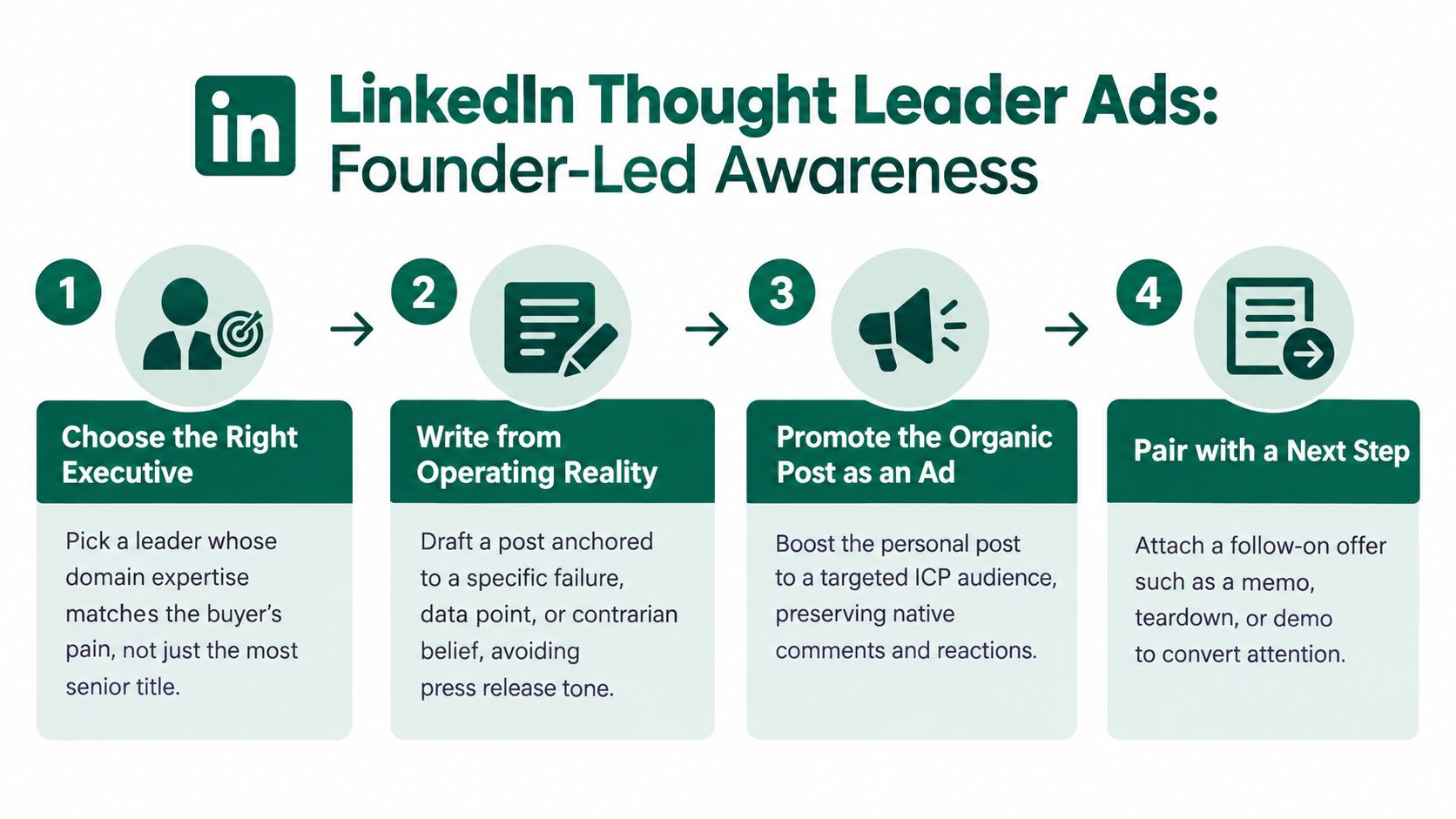
A founder's post can outperform a brand ad when the founder has a real operating point of view. Thought Leader Ads extend an organic executive post to a targeted audience, while preserving the personal voice that makes the format credible.
The post shouldn't read like a press release. A revenue intelligence CEO could explain why the company's own pipeline forecast missed in one quarter and what the team changed afterward. A developer tooling founder could explain why the company removed its pricing page and what that revealed about buyer confusion. Those topics create tension because they expose a decision, not a feature.
The executive's title matters less than the relevance of their experience. A VP of Product may be more credible to a technical buying group than the CEO if the post addresses a problem that person has personally handled. The strongest post names a failure, a trade-off, or a mistaken assumption.
Awareness without a next step becomes vanity distribution. Pair the post with a short memo, teardown, benchmark, or relevant product explanation. Avoid sending every reader directly to a demo page. The first job is to convert attention into a deeper interaction that signals fit.
“Write from an operating failure, not from a category definition.”
Track branded search, engagement from target accounts, and demo activity among the audience you're trying to reach. Impressions don't show whether the post changed a buying conversation. A founder post can also become a sales follow-up asset when account owners share it with prospects facing the same problem.
For a broader framework, read Big Moves Marketing's thought leadership strategy guidance. Repurpose the original post into a sales-email angle, a short video script, and a retargeting ad that points to the deeper memo.
Account-based advertising works when the account list and sales motion already exist. It doesn't work because LinkedIn can upload company names. The ad is one step in a coordinated sequence involving a defined buying group, a sales owner, and a relevant business problem.
A fintech infrastructure company might target named accounts with separate messages about cost, risk, and migration timing. A supply chain SaaS company could retarget accounts that visited pricing content but didn't book a conversation. Each message should answer the next question in the account's decision process.
Build the list from closed-won patterns, not broad firmographic guesses. If your best customers share a specific operating model, integration environment, or regulatory exposure, use those characteristics to shape the list. Industry alone is too blunt.
The account should see a progression. Start with problem framing. Follow with proof or a useful point of comparison. Then introduce a sales-readiness offer. Sending the same product ad to every stakeholder wastes the advantage of account-based targeting.
LinkedIn can support the sequence, but it can't create the operating discipline. Use the Big Moves Marketing explanation of account-based marketing to keep the motion focused on targeting and sequencing rather than channel activity.
Measurement step: Export account engagement into the CRM and compare target-account progression with sales activity. Don't optimize this format around impressions.
Document Ads work best when the document answers a specific buying question. The format lets a prospect swipe through a PDF in the LinkedIn feed, then submit a lead form for deeper access. That sequence pre-qualifies attention better than a generic ebook download.
A workflow automation vendor could offer a build-versus-buy cost model for engineering directors. A cybersecurity company could gate a compliance checklist for IT managers preparing for an audit. Both assets create a reason to engage because they help the buyer make a decision.
The first page has to earn the swipe. Put the answer or the most useful framing there. Don't spend the opening page on a logo, company history, or abstract category language. A CFO and a RevOps leader may need different versions of the same asset because their financial and operational questions differ.
Gating the document immediately can reduce engagement before the reader sees its value. Let the prospect inspect enough of the asset to understand its usefulness, then ask for information when the exchange is justified. The form should support qualification rather than inflate a download count.
Use a document title that names the decision. “Revenue Operations Guide” is weak. “How to Audit the Cost of Your Current Automation Stack” gives a specific role a reason to act.
Repurposing step: Convert the document into a sales-call worksheet and a landing page. Report which downloaded accounts become qualified opportunities. Download volume alone tells you almost nothing about pipeline quality.
G2 and Capterra placements reach buyers who are already comparing vendors. That makes them consideration-stage formats, not awareness channels. The buyer is checking reviews, use cases, integrations, category fit, and pricing signals. Your paid placement helps your product enter or remain in that comparison set.
It won't repair weak proof. A thin review profile, outdated feature description, or vague product page makes the sponsorship less persuasive. Paid visibility amplifies the page buyers see. It doesn't replace the evidence they need.
A customer success platform with a strong base of verified reviews can use a category sponsorship to support shortlist decisions. A finance automation company can target comparison queries that mention a legacy competitor and send prospects to a page built around switching concerns.
Update the profile before buying traffic. Name the use cases, integrations, customer types, and implementation conditions that matter to serious buyers. Sales should also know how to prioritize platform leads by company size, category fit, and urgency.
The decision metric is not placement traffic. It's qualified progression. Separate referred demo requests, opportunities, and pipeline by platform so G2 performance doesn't blend with Capterra performance or organic review traffic.
Repurposing step: Turn recurring review objections into comparison-page copy and sales enablement content. If buyers repeatedly ask about implementation, make that answer visible before the next paid placement.
Search ads are the most direct expression of existing demand. The buyer has named a problem, a category, a competitor, or a replacement scenario. Your job isn't to create curiosity. It's to match the searcher's situation with a credible next step.
Responsive Search Ads allow advertisers to provide multiple headlines and descriptions, which Google combines based on the query. That flexibility only helps when the inputs reflect real intent. Generic headlines produce generic clicks.
A procurement SaaS company bidding on “vendor risk management software” should address the evaluation concern, such as readiness, integrations, or implementation effort. A B2B HR platform targeting competitor terms needs a landing page that explains switching costs and decision criteria. The keyword, ad, and page must describe the same buying situation.
Separate problem searches from tool-switching searches. A buyer researching a category isn't at the same stage as someone looking to replace a named platform. Use negative keywords for students, job seekers, and people seeking free tools. Write headlines that identify the buyer's context, including company size or existing stack when relevant.
Google Ads benchmarks show why teams must separate branded, non-branded, Search, Display, and blended data. One benchmark reports a SaaS median CPC of $6.40, with the middle half ranging from $3.80 to $10.90. The same benchmark reports B2B SaaS Search conversion rates around 3% to 5% for demo or trial actions, while Display conversion is reported at 0.64%. These figures come from B2B Google Ads benchmark data, and they're useful only when the campaign type and conversion definition are clear.
Use Big Moves Marketing's B2B ad copy examples to pressure-test the message, then map each keyword cluster to a dedicated page. Measure qualified pipeline, not form completions.
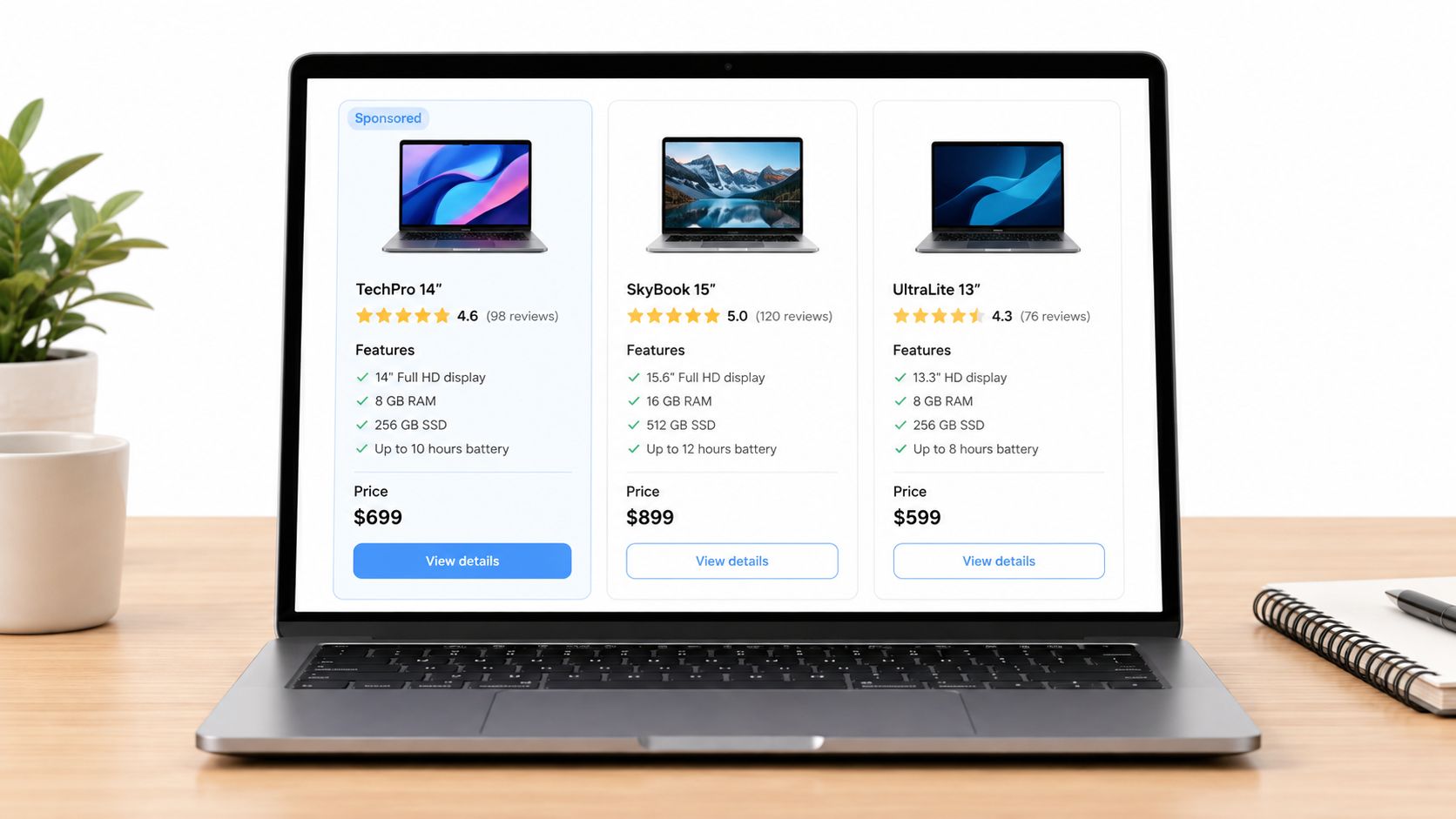
A single-image ad paired with a LinkedIn Lead Gen Form removes most of the friction from conversion. Profile fields are prefilled, so the buyer can submit without typing. That makes the format efficient at generating responses and dangerous at generating false confidence.
The form is not a faucet. It's a filter. A content download can attract people who have no authority, budget, or active problem. A scoped offer creates a stronger qualification signal. A B2B analytics company might offer a data-readiness assessment and ask which warehouse the prospect uses. A payroll vendor could offer an implementation review for finance leaders at companies with a defined employee profile.
Ask one question that disqualifies the wrong buyer. Keep it tied to your sales motion, such as current tooling, company size, or implementation need. Don't add a long interrogation that turns a low-friction form into a slow application.
Track the full path from lead to qualified lead, opportunity, and revenue. HubSpot's historical LinkedIn program reported CTRs between 1% and 3% and average CPC of about $3, with the company describing those CTRs as 60% higher than its average across other social networks. The figures come from LinkedIn's HubSpot case study. They're directional historical results, not a universal benchmark. The useful lesson is that media efficiency matters less than downstream lead quality.
Review lead-to-opportunity rates weekly during the first four weeks. Exclude job titles that consistently fail qualification. Use Big Moves Marketing's LinkedIn advertising guidance to refine the offer, targeting, and follow-up sequence.
Measurement step: Repurpose the highest-quality form responses into a qualification guide for sales. Scale only when the lead-to-opportunity rate holds, not when the cost per lead falls.
| Format | Funnel stage | Implementation complexity 🔄 | Resource efficiency ⚡ | Expected outcomes 📊 | Key advantages & tip ⭐💡 |
|---|---|---|---|---|---|
| Google Demand Gen Video Ads on YouTube and Discover for Problem Awareness | Upper / middle (problem awareness) | 🔄🔄🔄 | ⚡⚡ | Assisted pipeline growth and branded-search lift; low direct conversion rate | ⭐⭐⭐⭐, Expands consideration set; open with the cost of the problem in first 5s. |
| Tech Newsletter Sponsorship Placements for Developer and Operator Awareness | Upper (trusted editorial attention) | 🔄🔄 | ⚡⚡⚡ | Increased direct traffic and delayed branded-search lift; weak same-day pipeline attribution | ⭐⭐⭐, High attention per impression; use tracked URLs and request subscriber job/company data. |
| LinkedIn Thought Leader Ads (Executive-Authored Sponsored Posts) for Founder-Led Awareness | Upper (founder-led credibility) | 🔄🔄 | ⚡⚡⚡ | Trust transfer, social proof, and branded-search/directed traffic over time; measurement indirect | ⭐⭐⭐⭐, Credibility from a real POV; write from an operating failure and pair with a clear next step. |
| LinkedIn Matched Audiences Account-Based Ads for Target Account Awareness | Middle (ABM: account warming) | 🔄🔄🔄🔄 | ⚡⚡ | Multi-threaded account awareness and higher chance of pipeline when sequenced with sales | ⭐⭐⭐⭐, Concentrates spend on ICP; build lists from closed‑won patterns and assign named owners. |
| LinkedIn Document Ads (Swipeable PDF Carousel) for Lead Generation | Middle / consideration (qualified leads) | 🔄🔄🔄 | ⚡⚡⚡ | Strong intent signals and higher-quality leads when asset is role-specific; generic assets drive poor-fit downloads | ⭐⭐⭐⭐, Pre-qualifies attention; make first pages answer one buying question and gate after page 2. |
| Review Platform Sponsored Listings (G2 and Capterra) for Late-Stage Consideration | Late (shortlist / comparison) | 🔄🔄 | ⚡⚡ | High intent visibility and conversion when review profile is strong; amplifies existing review quality | ⭐⭐⭐, Reaches active evaluators; build a review program before buying placements. |
| Google Responsive Search Ads on High-Intent Category Keywords for Demo Conversions | Bottom (evaluation / demo) | 🔄🔄🔄 | ⚡⚡⚡ | Direct demo conversions with clean attribution; CPCs can be high and require tight segmentation | ⭐⭐⭐⭐, Captures explicit intent; segment by problem vs. switcher language and use aggressive negatives. |
| LinkedIn Single-Image Ad with Instant Lead Gen Form for Demo Requests | Middle (lead capture for demos) | 🔄🔄 | ⚡⚡⚡ | High lead volume with variable quality; fast capture but needs qualification to convert to pipeline | ⭐⭐⭐, Low-friction capture; ask one disqualifying question and scope the offer to improve quality. |
The strongest B2B ads examples don't prove that LinkedIn is better than Google or that video is better than search. They show a tighter relationship between buyer decision, message, format, and measurement.
Use Demand Gen video when the buyer needs to recognize the operational cost of a problem. Use a newsletter sponsorship when the audience is concentrated in a trusted editorial environment. Use Thought Leader Ads when a founder or operator has a credible point of view that can change how the category is understood.
Use account-based ads when named accounts, buying groups, and sales ownership are already defined. Use Document Ads when the buyer needs a decision asset before speaking with sales. Use review-platform placements when the prospect is comparing vendors and needs proof to narrow the shortlist.
Use Google Search for explicit demand capture. Use LinkedIn Lead Gen Forms when the offer creates a meaningful qualification signal, not merely a low-friction download. These formats are not interchangeable. Each one earns budget by moving a different decision.
Your reporting should reflect that reality. Awareness formats need account engagement, assisted conversions, and branded search analysis. Consideration formats need qualified visits, content engagement, shortlist behavior, and sales acceptance. Conversion formats need opportunity creation, pipeline contribution, and cost per qualified opportunity.
Industry context also changes the economics. A benchmark for combined IT Services and SaaS campaigns reports a 5.29% CTR, $7.08 CPC, 4.1% conversion rate, and $134.54 CPL in that category, according to B2B campaign benchmark data. Separate SaaS benchmarks estimate cost per SQL at approximately $650 for DevTools and developer platforms, $900 for project-management and collaboration products, $1,400 for HR technology, and $1,600 for ERP and operations software. Those figures show why lead volume is a weak optimization target for complex products. The qualification standard determines whether a campaign is commercially useful.
Branded and non-branded search also need separate reporting. A 24-month analysis of more than 53 B2B SaaS accounts reported average non-brand Search CPC of $13.75, CTR of 3.60%, and CPL of $207, compared with brand Search CPC of $3.12, CTR of 22.21%, and CPL of $34. The same analysis reported conversion rates of 3.94% for non-brand and 3.73% for brand. See the B2B SaaS Google Ads benchmark analysis. Brand campaigns often capture awareness created elsewhere. They shouldn't be used to represent the cost of creating new demand.
Before launch, write down three things: the decision you want to move, the role responsible for making it, and the metric that proves movement. Keep one format focused on one funnel stage. Cut formats that produce activity without progression. Judge influence over a full quarter, not just same-day clicks.
Big Moves Marketing helps B2B SaaS and technology companies clarify positioning, choose the right growth motion, and connect Google Ads, LinkedIn campaigns, content, and measurement to pipeline decisions. Visit Big Moves Marketing to discuss which ad formats fit your buyer, sales cycle, and current stage.

%20-%20white.svg)