%20png%20copy.avif)
You've built an incredible B2B SaaS or AI product. That's the hard part, right? Well, sort of. The real challenge—the one that keeps founders up at night—is figuring out how to actually get that product in front of the right businesses.
Innovation alone doesn't pay the bills. Customers do.
This guide is your strategic playbook for B2B marketing channels. It's not another generic list you'll find with a quick Google search. We built this specifically for early-stage B2B tech founders who need to turn a brilliant idea into a pipeline-generating machine.
We're going to cut through the noise, skip the fluffy theory, and give you a clear framework for picking the marketing channels that will actually move the needle for your startup.
Forget feeling overwhelmed by endless options. This is about laser-focusing on what works and building a marketing engine that fuels real, sustainable growth from day one.
The biggest mistake B2B founders make is treating marketing channels like a checklist of isolated tactics. "Let's do some SEO. Let's run some ads." That's a recipe for wasted time and money.
Instead, you need to think of your channels as an interconnected system. The goal is to create a seamless journey for your ideal customer, guiding them from that first "aha!" moment of awareness all the way to signing a contract. This starts with deeply understanding who you're selling to and, just as importantly, where they are active online and off.
For a great deep-dive on this, especially for SaaS companies, check out this modern B2B SaaS Lead Generation playbook.
This guide will give you the essential tools for that journey. You can also explore our complete B2B marketing playbook for startups for the full picture.
A scattered, "spray and pray" approach to B2B marketing burns through a startup's two most precious resources: time and cash.
Without a clear strategy, you’ll end up pouring money into channels that don't reach your target audience or simply fail to generate a positive return. A thoughtful plan ensures every marketing dollar is accountable and every action is intentional.
Here’s what we’re going to cover:
Picking your first marketing channels is one of those early decisions that can make or break a B2B startup. Get it right, and you'll find a direct line to your first customers. Get it wrong, and you’ll burn through your runway with little to show for it.
Think of it like planning a road trip. Your Ideal Customer Profile (ICP) is your final destination, your budget is the fuel in your tank, and your sales funnel is the map you'll use to get there.
Each piece tells you something critical. A super-technical, niche B2B buyer requires a completely different map than a broad, non-technical business audience. Your budget dictates whether you can afford the expensive toll roads for a direct route or if you need to find more creative, scenic backroads. Let's break down a practical framework using these three pillars to get you moving in the right direction.
Before you spend a single dollar, you have to know exactly who you're trying to reach. The most expensive mistake in B2B marketing is choosing a channel where your ideal customer simply doesn't spend time. Your ICP dictates where you need to show up.
Is your ICP a developer who despises sales pitches and corporate jargon? They’re probably active in niche communities on Reddit or Discord, reading deep-dive technical blogs, and searching for solutions on Google. That tells you to focus on channels like SEO, content marketing, and community building.
Or maybe your ICP is a C-suite executive at a Fortune 500 company. They're more likely to be on LinkedIn, attending exclusive industry events, or responding to highly personalized, value-first outreach. This points you toward targeted social media, account-based marketing (ABM), and strategic networking.
Answering the question, "Where does my ideal B2B customer go to solve their problems?" is the most important first step. The answer illuminates the specific marketing channels B2B companies should prioritize.
Your budget is your reality check. Some channels can deliver results almost overnight but come with a hefty price tag. Others require more sweat equity and time but are much lighter on the wallet. As a B2B startup, every dollar has to count.
It helps to think about channels in two main buckets:
For most early-stage B2B startups, a blended approach is the smartest path forward. You can allocate a small part of your budget to high-intent paid channels to get some initial data and user feedback, while investing the bulk of your effort into building those long-term organic channels. Understanding how to create an effective B2B channel mix is crucial for sustainable growth.
Different marketing channels play different roles depending on where a B2B buyer is in their journey. A channel that’s fantastic for building brand awareness might be totally ineffective at closing a deal. You need a mix of channels that can guide prospects all the way from "Who are you?" to "Here's my credit card."
For a B2B SaaS startup, mapping channels to the awareness, consideration, and decision stages of the funnel is a great way to build a cohesive strategy. It ensures you're not just generating leads, but actually nurturing them toward a purchase.
Here’s a quick breakdown of how different channels fit into each stage:
Thinking about the funnel this way helps you build a more complete marketing engine. You need top-of-funnel channels to fill the pipeline, mid-funnel channels to educate and qualify, and bottom-of-funnel channels to seal the deal.
This simple decision tree gives you a playbook for deciding on an outreach strategy based on how familiar a prospect is with you or your solution.
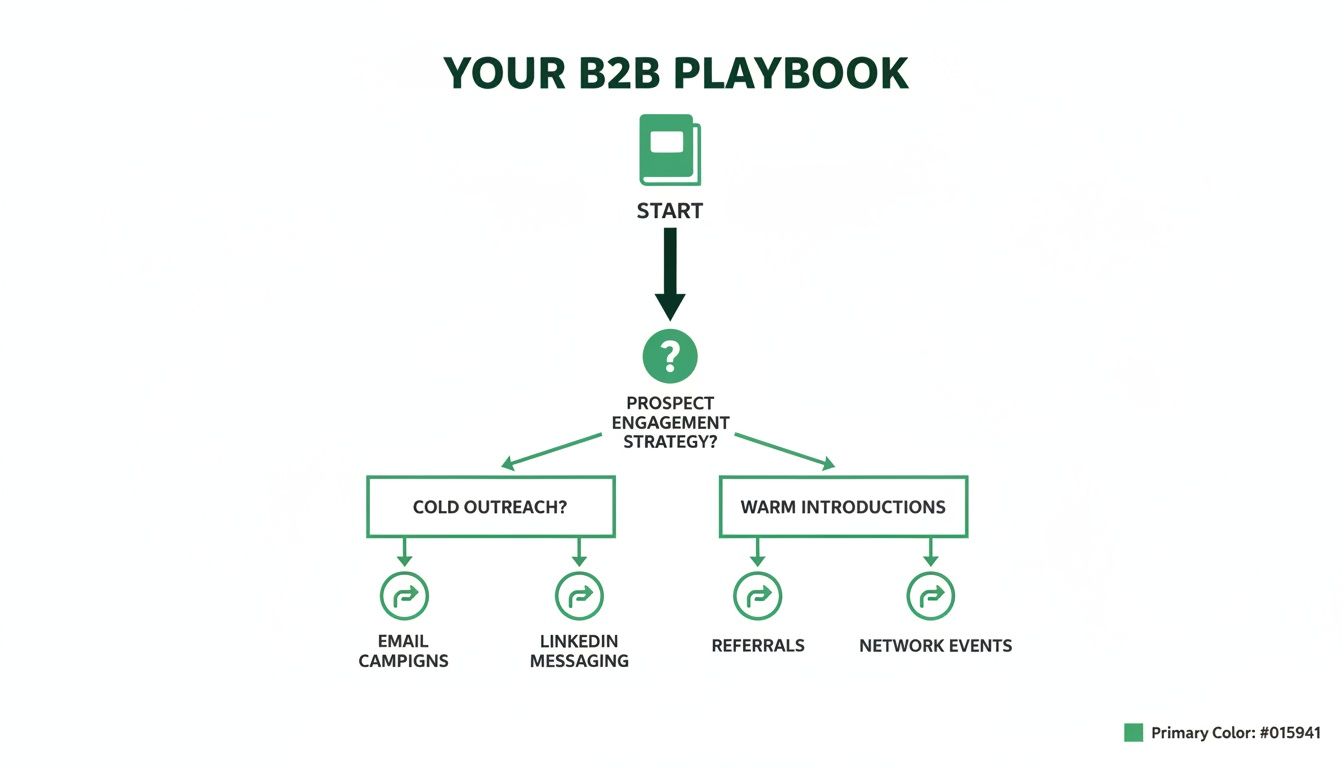
As the chart shows, your strategy has to adapt. You can't treat a cold prospect the same way you treat a warm lead who already knows your brand. Your channel plan has to account for every stage of that journey.
Theory is great, but execution is what builds a business. We've covered the strategy—now it's time to get your hands dirty with the actual marketing channels B2B founders use to land their first customers. This is your playbook for the most effective channels a B2B SaaS or AI startup can use right now.
For each channel, we'll break down the real-world pros and cons for a B2B tech startup. You'll get actionable first steps to get going and we'll flag the common pitfalls that burn through cash and confidence. This is where the rubber meets the road.
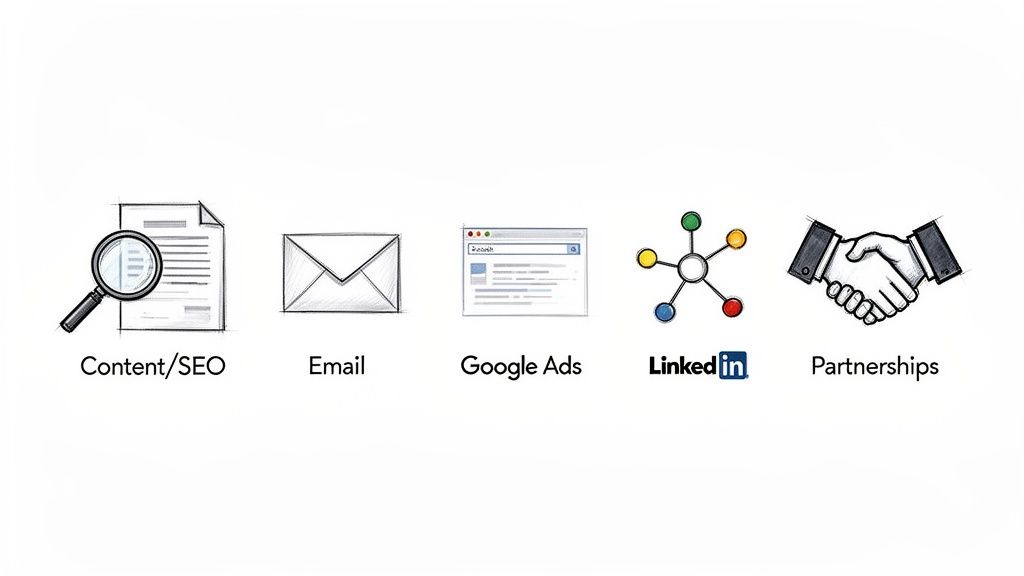
Here's a quick comparison of the channels we're about to cover. Think of this as your at-a-glance guide before we dive into the specifics of each one.
Each channel has its place, and the right mix depends entirely on your stage, budget, and who you're trying to reach. Now, let's explore how to make each one work for you.
Content and Search Engine Optimization (SEO) are the twin engines of sustainable, long-term growth. Think of content as the valuable material you create—blog posts, guides, whitepapers—and SEO as making sure people who need that information can actually find it on Google.
For a B2B startup, this is all about building an asset. Unlike a paid ad that vanishes when the budget runs out, a top-ranking article can bring in qualified leads for years. It positions your company as a trusted authority, answering your prospect's questions long before they're ever ready to talk to a salesperson. In fact, research shows that 77% of B2B buyers do their own research before ever speaking to sales, and your content is what they'll find.
Pros for B2B Startups:
Cons for B2B Startups:
A cybersecurity AI startup, for example, could write deep-dive articles on "AI-driven threat detection models" or "compliance automation for GDPR." By owning these niche keywords, they attract the exact technical buyers who need their solution. As AI plays a bigger role in search, understanding technical SEO strategies for AI discovery is becoming non-negotiable for any SaaS or AI company with serious growth ambitions.
Key Takeaway: SEO and content aren't a quick fix. They're a long-term investment in your brand's credibility and a powerful way to build a predictable pipeline of inbound leads.
Outbound email means proactively reaching out to a hand-picked list of potential customers who fit your Ideal Customer Profile (ICP). This isn't spam. It's a highly targeted and personalized way to start conversations with decision-makers who have likely never heard of you.
For a B2B startup with a clearly defined market, outbound can be one of the fastest ways to get initial traction and customer feedback. It puts you in the driver's seat, letting you test your messaging and value proposition with surgical precision.
The secret is to focus on helping, not selling. A generic "buy my stuff" email gets deleted on sight. But a thoughtful, personalized email that shows you understand their business world and offers a genuinely useful insight? That can open doors.
When a business professional has a problem, their first move is almost always a Google search. Paid Search, mainly through Google Ads, lets you put your company right at the top of those search results for very specific keywords. It's one of the most powerful marketing channels B2B companies have for capturing high-intent demand.
Think of it like setting up a shop on the busiest street in the world, but you only pay rent when someone actively looking for your product walks through the door. You bid on keywords like "project management software for remote teams" or "AI-powered contract analysis," making sure your solution shows up at the exact moment of need.
Pros for B2B Startups:
Cons for B2B Startups:
For a new project management tool, running ads on "Trello alternative for developers" could be a brilliant way to poach users from a competitor. The key is focusing on specific, long-tail keywords that signal someone is ready to buy.
For B2B marketing, one platform towers above the rest: LinkedIn. With over 800 million professionals, it’s the definitive network for reaching decision-makers, building your brand, and engaging with prospects in a business context.
LinkedIn is so much more than a place to post company updates. It's a powerhouse for hyper-targeted advertising, direct outreach, and content distribution. You can target ads based on job title, company size, industry, or even specific company names—giving you incredible precision in reaching your ICP.
Beyond ads, LinkedIn is where B2B founders build thought leadership. By consistently sharing valuable insights, jumping into relevant discussions, and connecting with peers, you can turn your personal profile into a magnet for potential customers, partners, and investors.
Strategic partnerships are all about collaborating with other, non-competing companies that serve the same customers you do. This is one of the most underused—and powerful—marketing channels B2B startups can tap into. Instead of building an audience from scratch, you get to access someone else's.
Imagine your AI analytics tool integrates with a popular CRM. A partnership could mean co-hosting a webinar, creating a joint case study, or getting featured in their newsletter. This gives your startup instant credibility and puts your solution in front of thousands of warm prospects.
How to get started:
Partnerships are about relationships, and they take time. But a single strong partnership can often bring in more high-quality leads than months of grinding away at other marketing efforts. A joint event is a fantastic way to kick things off; you can learn more by checking out our detailed guide on how to succeed with marketing with webinars.
In a world of ever-changing social media algorithms and fleeting trends, email is the steady workhorse for any B2B startup that’s serious about building a predictable revenue engine. Forget rented audiences on other platforms. Your email list is a direct line to your prospects and customers—an asset you actually own and control.
For early-stage B2B SaaS and AI companies, that control is everything. It’s the difference between just broadcasting messages and deploying smart, automated campaigns that guide prospects from initial curiosity to a signed contract. This direct access makes email one of the most reliable marketing channels B2B founders can invest in.
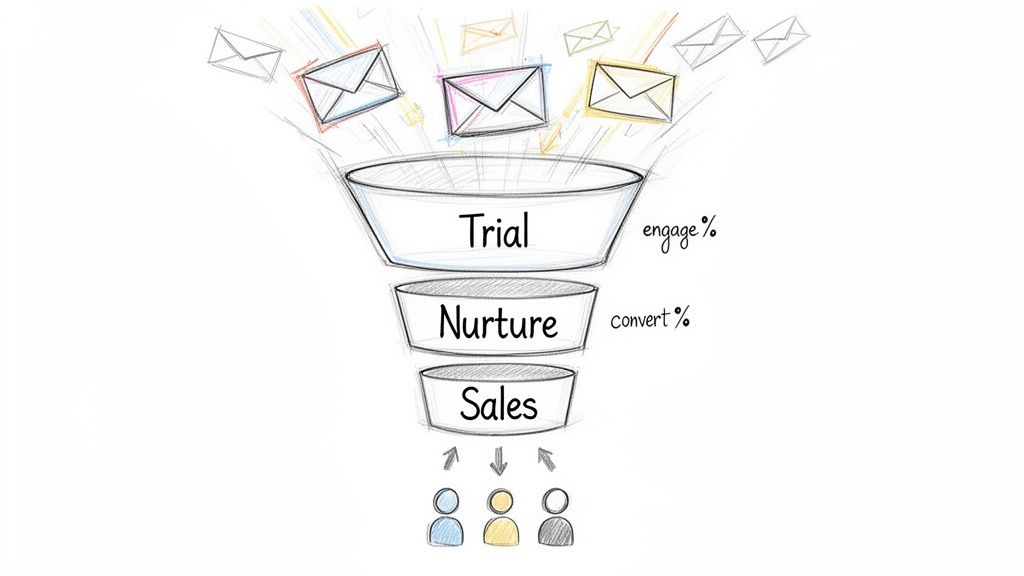
Beyond control, email delivers incredible bang for your buck, a game-changer for B2B startups watching every dollar. While paid channels demand a constant flow of cash just to stay visible, a well-executed email campaign can run for a fraction of the cost and deliver remarkably high returns.
The numbers don't lie. For B2B companies, email marketing consistently delivers a 261% ROI. And it's not a short-term fling, either; it generates a long‑term 3.5x ROAS over three years. It’s no surprise that 79% of B2B marketing agencies call email their most successful channel for distributing content and turning that content into actual sales conversations.
This isn't just about saving money. It's about building a scalable, repeatable system to generate and nurture leads without being hooked on expensive, high-risk ad campaigns.
Great B2B email marketing is so much more than a monthly newsletter. It’s about using automation and smart segmentation to get the right message to the right person at exactly the right time. For a B2B startup, this means running specific, goal-oriented campaigns.
Here are three tactical plays that can turn your email list into a primary growth engine:
By putting these strategies into action, you turn email from a simple communication tool into a strategic asset for creating pipeline. To get a closer look at how to structure these campaigns, check out our guide on using email marketing in B2B.
Marketing without measurement isn't a strategy—it's just expensive guesswork. Real B2B growth doesn't come from launching campaigns and hoping for the best. It comes from knowing exactly what’s working, doubling down on it, and ruthlessly cutting what isn’t.
Proving the value of your marketing isn't just about justifying your budget to the CEO or your investors. It's about making smarter decisions that fuel the entire business.
This means we have to move beyond the feel-good vanity metrics. Things like 'likes' or 'impressions' might look nice on a report, but they don't keep the lights on. True success is measured by drawing a straight line from your marketing efforts directly to revenue.
To show you’re making a real impact, you need to track the key performance indicators (KPIs) that tell a financial story. These are the numbers that founders and investors actually care about, and they’re what transforms marketing from a cost center into a predictable growth engine.
Here are the core metrics every B2B startup founder needs to obsess over:
Your goal is to build a clear line of sight from the first touchpoint to the closed deal. When you can show that a dollar invested in a specific channel generates three, five, or ten dollars in return, you've unlocked predictable growth.
You don't need a crazy expensive, overly complex system to get started. Honestly, a basic dashboard using free tools like Google Analytics is more than enough to begin tracking website traffic, user behavior, and goal completions (like a demo request or a whitepaper download).
The key is to trace the customer's journey. Use tracking parameters (like UTM codes) on every single link you put out there. This lets you see exactly which email, ad, or social post brought someone to your site. This simple step is what allows you to attribute leads—and eventually, revenue—back to their original source.
Once you start collecting this data, you can answer the questions that really shape your strategy. Which blog posts generate the most demo requests? Which LinkedIn ad campaign has the lowest CAC? This is the data that lets you make confident, informed decisions about where to put your time and money for the biggest possible return.
For a deeper look into setting this all up, check out our guide on how to measure marketing success for data-driven B2B growth.
Navigating the world of B2B marketing channels can feel like a high-stakes puzzle, especially for founders juggling product development, fundraising, and that first push for sales. It's completely normal to have questions.
Here, we'll tackle the most common ones we hear from B2B SaaS and AI startup leaders with direct, real-world answers. Our goal is to give you the clarity and confidence to make smart, decisive moves that actually build momentum.
Fewer than you think. By far, the biggest mistake we see is spreading limited resources—time, money, and focus—too thin across too many platforms. This "spray and pray" approach guarantees you'll be mediocre everywhere and a master of nothing.
For a true early-stage B2B startup, the magic number is one to two channels. That's it. This forces you to go deep, master the mechanics of a single channel, and get to a meaningful return before you add more complexity. A great starting combination is picking one channel for long-term growth (like SEO) and one for quicker feedback and leads (like hyper-targeted outbound).
Master a single channel before you even think about diversifying. Proving that one channel can predictably generate quality leads is a far more valuable milestone than running five mediocre campaigns at once.
Once you have a proven, repeatable process on your first channel—and only then—should you start experimenting with a third. This focused approach ensures your efforts compound, rather than just evaporate.
There's no single magic number here, but a solid benchmark for a seed-stage B2B SaaS company is to allocate 10% to 20% of your desired annual recurring revenue (ARR) to marketing. If your goal is to hit $1 million in ARR, a budget somewhere between $100,000 and $200,000 for the year is a realistic place to start.
But this really depends on your chosen B2B marketing channels. If you're all-in on content and SEO, a bigger chunk of that budget is going to be talent and time (whether in-house or an agency). If you're leaning heavily on paid search, most of that cash will be direct ad spend.
The best way to think about it is to start with a clear revenue goal and then work backward to define a budget that gives you a fighting chance to get there.
Patience is the price of admission for content marketing. While you can spin up a targeted ad campaign and see leads the same day, content is a long-term asset you're building. For most B2B startups, it takes a solid 6 to 12 months of consistent, high-quality content creation before you see significant organic traffic and leads.
Think of it like planting a tree, not flipping a switch. The first few months are all about building a foundation—publishing cornerstone content, earning those first few backlinks, and getting indexed. Around the six-month mark, you should start seeing the first signs of life as a few articles begin to rank. By twelve months, a well-executed strategy should be delivering a steady, predictable flow of inbound leads.
At Big Moves Marketing, we help B2B SaaS and AI startups build the right launch strategies and sales tools to win their first customers. If you need a proven partner to turn your product into revenue, let's connect: https://www.bigmoves.marketing.
Explore Big Moves Marketing services and resources:




%20-%20white.svg)