%20png%20copy.avif)
Most advice on hiring a marketing agency for B2B is backward.
It tells founders to compare service menus. SEO, PPC, content, ABM, paid social, lifecycle, RevOps. That's procurement thinking, not growth thinking. A service menu tells you what an agency can do. It does not tell you whether their operating model fits your stage, your sales motion, or the actual problem slowing revenue.
That's why so many founder-agency relationships fail even when the agency is competent. The team didn't buy the wrong tactic. They bought the wrong kind of partner.
Most failed agency engagements get blamed on execution. Bad content. Weak ads. Poor SEO. Slow reporting.
That's usually wrong.
The primary failure happens earlier, when a founder hires based on deliverables instead of operating model. They say they need lead generation. What they truly need is one of three things: sharper positioning, a validated go-to-market motion, or disciplined channel execution on an already clear strategy. Those are not the same problem.

A Series A SaaS company hires a content-heavy shop because the team wants “brand and inbound.” Six months later they have a full editorial calendar, traffic reports, and very little commercial movement. The agency didn't necessarily fail at content production. The company failed to admit the actual issue: the message wasn't clear, the ICP was too broad, and sales calls still depended on founder translation.
The opposite mistake is just as common. A pre-PMF company hires an enterprise ABM firm because ABM sounds advanced. It gets dashboards, target-account workflows, and expensive coordination around a sales motion that hasn't earned the right to scale. That isn't ambition. It's sequencing failure.
According to Zanata Marketing's breakdown of recurring B2B pitfalls, the common failure modes are strategic: weak messaging, poor ICP definition, neglected analytics, and poor integration across channels. The same source notes that complex B2B sales cycles can span 6 to 18 months and buyers often conduct 12 online searches before contacting a website. That makes the usual agency reporting obsession with raw lead counts highly misleading.
Practical rule: If your agency reports activity before it reports decision quality, you bought execution capacity, not strategic help.
Founders rarely brief agencies with enough honesty. They ask for pipeline growth when what they really want is an answer to one of these questions:
If you want a useful outside perspective on how outsourced teams tie activity to outcomes, this performance-based B2B marketing guide is worth reading because it frames outsourcing around accountability instead of output volume.
Agencies love broad menus because they make every prospect feel addressable. Founders love them because they create the illusion of flexibility.
Both sides pay for that vagueness later.
A full-service firm can be the wrong choice if you only need a specialist to fix one broken acquisition channel. A niche paid media team can also be the wrong choice if the landing page, offer, and positioning are bottlenecks. If you skip that diagnosis, you'll mistake clean execution for progress.
Traffic is easy to manufacture. Pipeline confidence isn't.
This is also why ROI debates with agencies get emotional. The problem often isn't the agency's effort. The problem is that nobody defined the level at which value should be created. Strategic clarity, message-market fit, channel economics, or revenue attribution. Pick the wrong level, and the relationship starts decaying on day one.
A founder should treat agency selection the same way they'd treat an executive hire. Start with the business problem, then the operating model, then the tasks. If you need a sharper framework for that conversation, measuring marketing ROI properly is the work that should happen before you obsess over channel output.
The useful way to classify a marketing agency for B2B isn't by services. It's by how the firm creates value.
That distinction matters because agency fit is mostly about sequence. As noted in Factors.ai's guide to B2B demand generation agencies, the best selection process matches the agency's core operational model, whether inbound, ABM, demand gen, or a “marketing team in a box,” to the client's growth stage and channel maturity. Choosing a full-service firm when you only need a narrow capability dilutes budget and impact.
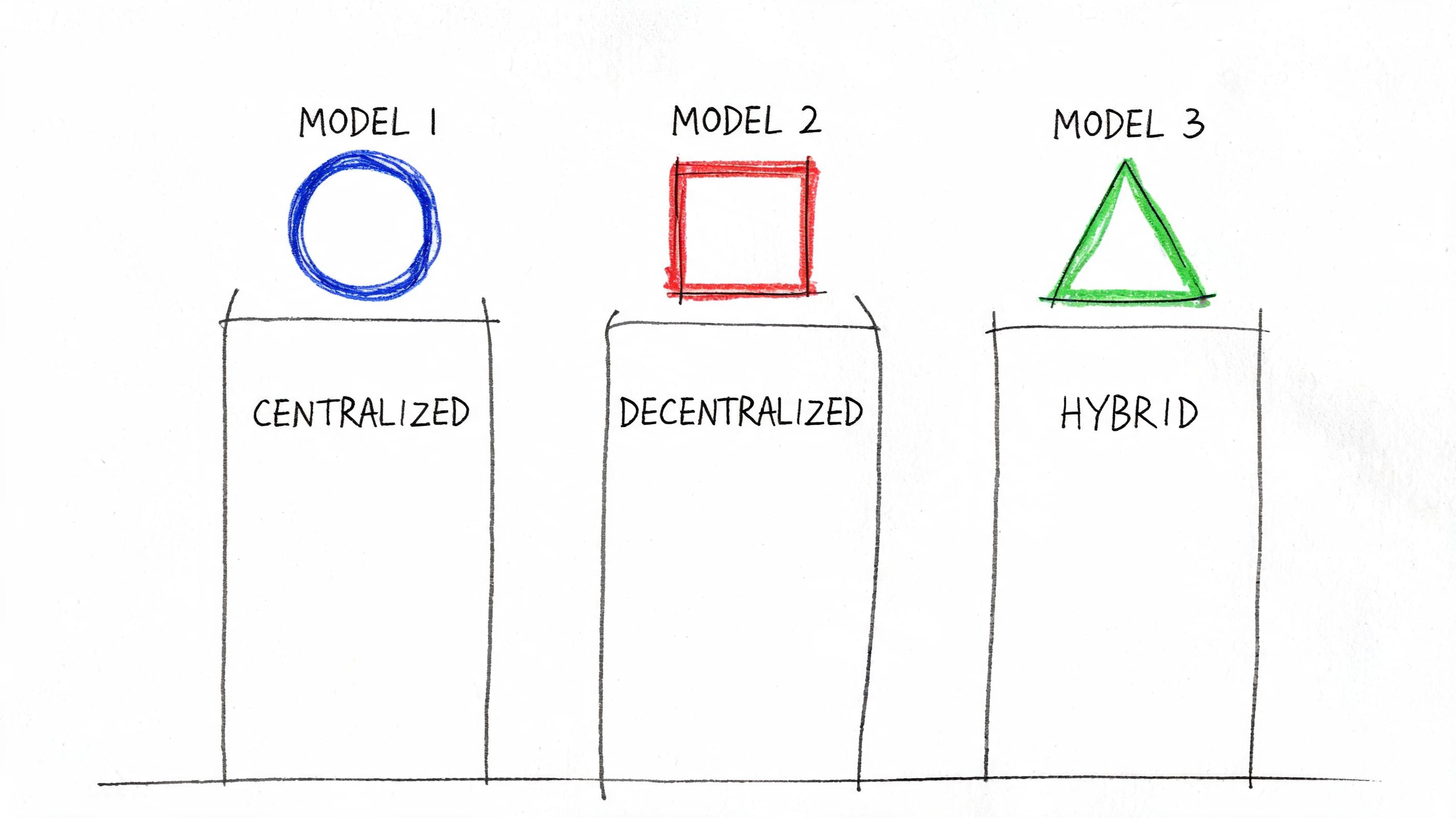
This model starts with diagnosis, not deliverables. The work usually begins with positioning, segmentation, message architecture, funnel design, offer strategy, and decision-making support for the founder or GTM lead.
This is the right fit when the company has signal but not clarity. Maybe founder-led sales works, but the message doesn't transfer to AEs. Maybe there's demand, but paid acquisition keeps underperforming because the category narrative is weak. Maybe growth exists, but it's too dependent on improvisation.
A strategic growth partner often looks more like a fractional leadership layer than a production vendor. That's why many founders are really looking for this model when they say they need an agency. They want someone to reduce bad decisions.
A team like fractional marketing support fits this category when the priority is GTM clarity before aggressive execution.
| Best fit | Usually wrong fit |
|---|---|
| Pre-PMF to post-PMF transitions | Companies that already have a stable motion and only need extra hands |
| Founder-led sales translation problems | Teams expecting high-volume task execution from day one |
| Repositioning, ICP refinement, GTM resets | Procurement-led buyers shopping on hourly output |
This model wins by depth. One channel, one discipline, one hard problem.
Think technical SEO, paid search, lifecycle automation, LinkedIn ABM, or conversion-focused landing page systems. The specialist isn't there to rethink your company strategy. They're there to outperform a generalist on a channel where expertise compounds.
This is a strong fit when your strategy is already clear and the bottleneck is execution quality. You know your ICP. You know the offer. Sales can convert the demand. You just need a stronger operator in one area.
Where founders get burned is expecting a specialist to solve upstream ambiguity. A great PPC team can't rescue unclear positioning. A sharp SEO shop can't fix category confusion. A LinkedIn ads specialist can't decide your market strategy for you.
Hire a specialist when the question is “who can run this better?” Don't hire one when the question is “what should we run?”
Later in the engagement, video reviews like this can help teams align on what specialization looks like in practice:
This is the “marketing team in a box” model. It works when strategy is largely set, internal bandwidth is thin, and the company needs coordinated execution across several channels at once.
This can include content, paid acquisition, design, email, web updates, reporting, campaign operations, and supporting assets for sales. The value isn't brilliance in one channel. The value is operational coverage.
For the right company, this model is efficient. For the wrong one, it becomes expensive theater. If the strategy is unclear, a full-service team just distributes confusion faster across more channels.
Use this model when:
The wrong question is “which agency is best?”
The right question is simpler. Which operating model fits the stage your company is in?
Most agency vetting is cosmetic. Founders ask for case studies, channel expertise, and sample reports. Agencies respond with polished decks and friendly confidence.
That doesn't expose anything important.
A better process forces the firm to reveal how it thinks, how it operates, and whether senior judgment will touch your account. In one annual ranking covered by Demand Gen Report, the top B2B agency reported $270 million in gross income, and the fastest-growing challenger added $7.6 million year over year for 67.9% growth. Those numbers don't prove client fit, but they do show something useful: strong agencies are measurable operators, not just presentation teams.

Don't ask, “What do you do for SaaS companies?”
Ask questions that force diagnosis.
A serious agency should be comfortable making the sales process slightly uncomfortable.
The deck is not the team.
Founders routinely buy senior expertise and get junior throughput. That isn't always malicious. It's often just the economics of agency delivery. You still need to uncover it.
Questions worth asking:
If you're comparing partner types, this view of a demand generation agency model can help separate strategic demand creation from generic campaign support.
A good agency should understand its own business mechanics. If it can't explain how it grows, prices, prioritizes, and protects quality, it probably won't bring much rigor to yours.
Ask for specifics in areas like:
Here's the test I trust most. Ask them to describe a client situation where more execution would have been the wrong answer. Strong firms can name those moments quickly. Weak firms always claim more output was the solution.
That's the tell.
Pricing isn't just about cost. It tells you how the agency sees the work.
A strategic partner prices for judgment, availability, and business context. A specialist often prices for scoped expertise. A full-service outsourced team prices for coordinated capacity. Confusion starts when founders compare those models as if they're interchangeable.
That's especially risky in a market where budgets are large and scrutiny is rising. Statista's B2B marketing data says U.S. B2B marketing spend reached about $107 billion in 2024 and is projected to rise to $144 billion by 2030. The same source notes average B2B website conversion rates are around 2.23%, and B2B companies with 10 or more landing pages generate 55% more leads than those with fewer landing pages. That's why agencies get hired in the first place. Not to produce assets, but to improve conversion efficiency and pipeline output.
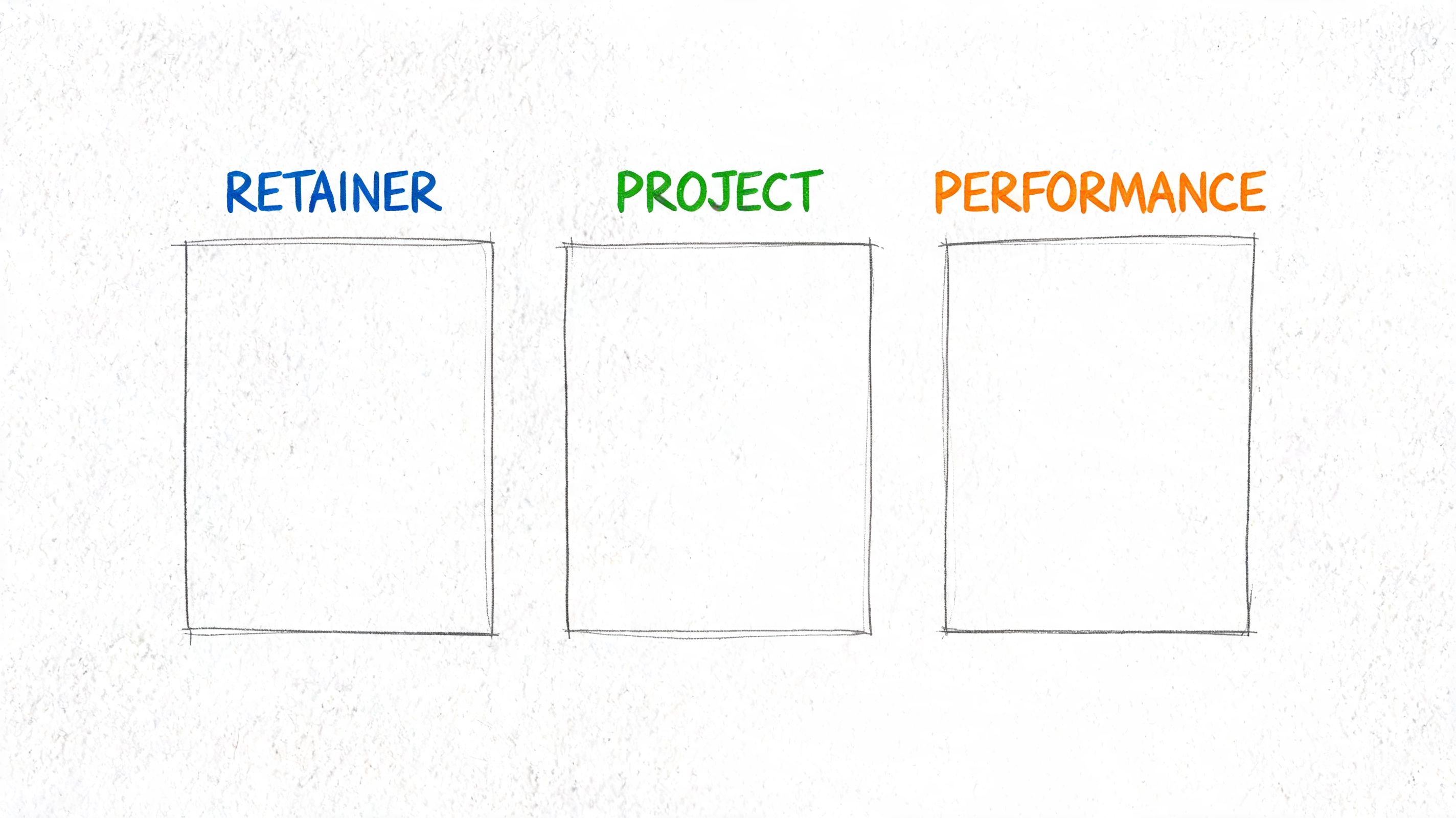
Retainers make sense when the work requires accumulation. Messaging refinement, campaign iteration, funnel diagnosis, sales feedback loops, and reporting discipline all improve when the same team stays close to the business.
This model fits strategic growth partners and many full-service teams.
The upside is consistency. The downside is inertia. A weak retainer becomes a monthly tax on executive optimism. If you can't clearly articulate the decisions, outputs, and review cadence attached to the retainer, don't sign it.
Project pricing works best when the problem has a defined boundary. Repositioning work. Website messaging. Paid media audit. Landing page rebuild. Attribution cleanup. A GTM diagnostic.
This model is useful when you need a sharp answer before committing to a longer relationship. It also works well with channel specialists who can solve one constrained problem without pretending to own your whole growth system.
Project work fails when both sides mistakenly expect strategic continuity after the scoped work ends. If the agency is building something foundational, ask who owns what happens next.
Founders love performance-based compensation because it sounds aligned. Sometimes it is. Often it's messy.
Attribution in B2B is rarely simple. Long cycles, multiple stakeholders, and blended channel influence make pure outcome pricing hard to structure fairly. If you use a performance layer, keep it attached to a base fee and tie it to metrics both sides can observe and influence.
A few practical rules:
For founders weighing strategic oversight versus pure execution support, fractional CMO services are often a better comparison point than a generic agency retainer.
The right question isn't “what should an agency cost?” It's “what kind of value am I buying?”
Most agency briefs are shopping lists.
We need four blog posts a month. Paid search management. LinkedIn campaigns. Email nurture. A landing page refresh. Maybe some case studies.
That kind of brief attracts vendors who are good at saying yes. It does almost nothing to attract partners who can think.
If you want a stronger pool, write a brief that exposes context, constraints, and strategic uncertainty. Good agencies want enough information to judge fit. Weak agencies want just enough to send a proposal.
A strong brief reads more like an investor update than a task list. It gives the agency a real picture of the business.
Include these elements:
Business context
Company stage, category, sales motion, average deal shape, current GTM structure, and what has changed recently.
Customer definition
Who you think the ICP is, where that definition is still fuzzy, and which segments create confusion in sales or marketing.
The actual problem
Not “we need content.” Say what's broken. Pipeline quality is weak. The website doesn't convert. Paid traffic isn't matching sales conversations. Founder-led messaging doesn't transfer.
What you've already tried
This matters more than many founders realize. It reveals whether the issue is capability, sequencing, or strategy.
Constraints
Budget range, internal team capacity, approval speed, data access, tech stack reality, and market timing.
Definition of success
What does a win look like over the next year? Better conversion on high-intent traffic? A tighter ICP and cleaner sales narrative? A repeatable outbound-plus-demand-gen motion?
The brief should make it easy for the right agency to say no.
That's a feature, not a bug.
One practical resource if you're building this from scratch is a set of marketing brief templates that force clearer problem framing before proposals start.
A weak brief usually says one of three things.
First, the company thinks tactics will substitute for strategy. Second, nobody internally agrees on the actual problem. Third, procurement is driving partner selection more than revenue leadership.
You can usually spot a weak brief by the language. It over-specifies outputs and under-specifies business context. It asks for channel plans before clarifying the market problem. It treats agencies as interchangeable labor.
A better brief gives room for disagreement. In fact, you want agencies to respond with different diagnoses. That's part of the filtering process.
For example, if one agency replies with a content calendar, another replies with a paid media proposal, and a third says your category story is too vague to scale channels yet, that third response may be the most valuable one in the room.
Ask every agency to answer a small set of hard questions in writing:
Those answers tell you more than any capabilities slide.
The right brief doesn't just attract better proposals. It changes the quality of the conversation before money gets committed.
The first 90 days tell you whether the relationship has a chance.
Most bad engagements reveal themselves early. The warning sign isn't slow execution. It's premature execution. Agencies that rush into campaigns in week one usually do it because they sell motion more easily than diagnosis.
A strong start is slower where it should be and faster where it matters. As explained in Intentsify's guidance on B2B marketing metrics, the right sequence is to define business-aligned objectives, ensure proper tracking setup with regular audits, create standardized reporting templates, establish data governance, train teams, and recalibrate tracking routinely. That's why the first deliverable from a serious agency should be measurement architecture, not ad spend.
The opening month should answer basic but critical questions.
What are we measuring? What counts as a qualified response? Where does the current funnel definition break? Which systems hold truth, and which ones only hold activity?
Expect work like this:
Don't let an agency hide behind page views if the company needs opportunities.
If you need hands-on strategic support here, a partner like Big Moves Marketing can sit in this layer by connecting positioning, measurement, website decision-making, and GTM pilots before broad channel expansion.
By this point, some activity should go live. But not everything.
Good teams start with constrained tests. One ICP slice. One core message. A narrow set of channels. Tight conversion paths. Clear ownership with sales. The point isn't to maximize exposure. It's to learn where the system breaks.
That often means:
Founders need discipline at this stage. Don't ask for more campaigns just because the agency is now embedded. Ask whether the current experiments are generating trustworthy learning.
At the end of the quarter, you should have more than activity reports. You should have a clearer growth hypothesis.
Review the partnership on a few serious dimensions:
| Question | What good looks like |
|---|---|
| Is the message clearer? | Sales and marketing are using the same narrative |
| Is measurement cleaner? | Reporting definitions are consistent and trusted |
| Are channels teaching you something? | You can explain what is and isn't working by ICP, offer, or stage |
| Is quality improving? | Lead handling and opportunity creation are part of the conversation |
The KPI stack should stay close to pipeline. Track MQLs and SQLs if they're useful inside your business. Add cost per opportunity and pipeline velocity where the sales motion supports it. Keep traffic and impressions in the background unless they clearly connect to downstream movement.
A marketing agency for B2B should leave you with sharper decisions, not just fuller calendars. If the first 90 days produce more activity but not more clarity, the engagement is already drifting.
If you're a B2B SaaS founder or revenue leader trying to decide whether you need positioning help, a fractional growth layer, or a tighter GTM operating model before hiring another agency, Big Moves Marketing is built for that kind of decision support. The focus is on clarifying the growth problem first, then choosing the right motion.
Explore Big Moves Marketing services and resources:




%20-%20white.svg)