%20png%20copy.avif)
Most advice about ai in marketing is wrong in one specific way. It treats AI like a faster intern.
That’s a cheap framing, and it produces cheap outcomes. You get more blog posts, more ad variants, more automation, and the same underlying go-to-market problems. Bad positioning stays bad. Weak demand gen stays weak. Messy handoffs between marketing and sales stay messy, just at higher speed.
If you’re a B2B SaaS founder or revenue leader, the question isn’t whether your team can use AI to produce more. The question is whether AI changes how your company makes growth decisions. That’s the essential shift. AI belongs in your operating model, not your content queue.
The market has already made that clear. The global AI marketing market is projected at $47.32 billion in 2025, up from $12.05 billion in 2020, and 92% of firms plan to increase their AI budgets according to this roundup of AI marketing statistics. Money is flowing in. The hard part now is proving strategic value, not buying access.
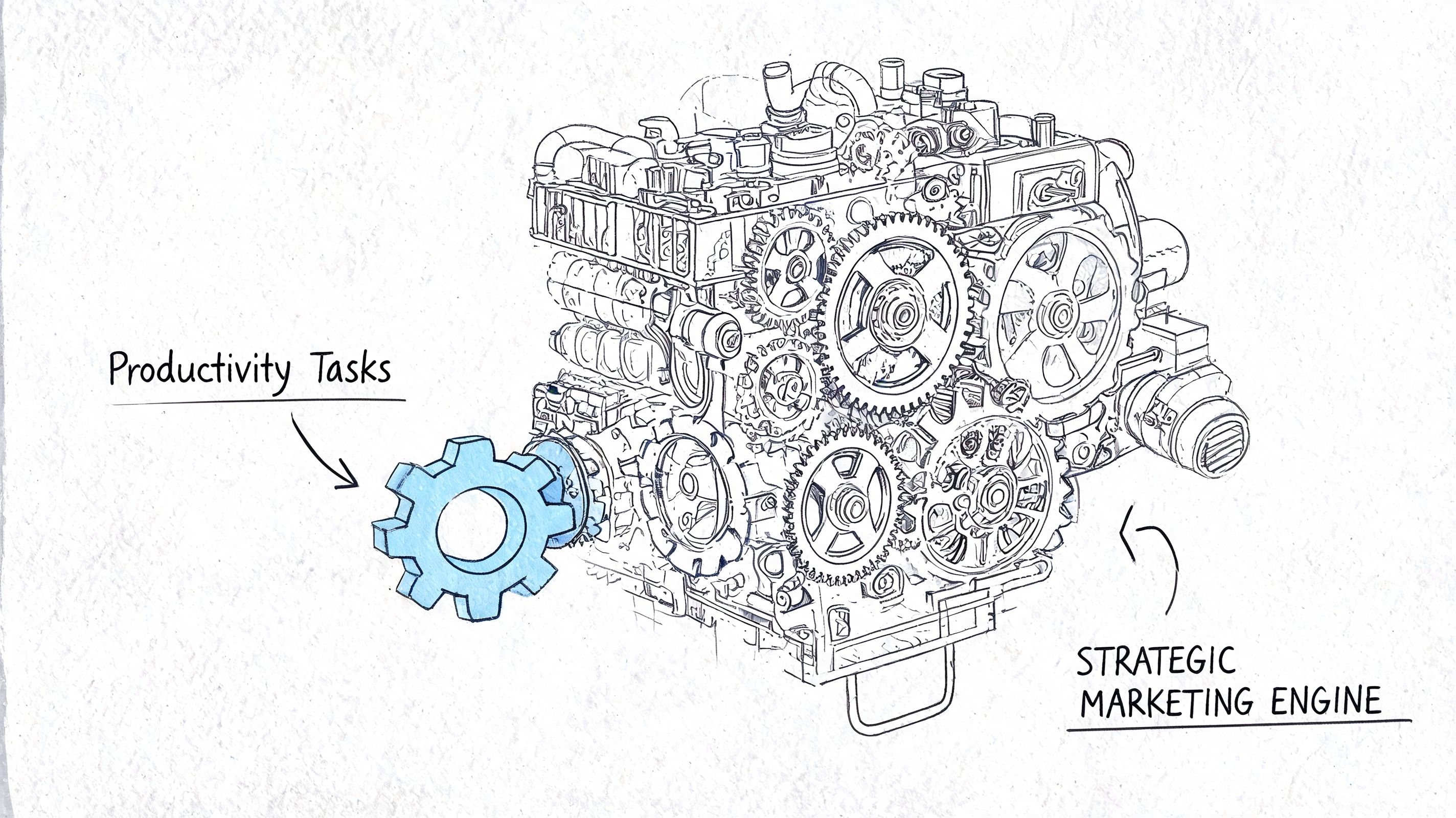
Most B2B teams are using AI at the shallow end of the pool. They ask it to draft content, summarize calls, clean lists, and automate repetitive tasks. None of that is useless. It’s just not strategic.
The mistake is simple. Leaders bolt AI onto an existing GTM system that already has weak assumptions. They think acceleration will solve a design problem. It won’t. Faster execution only exposes bad strategy sooner.
A founder usually sees the first-order benefit quickly. Content gets produced faster. Reporting gets easier. Campaign setup becomes lighter. Teams feel busier and more efficient.
That’s exactly where many companies stall.
AI in marketing isn’t valuable because it reduces manual work. It’s valuable because it lets you redesign how decisions get made across positioning, acquisition, qualification, sales support, and retention. If your team only uses it for output, you’re underusing it.
Practical rule: If your AI initiative starts and ends with content generation, you’re optimizing the cheapest layer of your GTM stack.
The companies getting real value aren’t asking, “How do we create more assets?” They’re asking different questions:
A lot of playbooks assume the underlying system is healthy. It usually isn’t. Early-stage and growth-stage SaaS companies often have some mix of ICP drift, inconsistent messaging, founder-dependent sales, and a reporting layer that tells them what happened too late to matter.
Adding AI to that stack can make things worse. You generate more content without message discipline. You automate sequences to the wrong accounts. You personalize generic positioning. You scale noise.
That’s why AI without strategic thinking is destroying B2B marketing results. The technology isn’t the problem. The operating assumptions are.
Teams don’t fail with AI because the tools are weak. They fail because they automate confusion.
If you want a better mental model, stop thinking of AI as a set of marketing tricks. Think of it as a system for compressing feedback loops and improving judgment across the revenue engine.
That changes what you invest in, what you measure, and what you expect from your team.
For a B2B SaaS company, AI matters in three places. It helps you place bets with less guesswork. It shortens the time between market signal and response. And it helps you scale what makes your company distinctive without diluting it.
That’s the useful frame. Not tools. Not prompts. Not novelty.
Most growth-stage teams don’t lack activity. They lack decision quality. They spread budget across channels, campaigns, and segments before they’ve built enough evidence about where revenue comes from.
AI improves that if you use it to sort signal from noise. Historical conversion patterns, engagement behavior, CRM activity, and product usage can be used to make smarter choices about where to push budget and where to pull back. That matters more than shaving time off copywriting.
A founder should care because poor GTM allocation compounds. If your team spends two quarters chasing low-intent segments, the cost isn’t just wasted spend. It’s the opportunity cost of not learning faster in the right market.
The second benefit is speed of learning. Most B2B SaaS companies operate with feedback loops that are too slow for the stage they’re in. Messaging gets reviewed quarterly. Campaign data is discussed after the fact. Sales objections are treated as anecdotes instead of pattern data.
AI can compress that loop. Not by replacing judgment, but by surfacing patterns earlier.
That changes how you run GTM. You can test a positioning angle across paid, outbound, lifecycle email, and sales calls. Then you can inspect the response pattern quickly enough to change course while the experiment still matters.
The advantage isn’t speed for its own sake. It’s speed to a better decision.
This is also where technical teams can contribute meaningfully. If you’re building internal systems, event pipelines, or product-led growth workflows, resources like advanced strategies for developers can help bridge the gap between marketing ambition and operational implementation.
The third benefit is the least discussed and the most important. AI can help you scale the company’s specific advantage with more consistency.
That advantage might be a founder’s sales narrative. It might be a sharp onboarding flow. It might be a highly specific point of view about a painful category problem. In good companies, that edge is usually trapped in a few people’s heads.
AI becomes strategically useful when it helps operationalize that edge across the team.
Here’s what that looks like in practice:
Stop evaluating ai in marketing by asking whether the output “looks good.” That’s a low bar.
Ask harder questions instead:
Strategic questionWeak AI useStrong AI useHow do we allocate spend?More campaign variationsBetter prioritization by conversion signalHow do we refine positioning?More copy draftsFaster pattern recognition across buyer responsesHow do we scale what works?Generic automationCodified founder insight across functions
The companies that win won’t be the ones with the most AI activity. They’ll be the ones that use AI to reduce GTM misallocation, learn faster, and preserve strategic clarity while they scale.
The easiest way to misunderstand ai in marketing is to keep the discussion abstract. So let’s make it concrete.
In B2B SaaS, AI tends to matter most when it improves four specific motions. Demand gen. Personalization. Pricing insight. Sales enablement. Not because those are trendy categories, but because each one sits close to pipeline creation and revenue conversion.

A common failure pattern looks like this. Marketing drives demo volume. Sales says lead quality is weak. Everyone debates definitions. Pipeline slows down while the dashboard still looks active.
Predictive scoring matters. AI systems analyze historical conversion patterns, account attributes, engagement signals, campaign touchpoints, and product usage indicators to prioritize leads and accounts with higher conversion likelihood. For demand generation, that’s not a nice-to-have. It directly affects sales efficiency.
According to Improvado’s breakdown of AI marketing analytics, predictive lead scoring can identify high-propensity accounts and increase sales team productivity by over 54% through smarter prioritization.
That matters because most B2B SaaS companies don’t have a volume problem. They have an attention allocation problem.
A practical example. If your team sells to both mid-market ops leaders and enterprise IT buyers, a raw demo request doesn’t tell you enough. AI-assisted scoring can factor in account fit, buying behavior, product signal, and engagement velocity. Sales then spends time on the accounts most likely to move, not the loudest form fills.
Personalization is where many teams create polished nonsense. They swap in company names, industry labels, and role titles, then call it relevance.
Real personalization is harder. It requires the message to reflect the buyer’s context without flattening your brand into generic software language.
This issue gets worse with AI because scale is easy and sameness is easy. If your prompts are weak and your strategic inputs are vague, AI will produce content that sounds plausible and forgettable.
Good personalization increases resonance. Bad personalization erases differentiation.
For B2B SaaS companies with founder-led messaging or niche positioning, the standard matters. If your voice becomes interchangeable with every other vendor in your category, you’ve lost more than efficiency can recover.
A better model is to define what must stay fixed and what can flex:
That’s how you personalize at scale without hollowing out your message. This is also where how winning companies use AI for B2B growth is a useful reference point. The strongest teams use AI to sharpen strategic execution, not to mass-produce interchangeable messaging.
Most companies don’t think of pricing when they think about ai in marketing. They should.
Pricing and packaging decisions are usually based on a mix of founder instinct, sales feedback, competitor noise, and a few customer calls. That’s better than nothing, but it’s rarely enough. Product usage data often contains early signals about willingness to pay, expansion potential, feature value concentration, and where plan boundaries are helping or hurting conversion.
AI can help surface those patterns across a larger set of customer behaviors than a human team can inspect manually.
For a PLG company, that might mean spotting which usage milestones consistently correlate with paid conversion. For a sales-led company, it might mean identifying which combinations of product need and account profile lead to cleaner expansions later.
You still need leadership judgment. Pricing is strategic. But AI can make that judgment less anecdotal.
Here’s a simple way to put it:
GTM areaTraditional approachAI-assisted approachLead qualificationRules-based scoringMulti-signal conversion modelingPersonalizationTemplate swapsContext-aware messaging adaptationPricing insightAnecdotal sales feedbackPattern detection from usage and conversion dataSales supportStatic battlecardsLive deal context and objection insight
A quick visual primer helps here:
The final use case is sales enablement. Not the old version where marketing uploads a deck nobody opens. The useful version, where AI helps reps respond better in the moment.
In complex B2B deals, reps need fast access to the right proof, objection handling, competitor context, and use-case framing. AI can support that if it’s connected to real company inputs like call transcripts, CRM notes, sales materials, and customer language.
That has immediate implications:
The point across all four areas is simple. AI moves the needle when it improves judgment close to revenue. If it only helps your team produce more artifacts, you’re still operating on the surface.
Most AI adoption plans fail because they start with shopping. Leaders compare tools before they’ve decided what operating problem they’re trying to solve.
That order is backward. Start with the GTM constraint. Then build the minimum system required to improve it.
You do not need perfect data. You need usable data tied to a meaningful decision.
If your immediate problem is lead prioritization, focus on the inputs that affect qualification and conversion. If your problem is message-market fit, focus on campaign engagement, sales call themes, and win-loss patterns. Don’t launch a six-month data cleanup project just to avoid making a decision.
The useful test is whether the data is good enough to support a pilot with bounded risk.
Operator view: Good AI programs begin with disciplined scoping, not with a company-wide transformation memo.
A lot of teams buy impressive tools that don’t fit daily workflows. The result is predictable. People test them, present them, and abandon them.
Pick infrastructure the team can use inside the systems they already depend on. CRM, marketing automation, analytics, call intelligence, support tooling, and product data should connect cleanly enough that people don’t need heroic effort to keep the model useful.
Selection criteria should be blunt:
This is also where options differ. A company might combine a warehouse layer, CRM scoring, conversation intelligence, and internal workflows. Another might need a strategic partner to define use cases and operating design before buying anything. Resources like how to use generative AI tools for B2B SaaS growth can help frame those choices, and firms like Big Moves Marketing can support the strategy and GTM design layer when the issue isn’t tooling but execution discipline.
The tooling conversation gets too much airtime. The team problem is usually bigger.
There’s a documented gap between usage and capability. According to Demand Gen Report’s coverage of AI use in marketing, 68% of sales and marketing professionals use AI at work, but only 17% have received thorough, job-specific training.
That creates a familiar pattern. Teams use AI often, but inconsistently. Leaders see activity, but not trust. Output rises, but confidence in business impact stays weak.
Your team needs a working model for:
If AI sits outside your normal operating cadence, it remains a side project.
Build it into weekly reviews. Demand gen should inspect lead scoring quality. Sales should review objection and conversion patterns. Growth should compare live message performance across segments. Leadership should ask whether the initiative changed a real business decision, not whether the team “used AI more.”
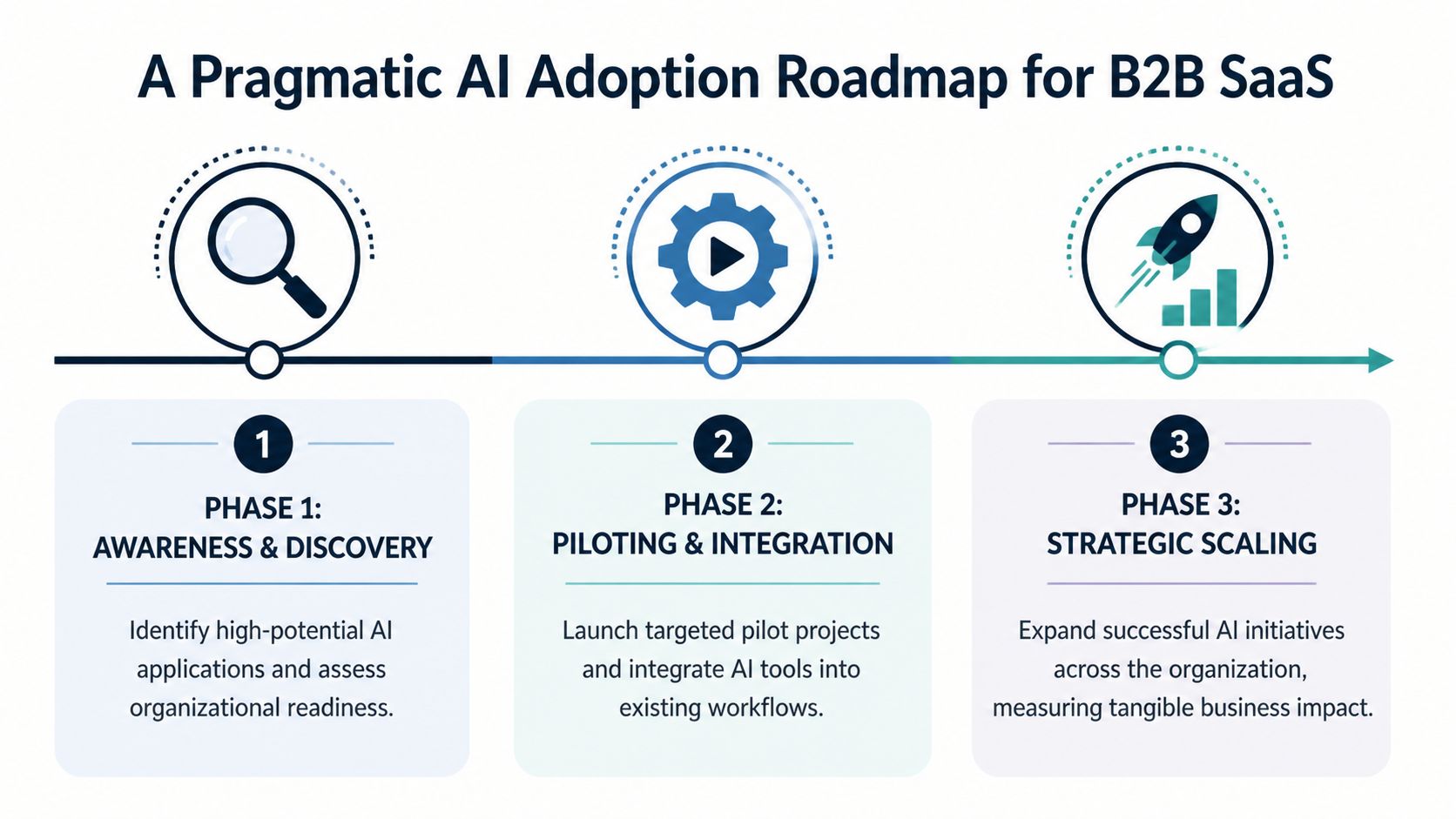
Here’s a practical roadmap:
PillarKey ActionExample Tools / PlatformsSuccess MetricData foundationPrioritize a narrow set of GTM signals tied to one business problemCRM, product analytics, warehouse, call transcriptsBetter quality inputs for one pilot workflowTooling and infrastructureSelect systems that integrate with current workflowsCRM scoring tools, analytics platforms, automation platformsConsistent weekly usage by the operating teamTeam and skillsTrain by role, not by theoryInternal playbooks, workflow training, review checklistsHigher confidence and cleaner output reviewWorkflow integrationEmbed AI into recurring GTM decisionsPipeline reviews, campaign reviews, sales enablement loopsAI changes decisions, not just tasks
The maturity path is simple. Awareness. Pilot. Scale. Most companies try to skip the middle and end up with scattered experiments and no operating change.
If your AI dashboard starts with “hours saved,” you’re already off track.
Productivity matters, but it’s not the business case. Founders and boards don’t fund AI because the team drafted assets faster. They fund it because they expect better revenue outcomes, better capital allocation, or better margin performance.
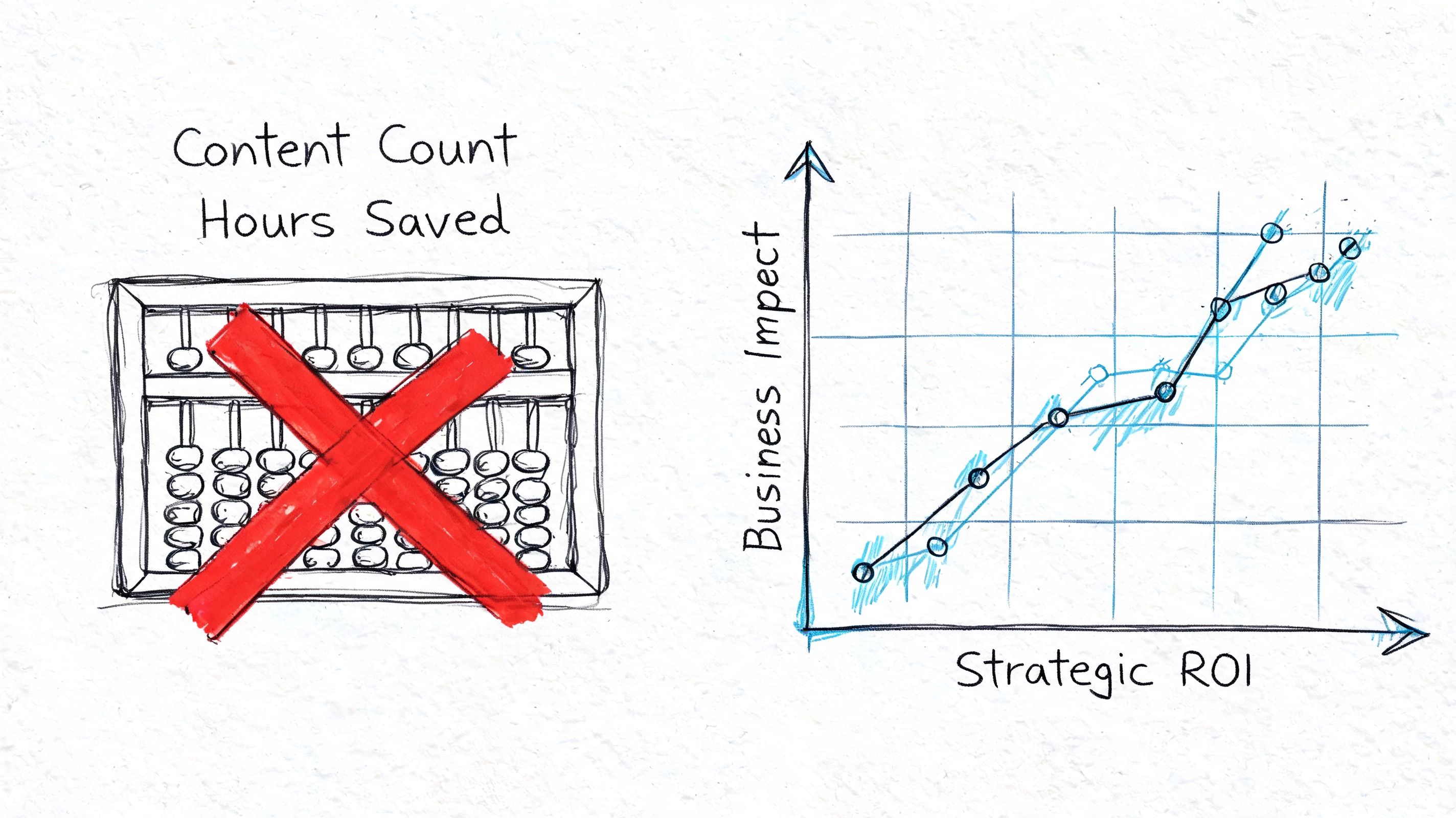
The cleanest measurement model starts close to pipeline. If an AI initiative affects lead prioritization, message quality, campaign optimization, or sales support, it should show up in conversion efficiency before it shows up in vanity output metrics.
That’s why campaign speed alone is not enough. AI-driven campaigns can launch 75% faster and produce 47% better click-through rates, according to Kairntech’s overview of AI in marketing use cases. Useful, yes. But those improvements only matter if they turn into better CAC, CLTV, and ROAS over time.
A serious measurement stack asks:
A faster campaign that feeds weak-fit pipeline is not progress. It’s accelerated waste.
Founders need both. Leading indicators tell you whether the mechanism is working. Lagging indicators tell you whether the business benefited.
A simple way to structure this:
Indicator typeWhat to trackLeadingScore accuracy, response quality, qualification alignment, campaign adjustment speedLaggingCAC movement, CLTV direction, ROAS efficiency, sales cycle improvement
Lagging outcomes take time. If you wait only for revenue proof, you’ll move too slowly. If you rely only on activity proof, you’ll fool yourself.
The middle ground is disciplined attribution. Tie each AI initiative to one core business hypothesis. Example: “AI-assisted lead scoring will improve sales focus on high-propensity accounts.” Then inspect whether handoff quality, opportunity creation, and pipeline progression improved in sequence.
That’s the language leadership should use in reviews. Not “the team liked the tool.” Not “we created more assets.” Business impact has to be legible.
If your team needs a cleaner framework for that conversation, how to measure marketing ROI is the right level of thinking. The point is to connect AI activity to commercial outcomes in a way finance, revenue leadership, and the board can take seriously.
The biggest AI mistakes in B2B marketing are operational, not technical.
Teams rarely fail because the model is weak. They fail because leadership treats AI like a side experiment instead of a GTM design decision. The result is predictable. Scattered adoption, unclear ownership, inconsistent output, and no measurable effect on pipeline quality.
Some teams delay action because the CRM is messy, attribution is incomplete, or tracking still needs cleanup.
That logic sounds responsible. It usually protects inertia.
You do not need perfect data to improve a bounded commercial decision. You need data that is good enough for a specific use case, clear judgment about where errors matter, and a team disciplined enough to inspect output quality. If AI can help sales prioritize accounts, help marketing identify content gaps, or help RevOps spot funnel leakage, start there. Waiting for a pristine system usually means keeping expensive human guesswork in place for another two quarters.
Use one standard. Decision usefulness.
This trap starts in the buying process.
A founder watches a strong demo. A marketing leader sees competitors adopting a category. RevOps gets excited about workflow automation. Nobody stops to define the constraint inside the GTM motion that needs fixing.
Then the company adds another tool that creates setup work, duplicate reporting, and half-hearted adoption. The stack grows. Execution does not improve.
Ask four hard questions before you buy anything:
If the answer is vague, skip the purchase.
This one creates real downside because it starts as convenience.
Teams use AI for copy, summaries, outreach drafts, call notes, and recommendations. Without clear standards, quality drifts fast. Brand language gets loose. Product claims lose precision. Sensitive customer context gets pasted into systems without enough review. Approval lines blur. Nobody owns the risk until something customer-facing goes wrong.
The training problem makes that worse. If people are expected to use AI without clear rules, examples, and review standards, they either overtrust the output or avoid it entirely. Both outcomes are expensive.
AI literacy is a management job.
Set simple rules that the team can follow under pressure. Define where human review is required. Define what data can and cannot be used. Define which outputs are assistive drafts versus final customer-facing assets. Protect founder voice, product truth, and pricing logic with explicit checks. If you need a practical leadership framework for that rollout, this CMO guide to integrating generative AI in B2B marketing is a useful reference.
AI projects die in the gap between functions.
Marketing thinks RevOps owns the systems. RevOps thinks marketing owns the use case. Sales wants the output but not the process change. Leadership approves budget and assumes adoption will sort itself out.
It will not.
Every AI initiative that touches GTM needs one accountable owner, one business outcome, and one review cadence. Without that, you get activity with no institutional learning. The company runs experiments, but nobody compounds what worked.
That is what the hype cycle misses. The primary risk is not slow adoption. It is unmanaged adoption that adds noise to your revenue system.
Your job isn’t to become the company’s prompt engineer.
Your job is to decide what AI changes inside the GTM system and what must remain human. That’s the leadership work. Strategy, sequencing, accountability, and guardrails.
The wrong mandate is “go use AI.” That produces scattered experiments, internal noise, and a pile of disconnected tools. The right mandate is sharper. Identify the few growth decisions where better signal, faster feedback, or tighter execution would materially improve performance. Then design around those.
That means asking a different set of questions in leadership meetings:
This is not a marketing side project. It’s an operating model decision.
If you treat ai in marketing like software procurement, you’ll get software. If you treat it like a redesign of how your company learns and executes, you’ll get a stronger revenue system.
That’s the standard. Leaders need to architect the change, not just approve the budget. If you want a sharper framework for that shift, this CMO guide to integrating generative AI in B2B marketing is worth your time.
If your team is trying to figure out where AI belongs in your B2B GTM model, Big Moves Marketing helps founders and revenue leaders turn vague AI ambition into clear positioning, tighter execution, and measurable growth decisions.
Explore Big Moves Marketing services and resources:




%20-%20white.svg)