%20png%20copy.avif)
Most advice on ai marketing points founders toward the wrong work.
It tells teams to write faster, post more, and master prompts. That's a productivity story, not a growth strategy. If your positioning is fuzzy, your ICP is too broad, and your sales team can't explain why you win, AI won't fix any of that. It will just help you produce more polished confusion.
The useful question isn't “How do we use AI in marketing?” It's “Where does AI change a revenue outcome we care about?” That usually means better targeting, better decision quality, faster learning, and tighter feedback loops across marketing, sales, and product.
The strongest teams I see don't treat AI as a content machine. They treat it as a way to sharpen judgment, compress analysis, and improve execution where the funnel is already constrained.
Most AI marketing work is waste because it starts with the tool, not the constraint.
A founder hears that AI can draft blogs, build ads, or write outbound sequences in minutes. The team starts generating assets. Volume goes up. Very little else changes. Pipeline quality doesn't improve, deal cycles don't tighten, and sales still says the leads aren't right.
The problem is simple. Numerous marketing organizations are using AI to accelerate production before they've clarified strategy.
Research highlighted by CMSWire's analysis of why asking better questions matters in marketing makes the point clearly. High-performing marketers are valued for curiosity, evaluation, and judgment. Prompting matters, but prompting is not thinking. For B2B SaaS teams, AI becomes useful when it helps answer harder questions first. Which segment converts fastest? Which pains show up in closed won deals but not in your homepage? Which competitor narrative is pulling your buyers off course?
That's why I'd ignore most “prompt engineering” discourse unless your strategic basics are already strong.
AI should be pointed at uncertainty before it's pointed at output.
If you're pre-PMF or just past it, your biggest problem usually isn't content throughput. It's message accuracy. You don't need ten more blog posts if your category framing is weak. You need clearer evidence about what buyers care about, how deals are won, and where your GTM story breaks.
That's also why AI without strategic thinking is destroying B2B marketing results is the more useful conversation. The failure mode isn't that AI writes bad copy. The failure mode is that teams use it to industrialize bad assumptions.
Use AI to interrogate call transcripts, CRM notes, win-loss themes, support tickets, search intent patterns, and campaign response signals. Use it to find strategic asymmetry. Then apply it to execution.
That order matters. It's the difference between ai marketing that changes outcomes and ai marketing that just fills a calendar.
Most teams need a filter, not more options.
If every AI idea looks interesting, priorities collapse. The simplest way to fix that is to sort initiatives into three tiers. This gives the leadership team a common language for where AI helps, where it merely saves time, and where it can change revenue performance.
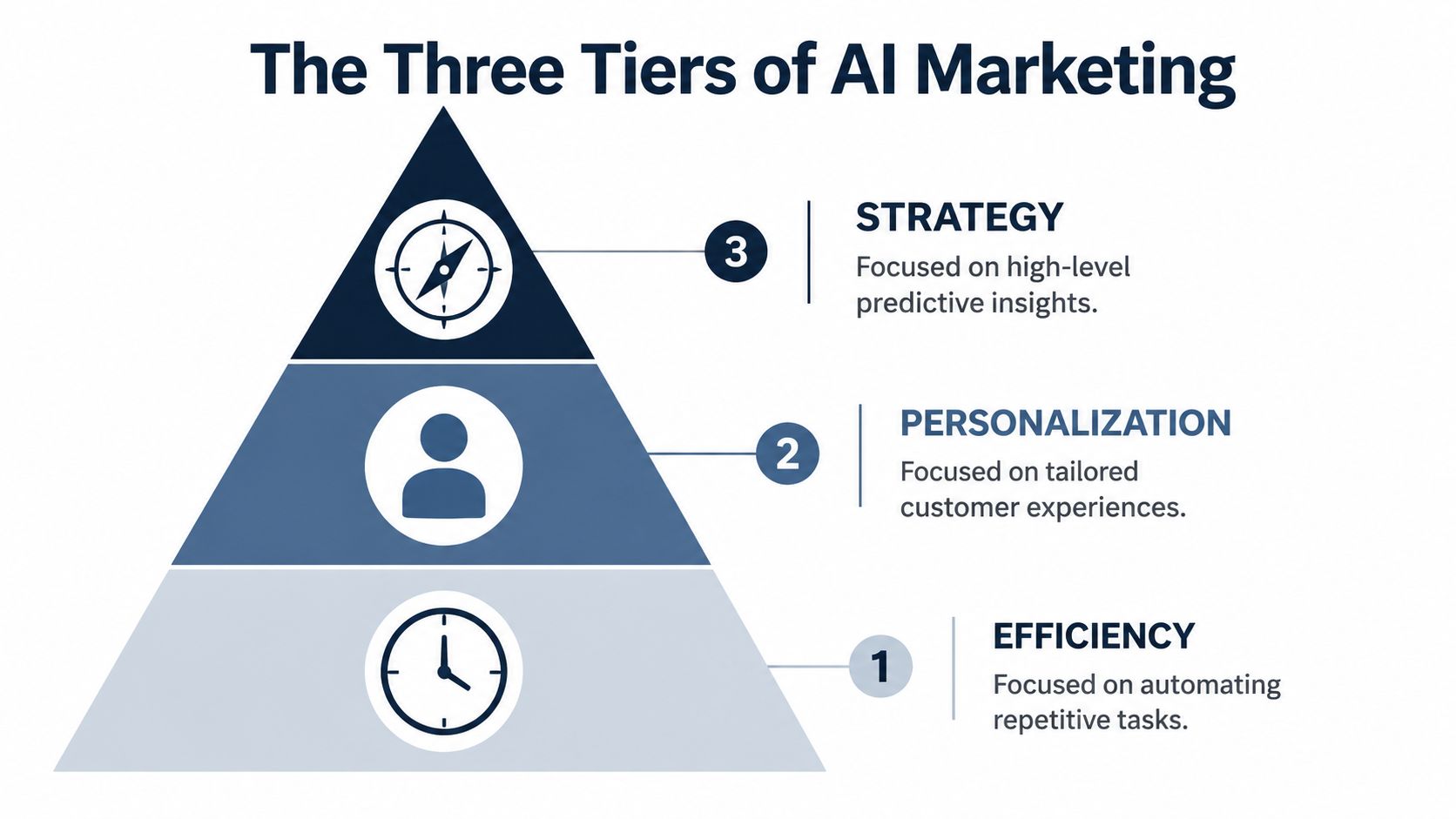
Tier 1 is the obvious stuff. Drafting first-pass content, summarizing calls, cleaning CRM fields, turning a webinar into email copy, or producing variant headlines for paid tests.
This layer matters. It reduces friction. It also creates almost no defensible advantage because everyone can do it.
Use Tier 1 to free capacity, not to claim transformation.
A content team that uses AI to draft landing page variants or repurpose case study material is working sensibly. A founder who thinks that alone creates a better GTM engine is fooling himself.
Tier 2 is where ai marketing starts touching economics.
AI improves conversion paths, audience targeting, bidding, testing, and prioritization. According to SQ Magazine's AI marketing statistics, in 2025 companies using AI for customer data analysis reported an average 38% boost in marketing ROI, AI-enabled campaign optimization drove a 23% reduction in customer acquisition costs, AI-driven A/B testing lifted conversion rates by up to 28%, AI-based lead scoring improved conversion efficiency by 31% over manual methods, and 47% of digital ad spend was optimized through AI algorithms.
Those numbers matter because they point to the right middle ground. Not content for content's sake. Better decisions inside existing GTM motion.
For a B2B SaaS company, Tier 2 often includes:
This is the layer where I'd expect most growth-stage teams to place their first serious bets.
Practical rule: If an AI initiative can't be tied to CAC, conversion rate, pipeline quality, or sales efficiency, it probably belongs in Tier 1.
Tier 3 is underused because it requires judgment.
This is not “AI writes our messaging.” This is AI helping leadership analyze market signals at a scale humans can't handle alone. Reviewing hundreds of sales conversations, clustering objections by segment, spotting language that consistently appears in expansion accounts, mapping competitor claims against buyer concerns, or finding patterns in churn reasons.
Here's the core distinction:
| Tier | Primary purpose | Typical outcome |
|---|---|---|
| Tier 1 | Reduce manual effort | Faster production |
| Tier 2 | Improve funnel performance | Better efficiency and conversion |
| Tier 3 | Improve strategic choices | Better market bets |
Tier 3 can influence segment selection, category framing, pricing communication, product packaging, and expansion strategy. It can tell you where your message is mismatched, where sales is compensating for weak positioning, and where a new wedge may exist.
That's where Big Moves Marketing's thinking on artificial intelligence and marketing becomes useful as a planning lens. AI shouldn't be treated as a separate workstream. It should be placed inside the decisions that already determine whether GTM works.
If you're an early-stage founder, spend lightly on Tier 1, commit seriously to Tier 2, and reserve leadership attention for selective Tier 3 work.
If you're Series A to C with a functioning revenue engine, Tier 2 and Tier 3 deserve board-level attention. They influence growth quality, not just team productivity.
The mistake is thinking all AI use is equal. It isn't. One tier saves time. One improves economics. One changes direction.
The best ai marketing use cases sit at the seams between functions.
Marketing sees pattern fragments. Sales hears objections. Customer success sees adoption friction. Product hears feature demand. AI becomes valuable when it helps combine those signals into decisions that improve revenue quality, not just activity volume.

Content drafting gets too much attention, but it's still useful when attached to real GTM work. According to Digital Applied's review of AI marketing ROI data, AI-powered content drafting delivers 3.2x ROI, personalization engines deliver 2.7x ROI, and teams that combine AI drafting with audience research (2.4x ROI) and ad copy optimization (2.3x ROI) create a cumulative stack effect.
The lesson isn't “generate more content.” The lesson is to combine drafting with research and optimization.
A few examples that matter:
A lot of B2B teams misuse AI here by separating “content ops” from “market insight.” That's backward. The research layer should drive the production layer.
If your team is evaluating practical workflows beyond pure marketing, this guide to scaling SaaS with AI is useful because it looks at AI across sales and growth operations, not just content.
Sales teams usually get more immediate value from AI than marketing does because the feedback loop is tighter.
An SDR or AE doesn't need AI to sound clever. They need it to identify who deserves attention, what angle fits the account, and where a deal is stalling.
Strong use cases include:
The real value is not writing another follow-up email. It's knowing which deal deserves the next hour from your best rep.
This is especially useful in founder-led sales transitions. The founder often carries tacit judgment that no one else can replicate. AI can help codify some of that pattern recognition by extracting what repeatedly shows up in the deals the founder wins.
This is the underfunded category.
Use AI to process qualitative inputs at scale. Not because the model knows your market better than you do, but because it can help expose patterns you're too close to see. That includes onboarding calls, churn interviews, demo recordings, support tickets, and analyst commentary.
Here are the strategic questions worth pointing AI at:
You can run a lot of this internally, but many growth-stage teams need an operator to structure the work, define hypotheses, and connect findings to GTM decisions. Big Moves Marketing's guide to using generative AI for B2B marketing and sales growth is relevant here because it treats AI as part of a revenue system, not a stand-alone content layer.
What matters is not the sophistication of the model. It's whether the insight changes targeting, messaging, sequencing, or account focus.
Most AI rollouts fail for a boring reason. Leadership buys capability before defining the business problem.
That creates scattered pilots, internal noise, and no clean answer to a simple question. Did this improve anything that matters? A better roadmap is narrower, less glamorous, and much more effective.

Start with one GTM friction point. Not a tool category.
If paid acquisition is expensive, look at targeting, bidding, landing page conversion, and lead quality. If pipeline is healthy but close rates are weak, look at objection handling, ICP fit, and sales narrative consistency. If volume is fine but expansion is soft, look at product adoption signals and customer communication gaps.
The biggest mistake mid-market SaaS teams make is chasing “personalization” as if it's universally available. As explained in AiDigital's breakdown of the personalization blind spot, true AI personalization requires substantial data infrastructure, creating a bifurcated market where data-rich enterprises can get closer to one-to-one experiences while most mid-market and smaller B2B companies cannot. The practical opportunity is in reachable use cases like segmentation, send-time optimization, ad targeting, and prioritization.
That should change how leaders think about maturity.
| Company reality | Better AI bet | Bad AI bet |
|---|---|---|
| Thin data, small team | Segmentation, lead routing, ad optimization | Grand personalization claims |
| Growing demand engine | Funnel testing, scoring, lifecycle automation | Tool sprawl |
| Complex GTM motion | Cross-functional signal analysis | Isolated content generation |
Pick one use case with one owner and one KPI.
Examples include improving demo-to-opportunity conversion, reducing wasted paid spend, increasing sales acceptance of inbound leads, or improving expansion account identification. Keep the scope narrow enough that attribution remains credible.
Good pilots share a few traits:
If you want to see how a company built category visibility around a defined market position rather than vague AI activity, how Yellow.ai scaled brand recognition is a useful example of why focus beats scatter.
Once a pilot works, leaders usually make the next mistake. They expand too fast.
Scale should mean standardization, governance, and integration. It should not mean buying five more tools because one workflow worked. Document the prompt logic, review process, escalation rules, data inputs, and reporting expectations. Make sure sales, marketing, and ops are reading from the same playbook.
A pilot proves possibility. Scale proves discipline.
This is also where governance becomes practical, not legal theatre. Who reviews outputs? What data can be used? When does a human override the model? Which decisions stay human because the downside of being wrong is too high?
For teams trying to build a sane implementation path, this practical AI implementation guide for B2B marketers is the right kind of resource. It starts from operating constraints, not vendor excitement.
The right roadmap is simple. Audit the bottleneck. Pilot one change. Scale only the workflows that improve a real GTM number.
Most teams measure ai marketing like a lab experiment. That's why they struggle to defend budget.
They track prompts written, pieces generated, hours saved, campaigns launched, or workflows automated. None of those are executive metrics. They might describe activity, but they don't say whether the business is growing more efficiently.
Don't build your dashboard around tool usage.
A team can generate more blog posts and still create no pipeline. An SDR team can use AI to personalize first lines and still book weak meetings. A demand gen team can automate reports and still miss revenue targets.
Vanity KPIs usually sound operationally tidy and strategically empty:
Those are supporting indicators at best. None should be the headline.
The dashboard should match the outcome the AI initiative was meant to improve.
If the initiative targeted acquisition efficiency, measure CAC movement, lead quality, and sales acceptance. If it targeted funnel performance, measure stage conversion and pipeline velocity. If it targeted outbound productivity, inspect meeting quality, progression to real opportunities, and rep time allocation. If it targeted expansion, inspect account coverage, risk detection quality, and expansion pipeline creation.
A simple way to pressure-test measurement is to ask one question. If this number improves, would the CFO care?
If the metric doesn't connect to revenue quality, cost efficiency, or speed to pipeline, it belongs in the appendix.
For leadership teams, the useful scorecard often includes a mix of hard and diagnostic measures:
| Metric type | What it should show |
|---|---|
| Economic | Whether acquisition or pipeline creation became more efficient |
| Funnel | Whether leads or opportunities progressed better |
| Sales | Whether reps spent time on higher-quality work |
| Message | Whether buyer response improved across calls, email replies, and win-loss patterns |
That last category matters more than many organizations acknowledge. You can create an internal message-market-fit readout by reviewing sales calls, call summaries, inbound language, and objection trends. Not to generate a fake precision score, but to see whether your market hears the story the way you intend it.
If your team needs a stricter way to tie activity to outcomes, how to measure marketing ROI is the right frame. Start with business outcomes, then work backward to channel and workflow metrics.
The point is simple. AI investments should be held to the same standard as any other GTM investment. If they don't improve business performance, they're experiments, not strategy.
The first AI initiative should be boring on purpose.
Don't start with a broad transformation plan. Start with one constrained problem that already affects pipeline, spend efficiency, or sales productivity. The goal of the first month is not sophistication. It's proof.
Choose one problem with visible commercial cost.
Good examples include low demo-to-opportunity conversion, poor sales follow-up prioritization, weak paid landing page performance, or messy inbound qualification. Bad examples include “improve our content strategy” or “make the team more AI-enabled.” Those are too broad to test effectively.
Write the bottleneck in one sentence. Then write why it matters in one sentence.
A useful format is:
Your hypothesis should predict one business effect, one operating change, and one measurement method.
For example:
Keep the test narrow. Don't blend multiple interventions or you won't know what worked.
This is also the point where a short internal briefing helps. Share the use case, owner, process, review cadence, and kill criteria with the team before launch.
Run the pilot with a control mindset.
That doesn't require academic perfection. It requires discipline. Hold back part of the workflow or compare against historical review quality. Make sure sales or marketing ops can inspect the output, not just accept it.
A simple walkthrough can help leaders keep the process grounded:
During the pilot, watch for three things:
Document misses aggressively. If the model keeps misreading intent, overvaluing weak accounts, or creating noise, that's useful evidence.
Many teams avoid this part. They'd rather keep a weak pilot alive than admit it didn't earn expansion.
Use a simple decision table:
| Result | Decision |
|---|---|
| Improved KPI and team adopted it | Scale carefully |
| Mixed KPI movement but useful workflow | Refine and rerun |
| No KPI movement and weak adoption | Kill it |
If you need more examples of where AI fits across sales and marketing workflows, the earlier linked resources are useful. What matters now is not reading more. It's making a clean decision.
Early wins should produce confidence, not complexity.
A strong first AI initiative creates two assets. A measured result and a repeatable decision process. That's enough to earn the next experiment.
AI doesn't create strategy. It exposes the quality of the strategy you already have.
If your ICP is sloppy, AI will help you target the wrong people faster. If your positioning is generic, AI will generate more generic assets. If your sales team improvises because your message is weak, AI will scale inconsistency.
That's why the human layer matters more now, not less.
Founders and GTM leaders still have to do the hard work. Define the market. Choose the segment. Clarify the pain. Build a message sales can use and buyers can understand. Decide which revenue constraint matters most right now. AI can help you analyze, prioritize, and execute against those choices. It can't make them for you.
This is the part many teams want to skip because software feels faster than thinking. It isn't. Clear thinking is still the scarce input.
Good ai marketing is disciplined. It starts with business constraints, not tool enthusiasm. It improves economics before it expands scope. It uses AI to sharpen judgment, not replace it.
That's the right mental model. AI is a mirror. It reflects the strength or weakness of your GTM system. If you want better output, fix the system first.
If your team needs a sharper GTM strategy before adding more AI motion, Big Moves Marketing helps B2B SaaS founders and revenue leaders clarify positioning, tighten messaging, and choose practical growth bets that connect to pipeline, not noise.
Explore Big Moves Marketing services and resources:




%20-%20white.svg)