%20png%20copy.avif)

AI for product marketing is the integration of artificial intelligence tools to continuously enhance product research, messaging, and campaign execution for faster, more effective marketing outcomes. The industry term for this practice is AI-augmented product marketing management, or AI-augmented PMM. Product Marketing Alliance, BCG, and IBM research all confirm that AI-augmented PMM is no longer optional for B2B tech companies. Teams using AI-driven GTM engines report 3x qualified meetings and measurable cost reductions per opportunity. This guide covers the full PMM lifecycle: research, positioning, go-to-market execution, compliance, and adoption realities for 2026.
AI replaces the old model of quarterly research sprints with a continuous intelligence engine. Instead of static competitive decks that go stale in weeks, AI-driven systems generate dynamic competitor profiles, real-time updates, and automated alerts the moment a rival shifts messaging or pricing. The result is faster decisions and tighter alignment between marketing and product leadership.
The practical shift looks like this:
B2B teams using just-in-time competitive intelligence can answer competitive questions live in sales meetings, pulling from a live internal knowledge base rather than a static dashboard. That capability changes the dynamic in enterprise deals.
Pro Tip: Design your competitive research workflow around query-based retrieval. Store call transcripts, win-loss notes, and competitor screenshots in a structured knowledge base. Then prompt your AI system with specific questions before each meeting rather than running broad weekly sweeps.

The speed advantage compounds over time. Teams that build continuous research systems reduce their insight cycle from weeks to hours. That means product launches go to market with fresher intelligence, and messaging updates happen in response to real market signals rather than gut instinct.
AI generates positioning angles fast. Feed it customer interview summaries, win-loss data, and competitor messaging, and it produces multiple draft frameworks in minutes. That speed is real and useful. The limitation is equally real: AI lacks the emotional intelligence and strategic judgment to know which angle will resonate with a skeptical CFO at a 500-person SaaS company.
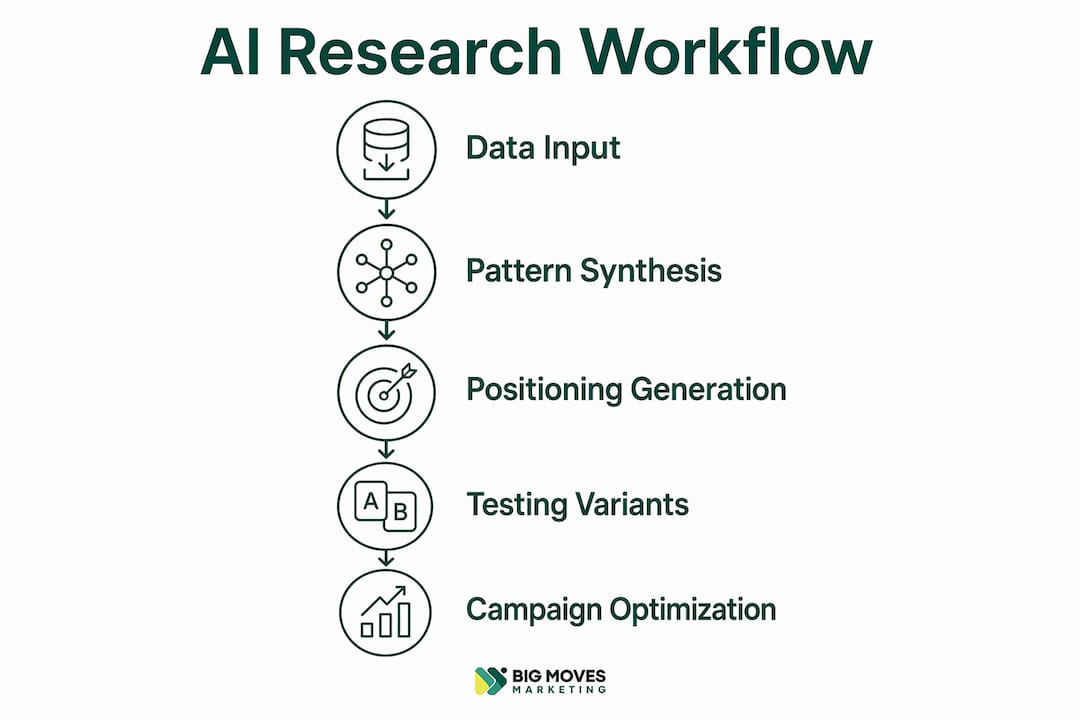
Without evidence inputs, AI produces plausible but average messaging. “Plausible but average” loses deals in competitive B2B markets. The fix is evidence-first prompt engineering.
The evidence-first approach requires feeding AI these specific inputs before asking for positioning output:
With those inputs, AI synthesizes patterns across hundreds of data points faster than any human analyst. Without them, it defaults to category-level language that every competitor already uses.
Pro Tip: Be uncomfortably specific in your prompts. Instead of “write positioning for our data security product,” write “write three positioning statements for a CISO at a 300-person fintech company who lost a deal last quarter because of SOC 2 concerns and currently uses a legacy on-premise solution.” Specificity is what separates strategic output from generic copy.
A structured testing framework matters here. Generate five to eight positioning variants with AI, then pressure-test each one with a small outbound sequence or a LinkedIn message test. Let reply rates and meeting conversion data tell you which angle works. AI accelerates the iteration cycle. Human judgment decides which signals to trust.
The shift from campaign-based GTM to system-based GTM is the most significant structural change AI brings to B2B product marketing. A campaign has a start date, an end date, and a retrospective. A system runs continuously, learns from every touchpoint, and adjusts targeting and messaging in real time.
Here is how to build an AI-powered GTM engine in four stages:
AI-driven GTM engines produce 3x qualified meetings and a 25% reduction in cost per opportunity. Those numbers reflect the compounding effect of continuous optimization rather than one-time campaign tuning.
The role of AI in marketing extends beyond campaign mechanics. AI feedback loops align product marketing, sales, and demand generation around shared data, reducing the internal friction that kills GTM velocity. When every team sees the same signal, decisions happen faster and with less debate.
Multi-agent autonomous marketing, where AI systems run entire campaign workflows without human intervention, is still nascent. Only 8% of marketing organizations operate at that level today. Phased adoption is the right approach: start with AI-assisted discrete tasks, then build toward system-level automation as your data foundation matures.
EU AI Act transparency rules effective august 2, 2026 require machine-readable labeling of AI-generated marketing content and explicit chatbot disclosures. B2B companies selling into European markets face direct compliance obligations. Ignoring them creates legal exposure and erodes buyer trust in regulated industries like fintech, healthcare tech, and enterprise software.
Practical compliance steps for marketing teams include:
Compliance-by-design metadata tagging built early into your content pipeline prevents costly retrofits later. Teams that treat compliance as an engineering problem from day one avoid the scramble of retroactively auditing hundreds of AI-generated assets.
Pro Tip: Add a compliance field to your content management system now. A simple “AI-generated: yes/no” tag with model and reviewer fields costs almost nothing to implement today. Retrofitting that structure across a large content library in 2027 will cost significantly more.
Compliance maturity is also a competitive factor in regulated B2B markets. Enterprise buyers increasingly ask vendors about AI governance practices during procurement. A documented, auditable AI content workflow signals operational maturity and reduces friction in security reviews.
The adoption gap between aspiration and execution defines the current AI marketing moment. 96% of CMOs acknowledge AI’s transformative impact on marketing. Only 8% run fully autonomous multi-agent campaigns. That gap is not a technology problem. It is an operating model problem.
“42% of marketing organizations still use generative AI for discrete task assistance rather than end-to-end workflows. The teams pulling ahead are those building AI-native operating models with defined roles, integrated data, and governance layers from the start.” — BCG, 2026
76% of CMOs say generative AI will change marketing operations fundamentally. The ones moving fastest are building foundation models trained on proprietary customer data rather than relying on generic AI outputs. Proprietary data is the moat.
The collaboration gap compounds the adoption gap. Only 26% of CMOs consistently integrate AI use across marketing, sales, and service. That means 74% of organizations leave significant value on the table by running AI in silos. Cross-functional data integration is the unlock.
| Adoption stage | Description |
|---|---|
| Discrete task assistance | AI handles individual tasks: writing, summarizing, scoring |
| Workflow integration | AI connects tasks within a single function like content or demand gen |
| Cross-functional AI | AI shares data and signals across marketing, sales, and service |
| Agentic marketing | AI runs multi-step campaigns autonomously with human oversight |
The practical sequencing for most B2B marketing teams starts at stage one and builds systematically. Jumping to agentic workflows without the data foundation and governance structure produces unreliable outputs and erodes internal trust in AI.
AI-augmented product marketing delivers measurable results only when built on continuous systems, evidence-grounded inputs, and cross-functional data integration.
| Point | Details |
|---|---|
| Continuous research beats static decks | AI-driven intelligence systems reduce insight cycles from weeks to hours. |
| Evidence-first prompting is non-negotiable | Feed AI call transcripts, win-loss data, and objections to get strategic outputs. |
| GTM systems outperform campaigns | AI-powered GTM engines produce 3x qualified meetings and 25% lower cost per opportunity. |
| Compliance is a design decision | EU AI Act obligations effective august 2026 require metadata tagging and output review workflows built in from the start. |
| The adoption gap is an operating model gap | 96% of CMOs see AI’s potential, but only 8% run autonomous workflows. Build the foundation first. |
I have worked with over 75 B2B tech companies across 17 years, and the pattern I see most often is this: teams adopt AI for speed, then lose their edge because they stop thinking strategically. AI accelerates the operational layer. It does not replace the judgment layer.
The AI-augmented PMM approach I recommend to every client starts with a clear division of labor. AI handles signal collection, pattern recognition, variant generation, and performance tracking. The marketer handles narrative construction, buyer empathy, and the strategic call on which insight actually matters.
What I have seen work in practice is treating AI outputs as a first draft, not a final answer. The teams that get the most from AI are the ones with the strongest human editors. They use AI to generate ten positioning angles in an hour, then apply deep category knowledge to pick the one that will land with a skeptical enterprise buyer. That combination is faster and sharper than either approach alone.
The uncomfortable truth is that most AI-generated B2B messaging sounds like it was written by someone who read about the industry but never sold into it. Buyers notice. The fix is not better AI. It is better inputs and sharper human review. Build your 2026 AI implementation around that principle and you will outperform teams that treat AI as a replacement for strategic thinking.
— Veb
Bigmoves works with B2B SaaS and tech companies that want to embed AI across their full product marketing lifecycle, from positioning to pipeline.
Veb and the Bigmoves team specialize in positioning and messaging grounded in real buyer evidence, not generic frameworks. The firm also offers branding and GTM strategy built for AI-enhanced execution, so your messaging, website, and outbound all pull in the same direction. If you are a founder, CMO, or growth leader at a scaling SaaS company, Bigmoves provides the structure and expertise to move from AI experimentation to AI-driven revenue.
AI for product marketing is the use of artificial intelligence tools to automate and improve research, positioning, and campaign execution across the product marketing lifecycle. The goal is faster decisions and more precise messaging grounded in real buyer data.
AI replaces periodic research sprints with continuous intelligence systems that monitor competitors, tag objection patterns, and alert teams to market shifts in real time. This reduces insight cycle times from weeks to hours.
EU AI Act transparency rules effective august 2, 2026 require machine-readable labeling of AI-generated content and explicit chatbot disclosures. Deployers must document AI use cases, data sources, and output review processes.
Without evidence inputs like call transcripts, win-loss data, and competitor messaging, AI defaults to category-level language that lacks competitive differentiation. Evidence-first prompt engineering is the fix.
Only 8% of marketing organizations run fully autonomous multi-agent campaigns as of 2026, according to BCG research. Most teams operate at the discrete task assistance stage and build toward greater automation over time.



%20-%20white.svg)