%20png%20copy.avif)

Most advice on ai digital marketing is backwards.
It tells founders to use AI to publish more blog posts, generate more ad copy, and move faster on low-value production. That's not a strategy. It's a cheaper way to create noise. For an early-stage or growth-stage B2B SaaS company, a primary constraint usually isn't content throughput. It's market clarity. You don't need more assets if you still don't know which buyer, pain point, trigger, and sales motion convert effectively.
AI is already mainstream. 88% of marketers use AI in their day-to-day roles, according to SurveyMonkey's AI marketing statistics. That matters, but not for the reason commonly assumed. It means AI is no longer a novelty. It's table stakes. So the question isn't whether your team is “using AI.” The question is whether it's helping you validate go-to-market faster, improve pipeline quality, and make better capital allocation decisions.
If your AI plan starts and ends with content generation, you're optimizing the wrong layer of the business.
The popular advice says AI's main value is speed. Faster content. Faster campaigns. Faster execution.
That's shallow thinking.
A startup doesn't win because it ships more marketing assets than everyone else. It wins because it figures out what the market cares about before the burn rate catches up. If you use AI to produce more material against an unproven message, you just scale confusion. That's expensive, even if the software is cheap.
The better framing is simple. AI should lower the cost of learning. It should help you test demand signals, compress research cycles, identify buying patterns, and sharpen sales conversations. If it's not doing that, it's probably just increasing output without increasing certainty.
Founders often mistake activity for momentum. They see more landing pages, more email sequences, and more posts in the queue and assume the machine is working.
It isn't, if the core GTM questions are still unresolved:
AI can help answer those questions. But it won't answer them if you deploy it as a writing assistant and nothing more.
Practical rule: Don't use AI to scale messaging you haven't validated in founder-led sales.
That's why the strongest use of AI in B2B isn't content multiplication. It's decision acceleration. The teams that understand this stop asking, “How can AI help us publish more?” and start asking, “How can AI help us waste less?”
That shift matters. It's the difference between treating AI like a content intern and treating it like a GTM instrument panel.
If you want a sharper take on where teams go wrong, AI without strategic thinking is destroying B2B marketing results.
Organizations often define AI by the interface they bought. That's the wrong model. The primary role of AI in B2B SaaS marketing sits in three functions: segmentation, prediction, and generation.
When those three work together, AI becomes useful. When generation runs alone, you get polished nonsense.
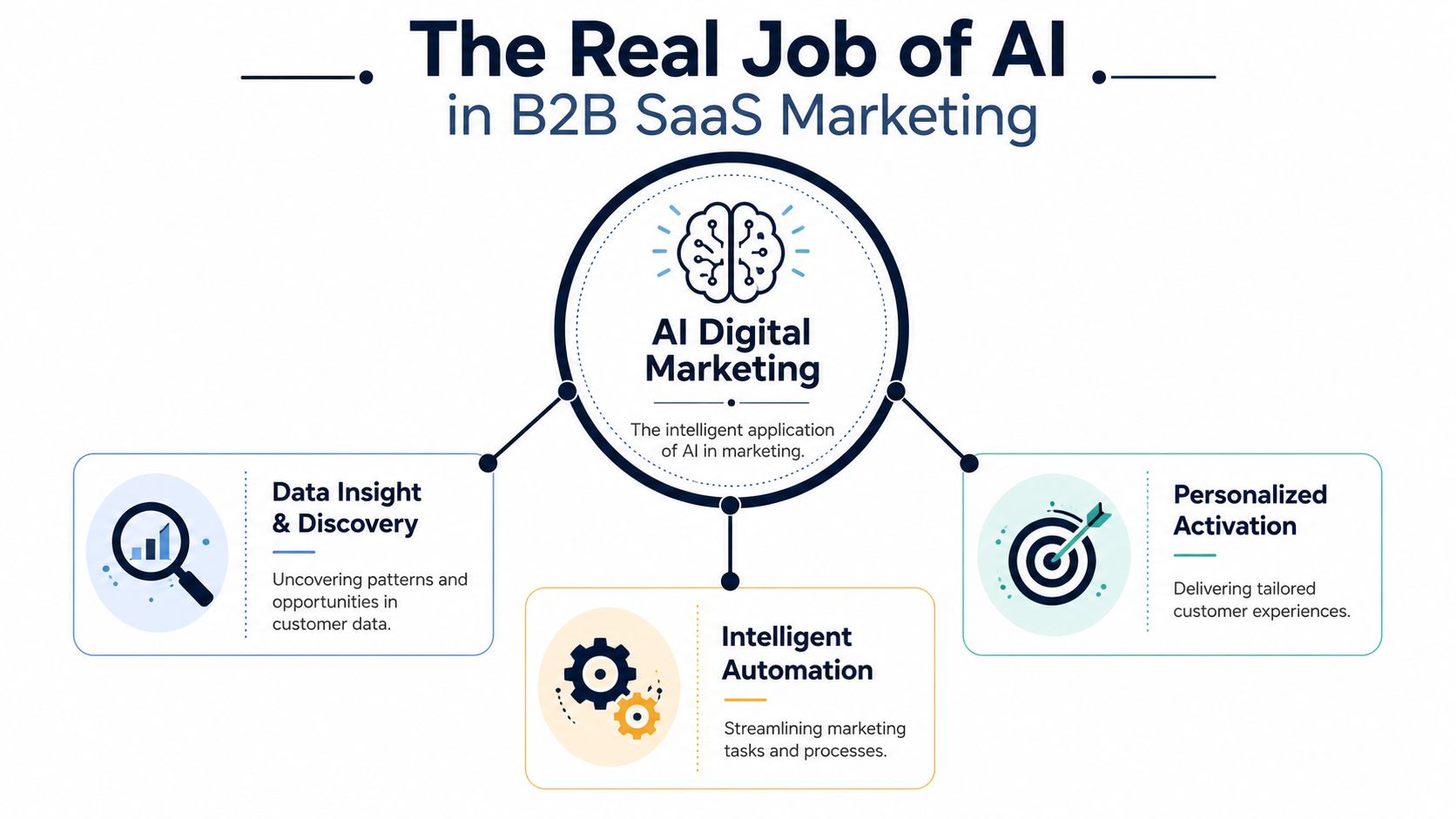
IBM describes AI marketing as using data-driven analysis, NLP, and machine learning to deliver customer insights and automate critical marketing decisions, while improving customer division by traits, interests, and behaviors for stronger engagement and ROI in its overview of AI in marketing.
Early-stage SaaS teams usually segment too broadly. “Mid-market fintech” isn't a segment. It's a bucket. Real segmentation means separating accounts by buying context, operational maturity, pain intensity, switching trigger, and motion fit.
AI helps when it processes patterns humans miss across CRM data, website behavior, email engagement, firmographics, demo notes, and campaign history. That's useful because founders often rely on anecdotes from a handful of deals. AI gives you another layer of pattern recognition.
A good segmentation system should help you answer:
| Question | What you need to know |
|---|---|
| Who is showing intent | Which accounts or contacts behave like active buyers |
| Who looks similar to closed-won customers | Which clusters deserve more spend and sales time |
| Who should be deprioritized | Which leads create pipeline noise but rarely progress |
Prediction is where AI starts affecting revenue decisions.
This is the part that scores likelihood. Who is more likely to book a meeting, move to opportunity, expand, churn, or go dark. That doesn't replace judgment. It improves triage. In a resource-constrained team, triage is strategy.
A founder-led GTM motion especially benefits here. When the founder is still close to sales, AI can surface which conversations deserve founder attention and which should stay automated or lower-touch. That prevents a common mistake. Founders spend too much time on polite interest and too little on actual buying intent.
AI should narrow focus before it scales execution.
Generation gets the attention because it's visible. It writes ads, drafts emails, creates landing page variants, and speeds up first drafts.
Useful, yes. Central, no.
If the segmentation is weak and the prediction logic is absent, generated content just automates generic messaging. That's why so much AI-written B2B marketing feels interchangeable. It's not because the models are useless. It's because the strategic inputs are lazy.
The right order is:
That's what ai digital marketing should mean in practice. Not “write faster.” More like “learn faster, prioritize better, and activate with context.”
The best AI use cases for B2B startups don't start with production. They start where uncertainty is highest.
Harvard's professional education article notes that AI is reducing time spent on repetitive, data-driven tasks, and that predictive models help marketers analyze consumer behavior and market trends to inform campaigns and adjust messages in real time in its piece on how AI will shape the future of marketing. For a startup, that matters less as a labor story and more as a learning-speed story.
A Series A company often has a blurry ICP. It knows who bought. It doesn't yet know who buys consistently, profitably, and with the shortest sales friction.
AI helps by clustering patterns across early customers, high-intent leads, sales call transcripts, support themes, and site behavior. You can use that to compare account groups that look similar on paper but behave differently in reality.
One example. Two segments may both be “operations leaders at mid-market logistics companies.” But one group buys after a clear compliance trigger. The other only browses, asks for custom workflows, and stalls in procurement. Human intuition will miss some of that if the sample is noisy. AI-assisted analysis can surface it faster.
What matters is the output. Not another persona deck. You want a sharper decision on where sales and marketing should concentrate.
Most startup positioning is too internally derived. It reflects product architecture, not buyer urgency.
AI can help you synthesize the language showing up across call notes, objection handling, competitor pages, onboarding transcripts, win-loss patterns, analyst coverage, and search behavior. That doesn't create positioning for you. It gives you faster feedback loops around which claims resonate and which ones die on contact.
Use it to test message families such as:
Then run those themes across paid search, landing pages, outbound sequences, and founder-led conversations. Watch not just click or reply behavior, but meeting quality and sales progression.
If you need the tooling side of that work, top AI tools for B2B marketing and sales in 2025 is a useful companion.
Startups often waste money by hiring ahead of signal. Pipeline looks active. Sales says lead quality is poor. Marketing responds by increasing volume. Everyone gets busier. Nobody gets clearer.
AI can help score leads based on fit and behavior instead of shallow form-fill logic. That lets you route differently, prioritize differently, and suppress noise before it clogs the CRM.
A simple operating model looks like this:
That's not glamorous, but it's where pipeline quality improves.
SEO advice around AI usually collapses into “write more faster.” Wrong again.
For B2B SaaS, the better use case is identifying high-intent problem clusters and building content that sales can use. AI can accelerate query analysis, competitor gap review, transcript mining, and brief creation. But the target shouldn't be generic traffic. It should be pages that attract active buyers and support late-funnel education.
The strongest pattern I see is this. Teams that pair AI research with real sales objections produce better commercial content than teams that let AI generate articles from keyword lists alone. One creates market-facing assets. The other creates indexable filler.
Your content engine should answer real buying friction. If it only satisfies a publishing calendar, it won't help revenue.
Buying a pile of AI tools won't create a capability. It creates software sprawl.
Most founders evaluate the stack the wrong way. They ask which tools have the most features. They should ask which workflow turns raw data into a better GTM action. That's a very different standard.
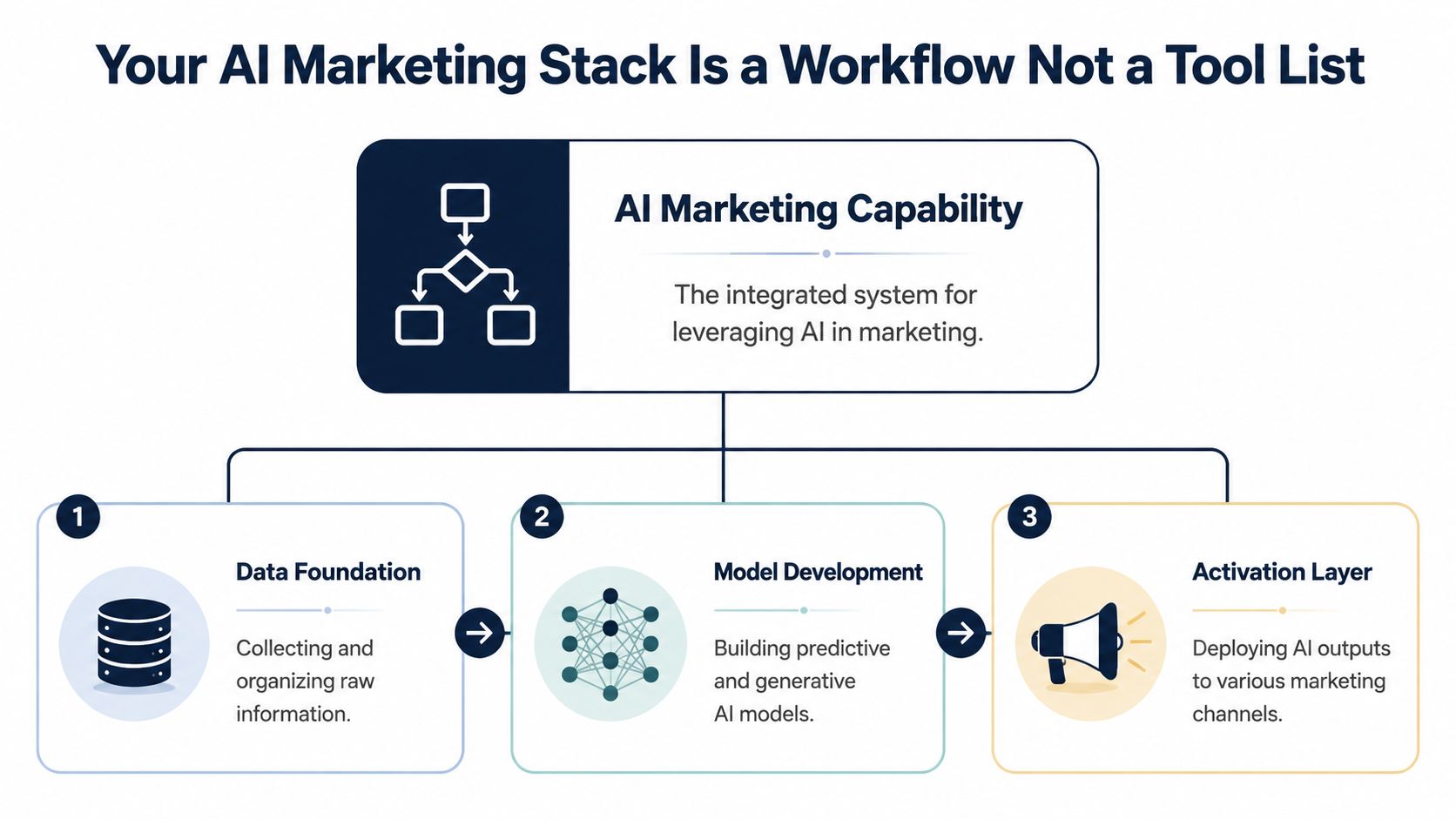
Think in layers.
First is the data layer. That includes CRM records, product usage, campaign engagement, website behavior, sales notes, support signals, and customer attributes. If this layer is fragmented or dirty, the rest of the system produces bad recommendations faster.
Second is the intelligence layer. In this layer, models classify, score, summarize, cluster, and recommend. Sometimes that sits inside HubSpot, Salesforce, GA4, or your warehouse workflows. Sometimes it's handled through external tools. The exact setup matters less than the logic.
Third is the activation layer. That's where the model outputs shape what happens next in email, paid media, outbound, on-site experiences, and sales routing.
Here's the only question that matters. Can a signal travel from customer behavior to business action without getting lost, delayed, or distorted?
There isn't one right answer. There is a right answer for your stage.
| Option | Better for | Risk |
|---|---|---|
| Integrated platform | Lean teams that need speed and easier adoption | Less flexibility and weaker customization |
| Modular stack | Teams with stronger ops, clearer requirements, and internal technical support | More integration burden and governance complexity |
Early-stage companies should usually bias toward simpler systems. You don't need an elaborate architecture if you still haven't nailed the motion. Complexity before clarity is a tax.
The bigger mistake is treating hyper-personalization as automatically good. CMS Wire argues that AI enables dynamic content and customized experiences, while warning that marketers need governance to avoid fragmented messaging and diluted positioning in its roadmap for AI in marketing. In B2B, that risk is real. Buying committees need a coherent story. If every touchpoint says something different, personalization becomes sabotage.
A practical workflow should include clear rules:
If you're designing that operating logic, marketing automation workflow is the right frame. The tools matter. The sequence matters more.
Founders waste money on AI when they treat it like a software rollout instead of a go-to-market learning system.
Your job is not to "adopt AI." Your job is to shorten the time between market signal, message change, sales action, and pipeline feedback. If AI does not help you validate positioning faster, qualify demand better, or improve deal quality, it is overhead.

Start with the systems that define reality in your GTM motion. Lifecycle stages, campaign names, CRM hygiene, call note capture, attribution rules, and ownership across marketing, sales, and ops all need to be stable enough to trust. If those inputs are messy, AI will produce faster guesses and cleaner-looking nonsense.
Early-stage teams have another issue. The founder often holds the best market judgment, but that judgment sits in conversations, inbox threads, and gut calls rather than in a system. Document it. What patterns make a deal feel real? Which objections signal a bad-fit account versus a late-stage concern? Which buyer language shows urgency? Those are the raw materials for your first AI use cases.
Use this checklist before you launch anything:
The first pilots should improve decisions, not just output volume.
Good starting points include transcript analysis to identify repeated objections, lead scoring models that help reps rank follow-up, landing page tests based on segment-specific pain points, and campaign analysis that shows which messages attract low-fit versus high-fit pipeline. Each pilot needs one question behind it. Which persona converts with urgency? Which problem statement gets meetings with the right accounts? Which intent signals deserve sales time?
That is how you build an AI program that supports a real B2B SaaS go-to-market strategy, instead of a content factory disconnected from revenue.
Big Moves Marketing can help structure these pilots around positioning, messaging, website paths, and channel testing. The point is not more experiments. The point is a tighter feedback loop between market response and pipeline decisions.
A pilot matters only after it changes behavior.
If transcript analysis keeps surfacing security objections, that insight should update sales talk tracks, page copy, outbound messaging, and qualification criteria. If a scoring model consistently identifies better-fit accounts, SDR queues should change. If campaign response patterns show that one segment clicks but never books, paid spend and nurture logic should change too.
Here is what a working loop looks like:
That loop is the engine. It turns AI from a production tool into a validation system.
To ground the operating model, this overview is worth watching:
Governance starts before the first serious mistake.
Set rules for model access, prompt review, claim approval, brand controls, experiment design, and human approval points. In founder-led and early GTM motions, keep humans close to anything that affects positioning, pricing communication, enterprise outreach, and high-intent lead routing. Those decisions shape revenue quality. They should not be handed to an unmonitored system.
One rule matters more than the rest.
Do not automate judgment you have not defined.
The teams that get value from AI follow a simple pattern. Clean inputs. Tight pilots. Workflow changes. Hard review gates. That is how you build an AI-enabled go-to-market engine that improves pipeline, not just activity.
Most AI reporting is junk.
Teams report how many drafts were created, how much time was saved, how many variations were tested, or how much content was published. Those metrics may matter operationally, but they don't justify investment to a founder, CFO, or board. Revenue leaders care about pipeline quality, conversion, and payback.
BCG notes that most companies are still in early stages of AI adoption, focused on foundational readiness and selected use cases rather than full transformation, which creates a practical attribution gap in its framework for AI-powered marketing.
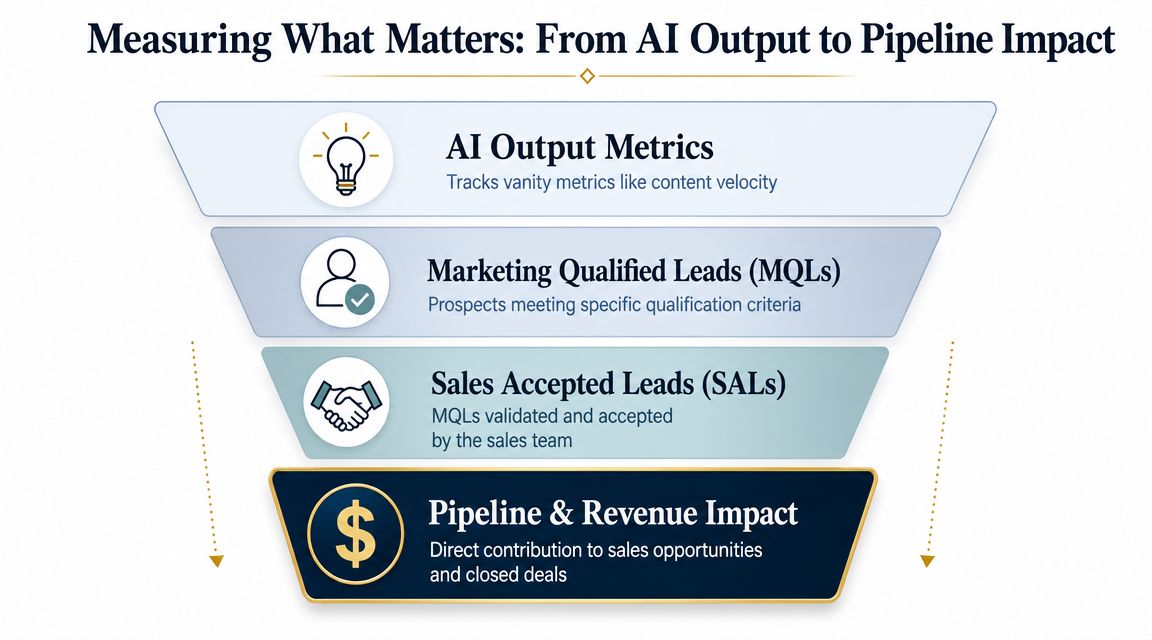
There's nothing wrong with tracking output. Just don't confuse it with business results.
If AI helped your team write faster, that's an efficiency signal. It is not evidence that AI improved pipeline. The distinction matters because founders often fund AI tools on the assumption that productivity will convert into growth. Sometimes it does. Sometimes it just creates more assets that nobody needed.
Here's a cleaner framework:
| Measurement tier | What it tells you |
|---|---|
| Output | How much work AI helped produce |
| Operational efficiency | Whether work happened faster or cheaper |
| Funnel movement | Whether buyer progression improved |
| Revenue impact | Whether pipeline quality or closed-won outcomes improved |
For early pilots, I'd track leading indicators that sit close to the use case. If AI is improving segmentation, look at meeting quality, sales acceptance, and opportunity creation by segment. If AI is shaping message testing, look at conversion differences between controlled variants. If AI is changing lead prioritization, track response speed and progression from accepted lead to qualified pipeline.
A few practical rules help:
If you can't explain how an AI experiment should affect a funnel stage, you're not running a growth test. You're running software theater.
Lagging indicators still matter. Over time, you want to know whether AI-assisted improvements show up in opportunity rates, sales cycle quality, pipeline efficiency, and CAC payback. But don't jump there too early. First prove the local mechanism.
If your team needs a stronger measurement discipline, how to measure marketing ROI is the right starting point.
Marketing-only AI is a dead end in B2B SaaS.
If the insights never reach sales, they don't affect revenue. The point isn't to replace reps with bots. It's to give reps better context before they speak to an account. Better timing, better talk tracks, better prioritization.
Generic personalization is cheap now. Everyone can insert company names, role titles, and industry references into outbound copy. Buyers see through it instantly.
What sales teams need is contextual intelligence. Which pain points did this account engage with. Which objections show up repeatedly in similar accounts. Which assets signal evaluation instead of casual research. Which stakeholder seems to be shaping the process.
That kind of support can show up in the CRM as:
Salesforce's marketing statistics page ties the business case for AI to efficiency and personalization. It reports that AI-powered content creation can reduce the time to write long-form content by 30 to 40 percent, 64% of businesses believe AI will help deliver a more personalized customer experience, and 49% of US generative AI decision-makers expect a return within 1 to 3 years in its collection of marketing statistics. In sales enablement terms, that only matters if the personalization improves conversations, not just formatting.
This is the operational step often overlooked.
Sales should feed outcomes back into the AI system. Which messages attracted poor-fit buyers. Which objections blocked progression. Which segments looked promising but stalled repeatedly. Without that loop, the model keeps rewarding shallow engagement and the marketing team keeps optimizing noise.
A simple rhythm works:
That's how AI becomes a shared revenue asset instead of a siloed marketing toy.
If AI ownership sits with the youngest person on the team because they know which tools are trending, you are not building a growth system. You are running software demos.
The founder has to own the AI brief because this is really a company learning problem. AI changes how quickly you can test positioning, spot weak demand, tighten ICP definition, and decide which messages deserve more budget. That has direct consequences for pipeline quality.
The mistake is treating ai digital marketing as a content production upgrade. More output is easy. Better judgment is harder, and far more valuable.
Use AI to pressure-test the questions that determine whether go-to-market works:
That is the standard.
A good AI setup helps the team learn faster than the market shifts. It should speed up feedback from campaigns, sales calls, and pipeline movement so you can cut weak bets early and put resources behind signals that convert. If your AI efforts are not improving targeting, qualification, message clarity, or sales readiness, they are adding noise.
Founders should also set the operating rules. Define what data gets used, who reviews outputs, where human judgment overrides the model, and how success gets measured against revenue stages. Without that discipline, teams default to vanity metrics and polished assets that do little to improve win rates.
AI should function as a co-pilot for GTM judgment. It should help you validate demand faster, improve pipeline quality, and make smarter calls about where to focus.
If you need a sharper AI GTM strategy, clearer positioning, or a way to connect marketing experiments to actual pipeline, Big Moves Marketing helps B2B SaaS teams tighten the message, structure smarter go-to-market pilots, and build growth systems that support revenue decisions instead of vanity output.
Explore Big Moves Marketing services and resources:




%20-%20white.svg)