%20png%20copy.avif)
Most demand generation is motion, not progress. It’s the flurry of activity B2B SaaS teams mistake for achievement: more content, more ad spend, more outreach. This default playbook, amplified by a thousand marketing blogs, celebrates vanity metrics while the pipeline remains dangerously thin. It leads founders to burn capital and exhaust their teams chasing disconnected tactics that fail to compound.
The core failure isn't a lack of effort. It's a lack of strategic clarity. The common approach treats all demand generation strategies as interchangeable parts, encouraging leaders to simply 'do more' without a coherent system. This creates noise, not leverage. It’s the difference between frantically treading water and building a powerful engine that propels the business forward. True progress comes from making deliberate, opinionated choices about how you create demand, not just how much activity you generate.
This is not another checklist of generic 'best practices.' Instead, this is a strategic breakdown of 10 distinct models for building a defensible demand engine. For each, we will dissect the first principles, the necessary trade-offs, and the specific implementation required to move from motion to momentum. It’s a guide for founders and revenue leaders who have tried the common playbooks, grown skeptical, and are ready to make smarter, more decisive bets on growth.
Most startups default to wide-net demand generation, celebrating top-of-funnel volume while ignoring its quality. This "more is better" approach burns cash and demoralizes sales teams who chase unqualified leads. Account-Based Marketing (ABM) inverts this broken model. Instead of marketing to the masses and hoping the right accounts show up, ABM starts with identifying your highest-value target accounts and marketing to them as a market of one.
This is not just another B2B tactic; it is a fundamental shift in GTM strategy. It forces alignment between marketing and sales, compelling them to agree on a finite list of dream customers. Resources are then concentrated on understanding these specific accounts' pain points, buying committees, and internal politics, enabling deeply personalized, multi-channel engagement that a generic inbound funnel could never replicate.

ABM is one of the most effective demand generation strategies when dealing with high-value contracts and complex sales cycles. It eliminates waste by focusing budget and effort exclusively on accounts with the highest revenue potential. For founders struggling to land their first enterprise logos or expand into a new vertical, ABM provides a disciplined framework for cracking strategic accounts. To dive deeper into this targeted approach, you can learn more about What Is Account-Based Marketing (ABM)? and how it drives significant pipeline influence.
Most startups treat content as a lead-generation machine, churning out SEO-optimized articles and gated assets to fill the top of the funnel. This volume-first approach mistakes activity for progress, creating a library of generic advice that attracts low-intent traffic and fails to build genuine authority. True demand generation through content isn't about winning keywords; it's about winning trust by becoming the most insightful resource in your category.
This requires a shift from content production to intellectual capital development. Instead of asking "what keywords can we rank for?", ask "what unique perspective can we own?". Thought leadership isn’t about founders sharing opinions on LinkedIn; it’s a deliberate strategy to educate the market, shape industry conversations, and demonstrate expertise so profoundly that high-value prospects conclude you're the only logical choice to solve their problem. It's the difference between being a vendor and being an indispensable advisor.

Content and thought leadership are foundational demand generation strategies for companies with complex solutions or those creating a new category. It builds an audience that is predisposed to trust you before they ever speak to sales. For founders selling to skeptical, sophisticated buyers, demonstrating deep domain expertise through insightful content is non-negotiable. It shortens sales cycles by pre-educating prospects on your methodology, ensuring they arrive ready for a strategic conversation, not a product demo. To truly succeed in generating demand through content, it's vital to first define what is content marketing strategy before investing in execution.
Most B2B teams treat LinkedIn as a digital resume book or a high-volume spam cannon. They either do nothing, letting profiles gather dust, or they deploy low-effort automation that alienates prospects and damages their brand. This misses the platform's true power: it is the single most valuable public database of professional intent and relationships ever created. Social selling isn't about blasting InMails; it’s about surgically building trust where your buyers are already congregating.
True LinkedIn outreach bridges the gap between cold prospecting and warm relationship-building. It transforms your sales and leadership teams from anonymous vendors into recognized voices in your market. By combining strategic, personalized engagement with insightful content sharing, you create a system for generating demand that feels less like a sales pitch and more like a valuable conversation. This is how modern B2B relationships are built and high-value deals are initiated.
For SaaS companies with a clearly defined ICP, LinkedIn offers unparalleled targeting precision. It allows you to bypass gatekeepers and directly engage the exact decision-makers and influencers within your target accounts. This is one of the most direct and capital-efficient demand generation strategies for founders navigating founder-led sales or for sales teams trying to break into new verticals. Instead of waiting for inbound interest, you proactively create it by establishing relevance and authority, one thoughtful interaction at a time.
Traditional demand generation treats the product as the prize at the end of a long, sales-led journey. Marketing captures leads, sales qualifies them, and only then does a prospect experience the software. Product-Led Growth (PLG) upends this model by making the product the primary vehicle for customer acquisition. It shifts the GTM focus from selling to a committee to empowering the end-user to discover value on their own terms.
PLG is not just about offering a free trial; it is a fundamental go-to-market motion that places the product at the center of the customer lifecycle. Instead of gating value behind demos, PLG provides immediate access, allowing the software’s inherent value to drive adoption and expansion. This self-serve motion creates one of the most powerful and efficient demand generation strategies, scaling user acquisition far beyond the limits of a traditional sales team.
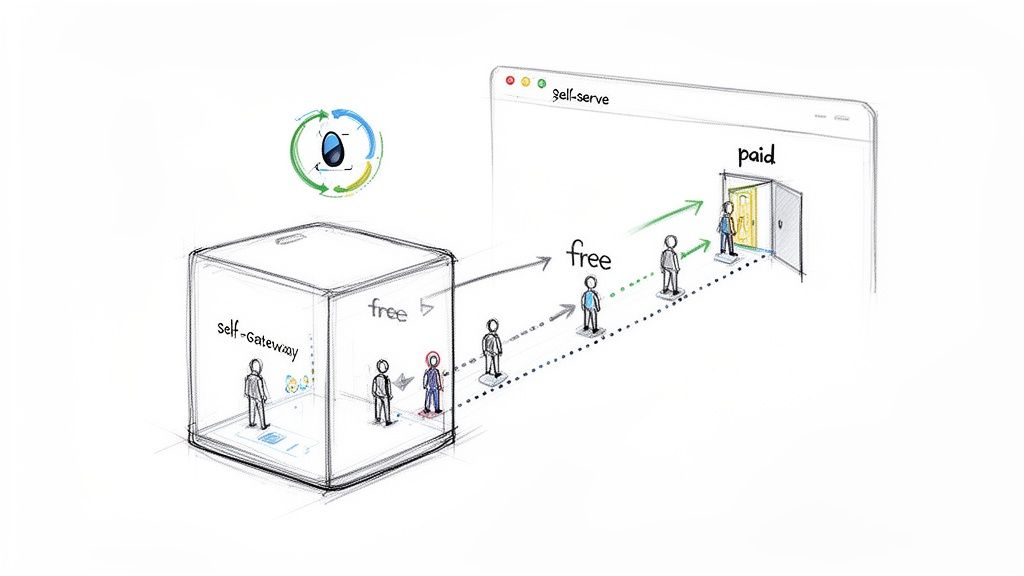
PLG excels in markets where users can quickly experience a "magic moment" of value. For companies like Slack, Calendly, and Figma, the product itself became the marketing engine, creating viral loops and organic growth that paid acquisition could never match. This approach dramatically lowers customer acquisition costs and shortens sales cycles by letting motivated users qualify themselves. For more on this, see how top PLG companies are built.
Most startups treat webinars as a glorified PowerPoint with a lead form attached. They deliver a generic, product-heavy pitch, wonder why engagement is low, and then blame the format. This approach completely misses the point. Effective virtual events aren't monologues; they are leveraged moments of authority that create, not just capture, demand. They serve as a scalable way to educate an audience on a critical problem you solve better than anyone else.
The goal isn't to host a webinar. It's to own a conversation. By shifting the focus from a sales pitch to a genuine educational experience, you transform the dynamic. Instead of being a vendor trying to sell a tool, you become a trusted advisor sharing valuable insights. This builds the social capital necessary to be considered when a buying cycle begins, making webinars one of the most powerful demand generation strategies for complex B2B SaaS solutions.
For products with a longer or more considered sales process, webinars provide the perfect mid-funnel platform to demonstrate expertise and build trust at scale. They allow you to control the narrative around a specific market problem, educate prospects on a better way to solve it, and subtly introduce your product as the logical solution. Brands like HubSpot built their empires by consistently delivering high-value educational content through webinars, conditioning their audience to turn to them for answers.
Most startups treat paid advertising as a vending machine for leads, pouring budget into Google and LinkedIn expecting predictable output. This transactional mindset leads to wasted spend, diminishing returns, and a constant battle for lower cost-per-lead. The fundamental error is viewing paid channels as simple lead capture mechanisms instead of powerful tools for market influence and intelligence gathering.
Effective paid advertising is not about winning keyword auctions; it's about renting access to hyper-targeted audiences to test messaging, validate GTM hypotheses, and accelerate pipeline velocity. It allows you to place a specific message in front of a specific buyer persona at a specific company, instantly. This capability provides a speed and precision that organic channels can take months or years to achieve, making it an indispensable part of a modern demand generation strategy.
Paid channels offer unmatched control and scalability. While SEO and content marketing build long-term assets, paid ads generate immediate feedback and traffic from high-intent buyers searching for solutions right now. For SaaS companies needing to hit aggressive growth targets, validate a new market position, or drive registrations for a key event, paid advertising provides the necessary velocity. It’s a direct lever on pipeline that, when managed with discipline, can be tuned to deliver predictable results.
Most startups view partnerships as an opportunistic, low-priority channel. This is a strategic error. Done right, partnerships are not a side project; they are a capital-efficient GTM motion that borrows trust and hijacks the distribution channels of established players who already serve your Ideal Customer Profile. Instead of building an audience from scratch, you tap into one that’s already built.
This approach bypasses the ever-increasing noise and cost of traditional paid channels. It allows you to enter new markets or ecosystems with instant credibility, piggybacking on a partner's established brand equity. For B2B SaaS, this means embedding your solution into a workflow your prospects already use and trust, transforming your product from a "nice-to-have" into an essential component of their existing tech stack.
Strategic partnerships are one of the most potent demand generation strategies for accelerating market penetration and building a defensible moat. Companies like HubSpot and Shopify built empires not just on their products, but on vibrant partner ecosystems. These relationships generate a consistent, high-quality stream of referred customers who arrive with a baseline level of trust, dramatically shortening sales cycles. This strategy is particularly effective for platforms aiming to become the central nervous system for their niche.
Most SaaS startups treat email as a volume game, blasting generic newsletters and "just checking in" sequences that burn their domain reputation and train their audience to ignore them. They see email as a free distribution channel, not as a strategic tool for building trust and guiding high-value prospects through a complex decision-making process. This lazy approach creates noise, not pipeline.
Effective email marketing is not about batch-and-blast. It is a system of strategic communication designed to deliver the right message to the right person at the precise moment it becomes relevant. From the cold outreach that earns a reply to the onboarding sequence that drives user activation, every email must serve a purpose. It's about segmenting with discipline and personalizing with intent, transforming an overused channel into one of your most effective demand generation strategies.
For B2B SaaS, particularly those with longer sales cycles, email is the connective tissue of the entire go-to-market motion. It is the most reliable channel for nurturing leads captured from other sources, maintaining engagement with prospects not yet ready to buy, and driving specific actions like demo requests or trial sign-ups. Companies like Superhuman and Slack built powerful growth engines by mastering email, using highly personalized, behavior-driven sequences to guide users from initial interest to deep product adoption.
Most startups view referrals as happy accidents—a passive benefit of a good product. This is a critical error in judgment. Leaving your most potent acquisition channel to chance means ignoring a powerful, scalable engine for high-trust growth. A formal referral and advocacy program transforms satisfied customers from passive fans into an active, motivated extension of your sales and marketing team.
This isn't about simply asking for introductions. It's about building a system that operationalizes trust. Prospects acquired through referrals arrive with built-in social proof, bypassing the skepticism that plagues cold outreach and generic inbound funnels. They convert faster, cost less to acquire, and often exhibit higher lifetime value because they start from a position of inherited confidence in your solution, making it one of the most capital-efficient demand generation strategies available.
For SaaS companies that have achieved strong product-market fit, advocacy programs are a force multiplier. While paid ads fight for attention and content marketing builds authority over time, referrals tap directly into existing customer relationships to generate immediate, high-intent pipeline. This strategy is particularly effective for products where inherent network effects make sharing the product a natural behavior that a formal program can amplify and reward.
Many founders view events as a costly distraction, a necessary evil for brand visibility that rarely delivers clear ROI. They send junior teams to scan badges at a booth, collecting a list of low-intent "leads" that sales rightfully ignores. This approach mistakes presence for impact and treats events as a channel for lead volume, not strategic relationship building. The real value isn't in the booth traffic; it's in earned authority and targeted access.
Events are one of the few remaining forums where you can command the undivided attention of your ideal customers. A well-executed speaking slot or a series of pre-scheduled meetings accomplishes more in 48 hours than months of cold outreach. This is not about handing out swag; it is a concentrated GTM motion designed to build trust, demonstrate expertise, and open doors with key accounts in a high-context environment.
For B2B SaaS companies with a complex sale or a new product category, events are one of the most effective demand generation strategies for building market credibility. Placing your founder or top executive on stage instantly positions your company as a thought leader, not just another vendor. This authority is a powerful differentiator that shortens sales cycles. It provides a rare opportunity to connect directly with decision-makers, gather raw market intelligence, and forge partnerships that are impossible to build over email.
We have dissected ten distinct demand generation strategies, from the surgical precision of ABM to the self-serve efficiency of PLG. Each represents a valid path to market, but the central truth is this: you cannot walk them all at once. An effective demand engine is not an accumulation of tactics; it is a coherent system born from deliberate, often difficult, choices.
Attempting to layer a high-touch ABM motion on a low-ACV PLG product creates friction. Pouring capital into paid ads before establishing a clear point of view through content marketing is a costly way to shout into the void. The strategies detailed here are building blocks, not a checklist. The critical error most founders and marketing leaders make is mistaking activity for progress.
The pressure to "do more" is immense. It comes from boards, from competitors, and from within. It leads to fragmented efforts, diluted messaging, and a team stretched too thin to achieve excellence in any single channel. The result is a demand generation function that is complex but not powerful, busy but not effective.
Your goal is not to have a "presence" everywhere. Your goal is to create disproportionate impact somewhere. This requires a ruthless focus that can only come from a deep understanding of your own unique context:
The most successful demand generation strategies are those that become self-reinforcing systems. A strong thought leadership position fuels your social selling efforts on LinkedIn. An elegant PLG motion generates advocates for your customer referral program. A targeted virtual event provides the perfect audience for a high-intent email nurture sequence.
This is the shift in thinking you must make. Stop asking, "What else can we add?" and start asking, "What is the single most powerful lever we can pull that makes everything else easier?" This question forces you to confront trade-offs and commit to a primary motion. It moves you from chasing a scattered portfolio of tactics to building a singular, powerful growth engine.
Mastering these demand generation strategies is not about technical execution alone. It is about developing the strategic clarity to select the one or two approaches that align perfectly with your company's reality. That is not just marketing; it is company-building. Your choice architecture defines your growth trajectory. Choose with intention.
Tired of chasing tactical wins without a clear GTM strategy? Big Moves Marketing helps B2B SaaS founders and leaders move from a fragmented list of tactics to a coherent, high-leverage demand generation system. We provide the strategic clarity to help you make the right choices and build a growth engine that scales. Learn more at Big Moves Marketing.
Explore Big Moves Marketing services and resources:




%20-%20white.svg)