%20png%20copy.avif)

Most B2B SaaS founders hire salespeople based on the wrong signals: past performance at a big-name company, a confident pitch, or charisma. These are lagging indicators, not predictors of success within your specific context. The common playbook says to find reps who can ‘sell anything.’ This is a dangerous myth. You need reps who can diagnose specific problems, articulate nuanced value, and navigate complex buying committees for a product that is still evolving.
The fundamental question isn't just 'what makes a good salesperson?' It’s what makes a salesperson effective at translating your product's potential into predictable revenue. Most teams get this wrong. They hire for closing ability when they should be hiring for diagnostic precision and positioning discipline. This miscalculation leads to missed quotas, bloated sales cycles, and a team that burns through cash without building a scalable revenue engine. It’s why so many promising products fail to gain market traction; the go-to-market motion is built on a flawed understanding of what great selling actually requires.
This article breaks down the 10 non-negotiable traits that separate top-tier B2B SaaS salespeople from the rest. These aren't abstract qualities. They are observable, coachable, and directly tied to pipeline velocity and win rates. Forget the clichés about ‘hunters’ and ‘farmers.’ We’re going deeper to give you a framework for identifying, interviewing, and developing the reps who can actually move the needle for your business. This is your blueprint for building a sales team that doesn't just sell, but wins.
Most underperforming sales reps think discovery is a checklist of questions to get through before they can start pitching. Elite performers know discovery is the sale. The ability to deeply understand a prospect's operational reality, hidden costs, and political landscape is what separates a transactional vendor from a strategic partner. This isn't about being a better talker; it's about architecting a better conversation. What makes a good salesperson in B2B SaaS is their capacity to map the prospect's problem so clearly that their solution becomes the only logical conclusion.
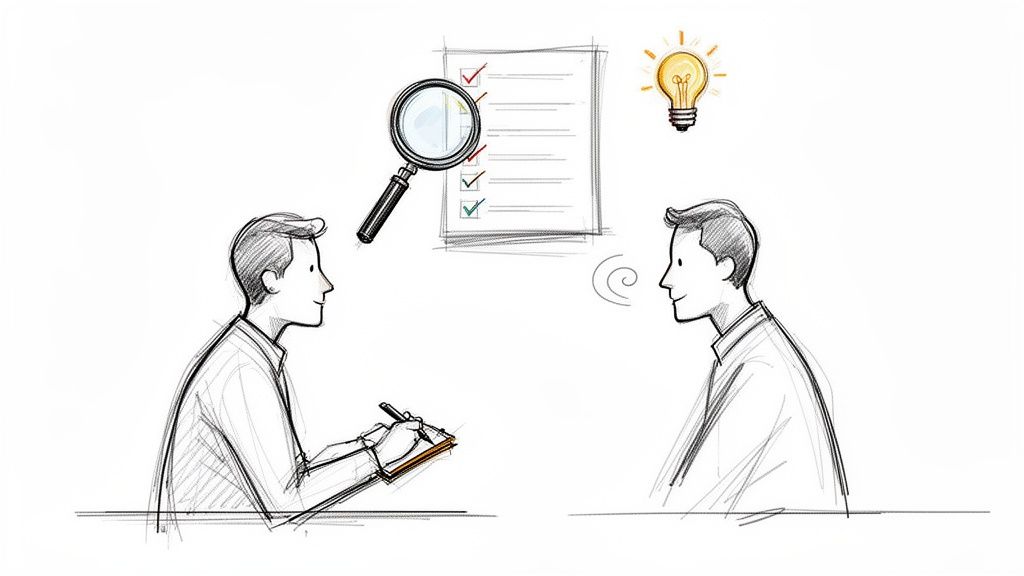
This skill goes beyond simply asking "what are your pain points?" It involves dissecting business processes to find the second-order consequences of inaction. For instance, a Datadog account executive won't just ask about server downtime. They will dig into the cost of that downtime: engineering hours wasted on firefighting, customer churn from reliability issues, and delayed feature releases. They quantify the problem in terms the CFO understands, not just the CTO.
The goal of discovery isn't to qualify the prospect for your product. It's to help the prospect qualify the true cost of their problem. When done right, you co-create the business case.
Weak discovery is a primary driver of stalled deals and steep discounts. To build this muscle across your team, stop treating it as an art form and start treating it as a science.
By mastering discovery, you shift the conversation from your product’s features to your prospect’s business outcomes. True discovery skills are a foundational pillar of modern B2B growth, shaping not just sales but your entire go-to-market strategy.
In a world of complex B2B SaaS and AI, shallow product knowledge is a deal-killer. Any rep can recite a feature list, but what makes a good salesperson is the ability to connect that functionality to a prospect's technical reality and business objectives. Elite reps don’t just sell a product; they demonstrate a deep, credible understanding of the ecosystem their product lives in. This technical fluency is the bridge between what your product does and why a CTO or Head of Engineering should care. It’s what transforms a sales pitch into a credible technical consultation.
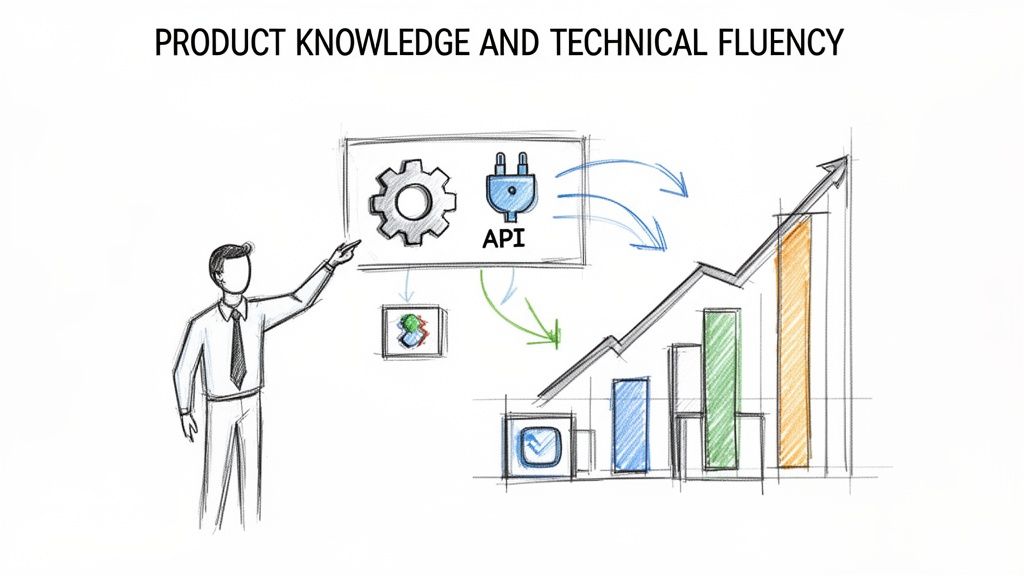
This goes far beyond knowing button-level features. A Stripe account executive must be able to discuss payment processing architecture, PCI compliance, and settlement mechanics. An OpenAI enterprise rep needs to explain token pricing, fine-tuning models, and API rate limits with confidence. They don't need to be engineers, but they must speak the language of their technical buyers to build trust and disarm skepticism. This capability allows them to lead the conversation, not just react to it.
True product fluency isn't about knowing every feature. It's about knowing which three features solve the buyer's multi-million dollar problem and being able to explain the technical 'how' with conviction.
Technical credibility isn't an innate talent; it’s a systemized skill. It prevents reps from defaulting to "let me get back to you," which erodes momentum and signals a lack of expertise.
By arming your sales team with genuine product and technical depth, you equip them to move beyond feature-selling and become trusted advisors who can confidently guide technical stakeholders toward a solution.
Transactional reps close deals. Top-tier salespeople build empires. They understand that in B2B SaaS, the initial sale is not the finish line; it's the starting block for a multi-year partnership with compounding returns. The real value is unlocked through renewals, expansion, and advocacy. What makes a good salesperson is their ability to see beyond the immediate commission and cultivate genuine, trust-based relationships that turn customers into a strategic asset for the business. This isn't about sending gift baskets; it's about becoming an indispensable part of the customer’s success.
This long-term mindset fundamentally changes a rep’s behavior. Instead of disappearing after the contract is signed, they stay involved. They connect their customers with other valuable contacts, share relevant industry insights, and actively look for new ways their product can solve emerging problems. Consider how Twilio’s best account executives remain engaged post-sale; they don’t just wait for an expansion request. They proactively identify new use cases within the account, effectively acting as internal champions for their own product and driving organic growth from the inside.
True relationship building isn't about being likable. It's about being valuable. It shifts the dynamic from a vendor asking for a budget to a partner co-creating a roadmap for future success.
Leaving relationships to chance is a recipe for churn and missed expansion revenue. To scale this capability, you must operationalize long-term thinking within your sales motion.
By embedding long-term thinking into your sales process, you stop selling a product and start selling a partnership. You build a defensible moat of trust that competitors can't easily cross, ensuring a durable revenue stream and a powerful engine for advocacy.
Mediocre sales reps view objections as roadblocks; elite reps see them as detours that reveal a better path to the deal. In complex B2B sales cycles, a "no" is rarely a final answer. It’s a signal of a misunderstanding, a hidden priority, or an unaddressed risk. What makes a good salesperson is not their ability to argue a point, but their resilience in absorbing pushback and reframing it as a prompt for deeper discovery. They treat objections not as rejection, but as requests for more information.
This skill is crucial in multi-stakeholder deals where conflicting priorities are the norm. When a VP of Engineering objects to a new tool on grounds of implementation complexity, a top performer doesn't just defend their onboarding process. They ask questions to understand the source of that fear. Perhaps the team is burned out from a failed implementation of another product. The objection isn't about your product; it's about their team's capacity and past trauma. This is what separates partners from vendors.
An objection is the prospect’s way of saying, "You haven't connected the dots for me yet." The best reps welcome this, using it to diagnose the gaps in their narrative and strengthen the business case.
Resilience can’t be taught, but a systematic approach to handling objections can be installed. This builds confidence and prevents reps from getting discouraged during long sales cycles.
The B2B SaaS buying process is not a rational calculation; it is a human drama filled with fear, ambition, and political risk. What makes a good salesperson is the ability to navigate this emotional undercurrent. Elite reps understand that logic and data build the business case, but empathy and emotional intelligence (EQ) get the contract signed. They recognize that a champion fears looking incompetent, a CFO is skeptical of another vendor's promises, and an end-user dreads a disruptive implementation.

High-EQ selling means addressing these unspoken anxieties directly. When a prospect goes silent, the average rep sends a "just checking in" email. The emotionally intelligent rep sends a note acknowledging the pressure of a big decision and offers to help navigate internal conversations. They build relationships grounded in genuine helpfulness, moving beyond a transactional script to become a trusted advisor. For a deeper understanding of how self-awareness and managing emotions can enhance your sales approach, explore the principles of emotional intelligence in leadership.
The goal of EQ in sales isn't to be liked. It's to be trusted. Trust is the currency that buys you access to the real problems, the real budget, and the real decision-makers.
EQ is often dismissed as a "soft skill," but its absence has hard costs: stalled deals, ghosting, and champions who won’t go to bat for you. Building this capability requires intentional systems, not just hiring for "people skills."
By embedding EQ into your sales process, you stop selling a product and start solving for the human factors that drive every significant business decision. This creates resilient deals that are less susceptible to price pressure and internal politics.
In fast-moving markets like B2B SaaS, the initial go-to-market strategy rarely survives first contact with the customer. While discipline is essential, rigid adherence to a failing script is a recipe for stagnation. What makes a good salesperson is not just their ability to execute a playbook, but their capacity to rewrite it based on real-time market feedback. Elite reps operate like a rapid iteration engine, constantly testing, learning, and adapting their approach.
This skill is about treating every sales interaction as a data point. When a certain messaging angle falls flat, a top performer doesn't just blame the lead quality; they dissect why it failed. They are the first to notice when a competitor’s new feature starts changing the conversation or when a new buyer persona emerges. For example, early sales teams at companies like Notion or Slack didn't find product-market fit by sticking to one pitch; they found it by rapidly testing different value propositions with different segments until the market pulled the product from them.
The best salespeople aren't just selling a product; they are active sensors for the go-to-market team. They close deals while simultaneously de-risking the company's growth strategy by finding what actually works.
Learning agility can seem like an innate trait, but it can be engineered into your sales culture. Stop rewarding reps only for closing deals and start celebrating the learnings that prevent future losses.
Mediocre reps send generic emails and hope for a reply. Elite performers show up to the first conversation knowing a prospect’s recent funding round, key strategic initiatives, and the name of the VP who just joined from a competitor. This isn't about stalking; it’s about demonstrating relevance from the first sentence. What makes a good salesperson effective is their ability to transform cold outreach into a warm, informed consultation, proving they've invested time before asking for the prospect's.
This skill is the engine of any modern Account-Based Marketing (ABM) strategy. A rep selling to a retail brand shouldn't just know they sell apparel; they should know the brand just launched a new loyalty program, is struggling with supply chain costs, and mentioned "omnichannel experience" in their last earnings call. Referencing these specific details is how you earn the right to a conversation, showing you've connected your solution to their visible business priorities.
Great outreach isn't about having a better template. It's about having better intelligence. The goal is to make the prospect feel understood before you've even met.
Uninformed outreach is a leading cause of damaged brand perception and low reply rates. To make research a scalable habit rather than a sporadic effort, embed it directly into your sales motion.
By operationalizing research, you turn a reactive sales function into a proactive, intelligence-led growth engine. You stop guessing and start engaging with precision.
Mediocre reps sell products; elite reps architect solutions. The shift from vendor to advisor is not a matter of semantics but a fundamental change in sales motion. Consultative selling is the ability to diagnose a prospect's entire business ecosystem and design a solution that addresses root causes, not just surface-level symptoms. What makes a good salesperson is their capacity to move beyond feature-function discussions and operate as a strategic partner, guiding the prospect through complex business and technical decisions. They don’t just push a product; they co-create a path to a better future state.
This approach is what separates transactional B2B players from enterprise partners. Consider Figma’s growth, which was driven not just by a superior product but by integrating design system consulting into the sales process. Their reps didn’t sell a tool; they sold a new operational model for design and engineering collaboration. Similarly, a top Workday account executive acts more like a change management consultant, helping prospects map out the organizational alignment needed for a successful ERP implementation, not just quoting software licenses.
True consultative selling isn't about having all the answers. It's about knowing all the right questions to ask to build the business case for the prospect, with the prospect.
Building a team of solution architects requires moving beyond product training and investing in business acumen. It’s about teaching reps to think like a COO or CFO, not just a power user.
Charisma closes deals, but discipline builds empires. Many sales reps view CRM updates and pipeline reviews as administrative chores that steal time from selling. Elite reps understand that rigorous pipeline management is selling. It is the operational backbone that turns individual wins into predictable revenue. The ability to manage a pipeline and forecast with precision is what makes a good salesperson a reliable asset, transforming them from a lone wolf into a core component of the company's growth engine. This isn't about micromanagement; it's about professional execution and creating visibility that the entire organization can depend on.
This skill separates the deal-chasers from the business-builders. A rep with poor pipeline hygiene might have a great month followed by a terrible one, creating whiplash for the company. A disciplined rep, in contrast, uses their pipeline as a diagnostic tool. They know their pipeline coverage, their average sales cycle, and which deals are at risk of stalling. They use tools like Salesforce and Outreach not just to log activities, but to strategically plan their next move, ensuring a consistent flow of opportunities moves toward close. This is how best-in-class SaaS companies like Stripe and Twilio build revenue functions that achieve over 95% forecast accuracy.
Accurate forecasting isn't about predicting the future. It's about controlling the present by applying a rigorous, data-informed process to your sales pipeline.
Inaccurate forecasts and anemic pipelines are symptoms of a broken process, not just a lack of effort. Building this discipline requires a system that rewards consistency and provides clarity.
By embedding pipeline management into your sales culture, you create a system of record that drives accountability and predictability. You shift from hoping for revenue to engineering it.
Average reps recite features from a spec sheet. Great reps articulate a point of view. The ability to translate your product into a clear, differentiated market position is what makes a good salesperson a true revenue driver, not just an order-taker. This isn't marketing's job alone; it's the rep's responsibility to internalize, adapt, and weaponize positioning in every conversation. They must connect the dots from product functionality to buyer-relevant outcomes, anchoring the entire sales cycle around a message that cuts through the noise.
This skill is the difference between competing on price and commanding a premium. For instance, a rep selling Notion doesn't just list its database and page features. They sell the 'All-in-One Workspace' that eliminates tool sprawl and information silos. A Figma seller doesn't talk about vector networks; they talk about 'Collaborative Design' that breaks down barriers between design and product teams. The product is the mechanism, but the positioning is the strategic narrative.
Reps who can't articulate positioning sell a commodity. Reps who master it sell a category of one. They don't just win deals; they define the buying criteria.
Inconsistent messaging creates market confusion and gives competitors an easy opening. To operationalize clear positioning, you must equip your sales team with the right assets and frameworks.
By arming reps with sharp, consistent messaging, you enable them to control the narrative, disqualify bad-fit prospects faster, and close deals based on strategic value, not a feature checklist.
| Capability | 🔄 Implementation Complexity | ⚡ Resource Requirements | 📊 Expected Outcomes | 💡 Ideal Use Cases | ⭐ Key Advantages |
|---|---|---|---|---|---|
| Active Listening & Discovery Skills | Medium — structured training and discipline | Low–Medium — rep time, coaching, call recordings | Better qualification, higher close rates, larger deals 📊 | Early-stage discovery, complex B2B deals | Builds trust, enables tailored value propositions ⭐ |
| Product Knowledge & Technical Fluency | High — deep product and architecture understanding | High — ongoing training, SE support, documentation | Faster technical closes, fewer escalations, lower buyer regret 📊 | Technical stakeholders, integrations, AI products | Credibility with engineers/CTOs; enables upsell ⭐ |
| Relationship Building & Long-Term Thinking | Medium–High — sustained multi-touch programs | Medium — CRM workflows, CSM collaboration, time investment | Higher LTV, stronger retention, advocacy generation 📊 | Strategic accounts, renewal-focused motion | Drives expansion, reduces churn, creates advocates ⭐ |
| Objection Handling & Resilience | Medium — practice, role-play, playbooks | Low–Medium — playbooks, coaching, analysis | Converts hesitant prospects, shortens resolution time 📊 | Competitive deals, pricing/security objections | Recovers deals, improves rep confidence and close rates ⭐ |
| Emotional Intelligence & Empathy | High — softer skills, harder to standardize | Low–Medium — hiring assessments, coaching | Stronger rapport, smoother committee navigation, fewer post-sale issues 📊 | C‑suite/founder selling, complex buying committees | Builds trust, eases negotiations, improves buyer comfort ⭐ |
| Adaptability & Learning Agility | Medium — requires feedback loops and experimentation | Medium — analytics, testing time, shared learnings | Faster PMF adjustments, improved win rates in changing markets 📊 | Rapidly evolving products/markets, GTM pivots | Enables rapid iteration and shorter ramp times ⭐ |
| Target Account Intelligence & Research | Medium–High — systematic research processes | High — intent tools, data subscriptions, analyst time | Higher outreach response, better qualification, larger deals 📊 | ABM, enterprise targeting, outbound campaigns | More targeted outreach and higher-quality pipeline ⭐ |
| Consultative Selling & Solution Architecture | High — senior-level skills and cross-team alignment | High — solution engineers, implementation planning, longer cycles | Larger deals, lower implementation friction, reduced churn 📊 | Enterprise deals, complex implementations | Positions reps as trusted advisors; drives expansion ⭐ |
| Pipeline Management & Forecast Accuracy | Medium — process discipline and regular reviews | Medium — CRM, ops, analytics, reporting cadence | Predictable revenue, early gap detection, improved planning 📊 | Scaling sales teams, forecasting and ops-led orgs | Provides visibility, accountability, and repeatability ⭐ |
| Positioning & Messaging Clarity | Medium — cross-functional alignment and iteration | Medium — marketing collaboration, testing and enablement | Shorter cycles, higher win rates vs alternatives, consistent messaging 📊 | Competitive markets, new rep onboarding, market launches | Clear differentiation, faster rep ramp, aligned GTM ⭐ |
We've dissected the anatomy of a high-performing B2B SaaS salesperson. We've explored the critical importance of active listening, the non-negotiable need for technical fluency, and the strategic power of consultative solution architecture. From resilience in handling objections to the forecasting precision required for pipeline management, the picture is clear.
But the most dangerous mistake a founder or revenue leader can make is to view this list as a simple hiring checklist. Searching for a "unicorn" who arrives with all ten attributes perfectly formed is a losing strategy. It’s a passive approach that cedes control of your revenue engine to the whims of the talent market.
The real insight is this: what makes a good salesperson is not an innate gift but a commitment to a process. The traits we’ve detailed are not fixed personality types; they are the teachable, measurable components of a scalable sales system.
An elite salesperson is a disciplined operator. They are someone who excels at discovery because your process demands it, masters the product because your enablement facilitates it, and communicates value because your positioning provides the language for it. They are not born; they are built. And they are built inside a structure that you, as a leader, must architect.
Your primary function is not to find top talent. It is to create the environment where such talent can be systematically developed, deployed, and replicated. This is the shift from talent scouting to system building.
A team of B-level reps executing an A-level sales system will consistently outperform a team of A-level "lone wolf" reps running a C-level (or nonexistent) process. Your system is the ultimate force multiplier.
Stop asking, "What makes a good salesperson?" and start asking, "What system will produce good salespeople for my specific market and product?" This requires you to focus on the inputs you control:
Chasing sales unicorns is an expensive, unreliable path to growth. It leads to inconsistent performance, tribal knowledge that walks out the door, and an inability to scale predictable revenue. The real work is less glamorous but infinitely more powerful: building the machine that manufactures success.
Focus on building the system. The right people will not only be attracted to it; they will be forged by it. This is how you stop competing on individual talent and start winning on operational excellence.
Tired of your sales team struggling to articulate your value? A weak go-to-market position is often the root cause. At Big Moves Marketing, we help B2B SaaS founders build the strategic clarity that makes sales conversations effective and predictable. See how we help companies build a stronger foundation for growth at Big Moves Marketing.
Explore Big Moves Marketing services and resources:


%20-%20white.svg)