%20png%20copy.avif)
Most B2B SaaS companies treat their website as a design project. That framing is expensive. A website is part of your go-to-market infrastructure, and its job is to turn unclear demand into qualified conversations, sales enablement, and pipeline.
Webflow matters because it lets marketing teams change the asset without waiting for every message, page, and experiment to become an engineering ticket. But the platform won't rescue weak positioning. A polished site with vague category language is still a growth constraint.
A redesign owned by a marketing manager and judged by internal taste usually produces a prettier bottleneck. The team debates colors, animations, and page layouts while buyers still can't answer three basic questions: Who is this for, what problem does it solve, and why should we believe you?
Revenue leadership should own the business case. The website needs to support the same positioning used in sales calls, paid acquisition, product launches, and investor conversations. If sales says the product reduces operational risk while the homepage says it “transforms workflows,” the site is creating friction rather than removing it.
That's why your website belongs in the same operating conversation as pipeline coverage and sales capacity. A buyer often reaches your site before speaking to a representative. The site has to make the next decision easier, whether that means requesting a demo, reviewing an integration, comparing use cases, or sharing the page internally.
Practical rule: If a website project has no defined revenue or pipeline job, it isn't a strategic project. It's decoration with a budget.
Webflow is the enabling layer, not the strategy. It gives teams visual control over page construction, content publishing, and reusable components. The commercial value appears when that control helps the company test positioning, publish relevant pages, support new segments, and remove avoidable dependencies.
The platform has also moved beyond its early reputation as a niche no-code product. Webflow surpassed 2 million users and 100,000 customers across 190 countries, and its Series C funding lifted its valuation to $2.1 billion, as reported in Webflow's company profile and growth overview. Those milestones don't prove that every Webflow build performs well. They do establish the platform as a mature option for global B2B teams.
Your first diagnostic should be strategic, not visual. Compare the pages that generate commercial intent with the claims your sales team uses. The gaps will tell you whether the current website needs a new design or a new point of view. The broader business case is covered in why the website is the heart of B2B SaaS growth.
Webflow is the practical middle ground for most B2B SaaS companies from Seed through Series C. WordPress can become a maintenance exercise full of plugins and conflicting ownership. A fully headless stack can provide control, but it often creates more coordination overhead than a growth team needs. Webflow gives marketing enough control to move while preserving a coherent system for design and content.
The first advantage is iteration speed. A product launch shouldn't require a queue of engineering work before marketing can explain the change. In Webflow, a team can build a landing page, revise a use-case page, or adjust a conversion path within the same visual system. The strategic benefit isn't that pages appear faster. It's that the company can respond to market feedback before the opportunity has gone cold.
The CMS creates a second advantage. Structured collections let teams manage repeatable content such as blog posts, customer segments, integrations, resources, or product pages. Webflow's CMS Data API documentation describes programmatic creation, management, and publishing of collection content, which supports external data integration and publishing automation. That matters when marketing, product, and localization teams need dependable workflows instead of manually rebuilding similar pages.
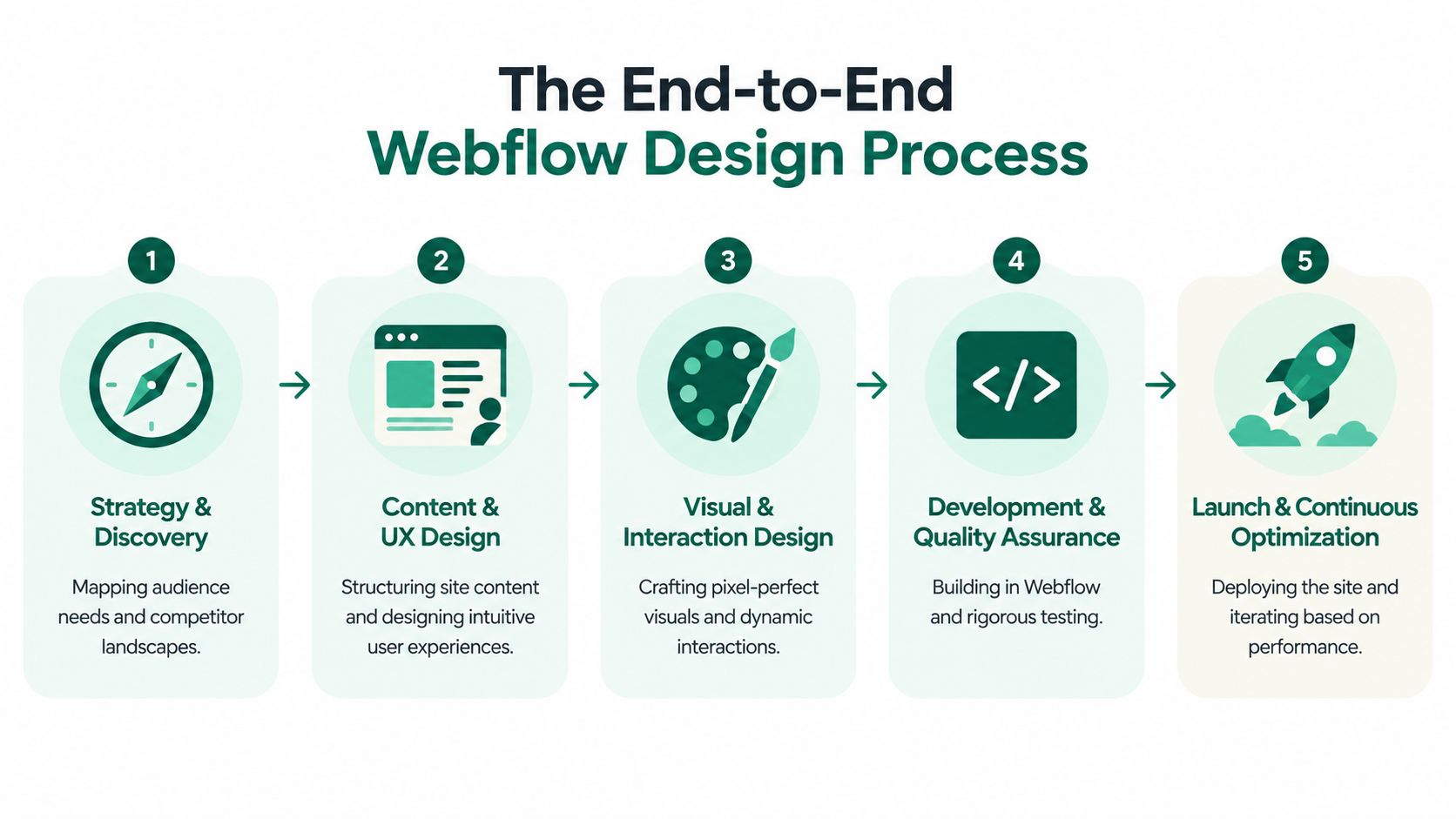
Webflow also makes governance possible through reusable components, controlled publishing, and consistent page structures. Without those decisions, visual flexibility becomes inconsistency. Every new marketer can create a slightly different version of the brand, the CTA, or the proof architecture.
Performance needs the same discipline. A comparative study using identical sites found that WordPress outperformed Webflow on most individual Lighthouse metrics, while Webflow performed better overall at the desktop breakpoint in both static and dynamic hosting tests, according to the comparative Webflow and WordPress performance study. The conclusion is useful: managed hosting can reduce deployment complexity, but asset weight, build choices, and breakpoint optimization still determine outcomes.
Webflow's adoption also reflects its relevance beyond startups. Independent vendor data from August 2026 reports Webflow usage among 20% of mid-market organizations and 17% of enterprise organizations in the web hosting and site builders category, as documented in Webflow adoption data by company size. Larger teams still need governance, content velocity, and lead-generation control. A platform that supports those needs earns a place in the operating model.
The mistake is selecting Webflow because the canvas feels easier. Select it because your growth team needs to control the message, publish without unnecessary engineering dependency, and improve the path from interest to action. That is the argument behind a disciplined content strategy for websites.
The strongest Webflow website design projects start before anyone opens the designer. A team that begins with page layouts usually inherits the assumptions of the existing site. A team that begins with the market can decide what the website must make buyers understand and do.
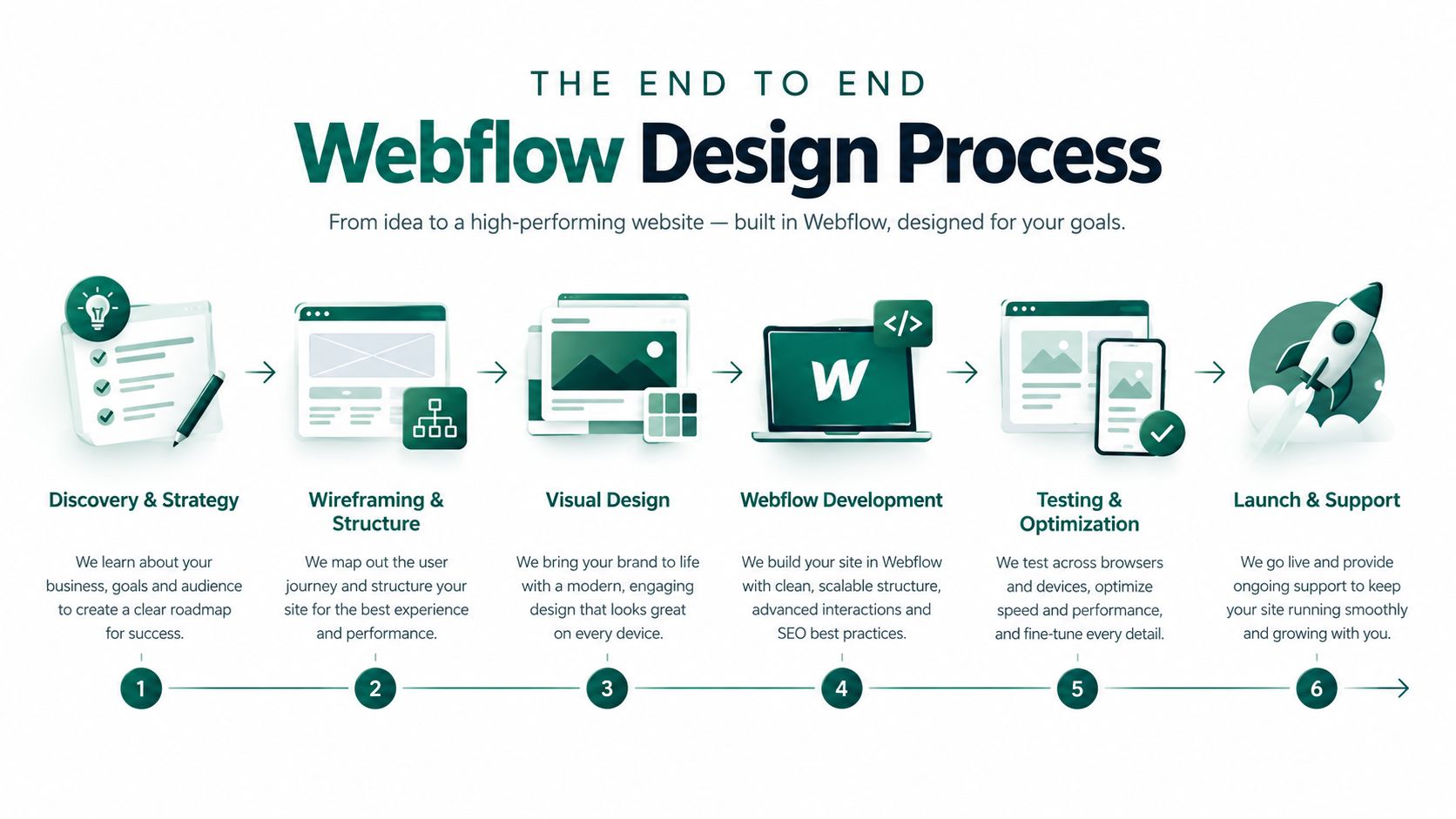
Audience and competitor mapping comes first. Define the economic buyer, daily user, technical evaluator, and internal blocker. Then compare how competitors describe the category, frame risk, present proof, and route visitors toward action. This work exposes overused claims and identifies the language your buyers already use.
The next step is a messaging framework, not a homepage headline workshop. Codify the problem, audience, category, differentiated value, proof, objections, and desired action. If your sales team needs five minutes to explain what makes the product different, your website won't solve the problem with stronger typography.
Design and development should express the framework. Build page types around buyer questions, not around the internal org chart. A product page can explain capability, but a use-case page should connect that capability to a business situation, a proof point, and a next step.
The CMS and SEO layer then determine whether the site can grow without losing coherence. Establish collection structures, naming conventions, internal linking, metadata ownership, redirects, semantic hierarchy, and reusable components before content volume expands. Machine-readable structure is becoming a commercial requirement, not a technical afterthought.
A scalable website is a content operating system with a visual interface.
Quality assurance should test more than broken links. Review responsive layouts, form routing, analytics events, page titles, indexing controls, accessibility, navigation logic, and the handoff between marketing and sales. A launch that looks correct on a laptop can still fail the buyer journey on another breakpoint or create untracked conversion activity.
After launch, measure the relationship between page behavior and commercial intent. Review which pages assist sales conversations, where qualified visitors exit, which use cases attract the right accounts, and whether new messaging changes the quality of inbound conversations. Don't reduce the scorecard to traffic. Traffic without fit creates work for sales, not pipeline.
A partner's portfolio can show craft, but it doesn't prove strategic competence. For a useful benchmark, review guidance on crafting a compelling design portfolio, then ask whether the partner can explain the decisions behind the work. The relevant standard for B2B SaaS is not visual novelty. It's whether the system helps buyers understand value and helps the team change course.
For teams evaluating an external build, the Webflow website service from Big Moves Marketing is one example of a delivery model that combines page structure, messaging, and Webflow deployment. The same evaluation should apply to any partner: strategy must precede production.
Website budgets fail when leaders treat scope as a page-count exercise. A site with a small number of pages can require substantial positioning work, while a larger CMS site can become efficient once the structure is sound. The investment should reflect the commercial problem, the number of audiences, the complexity of proof, and the publishing model.
A focused site for one clear audience can move quickly because it has fewer decisions to resolve. A broader site supporting multiple products, regions, industries, or buying committees needs stronger governance and content architecture. Paying for pages before resolving those variables creates rework.
Webflow's public Site plans make the platform constraints explicit. The Starter plan is free. Basic costs $15 per month when billed yearly or $25 per month when billed monthly, while Premium costs $25 per month when billed yearly or $39 per month when billed monthly, according to Webflow's pricing page. Those are platform subscription costs, not the total investment in strategy, copy, design, implementation, QA, and optimization.
The Premium plan includes 300 static pages, 20,000 CMS items, 40 CMS collections, and 50 GB bandwidth, as detailed in Webflow's pricing calculator. Those limits should shape the information architecture early. A team planning product, integration, industry, and resource collections needs to know how its publishing model fits the plan before content production begins.
Teams comparing external production options should evaluate the total operating trade-off, including senior strategic input, design quality, copy, and local hiring economics. A useful reference for assessing competitive offers in Latin America can add context to that decision, but price alone shouldn't determine the partner.
Conversion design starts with a clear next action. Put the CTA where the buyer has enough context to act, use forms that ask only for information the sales process needs, and place proof beside the claim it supports. Social proof isn't decoration. It reduces perceived risk when the buyer can't yet validate the product through a conversation.
SEO architecture should support understanding. Use semantic headings, descriptive page titles, useful internal links, structured content, and lightweight assets. Don't add motion because the builder makes it easy. Every interaction needs to help the buyer orient, compare, trust, or act.
Governance is the underused growth advantage. Webflow's 2026 State of the Website report says 52% of marketing leaders will prioritize optimization for AI-driven search, while poor governance is already limiting teams' ability to manage websites effectively, as described in the 2026 State of the Website report. A site built for machine-readable discovery needs reusable components, clear permissions, structured content, and an update workflow that survives team growth.
Migration is rarely a technical reset. It's a chance to remove the accumulated compromises that made the old site difficult to operate. The strongest migration plans preserve valuable search equity, clarify page ownership, rebuild the information architecture, and cut pages that no longer support the market.
That work needs evidence. Don't invent success stories to justify the platform, and don't accept a portfolio that hides the commercial result behind visual screenshots. Ask what changed in the buyer journey, how the team measured it, and which operating decisions made the result possible.
A typical failure pattern looks familiar. Product pages describe features, industry pages repeat the same copy, the blog operates separately from the main narrative, and sales sends custom explanations because the website doesn't answer serious buyer questions. Moving those pages into Webflow without changing the underlying logic transfers the problem.
A better migration creates a coherent system:

Webflow can support a more mature governance model. Webflow says its Enterprise offering includes SSO, SCIM, and SOC 2 Type II compliance, features that matter when marketing, product, operations, and regional teams share responsibility for the website, as outlined on Webflow Enterprise. Security controls don't replace sound ownership, but they reduce the friction of scaling access responsibly.
The migration decision should also account for performance rather than assuming the platform decides the outcome. The comparative research cited earlier found that hosting, assets, build choices, and breakpoint-specific optimization all matter. A Webflow build still needs performance budgets, image discipline, restrained interactions, and QA across real devices.
Your website should also make commercial information easier to find. Whether you publish pricing depends on the product, market, and sales motion, but the decision deserves analysis rather than habit. The case for showing pricing on B2B websites offers a useful way to evaluate that choice against buyer intent and qualification.
The wrong partner asks what style you want. The right partner asks what the website must change in the business.
Review the portfolio, but don't stop at screenshots. A polished collection can demonstrate visual skill while revealing nothing about positioning, conversion logic, content operations, or decision quality. Ask for the reasoning behind the structure, not just the final appearance.
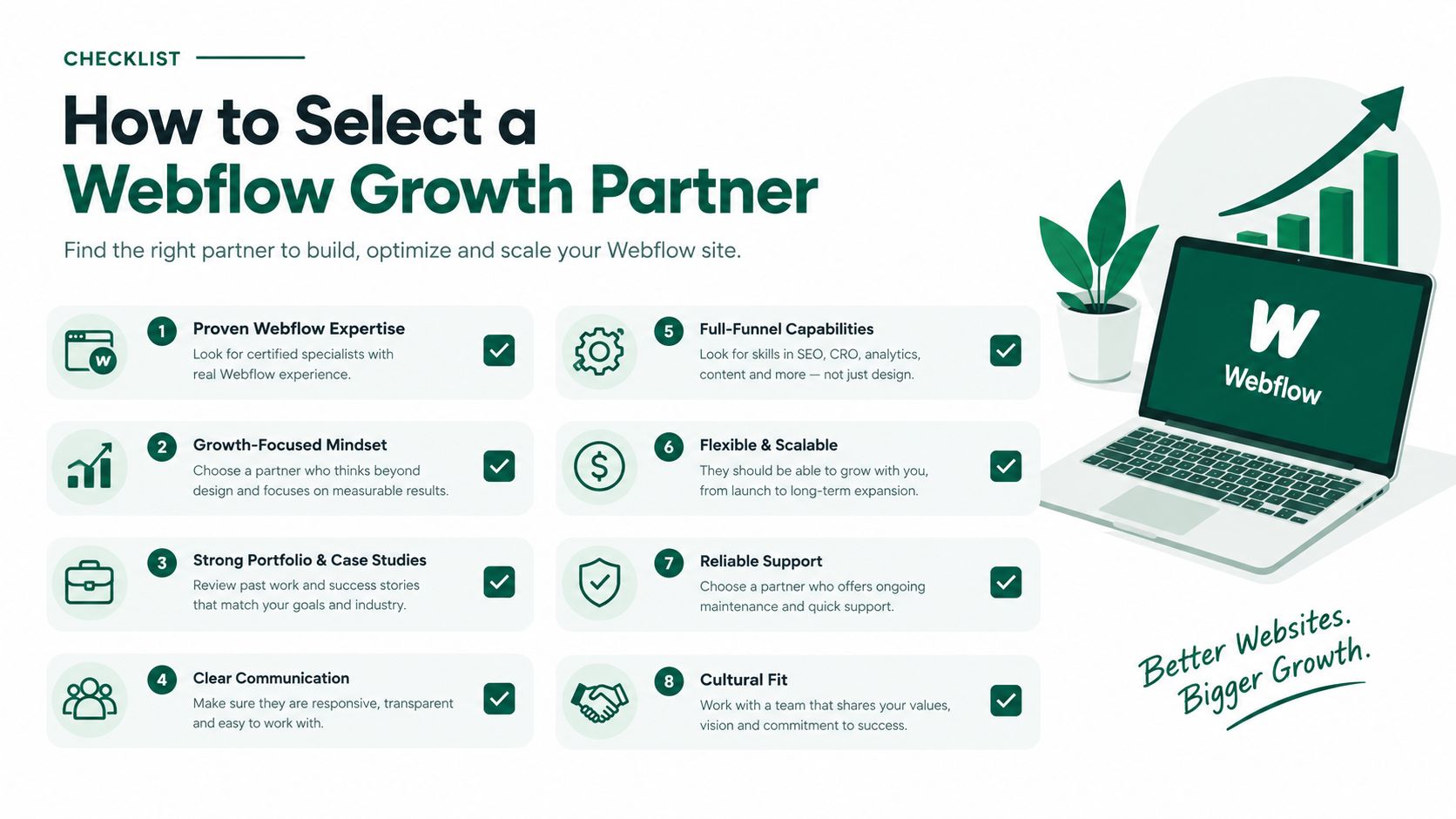
Use the first conversation to test whether the partner understands B2B SaaS buying behavior.
A partner that can't answer these questions clearly is a production vendor, regardless of how attractive its work looks. That may be acceptable for a contained design task. It isn't sufficient when the website needs to support a changing go-to-market motion.
Red flags include a proposal organized entirely around page counts, a discovery process that skips customer and competitor research, and a promise to “make it modern” without defining modern for your buyers. Be cautious when the partner recommends animation before clarifying the message or presents SEO as a list of keywords rather than a structure for answering demand.
You should also challenge any process that makes marketing dependent on the partner for routine changes. Webflow's value declines when your team still needs external help to update a use-case page, add a resource, or correct a core message.
Founders often delegate partner selection to the person most available. That's how companies buy an attractive site that revenue leaders don't trust. Treat the decision as a strategic hire, and use the criteria in this B2B web design agency evaluation framework to pressure-test capability, not personality.
Your website's primary job is not to look current. It is to make the right buyers understand your value quickly enough to take a commercially useful next step.
Webflow is effective because it can put messaging control, publishing speed, structured content, and conversion iteration closer to the team responsible for growth. Its maturity is established, its CMS supports repeatable operations, and its enterprise offering addresses important access and compliance requirements. None of that matters if the site reflects internal preferences instead of buyer reality.
The sharper mental model is simple:
Review your homepage, product pages, use cases, proof, and conversion paths as a revenue leader would. Identify where the message breaks, where ownership slows updates, and where a serious buyer still needs to contact sales for basic context. Then decide whether your current site is helping the company move or taxing every growth initiative.
Big Moves Marketing helps B2B SaaS teams connect positioning, messaging, website structure, and pipeline strategy through conversion-ready Webflow websites and broader growth planning. Visit Big Moves Marketing to assess whether your website is operating as a revenue asset or needs a more strategic rebuild.





%20-%20white.svg)