%20png%20copy.avif)
Most value proposition advice is recycled, surface-level nonsense that leads to generic website copy and confused sales teams. The result is wasted growth motion. A strong value proposition is not a clever tagline; it’s the core logic of your go-to-market strategy, articulating precisely why a specific buyer should choose you over the status quo or a competitor.
It’s not about what your product does, but what it enables for the customer. The difference between a weak and a strong value proposition is the difference between a stalled pipeline and a scalable revenue engine. Teams that master this see shorter sales cycles, higher average contract values, and clear market differentiation. Those who get it wrong burn millions on marketing that doesn't connect and sales efforts that go nowhere.
This isn't an exercise in finding the perfect words. It's about codifying the fundamental reason your company deserves to win. This collection of value proposition statement examples is designed for that purpose. We will dissect the strategic frameworks that actually work for B2B SaaS, not the marketing-school theories. Each example is broken down into its core components, offering a replicable blueprint for founders and revenue leaders to build a value proposition that functions as a true GTM weapon. Forget slogans; this is about building the argument that closes deals.
The Problem-Solution framework is the most direct path to a resonant value proposition. It operates on a simple, powerful premise: state the acute, undeniable pain your ideal customer experiences, then immediately present your product as the specific, effective remedy. This structure cuts through the noise because it mirrors how B2B buyers think—they are searching for solutions to recognized problems that impede their work.
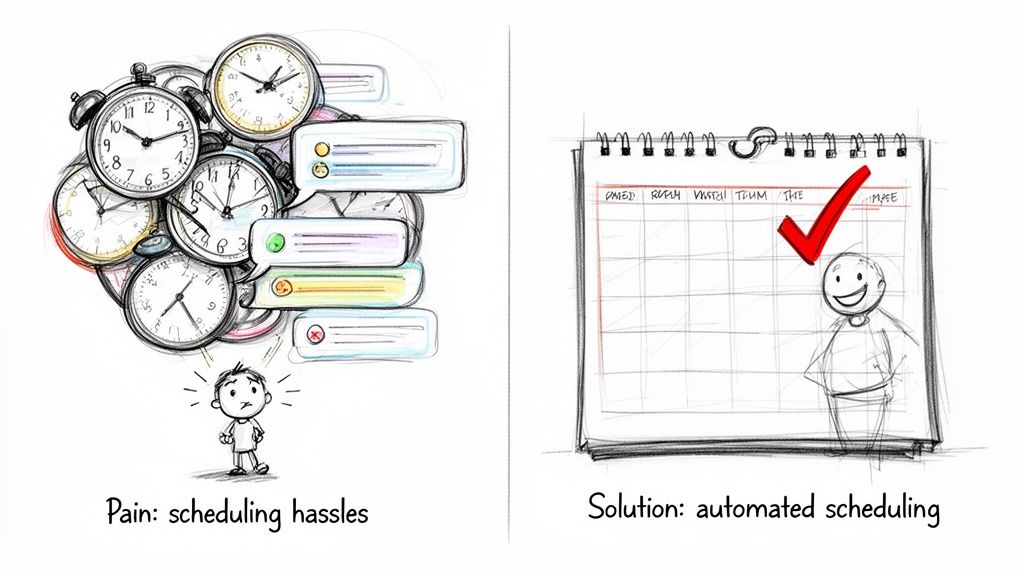
This approach is especially potent for B2B SaaS because it bypasses vague feature descriptions and connects directly to operational drag or strategic failure. Consider Calendly: they don’t lead with "automated scheduling software." They lead with the universally understood frustration of "back-and-forth emails" to find a meeting time. The problem is the hero of the story.
Key Insight: Most founders are too close to their solution. They explain what it is before explaining what it solves. The Problem-Solution framework forces you to lead with the customer's reality, not your product's features.
Success hinges on the precision of your pain point statement. It cannot be generic. "Wasting time" is weak; "Spending hours in back-and-forth email chains to schedule one meeting" is strong. It must be a pain the buyer feels acutely and frequently.
To implement this, you must rigorously validate the #1 pain point with real customers. Mastering this framework requires a deep commitment to understanding your buyer's world, a core principle of effective product thinking for B2B marketers. These value proposition statement examples demonstrate that clarity about the problem is the foundation of a compelling offer.
While the Problem-Solution framework wins on clarity, the Outcome-Based Value Proposition wins on economic justification. It skips straight to the finish line, articulating the specific, quantifiable business results your customer will achieve. This approach is exceptionally powerful in B2B SaaS, where every purchase must be defended with a clear return on investment. It translates features into dollars, hours, and percentages—the language of the C-suite.
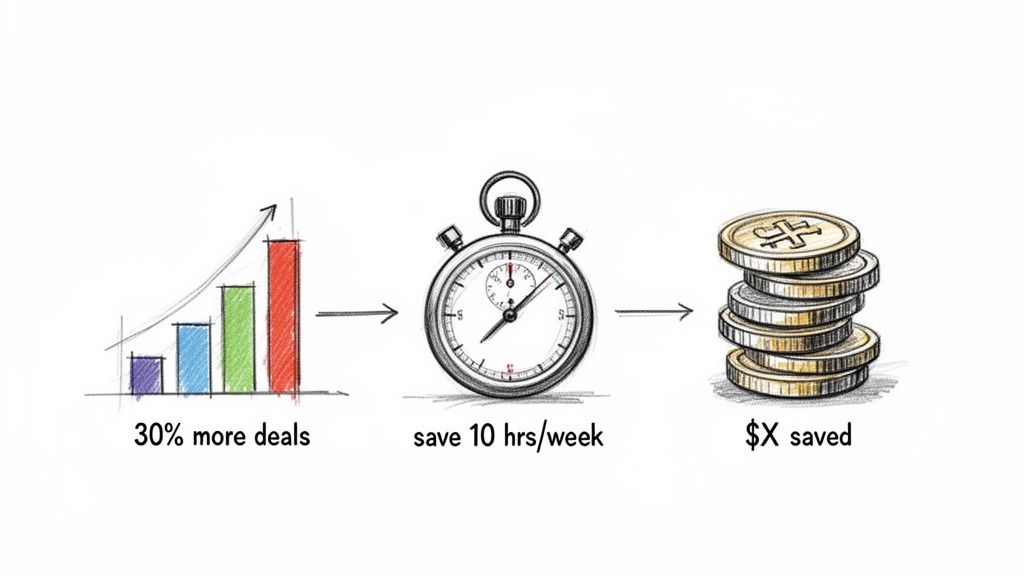
Founders and marketers often default to describing what their product does. This framework forces you to describe what your product delivers. Instead of “sales automation software,” HubSpot can claim a specific outcome: “Close 30% more deals without hiring.” The former is a category; the latter is a business case. This shift is critical for moving upmarket and justifying premium pricing.
Key Insight: A feature is a cost until it’s tied to an outcome. Buyers don’t purchase software; they purchase a more profitable, efficient, or resilient version of their own company. Your value proposition must make that future state tangible and believable.
Success depends on validating and quantifying the results your product generates. Vague promises like "increase revenue" are useless. Specific, metric-driven claims build immediate credibility and create a clear benchmark for success. These value proposition statement examples show how to connect action to result.
To build this, you must obsessively collect customer data and build case studies that substantiate your claims. A powerful guide for this process involves shifting your entire messaging strategy from features to outcomes, a necessary step for any B2B marketer aiming for real impact. The most effective claims are updated annually as your product and customer base mature.
The Positioning Against Alternatives framework forces a direct confrontation with the buyer's actual consideration set. It answers the question, "Why you instead of what I'm already doing or who I'm already considering?" This method is critical for differentiation in crowded markets where buyers are fatigued by look-alike solutions and are often leaning toward the status quo.
This approach is powerful because it frames the decision in your favor by naming the enemy. That enemy isn't always a direct competitor; often, it's a manual process, a spreadsheet, an internal tool, or simply inertia. By explicitly contrasting your method against these primary alternatives, you define the category and establish yourself as the intelligent choice. Stripe didn't just sell payment processing; it sold developer-friendly APIs as a direct alternative to clunky enterprise contracts.
Key Insight: Your buyers aren't comparing your feature list to a competitor's. They are weighing the pain of switching against the pain of staying the same. Your value proposition must make the cost of inaction feel higher than the cost of adoption.
Success with this framework depends on an unflinching understanding of the alternatives your buyer actually considers, not the ones you list on a competitive matrix. It requires defining your value in negative space: what you are not.
To build these value proposition statement examples, first identify the top three alternatives, including the "do-nothing" option. Then, articulate why your approach makes those options obsolete. This is especially evident when considering options like owning your own fan subscription platform versus relying on third-party marketplaces. The choice becomes about control and ownership, not just features. Digging into the specifics of what competitive positioning in marketing truly entails is fundamental to making this framework succeed.
This framework is a powerful strategy for resource-constrained startups: dominate a single, critical dimension of performance. It’s a bet on being indisputably best-in-class at one specific capability and making that the core of your positioning story. Instead of trying to be everything to everyone, you claim one hill—fastest, simplest, most secure—and defend it relentlessly. This creates a sharp, memorable brand identity.
This approach works because B2B buyers often make decisions by prioritizing a single, decisive factor. When a specific capability is the bottleneck to their success, the company that excels at that one thing becomes the obvious choice. The goal is to become synonymous with that single attribute, making your product the default option when that specific need arises.
Key Insight: Most startups dilute their message by claiming to be good at everything. The Leadership Framework forces radical focus. By owning one dimension, you simplify the buyer's choice and build a defensible moat that is difficult for larger, slower competitors to replicate.
Success depends on choosing a differentiator the market truly cares about and then delivering on it without compromise. This isn't just a marketing claim; it must be a product truth. You have to be quantifiably better, and all marketing, sales, and product narratives must reinforce this single point of leadership.
To implement this, you must first validate your chosen dimension with at least 20 ideal buyers to confirm it's a top-tier priority. Then, you must invest heavily and continuously in your product to maintain that leadership position indefinitely. This is how you create compelling value proposition statement examples that are not just words, but a reflection of your product's core identity.
Enterprise deals are rarely won by convincing a single person. They require consensus across multiple stakeholders with competing priorities. The Buyer Persona-Specific Value Proposition recognizes this reality by moving beyond a single, generic message and creating distinct value statements tailored to each key decision-maker within the same target account. This framework speaks directly to the unique pain points, metrics, and goals of each stakeholder.
This approach is critical in complex B2B sales cycles where the CFO, CTO, and Head of Sales all have a vote but care about vastly different outcomes. The CFO is concerned with ROI and cost reduction, the CTO with security and integration, and the sales leader with pipeline velocity and rep productivity. A single value proposition will fail to resonate with at least two of them.
Key Insight: Most founders and marketers default to a "one-size-fits-all" value proposition. This is a critical error. The job of your messaging is not just to attract the initial champion but to arm them with the right arguments to persuade their colleagues.
Success depends on a deep, almost anthropological understanding of each buyer's role. You must map their individual pains, desired gains, and the language they use to describe them. You are essentially creating a portfolio of value propositions for a single product.
To build this, you must stop guessing and start interviewing. A practical guide on using buyer personas to accelerate B2B marketing and sales can provide the foundational process. Create role-specific case studies, one-pagers, and website messaging paths that guide different personas to the outcomes that matter most to their function. These persona-specific value proposition statement examples show that winning complex deals means speaking everyone's language.
In B2B SaaS, time is the enemy of adoption. The Speed-to-Value framework directly confronts this by centering the value proposition on one critical promise: how fast the customer will see a meaningful result. This approach positions your solution against slower, more complex competitors or painful, months-long implementation cycles. It reframes the buying decision from "what features do I get?" to "how quickly can I solve my problem?"
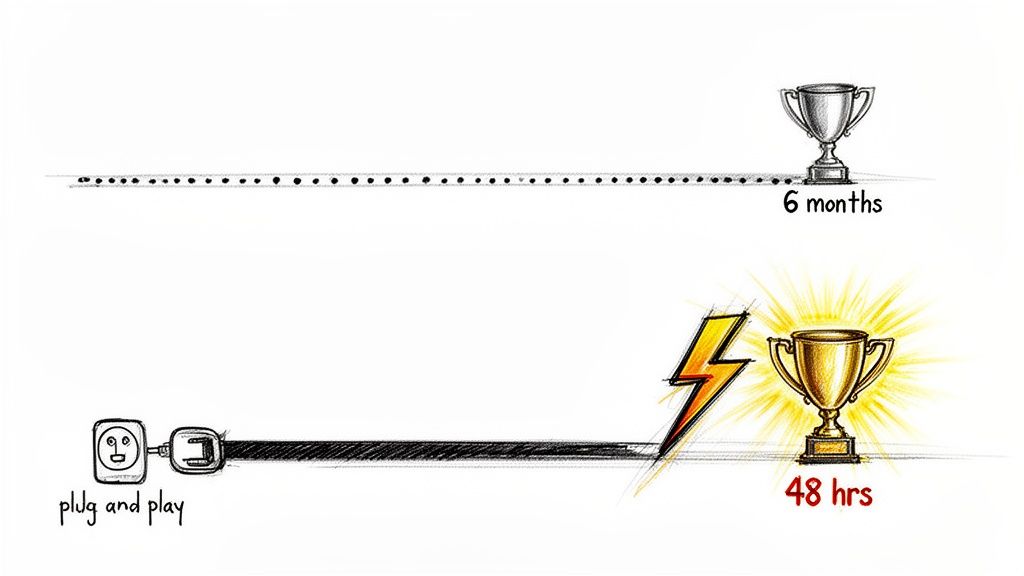
This is the native language of no-code, low-code, and modern product-led growth companies. They understand that the longer it takes a user to experience a tangible win, the higher the probability of churn. Zapier doesn’t sell "API integrations"; it sells the ability to "automate workflows in minutes." The outcome is delivered on an accelerated timeline, which becomes the core differentiator.
Key Insight: Most buyers are risk-averse and scarred by past software projects that promised big but delivered slow. Speed-to-value de-risks the decision by promising an immediate return on their investment of time and resources, not just money.
Your entire product and onboarding experience must be engineered to deliver on this promise of speed. A "5-minute setup" claim collapses if the user is stuck in a 20-step configuration wizard. The claim is just the tip of the spear; the product experience is the shaft that drives it home.
To make this framework effective, track and publish your time-to-value metrics. Build case studies around "48-hour ROI" and create quick-start templates that get users to their first "aha!" moment as fast as possible. These value proposition statement examples show that in a world of complex enterprise software, speed is the ultimate feature.
This framework positions your product not as a tool for growth or efficiency, but as a shield against catastrophe. It speaks directly to the avoidance of penalties, data breaches, and legal liabilities. This is the language of necessity, not preference, making it exceptionally powerful in regulated industries like fintech, healthcare, and legal tech where the cost of non-compliance can be fatal.
This approach flips the typical value proposition on its head. Instead of selling a future gain, you are selling the prevention of a definite loss. For buyers in high-stakes roles, like a Chief Information Security Officer (CISO) or a compliance officer, mitigating risk is their primary job function. Your value proposition becomes their job justification.
Key Insight: Most founders focus on adding value. This framework is about preserving value. When the downside risk includes seven-figure fines or a complete loss of market trust, a solution that neutralizes that threat becomes an immediate, non-negotiable priority.
Success with this framework depends on quantifying the threat with concrete, terrifying numbers. "Avoid problems" is weak. "Avoid a €20M GDPR fine" is a budget-unlocking statement. You must connect your solution directly to the specific regulation, penalty, or disaster your buyer fears most.
To make these value proposition statement examples effective, you must build certifications and compliance into your product roadmap from day one. Your sales and marketing materials must speak the language of auditors and legal teams, demonstrating a deep understanding of the regulatory landscape. This isn't just a marketing angle; it's a foundational product and GTM commitment.
In a market saturated with vague promises of "efficiency" and "productivity," the ROI Proof/Pricing Transparency framework is an act of radical trust-building. It abandons abstract claims and instead presents the cold, hard math. This approach leads with concrete, often third-party-validated ROI calculations and transparent pricing, allowing a sophisticated buyer to immediately calculate the payback period and cost of ownership.
This framework is particularly effective in crowded markets or with finance-driven buyers who are skeptical of marketing fluff. By showing the numbers upfront, you shift the conversation from a subjective evaluation of features to an objective assessment of financial impact. You are not just selling a tool; you are presenting a balance sheet decision.
Key Insight: Most B2B SaaS companies hide their pricing and obscure their ROI, forcing buyers into a lengthy and often frustrating sales process. Leading with transparent numbers demonstrates confidence and respects the buyer's intelligence, accelerating their decision-making by giving them the data they need to build an internal business case.
Success with this model requires a commitment to financial clarity. You must be prepared to defend your numbers and justify your value against lower-priced competitors. The goal is to make the economic choice undeniable.
Implementing this means equipping your marketing and sales teams with undeniable proof. Build an interactive ROI calculator, publish case studies with hard numbers, and consider creating a "12-month cost of ownership" spreadsheet for your sales team to use against competitors. This approach anchors your value proposition in financial reality, which is essential when seeking to define value-based pricing for your solution. These value proposition statement examples show that sometimes, the most powerful statement is an equation where your value is clearly greater than your cost.
This framework positions your product not as a single tool, but as the central nervous system of your buyer's entire tech stack. It’s a value proposition built on gravity. By connecting to, or outright replacing, the constellation of apps a company uses daily, you move from being a helpful utility to an indispensable operational backbone. The core message is one of consolidation, automation, and control.
The strategy exploits the natural chaos of the modern SaaS stack. Teams suffer from "tool sprawl"—fractured data, broken workflows, and recurring costs. A platform that promises to connect, automate, or unify this mess doesn't just offer a feature; it offers a strategic cure for operational complexity. Zapier, for instance, doesn't sell API connections; it sells the ability for your existing tools to finally talk to each other without engineers.
Key Insight: This isn't about having an open API. It's about building a gravitational pull. The more tools you integrate with, the more workflows you enable, and the harder it becomes for a customer to even imagine leaving. Your value is measured by the ecosystem you command.
Success depends on becoming the default hub for a specific business function. You must be the "connective tissue" that other tools plug into. This requires a deep focus on integrations, not as an afterthought, but as a core product strategy.
To build one of these valuable value proposition statement examples, you must make your integration count a headline feature. Publish pre-built workflows for common use cases and invest heavily in developer-friendly API documentation. The goal is to make it easier for others to build on your platform than it is for your customers to leave it.
This framework shifts the value proposition from the product itself to the ecosystem surrounding it. The core premise is that the product’s utility increases directly with the number of people using it. This is not about features; it is about creating a center of gravity so powerful that your ideal customers cannot afford to be elsewhere. It builds a natural, compounding moat that competitors find almost impossible to cross.
This approach is potent because it makes the customer a co-creator of the product’s value. Consider Figma: its value isn't just its design tools, but the fact that millions of designers are already there, making collaboration seamless. The network is the product's most defensible feature, a concept central to many successful value proposition statement examples in the platform economy.
Key Insight: Founders often see community as a marketing channel. In this framework, the community or network is the core value being delivered. Your messaging must elevate the "who" (the other users) to the same level as the "what" (the software).
Success depends on making the network's value tangible and aspirational. It’s not enough to say "join our community." You must demonstrate why that network is the epicenter of your industry's activity and how belonging to it confers a distinct professional advantage.
To implement this, marketing must focus on user stories and social proof. Make the network’s scale and quality visible with statistics like "Used by 80% of design teams at Fortune 500 companies." Your product roadmap should prioritize features that amplify network benefits, such as sharing, co-creation, and discovery.
We have dissected ten distinct frameworks for building a B2B SaaS value proposition. We’ve moved beyond surface-level descriptions and analyzed the strategic logic behind each approach, from outcome-based promises to competitive differentiation. Studying these value proposition statement examples is a necessary intellectual exercise, but it is insufficient for driving growth. The real work begins now: operationalizing a single, defensible claim.
A value proposition is not a static headline for your landing page. It is a dynamic asset that must be pressure-tested in sales calls, refined with customer feedback, and defended with every product decision you make. It is the central logic of your entire go-to-market motion. Most founders and marketing leaders mistake this for a copywriting project. It is a strategy project. The words are simply the final output of a series of difficult business decisions.
The critical error teams make is choosing a framework because it sounds good or because a competitor uses a similar one. This is a recipe for a generic, forgettable message. The right framework is not a matter of taste; it is a reflection of your market, your product’s maturity, and your unique competitive reality.
Your next step is not another brainstorming workshop to find the perfect words. Your next step is to answer three questions with unflinching honesty:
The most powerful value proposition statement examples we've examined are not the result of a lucky discovery. They are the result of a deliberate, focused choice. Slack did not stumble into being the "channel-based messaging platform"; it was a strategic decision to position against email. Gong did not accidentally become the "Revenue Intelligence" leader; it was a calculated move to own a new category.
A strong value proposition forces clarity. It dictates your product roadmap by telling you which features matter and which are distractions. It simplifies your marketing by giving you a clear, singular message to repeat. Most importantly, it gives your sales team the confidence and conviction to close deals at a premium, because they aren't just selling software; they are selling a specific, provable outcome.
Your value proposition is the sharpest tool you have to cut through a noisy market. It is a decision, not a discovery. Make the decision. Own it. And build your growth engine around it.
Tired of value propositions that don't translate into pipeline? Many founders have a strong product but struggle to codify its value in a way that fuels their GTM engine. At Big Moves Marketing, we work with B2B SaaS leaders to translate product capabilities into a defensible market position and a high-conviction growth strategy.
Explore Big Moves Marketing services and resources:





%20-%20white.svg)