%20png%20copy.avif)
Competitive positioning is the strategic decision of how your B2B SaaS will win. It's the deliberate act of defining how your solution is uniquely valuable to a specific customer with a specific problem. It is not a marketing exercise. It is the central logic of your entire go-to-market strategy, and most early-stage companies get it dangerously wrong.
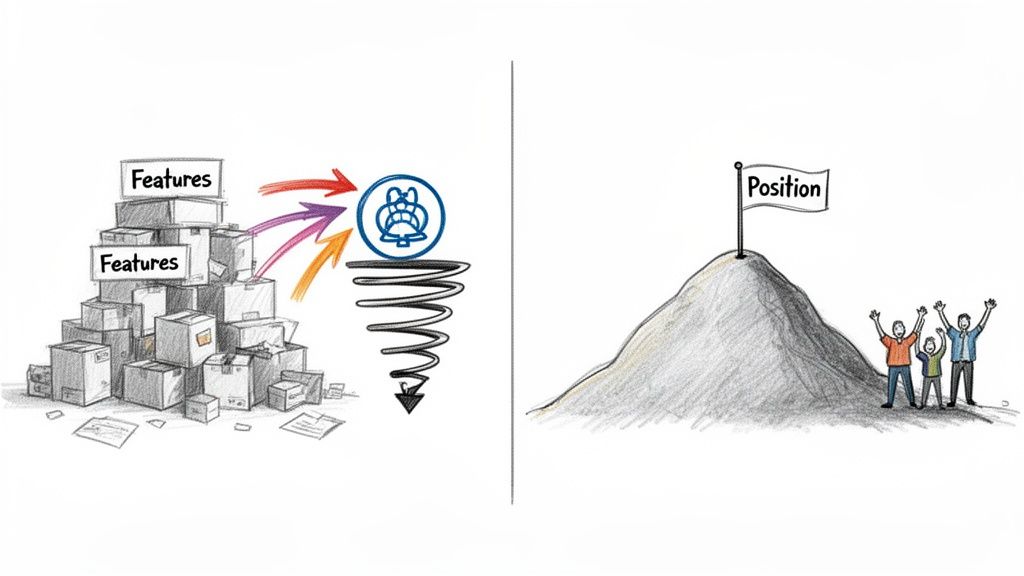
Most B2B SaaS founders don’t have a positioning problem. They have a reality problem. They believe their product's feature set is their position. I’ve seen this pattern across dozens of early and growth-stage companies, and it’s the most common point of failure. It’s a fatal assumption that leads directly to stalled growth, wasted capital, and a demoralized GTM team.
Your product is not your position. Your feature list is not why a sophisticated buyer will choose you over everyone else.
This confusion between product capabilities and market strategy is the root cause of nearly all go-to-market friction. It manifests as predictable, painful symptoms that revenue leaders mistake for tactical execution issues when the problem is foundational.
When your positioning is weak, the entire revenue engine sputters. Marketing generates activity but no pipeline. Sales cycles stretch into infinity. The symptoms are always the same:
The hard truth is that a lack of clear positioning forces you to compete in the crowded, bloody middle of the market on features and price—a battle you will lose to incumbents with deeper pockets.
So, what is competitive positioning in marketing? It's a strategic choice. A deliberate decision to be the absolute best solution for a specific problem for a specific buyer. Without this clarity, your go-to-market strategy is just a collection of disconnected tactics. You’re burning cash and effort to run in place.
Growth begins the moment you stop describing what your product does and start articulating the unique value it delivers.
Let's cut through the theory. Here’s the only definition a founder needs.
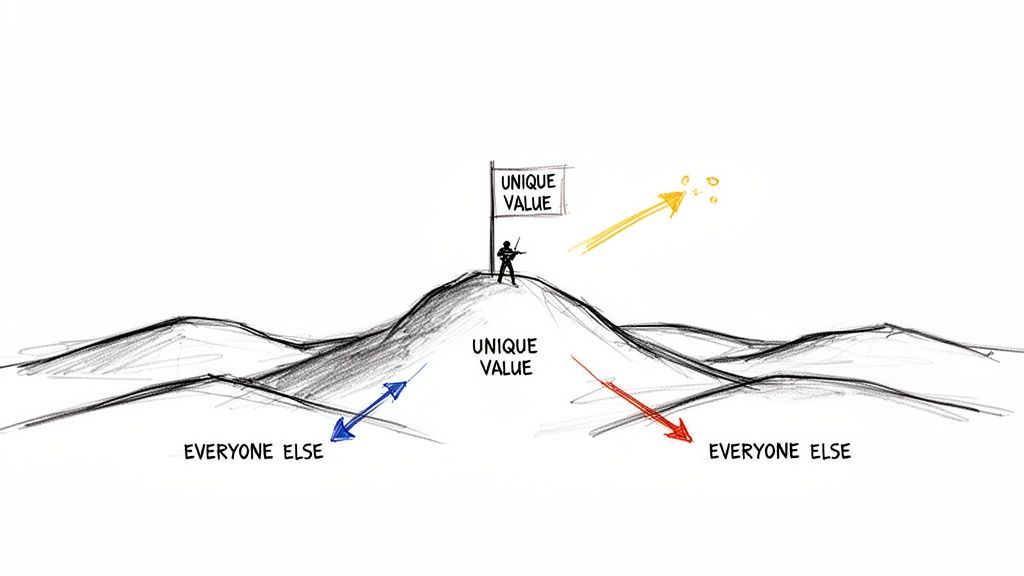
Competitive positioning is the deliberate act of defining how you are the best in the world at solving a specific problem for a specific customer. It is not about being different; it is about being uniquely valuable.
Think of it as claiming a single, strategic hill in a war. You cannot defend all the ground. You must choose the one piece of terrain where your advantages are insurmountable, forcing every competitor to fight on your terms. That’s what strong positioning does—it chooses the battlefield.
This requires aggressive trade-offs. You must actively say 'no' to certain customers, markets, and feature requests to win decisively with the right ones. Your positioning becomes the strategic filter for every GTM decision, from your product roadmap to your demand generation campaigns.
Defensible positioning is built on four pillars. If you can’t articulate each one with precision, your position is built on sand.
This strategic clarity is critical. The battle for attention has never been fiercer. With the global digital marketing market projected to hit $786.2 billion by 2026, your message must be ruthlessly precise to cut through.
Positioning is an act of sacrifice. It’s the disciplined choice to be meaningfully relevant to a few, rather than vaguely interesting to many. This choice is the foundation of scalable growth.
To do this effectively, a deep and honest understanding of your competitors is non-negotiable. A clear guide to SaaS competitive analysis is a good starting point. While many founders mistake product positioning for a messaging exercise, it’s a strategic imperative that dictates who you win and why.
Without this foundational work, every marketing dollar and sales hour is spent at a severe disadvantage.
Many founders struggle to self-diagnose their positioning. This table outlines the common symptoms of weak positioning versus the signals of a strong, defensible one.
If your company leans toward the "Weak Signal" column, revisiting your core positioning is the most important strategic work you can do. Getting this right makes everything else—from marketing to sales to product—dramatically more effective.
A defensible position doesn’t come from a clever tagline. It’s forged from three strategic choices that must work in concert. I see B2B SaaS companies get at least one of these wrong, failing to see how they interlock. When that happens, your entire GTM strategy becomes an uphill battle.
Getting these three levers right is non-negotiable. They shift your company from being another option in a crowded market to becoming the only logical choice for your ideal buyer.
Your Unique Value Proposition (UVP) is not a list of features. It's the tangible, specific outcome or capability you deliver better than anyone else, framed from the customer's perspective. A strong UVP acts as an internal compass for your product and GTM teams, ensuring every decision reinforces your core advantage.
It must be a promise only you can credibly make. If your UVP sounds like something your competitor could put on their homepage tomorrow, it’s not a UVP—it’s a generic benefit statement. It must be specific, provable, and tied to the most acute pain your ideal customer faces.
Your Ideal Customer Profile (ICP) is the most important filter for your business. It is not a vague persona like "mid-market tech companies." It's a precise, multi-dimensional definition of the exact type of business that feels the pain you solve most acutely and will gain the most value from your solution.
A proper ICP describes an organization, not just a user. It details:
Without a specific ICP, your marketing attracts low-fit leads, your sales team wastes time on deals that are doomed from the start, and your product roadmap gets pulled in a dozen different directions. Precision here creates leverage.
The final strategic decision is choosing where to fight. You have two options, and each comes with serious trade-offs. Many founders get stuck here, trying to do both and succeeding at neither.
You must decide if you will compete in an existing market category or create a new one. The former is a battle for market share; the latter is a battle for mindshare.
Competing in an existing category means positioning yourself as a better, faster, or more specialized alternative to an established player. The buyer already understands the problem and the solution category. Your job is to prove you are the superior choice for a specific segment.
Creating a new category involves defining a new problem or a radical new solution to an old one. This is a much heavier lift because it requires educating the market. The prize, however, can be uncontested leadership and the power to set the rules. Exploring various differentiation strategy examples can clarify which path is right for you.
These three levers—a sharp UVP, a focused ICP, and a deliberate category strategy—are not independent. They must lock together to create a single, coherent, and defensible market position.
Theory is useless without a repeatable process. Most positioning exercises devolve into subjective workshops that go nowhere. This is a stripped-down framework designed for execution.
The rigor of this process is more valuable than the final document. It’s about building institutional knowledge of your customer and market, not just wordsmithing a sentence.
You don’t know your position; your best customers do. They just don't use marketing language to describe it. Your first job is to extract their reality through deep, non-leading interviews. Forget surveys. You need real conversations.
Ask open-ended questions that uncover their reality before your solution existed:
You're listening for patterns in their language, pain points, and perceived value. This isn't a fishing expedition for compliments; it's a forensic investigation.
Analyzing competitors isn't about creating a feature-for-feature spreadsheet. That’s a product management task. For positioning, you must analyze their messaging and market perception. How do they claim to be valuable?
Review their website, G2 reviews, and sales decks. Map their claimed position. Who do they say they are for? What problem do they claim to solve? What is their core promise?
Doing this for your top three to five competitors reveals the occupied territory and, more importantly, the unclaimed high ground. For more on this, see our guide on building a competitive analysis framework.
This step connects your product’s features to the tangible outcomes customers buy. It forces you to translate internal jargon into external value.
Create a simple three-column map:
Your positioning lives in the Outcome column. Customers don't buy features or benefits; they buy business outcomes.
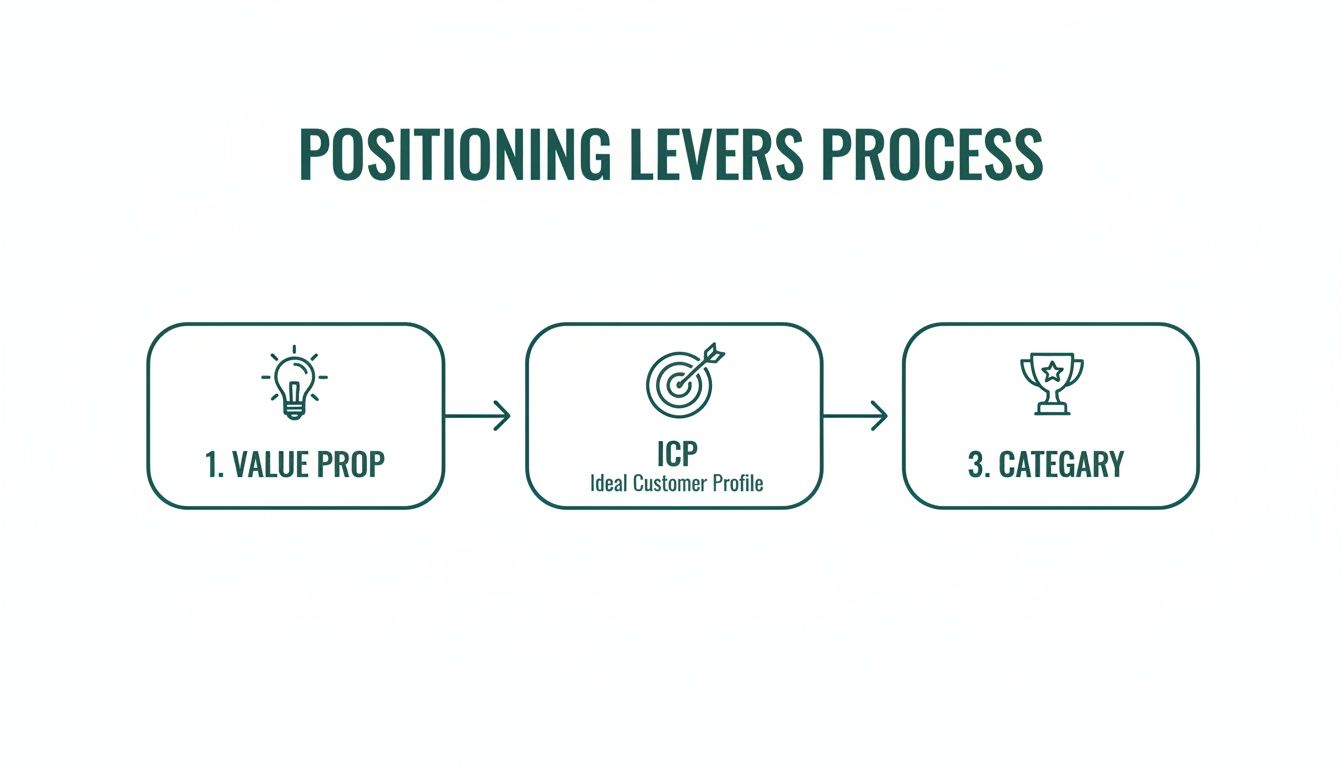
This process shows how everything connects. A strong value proposition, ruthlessly focused on a specific ICP, allows you to win a defined market category.
Finally, synthesize this work into a simple, internal-facing positioning statement. This is not marketing copy. It’s a formula for strategic clarity—a North Star for your entire company.
The template below forces choices based on your research. It distills everything into a concise, defensible articulation of your market position.
This statement becomes the source of truth for every subsequent marketing message, sales conversation, and product decision. It is the strategic foundation.
Positioning is not a marketing asset. It’s a GTM weapon. Founders who treat it as a branding exercise will wonder why their sales cycles are long and their CAC is crippling.
When your position is clear, it becomes the central logic for your entire revenue organization. It aligns marketing, sales, and product, smoothing out the friction that kills deals and burns cash. It turns your GTM motion from disconnected campaigns into a coherent system.
Weak positioning forces your sales team to re-educate every prospect. Strong positioning pre-sells your value before a demo is booked.
A well-defined position is the bedrock of effective sales enablement. Your battlecards become sharper because you know exactly which competitor claims to dispute. Your pitch decks stop being a feature tour and start telling a story that resonates with your ICP’s most urgent problems.
This clarity directly impacts pipeline quality. Marketing no longer guesses what messaging will land. Ad copy, landing pages, and content are built on the same strategic core, creating a magnet for high-fit leads who already understand your value.
This alignment has a measurable impact on sales effectiveness. According to one 2023 marketing statistics report, 77% of B2B purchasers won’t speak to a salesperson until they’ve done their own research. This means your competitive position must be compelling and visible from the very first Google search.
The benefits extend beyond marketing. A clear position empowers your sales reps to disqualify poor-fit leads faster, preserving resources for deals they can win.
Positioning gives your team the confidence to hold the line on price. When a prospect pushes for a discount, your reps can re-anchor the conversation on unique value, not cost. They stop selling a commodity and start selling an outcome.
This strategic alignment is a force multiplier. It shortens sales cycles because the prospect’s journey is consistent, from the first ad they see to the final proposal. We've broken down how to create this consistency in our guide on the 5 steps to align B2B marketing and sales.
Ultimately, understanding what is competitive positioning in marketing means understanding it is the most powerful lever for building a scalable revenue engine. It’s not about finding clever words for a webpage; it’s about creating a decisive advantage in the market that translates directly to your bottom line.
Many founders treat positioning as a one-and-done project. They block out a week, hammer out a statement, update the website, and then shelve the deck. This is a critical error.
Your market isn’t static, so your positioning can’t be. Competitive positioning is a discipline—an ongoing practice of sensing, testing, and sharpening your place in the market. The moment you see it as a completed task is the moment it begins to decay.
Your competitors are constantly evolving. Customer needs shift. New technology can make your differentiator irrelevant overnight.
Your GTM data will always tell you when your positioning is losing its edge. The warning signs are rarely a sudden explosion; they are a slow leak, gradually deflating your key metrics.
Watch for these corrosive trends:
Building a system for continuous feedback is the only defense against market irrelevance. This requires tight feedback loops between sales, customer success, and marketing to constantly test your assumptions against frontline reality.
So, what is competitive positioning in marketing, really?
It’s not finding the perfect tagline. It is the active, relentless reinforcement of a strategic choice. It is making a clear decision on where you will play and how you will win—and then defending and adapting that choice, every single day.
Theory is one thing; execution is another. Founders and revenue leaders wrestle with the same high-stakes questions when turning a positioning document into a GTM strategy. Here are the most common ones, with direct answers.
Positioning is the strategy; branding and messaging are the execution.
Your position is the fundamental choice: who you serve, what problem you solve, and what unique value you deliver. It's the stake you plant in the ground.
Branding is the emotional and visual identity that expresses that strategy—logo, design system, tone of voice. Messaging is the specific language used to communicate your position across different channels and to different audiences.
Without a sharp position, your branding is generic and your messaging is inconsistent. They have no strategic core to anchor them.
No. Your company gets one overarching competitive position. Anything else creates market confusion and internal chaos.
However, each product or solution should have its own distinct value proposition that supports and proves the central company position. The company owns the position (e.g., “The most secure data platform for finance teams”), and each product has a value proposition that delivers on that promise.
Juggling multiple company positions is a fatal error. A crucial first step to maintaining focus is a clear ideal customer profile template.
Positioning isn't set in stone, but it shouldn't change quarterly.
Make it a core part of your annual strategic planning. That said, certain events should trigger an immediate review: a major new competitor emerges, your core product capabilities change dramatically, or your sales team starts losing deals repeatedly for the same reason.
The goal is stability with vigilance. Strong positioning should last for years, but you must constantly check if its underlying assumptions still hold true against market feedback and performance data. It's an active discipline, not a document you write once.
At Big Moves Marketing, we help B2B SaaS founders establish the clear, defensible positioning that drives scalable growth. If you need to sharpen your GTM strategy, let's connect at https://www.bigmoves.marketing.
Explore Big Moves Marketing services and resources:
June 26, 2026





%20-%20white.svg)