%20png%20copy.avif)
Most B2B SaaS founders are trapped on a hamster wheel of their own making. More leads, more features, more hires. This frantic activity feels like progress but is often a symptom of a broken growth engine—a system that burns cash and morale with little to show for it.
The hard truth is that frantic motion is not a proxy for growth. It’s a signal of strategic failure. Applying more force to a flawed go-to-market model doesn’t create momentum; it amplifies waste and hard-codes bad habits into your company’s DNA. This is where well-funded companies with strong products stall, leaving founders wondering why their efforts yield diminishing returns.
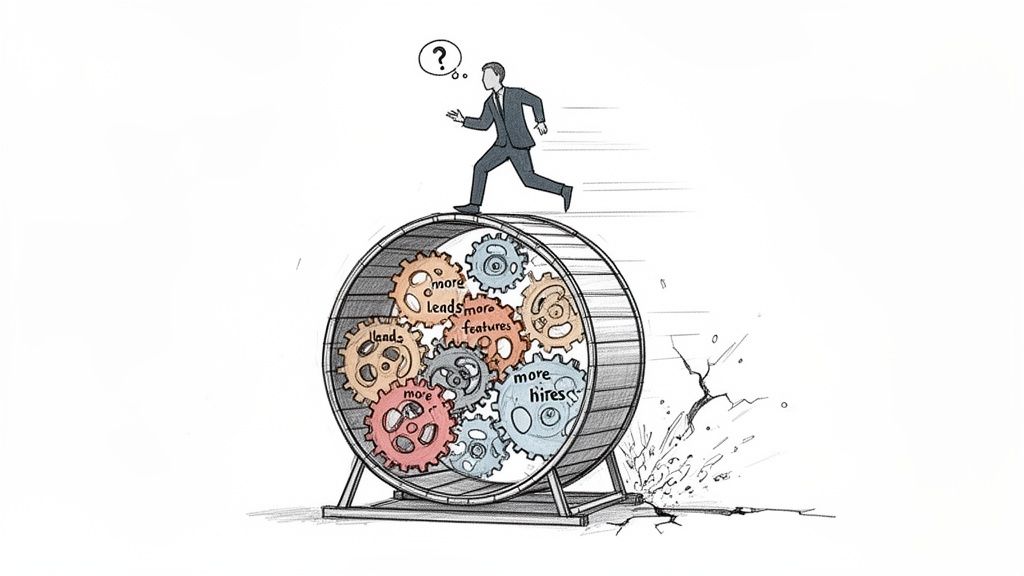
When growth flattens, the default reaction from operators is to demand more from the machine. More MQLs from marketing. Higher activity from sales. More features from product. This mistakes tactical gaps for strategic rot. I’ve seen this pattern derail dozens of early-stage and Series A–C companies. The product is sound, but the team cannot coherently answer who it’s for and why it’s urgent.
The problem is almost never effort. It is almost always a lack of clarity.
Founders, biased toward execution, see surface-level problems and apply surface-level solutions. They see a weak pipeline and demand more leads, failing to recognize the core messaging doesn't resonate with their Ideal Customer Profile (ICP). They push for feature parity with a competitor, not understanding their positioning is what’s failing to differentiate them.
This leads to a predictable and expensive cycle of chaos:
This is a systems problem. Adding more fuel won't fix it. It will only accelerate the burn rate. For a deeper look at diagnosing these systems, see our thinking on a cohesive B2B growth strategy.
The most expensive mistake a startup can make is scaling a broken go-to-market model. You aren’t just wasting money; you are encoding dysfunction into your company.
This is the precise entry point for a high-impact startup consultant. They are not hired to run campaigns or write copy. They are engaged to diagnose and repair the fundamental mechanics of the growth engine itself.
Their job is to install clarity, focus, and a repeatable system before you scale. They provide the experienced, objective pattern recognition required to see the flaws in the machine that operators, by definition, are too close to notice.
Let’s be clear: a real startup consultant—the kind a B2B SaaS founder needs—is not a freelancer you hire to execute a to-do list. They are not a generalist agency you pay to run campaigns. Their function is to install a strategic operating system where chaos and wasted motion currently reign.
Most founders are too deep in the daily execution to see the systemic flaws throttling growth. A high-caliber consultant brings an outside-in perspective, one hardened by observing the same patterns across dozens of companies, to diagnose and fix the root causes of stalled growth. Their value is not in doing the work; it is in fundamentally changing how the work gets done.
This distinction is critical. Hiring a content writer when your positioning is undefined is like polishing brass on a sinking ship. The activity feels productive but does nothing to alter your trajectory. A true consultant forces you to acknowledge the iceberg and change course.
The consultant's role is to deliver leverage, not labor. They focus on solving the high-consequence problems that are constricting the entire company’s potential.
A high-impact startup consultant does three things:
The failure rates for startups remain brutal. About 20% fail in the first two years and 45% are gone by year five. For many B2B SaaS companies, a flawed market entry or a broken growth model creates a cash crunch they cannot escape. You can find more data on these trends on platforms like GrowthMentor.
A consultant’s primary deliverable is clarity. They provide the frameworks that allow your team to make better, faster decisions without founder intervention. This is how you build a scalable growth engine, not a founder-dependent sales motion.
They are not another pair of hands. They are an external brain that has already seen your movie play out a dozen times. Their expertise is pattern recognition—knowing which levers to pull and, just as importantly, which to ignore.
This function is distinct from a typical marketing advisor. To grasp the difference, it’s useful to see how this foundational work compares to a standard B2B marketing consultant. The focus is on core strategy, not channel-specific execution.
Ultimately, engaging a startup consultant is an investment in your company's operational intelligence. They are brought in to solve a specific, high-stakes problem, transfer that knowledge to your team, and then make themselves redundant.
A great startup consultant doesn’t arrive with a menu of marketing tactics. They act like a master locksmith, focused on the 2-3 strategic tumblers that, once aligned, unlock the entire growth engine.
While you wrestle with surface-level problems like a weak pipeline, the real issues are almost always buried deeper. A seasoned consultant knows where to dig.

Their job is not to produce more stuff—it is to build the systems that produce consistent results. The deliverable isn't a prettier pitch deck; it's a sales team that can close deals without the founder in every meeting. This impact is concentrated in three critical areas.
Your GTM strategy is the operational blueprint for connecting your product with customers who will pay for it. Most early-stage companies don't have a strategy; they have a collection of uncoordinated activities. This "spray and pray" approach burns cash and kills morale.
A consultant’s first job is to cut through the chaos by forcing concrete answers to core questions:
A well-defined GTM strategy gives the team a map. It stops marketing from trying to be everything to everyone and prevents sales from chasing anyone with a budget.
If GTM is the map, positioning is the compass. It defines your place in the market and in the buyer's mind. Without it, your product is a commodity, competing on features and a race to the bottom on price.
A consultant acts as a forcing function for clarity. They work with the leadership team to distill the company’s complex value into a powerful and consistent narrative. The output isn't just clever copy; it's a foundational messaging framework for the entire company.
This framework becomes the single source of truth for how everyone talks about the product. It stops engineering from speaking in feature-lists and prevents sales from promising vaporware. Every webpage, demo, and email reinforces the same core value. To see the specific activities involved, it's worth exploring what marketing consulting entails.
Sales enablement is where strategy meets execution. It is the critical function of arming your sales team with the message, tools, and training to win deals. In a founder-led sales motion, this is almost always the most broken part of the machine.
A startup consultant bridges the gap between high-level strategy and the front lines. They translate the positioning framework into tangible assets reps can use tomorrow:
The goal is to systematize the founder’s sales magic. By codifying what works into a repeatable playbook, a consultant makes it possible for new hires to ramp up and sell effectively. Our guide on how B2B marketing and sales consultants drive startup growth dives deeper into this process.
The consultant’s job is to build a sales engine that runs on a system, not on the founder’s charisma. The deliverable isn't a document; it's a team that can execute.
The table below contrasts the typical internal chaos with the focused, systematic approach a seasoned consultant installs.
| Growth Function | Typical Internal Approach (Ad-Hoc) | Strategic Consultant Approach (Systematic) |
|---|---|---|
| GTM Strategy | Chase any lead from any channel; "spray and pray." | Define a tight ICP and focus resources on 2-3 high-ROI channels. |
| Positioning | Messaging changes based on the last sales call or competitor launch. | Build a core messaging framework that is consistent across all touchpoints. |
| Sales Enablement | Sales team creates their own one-off materials; inconsistent value props. | Develop a unified library of assets and training to ensure every rep tells the same story. |
A high-impact startup consultant does much more than offer advice. They install the strategic plumbing required for scalable, repeatable growth, ensuring the company is built on a solid foundation, not just frantic activity.
Timing is everything. Bring in a consultant too early, and you burn capital. Bring one in too late, and you’ve already hard-coded bad habits into your company. The right moment isn't a date on the calendar. It’s an inflection point where the cost of inaction—wasted runway, muddled positioning, team churn—is far higher than the cost of expert help.
Smart founders don’t hire consultants when things are good. They hire them the moment they recognize a pattern of sophisticated failure that simply trying harder won't solve.
You have a solid product and initial traction from founder-led sales was strong. But now, growth has flatlined. The pipeline is anemic, sales cycles are stretching, and your win rate is cratering. Your team is working harder than ever, but the numbers aren't moving.
This is the classic sign that you’ve outgrown your initial GTM motion. What worked for your first 10 customers won't work for the next 100.
This is the trigger point. A startup consultant isn’t brought in to find more leads. Their job is a root cause analysis—to diagnose why the growth engine seized. They will dissect your sales process, messaging, and targeting to architect a new, scalable growth model.
If you, the founder, are the only person who can effectively articulate value and close a deal, you don't have a scalable business. You have a single point of failure. The problem isn't a weak sales team; it's the absence of a replicable system. The "magic" is still trapped in your head.
The primary goal of sales enablement is to systematically extract the founder's knowledge and translate it into a playbook that any competent salesperson can execute. Until this happens, you don't have a sales team; you have an audience.
An experienced consultant will codify that process. They build the pitch decks, battlecards, and messaging frameworks required to turn your intuitive sales motion into a teachable, repeatable system.
Another undeniable signal is internal friction. Marketing complains that sales ignores their leads. Sales complains that marketing's leads are garbage. Product is building features based on conflicting feedback, and the leadership team can't agree on who the real customer is.
This is not a personality problem; it is a strategy problem. Your team is at war with itself because they lack a single, unified vision of the customer, the problem, and your unique value. A consultant provides the objective, outside-in perspective needed to forge alignment.
For founders considering a more embedded leadership solution to this problem, understanding the role of a Fractional Chief Marketing Officer can offer a valuable alternative.
Hiring a startup consultant at these trigger points isn't an admission of failure. It's a mark of strategic maturity—a recognition that an external, pattern-matched expert is the fastest way to fix the machine.
Choosing the right consultant is a high-stakes decision. Get it right, and you can change your company's trajectory. Get it wrong, and you’ll burn cash, time, and morale.
Do not be fooled by polished websites and client logos. Your job is to find hard evidence of strategic depth, not just tactical skill. The market is flooded with "consultants" who are little more than glorified freelancers. You are not hiring an extra pair of hands; you are hiring a strategic partner whose pattern recognition will give your team a decisive edge.
A dirty secret of consulting: many brilliant subject matter experts think their technical skills translate to business acumen. They are often wrong. A staggering 80% of new consulting startups fail within two years, usually because they lack the business development and client management skills to deliver tangible value. As you can learn in this deep-dive on consulting firm failure rates, you must be diligent to avoid hiring someone who is learning on your dime.
Standard interview questions get rehearsed answers. To gauge a consultant's ability, you must ask questions that force them to deconstruct their thinking and show you how they handle failure.
Forget, "Tell me about your successes." Instead, ask:
This simple flowchart provides a quick decision tree for figuring out if a consultant is the right answer for your current stage.
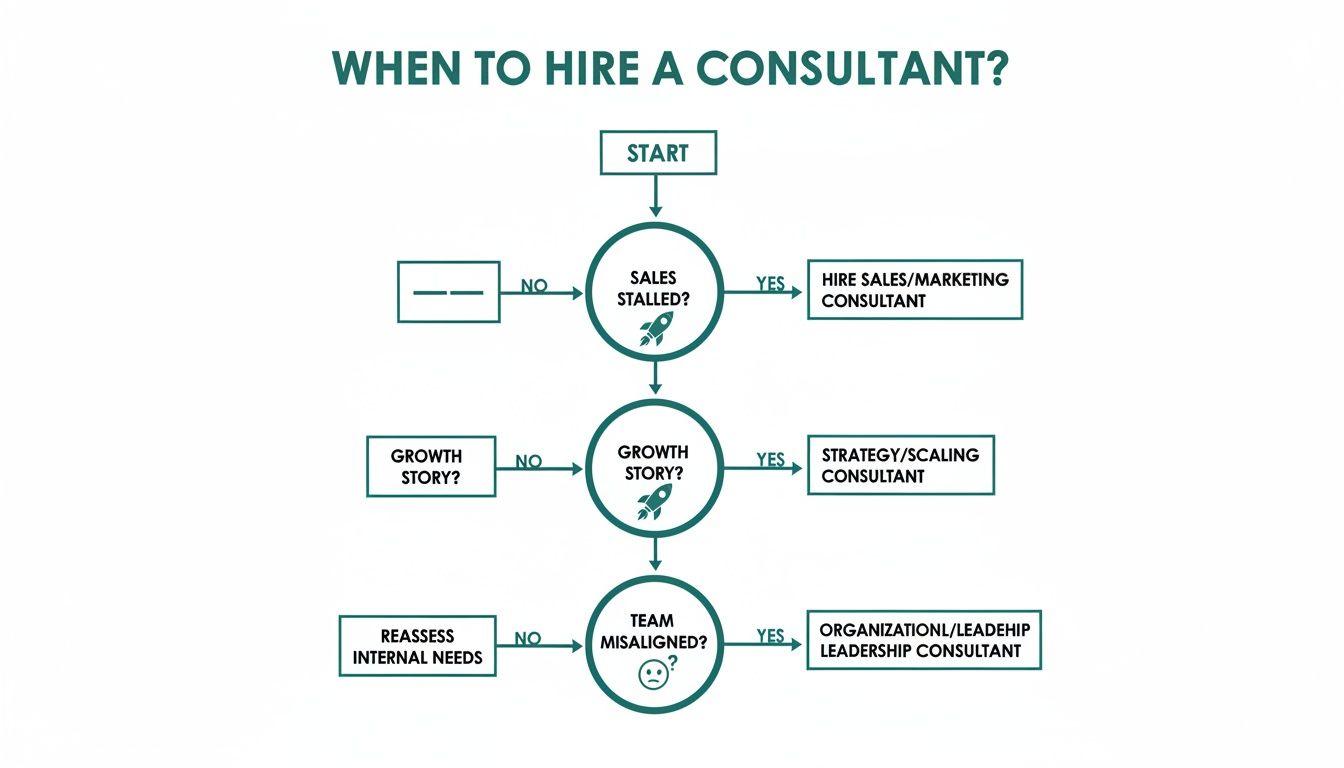
As the chart shows, stalled sales, a weak growth narrative, and team misalignment are the real triggers. Consultants are best used to solve these systemic problems, not just tactical ones.
Clarity on the engagement model is non-negotiable. It defines the relationship and sets expectations for outcomes, not just activities. Common models include:
Pricing is a powerful signal. Be deeply skeptical of low hourly rates. High-impact consultants price based on the value they create, not the hours they log. A $50,000 project that fixes your positioning and unlocks millions in pipeline is a bargain. A $100/hour "consultant" who wastes three months chasing bad ideas is a catastrophic expense.
When reviewing a proposal, focus on the clarity of the deliverables and the logic connecting the work to your business goals. If you find yourself comparing a consultant's proposal to an agency's, you may be asking the wrong question. Our guide on choosing an agency for B2B marketing can help clarify that distinction.
Your vetting process should be about their ability to diagnose problems, structure solutions, and challenge your assumptions. The right startup consultant doesn't just deliver a deck; they upgrade your team's ability to think strategically.
Hiring a consultant isn't the finish line; it's the starting gun. The success of the engagement rests on your organization's ability to absorb and act on their advice. A transactional mindset—"just give me the deliverable"—guarantees failure. You are not buying a report; you are investing in a temporary upgrade to your company's collective intelligence.
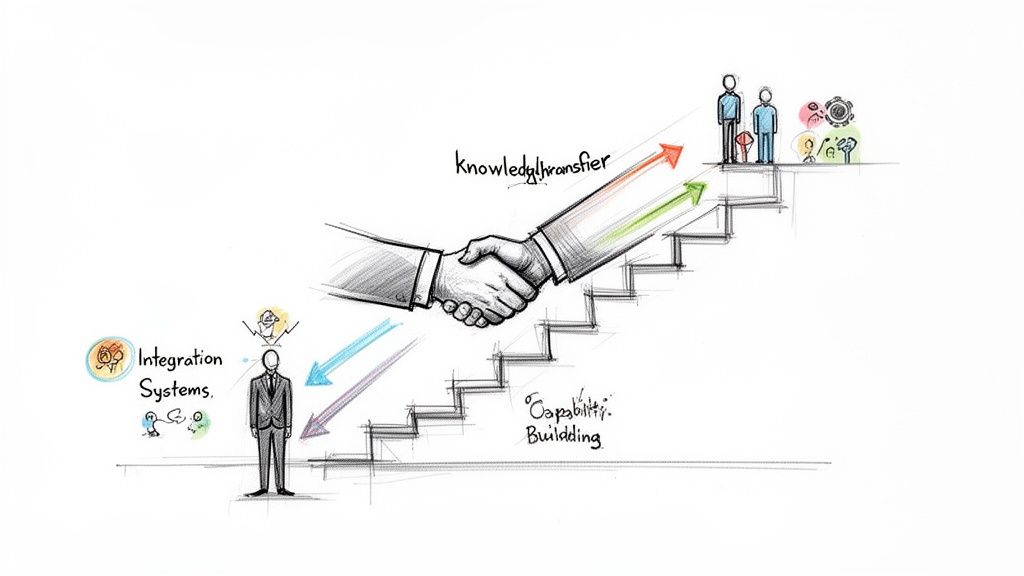
The real ROI is measured by what your team can do after the consultant leaves. The goal is not dependency; it is capability. To achieve this, you must champion a culture of active partnership.
This requires a fundamental shift in approach:
The global management consulting sector now exceeds $1 trillion. This growth is fueled by results; studies show elite founders who received early mentorship saw 3.5x higher growth and secured 7x more funding. The impact is undeniable, as shown in these consulting industry statistics.
The purpose of a consulting engagement is to make the organization smarter. The final deliverable is not a PowerPoint deck; it is a more capable leadership team with a sharper mental model for making decisions.
A successful engagement ends with your team owning the new frameworks. It's on you, as the leader, to drive this transition from advice to action.
Your Action Plan:
By treating the engagement as an investment in your company’s long-term operational intelligence, you ensure the value multiplies long after the final invoice is paid.
When founders consider bringing in a consultant, a few questions consistently surface. Let's address them directly.
They solve different problems. You hire a consultant for a specific, high-stakes project with a clear beginning and end. They are the specialist you bring in to architect a solution—like designing your GTM strategy or overhauling your positioning. Their job is to solve the puzzle, transfer the knowledge, and get out of the way.
A fractional executive, like a Fractional CMO, becomes part of your team, taking on an ongoing, part-time leadership role. They are embedded in your day-to-day, responsible for both strategy and execution over a longer period.
The consultant builds the system; the fractional executive runs the system. One gives you the blueprint, the other manages the construction site.
The question is: do you need a complex problem solved once, or do you need sustained, part-time leadership?
Rates vary, but you should be deeply skeptical of anyone charging low hourly rates. Top-tier strategic consultants don’t bill like freelancers because they aren’t selling their time—they’re selling a specific, high-value outcome.
High-impact consultants typically price their work in two ways:
Remember, the cost is relative. A $50,000 project that unblocks growth and adds millions to your pipeline isn't an expense; it's a high-leverage investment. A $5,000 engagement that delivers recycled frameworks and wastes three months of runway is a catastrophic failure. The price tag is a signal of whether the consultant is focused on strategic impact or tactical tasks.
Your team is an expert at running the business. But a consultant’s value comes from a place your internal team simply cannot access.
A seasoned startup consultant brings two critical advantages:
A consultant’s job isn’t to replace your team; it’s to make them more powerful. The engagement should end with your team possessing sharper skills, better frameworks, and a much clearer path forward.
At Big Moves Marketing, we partner with B2B SaaS founders to install the positioning, messaging, and GTM strategies that create market clarity and drive repeatable revenue. If you're ready to fix the system, not just treat the symptoms, learn more at https://www.bigmoves.marketing.
Explore Big Moves Marketing services and resources:



%20-%20white.svg)