%20png%20copy.avif)

Most SEO advice for technology companies is built around the wrong unit of value: traffic. Teams chase broad terms, publish interchangeable articles, and celebrate impressions while product pages remain vague, documentation stays difficult to use, and sales still answers the same technical questions manually.
That approach is breaking down. Pew Research's analysis of 68,879 Google searches in 2025 found that users clicked a traditional or summary result on 8% of visits when an AI summary appeared, compared with 15% when no AI summary appeared. Google's discussion of AI search and click quality makes the measurement tension clear. Fewer clicks don't necessarily mean less influence, but they do mean that raw organic sessions are an increasingly weak proxy for commercial value.
SEO for tech companies should make the product easier to understand, validate, compare, implement, and recommend. That means connecting product truth to buyer questions, developer workflows, technical accessibility, and evidence that both humans and AI systems can interpret accurately.
Generic SEO treats audience size as the goal. Tech companies should treat product understanding and AI discoverability as the goal. A founder searching for “best project management software” needs a different page from an engineering leader searching for “SCIM provisioning with Okta” or a security buyer reviewing a trust center.
Broad keyword traffic can fill reports without helping a buyer choose. The higher-value work covers integrations, implementation, compliance, migration, pricing logic, and product limitations. These details help prospects evaluate the product and give developers, sales teams, and AI systems accurate material to interpret and recommend.
Google's search history shows why lightly differentiated feature pages and keyword variants are a weak foundation. Google Search's historical timeline documents the shift toward systems that reward useful, distinct content. A tech company with near-identical pages for every integration should consolidate them into a clear integration hub, then give each page a genuine purpose, supported by setup steps, compatibility details, and known constraints.
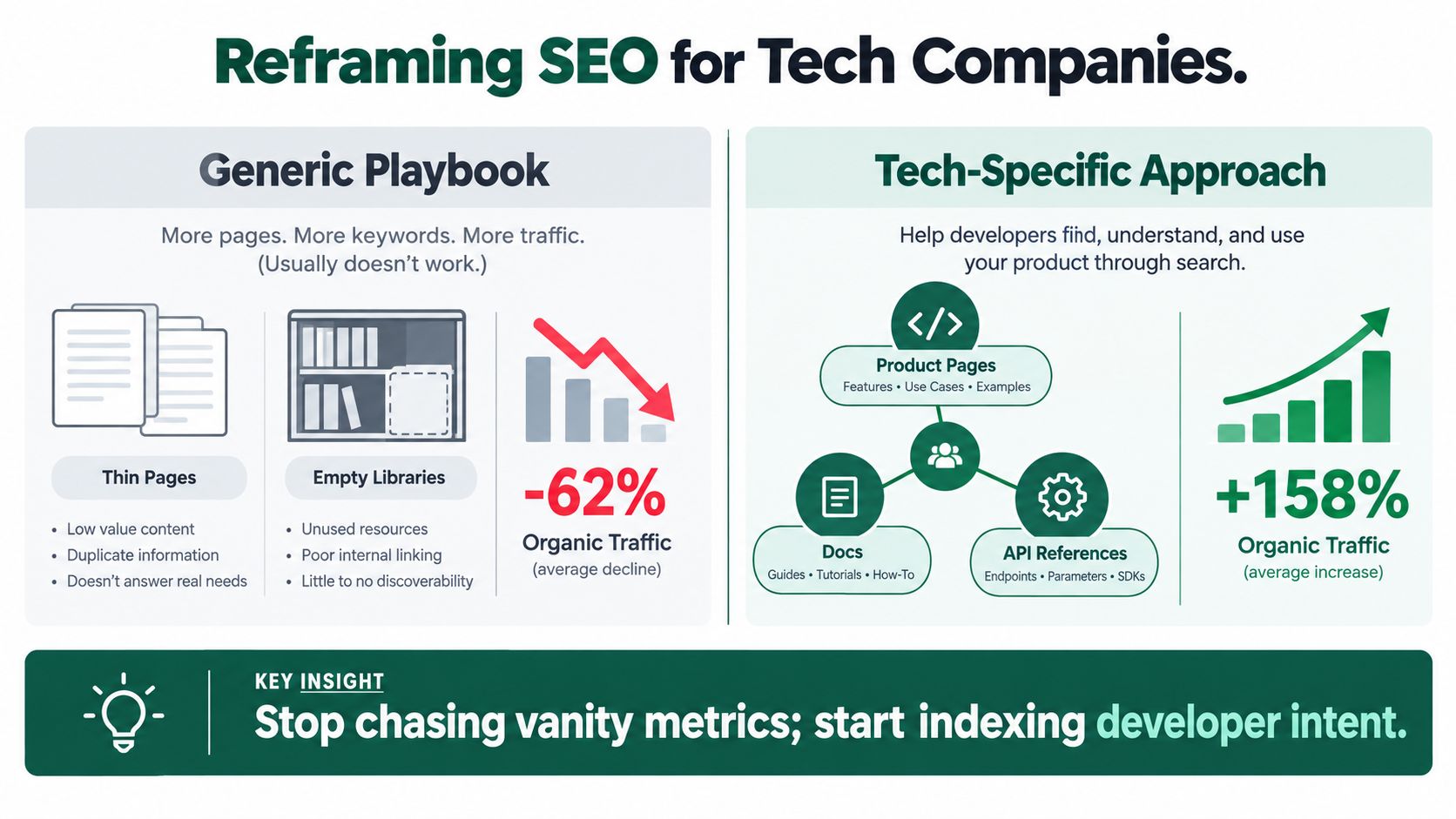
A durable program starts with questions the product can answer better than competitors:
Technical leaders should assign ownership across product marketing, engineering, documentation, and a fractional CMO who can turn these inputs into an execution system. Developer-facing pages need crawlable structure, stable URLs, explicit entities, usable examples, and language that retrieval systems can quote accurately.
Capstacker's founder growth playbook helps connect channel choices to broader growth decisions. SEO should support the product and sales motion, not operate as an isolated publishing function.
Big Moves Marketing's marketing for tech companies guidance makes the same distinction. Build discoverability around the product, the buyer, and the evidence required for a decision.
Practical rule: If a page does not help a buyer understand, evaluate, implement, or defend a purchase, remove it or give it a clearer job.
Search intent mapping is where most SEO programs become commercially useful or remain a spreadsheet exercise. Don't begin with a keyword export. Begin with the decisions your buyers must make before they can buy.
A Series A SaaS company may have one product, but it still serves multiple search audiences. A developer wants implementation detail. A VP of Operations wants workflow fit. A security lead wants controls and evidence. A founder may want a fast comparison against an incumbent. Each audience creates different queries, objections, and conversion paths.
Google reported 4,725 changes to Search in 2022, approximately 13 per day, including ranking-system and interface changes. BERT, announced in 2019, affected 10% of searches and improved interpretation of natural-language queries. Search Engine Land's Google algorithm update reference explains why literal keyword matching is a poor operating model for complex B2B searches.
Use customer conversations, support tickets, sales-call recordings, site-search data, and product documentation requests. Then classify each question by the job it performs.
| Buyer stage | Typical question | Useful page type | Commercial signal |
|---|---|---|---|
| Problem discovery | How do teams automate access reviews? | Educational guide | Problem awareness |
| Solution evaluation | How does automated access review work? | Product or solution page | Product fit |
| Technical validation | Does it support SCIM, SAML, or a specific API flow? | Documentation or integration page | Implementation confidence |
| Risk reduction | How is customer data protected? | Trust center or security page | Procurement readiness |
| Vendor selection | Product A versus Product B | Comparison page | Shortlist intent |
| Purchase action | What does implementation involve? | Pricing, demo, or migration page | Sales readiness |
Don't treat informational intent as low value. In enterprise SaaS, a technical guide can influence a later opportunity even when the first session doesn't convert. The important question is whether the page contributes to a coherent evaluation path.
A high-volume query deserves attention only when it connects to your ICP and product. A narrow query about a supported integration may bring fewer visitors, but those visitors often arrive with a defined problem and a shorter path to product evaluation.
For each topic, record:
This process exposes content gaps that keyword tools miss. A post-PMF company may rank for broad category terms while lacking pages that explain migration, governance, deployment, and integration constraints. That's not a ranking problem. It's a buying-system problem.
Use Big Moves Marketing's user research framework to ground the map in real customer language rather than assumptions from internal teams. Product terminology matters, but buyer terminology determines discoverability.
Keyword strategy for a technology company should function like product architecture, not a spreadsheet of phrases. Organize clusters around capabilities, workflows, integrations, technical entities, and buyer comparisons. Then assign each cluster to the page that can answer it with firsthand product knowledge.
Use one page for one dominant intent. A feature page should connect the capability to a job. A documentation page should help a developer complete an implementation. An integration page should specify supported flows, prerequisites, setup, and limitations. A comparison page should help a buyer make a defensible choice without asking sales to translate generic claims.
Thin, duplicated pages create a poor experience for developers and buyers. SaaS teams that publish near-identical pages for industries, features, or keyword variants spread authority across URLs and make AI systems less likely to identify the clearest answer. Consolidate overlapping intent before producing another page.
Start with a product inventory:
Map each cluster to one primary page. Use documentation and articles to address related questions, then link them deliberately to the product page. For example, map SCIM provisioning, SCIM Okta, and SCIM API to a documentation page when the intent is implementation. Create a separate comparison page only when the reader is evaluating providers or approaches. Do not publish three pages that repeat the same explanation under different titles.
A fractional CMO should make this mapping operational. Have product marketing define the commercial promise, developers validate technical accuracy, and customer success identify recurring implementation questions. That ownership model keeps search pages aligned with the product and gives AI search systems a clear, consistent source to interpret.
High-volume category terms can build awareness, but they often combine several intents and demand significant authority. Narrow technical queries reveal a more defined problem and often lead to a clearer product evaluation.
Use each page type for a specific job:
Prioritize the question that sales, solutions engineering, or customer success repeatedly explains. If buyers ask it across calls, publish the answer in the format they need.
Big Moves Marketing's keyword research guidance for Shopify app growth supports the same principle. Search research should connect language to an action, not merely collect phrases with attractive volume.
The strongest keyword is often the question your best customer asks immediately before they trust your product.
Technical SEO fails most visibly on JavaScript-heavy SaaS sites. The marketing team sees a complete application. Googlebot may initially receive an app shell, blocked resources, missing links, or directives that change after rendering.
Google processes JavaScript pages through crawling, rendering, and indexing. Blocking CSS or JavaScript can delay indexing or prevent Google from discovering links that appear only after execution. Google's JavaScript SEO documentation provides the correct mental model for engineering and marketing teams.
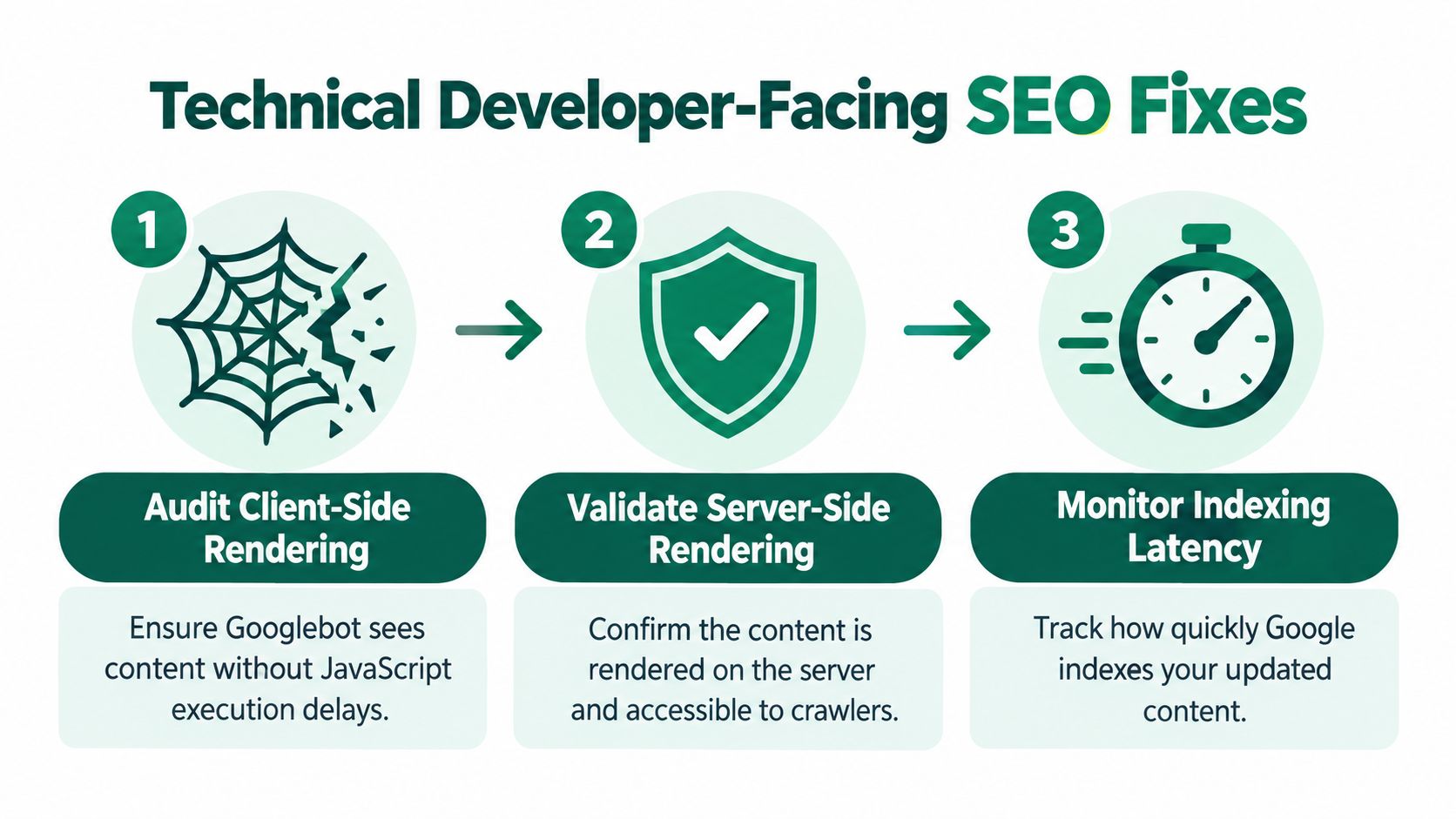
Run the workflow on representative templates, not isolated URLs.
Server-side rendering or static generation is usually the sensible default for high-value product, solution, documentation, and comparison pages. Keep client-side JavaScript for interaction rather than making the primary content depend on it.
Google defines a good real-user experience at the 75th percentile: LCP at or below 2.5 seconds, INP at or below 200 milliseconds, and CLS at or below 0.1. Google's Core Web Vitals documentation gives the thresholds and the diagnostic logic behind them.
Measure the homepage, product pages, pricing pages, documentation, blog templates, and campaign landing pages separately. Fix the largest above-the-fold element for LCP, reduce long JavaScript tasks for INP, and reserve dimensions for images, embeds, forms, consent banners, and dynamic components to control CLS.
Watch for faceted URL proliferation, conflicting JavaScript-injected canonicals, blocked asset directories, app-shell responses, and orphaned documentation pages. These are engineering defects with commercial consequences, not SEO housekeeping.
A short technical walkthrough can help align developers and marketers before a release:
A blog is not a content strategy. It's one format with a specific job, and B2B SaaS teams often assign it every job because publishing is easier than fixing the information architecture around the product.
Use format according to buyer need. Documentation supports implementation and product adoption. Product pages clarify value and fit. Comparison pages support vendor selection. Blog posts build problem awareness and explain changing practices. PR can create external context and reinforce positioning, but it can't compensate for weak product evidence.
A 2025 survey of marketing decision-makers at B2B technology companies in the United States, France, Germany, and the United Kingdom found that AI-native platforms such as ChatGPT and Perplexity were the second-most common source of qualified leads, representing 34% of reported sources, while only 11% said at least 75% of their content was ready for AI discovery. The survey announcement identifies a gap most content programs still ignore.
AI discoverability isn't achieved by adding a generic FAQ to every page. It depends on clear, consistent, citation-worthy information:
Keep terminology stable across the website. If the product calls a capability “policy orchestration” on one page and “workflow automation” on another, both human buyers and AI systems have more difficulty connecting the concepts.
A fractional CMO model works when it forces prioritization. An early-stage company may need a strong product architecture, a small set of high-intent pages, and documentation cleanup before it needs a large editorial calendar. A growth-stage company may justify dedicated content production after product marketing, engineering, and sales agree on the highest-value gaps.
The decision matrix is simple:
| Business need | Primary format | Internal input required |
|---|---|---|
| Explain a capability | Product page | Product marketing and sales |
| Help a developer implement | Documentation | Engineering or solutions team |
| Resolve vendor uncertainty | Comparison page | Product and commercial teams |
| Capture problem discovery | Blog or guide | Subject-matter expert |
| Strengthen market position | PR or research | Leadership and communications |
Big Moves Marketing's B2B content strategy guidance is useful for making those trade-offs explicit. The objective isn't a larger publishing machine. It's a smaller set of assets that sales, buyers, search systems, and AI answer engines can use accurately.
SEO earns more investment when leaders can connect search work to commercial outcomes. Impressions and rankings belong in diagnosis. Qualified visits, demo requests, opportunities, pipeline, and revenue belong in the decisions that determine what happens next.
Use a measurement chain:
Search exposure → qualified organic visit → meaningful action → sales acceptance → pipeline → revenue
Each stage answers a different question. Impressions show whether Google can surface a page. Rankings show visibility for a defined query set. Qualified visits show whether the audience matches the ICP. Demo requests and trials show response. Pipeline and revenue show whether the program deserves more resources.
A documentation page should not carry the same target as a demo page. Documentation can support technical validation, assist sales conversations, and reduce implementation objections. A comparison page may influence a shortlist decision, while a category guide may create awareness and direct readers toward product evaluation.
Build reporting around page roles:
AI summaries make this separation more important. Google has reported that overall organic click volume remained relatively stable year over year while average click quality increased slightly. Treat traffic as a means, not the outcome. Test whether fewer visits produce better-fit opportunities before labeling a session decline a channel failure.
Measure technical performance by template, not only across the whole site. Benchmark documentation, pricing, product, and comparison templates independently, since a site-wide average can hide the weakest commercial page. Use the Core Web Vitals thresholds already established for performance review, then prioritize the template with the highest business impact.

An in-house SEO hire fits a company with enough technical, content, and product complexity to support a full-time owner. That person still needs access to developers, product marketing, analytics, and revenue data. Without those relationships, the hire creates another reporting function instead of a growth system.
An agency supplies specialist capacity, but a deliverables-first model fails when the main constraint is positioning, prioritization, or product knowledge.
A fractional CMO with an execution team fits when leadership needs senior judgment and hands-on progress before building the entire function. The fractional leader should own decisions, establish the measurement model, coordinate product and engineering inputs, and make trade-offs visible. That structure also keeps AI-discoverability, developer experience, and revenue reporting connected rather than treating SEO as isolated keyword production.
Big Moves Marketing operates in this category, combining fractional CMO leadership with positioning, website architecture, content, SEO program design, analytics, and campaign execution. Treat it as one resourcing option, not a substitute for internal product expertise.
If high-value pages are not crawlable, fund technical remediation before commissioning more articles. If the site works technically but buyers cannot understand the product, invest in positioning and core pages. If the foundation works and sales needs more qualified demand, expand content around validated intent clusters.
Big Moves Marketing's approach to measuring marketing success provides a useful framework for connecting channel metrics to business reporting. The leadership question is not how much content the team published. It is which constraint currently limits qualified pipeline.
Speed comes from removing obvious friction, not from publishing faster. Assign an owner to each fix and record the resulting change in crawlability, qualification, or conversion.
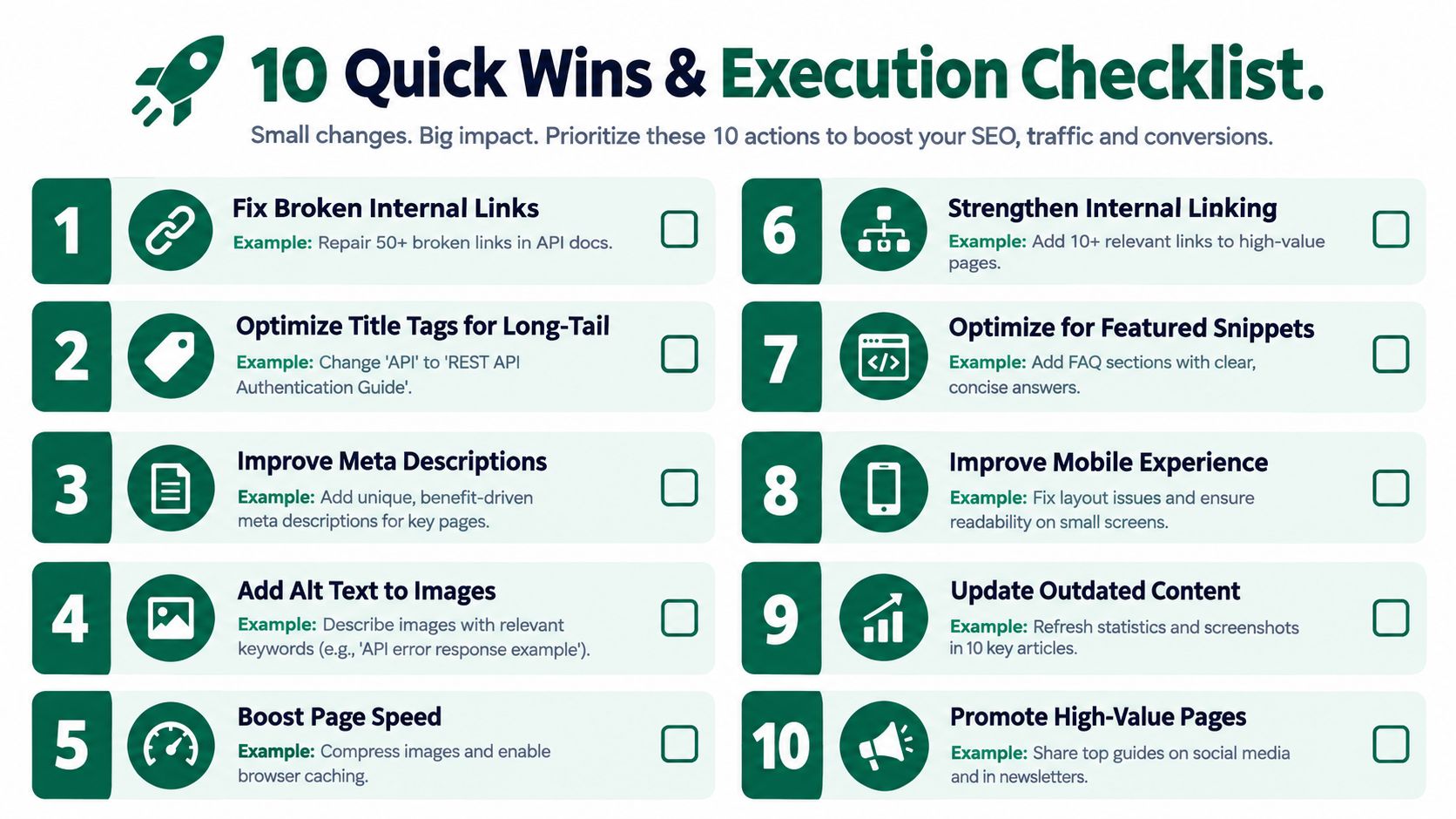
The practical sequence is clear: make the product accessible, make the evidence complete, then measure whether the right buyers move closer to a decision.
Big Moves Marketing helps B2B SaaS and technology leaders turn SEO into a product-led growth system through positioning, buyer research, technical website architecture, content strategy, and fractional CMO execution. Visit Big Moves Marketing to discuss which discoverability and pipeline constraints should be addressed first.




%20-%20white.svg)